


0,49 €
Niedrigster Preis in 30 Tagen: 1,99 €
Niedrigster Preis in 30 Tagen: 1,99 €
Mehr erfahren.
- Herausgeber: DigiCat
- Kategorie: Fachliteratur
- Sprache: Englisch
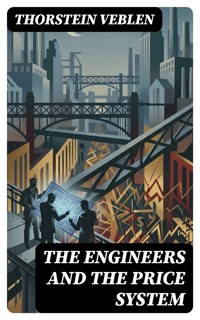
In "The Engineers and the Price System," Thorstein Veblen offers a penetrating analysis of the role of engineers in the modern economic landscape, particularly within the constraints of the capitalist price system. Veblen employs a unique blend of sociological insight and economic theory, illustrated through sharp critique of prevailing economic ideals and practices. He advocates for the integration of engineering principles into economic structures, positing that the professional and technical expertise of engineers could restore efficiency in production and mitigate the chaos wrought by speculative capitalism. This book stands as a vital touchstone in the fields of both economics and sociology, highlighting the discord between technological advancement and economic organization. Thorstein Veblen, renowned for his critical examinations of capitalism, was deeply influenced by the economic disruptions of his time, including the rise of industrialization and the burgeoning role of technology in society. His earlier works, such as "The Theory of the Leisure Class," laid the groundwork for his exploration of class and productive labor, informing his perspective on the necessity of an economic system that harmonizes innovation and social welfare. Veblen's background in sociology and economic theory uniquely positioned him to address the complexities of his era. For readers seeking a profound understanding of the tensions between technological progress and economic structure, Veblen's "The Engineers and the Price System" offers invaluable insights. It beckons both scholars and the general public to reconsider the possibilities of an economy guided by technical ingenuity rather than mere profit motives, making it an essential read for anyone interested in the relationship between technology, economics, and society. In this enriched edition, we have carefully created added value for your reading experience: - A succinct Introduction situates the work's timeless appeal and themes. - The Synopsis outlines the central plot, highlighting key developments without spoiling critical twists. - A detailed Historical Context immerses you in the era's events and influences that shaped the writing. - A thorough Analysis dissects symbols, motifs, and character arcs to unearth underlying meanings. - Reflection questions prompt you to engage personally with the work's messages, connecting them to modern life. - Hand‐picked Memorable Quotes shine a spotlight on moments of literary brilliance. - Interactive footnotes clarify unusual references, historical allusions, and archaic phrases for an effortless, more informed read.
Das E-Book können Sie in Legimi-Apps oder einer beliebigen App lesen, die das folgende Format unterstützen:
Veröffentlichungsjahr: 2022
Ähnliche















The Engineers and the Price System
Table of Contents
Introduction
The Engineers and the Price System hinges on a stark friction between the disciplined logic of industrial technique and the unruly incentives of profit-seeking exchange, asking what results when those who keep the machinery of modern life running face institutions that value pecuniary gain over workable efficiency, and inviting readers to consider whether technical knowledge might serve the community more directly than the market permits, even as engineers themselves remain entangled in the very arrangements they could, in principle, rationalize for collective use, in a society increasingly organized by machines and complex interdependence.
Thorstein Veblen’s book is a work of social theory and political economy, composed as a set of argumentative essays and published in the early 1920s, when the American industrial order had been tested by wartime mobilization and was unsettled by postwar volatility. Its setting is the modern factory system and the broader corporate economy that surrounds it, with engineers, managers, financiers, and the wider public sharing a common fate. While rooted in the United States, the book treats industrial life as a global technical system. Veblen writes not as a policy functionary but as a critical analyst of institutions and habits of thought.
The premise is straightforward yet ambitious: Veblen scrutinizes how the price system governs production and how engineers, as custodians of the machine process, navigate a regime organized around profits rather than serviceable output. He traces the social consequences of business control over industrial operations and considers what forms of coordination might emerge if technical efficiency, rather than financial gain, set the terms. The reading experience is briskly analytical and dryly sardonic, with an exacting prose that rewards patience. Veblen’s tone is diagnostic rather than declamatory, building its case through cumulative observation, strategic hypotheticals, and a sustained contrast between workmanship and pecuniary logic.
Key themes include the conflict between industrial efficiency and pecuniary motives, the authority claimed by owners versus the competence held by technicians, and the ways market discipline can encourage deliberate restriction of output to stabilize prices. Veblen explores how absentee ownership and financial control shape production rhythms, how professional knowledge acquires social significance, and how collective coordination might differ from competitive rivalry. He is attentive to incentives, vocabulary, and institutional inertia, showing how habits of business decision-making can override the requirements of a large, interdependent technological system that depends on reliable flow, precision, and continuous learning.
The book matters now because contemporary economies are organized around complex infrastructures—digital platforms, logistics networks, energy grids—whose reliability depends on technical expertise yet whose operation is filtered through financial metrics and market timing. Veblen’s questions illuminate debates about platform power, algorithmic management, and the fragility of supply chains under speculative pressure. They also sharpen discussions about critical infrastructure, climate transition, and public investment, where engineering rationality confronts short-term returns. By reframing efficiency as a social, not merely a business, criterion, the work helps readers ask who should set priorities when system stability, public safety, and long-horizon projects are at stake.
Veblen’s method remains instructive: he neither offers a utopian blueprint nor endorses technocratic rule as a fait accompli. Instead, he examines how incentives shape behavior and how organizational forms either harness or frustrate the capacities of skilled practitioners. His prose highlights the gap between the demands of a continuous industrial process and the discontinuities introduced by profit accounting. Readers encounter a critique that is cool in tone yet normatively pointed, encouraging them to track causal chains across factories, offices, and markets, and to weigh how professional responsibility intersects with property rights and the politics of industrial coordination.
Approached today, The Engineers and the Price System invites a reconsideration of who exercises authority over the systems on which collective life depends and by what criteria that authority is justified. It asks engineers, managers, and citizens to evaluate whether the tools that secure technical reliability can be aligned with broader social well-being, and how institutional change might proceed without romanticizing either markets or expertise. In doing so, the book remains a catalyst for thinking about value, stewardship, and accountability in a world where production is intricate, interdependent, and consequential far beyond the ledger of private gain.
Synopsis
Thorstein Veblen’s The Engineers and the Price System, published in the early 1920s, examines how modern industry is organized under what he calls the price system. He contrasts the machine process, governed by exacting technical routines, with business enterprise, oriented to money values and competitive gain. Engineers, as custodians of the industrial arts, are trained to maximize output and reliability. Business managers, by contrast, judge success by pecuniary returns. Veblen frames the book around this tension, asking whether a community that depends on intricate technology can thrive when production is ultimately steered by owners and financiers rather than by workmanship and efficiency.
In setting out that conflict, Veblen develops his controversial idea of sabotage, not as destruction but as calculated restriction. Because profits depend on selling at remunerative prices, business enterprise regularly restrains output, withholds capacity, or times operations to sustain earnings. The machine process is indifferent to price and pushes toward continuous, standardized throughput. The clash yields idle equipment, recurrent bottlenecks, and periodic unemployment, even when technical means could provide abundance. Veblen argues that such waste is structural to competitive business, not accidental mismanagement, and he links it to the familiar cycle of expansion and contraction that destabilizes industrial livelihoods.
He then examines how control over industry resides in the business community through ownership, capitalization, and credit. Decisions about investment, shutdowns, mergers, and schedules follow financial strategy rather than technical best practice. Engineers and production experts execute plans they do not set, and their measurements of physical efficiency are subordinated to accounting measures of gain and loss. Veblen underscores the institutional separation between workmanship and ownership, and he notes that professional standing or technical merit offers little leverage in disputes defined by pecuniary claims. The resulting hierarchy gives precedence to negotiable securities and market sentiment over sustained, reliable serviceability.
Against this backdrop, the extraordinary coordination of wartime production provides, for Veblen, an instructive contrast. Under emergency administration, many competitive inhibitions were temporarily suspended, and engineering staffs directed procurement, standardization, and scheduling on a collective plan. The demonstration that industry could be run for assured output rather than market chancing did not, however, settle the peacetime question. With hostilities ended, business control and price calculations reasserted themselves, and the community faced renewed instability. Veblen uses this episode to show both the technical feasibility of planned cooperation and the institutional pull of established interests that return operations to competitive pecuniary footing.
From these premises he explores the potential agency of engineers. If those who understand the machine process withheld their technical cooperation from business-as-usual, they might compel a reorganization of industry on lines of serviceability. Veblen treats this as a live possibility rather than a program, and he appraises the obstacles: engineers’ dispersed employment, loyalty to employers, professional caution, and their limited standing in matters of ownership. He also considers how technical groups could, in principle, coordinate across plants and regions through councils or committees, yet he remains attentive to the risks and ambiguities of shifting authority from proprietors to technicians.
Veblen extends the argument by tracing the cultural and legal scaffolding that sustains the price system. Property rights, contract enforcement, and accepted business standards channel public policy toward safeguarding investment values. In such a setting, technical competence alone cannot settle the terms of industrial life. He insists that the community’s livelihood is anchored in the machine process, yet its governance is adjudicated in pecuniary terms that reward strategic idleness. The analysis yields a persistent question about measurement: whether to value operations by tangible efficiency and service, or by money returns, and what happens when these two yardsticks diverge.
The book closes by situating this conflict within a broader inquiry into institutional change. Veblen does not promise an easy resolution, nor does he offer a definitive blueprint. Instead he underscores the stakes: a modern community whose welfare depends on complex equipment and trained personnel must decide whether the conduct of industry will answer chiefly to business calculations or to serviceable workmanship. The Engineers and the Price System remains significant for ongoing debates about economic planning, professional responsibility, and the governance of technology. Its questions about efficiency, control, and public interest continue to echo wherever technical capability meets pecuniary rule.
Historical Context
Thorstein Veblen’s The Engineers and the Price System appeared in 1921, in the immediate aftermath of World War I and amid the transition from the Progressive Era to the early 1920s order. Veblen, a Norwegian American economist associated with institutional economics, had taught at Chicago, Stanford, and Missouri before joining the newly founded New School for Social Research in New York. He addressed a United States transformed by giant corporations, professionalized engineering, and expanding federal oversight. The book speaks to readers acquainted with wartime mobilization, postwar dislocation, and the debates over how modern industry should be organized, governed, and justified within a democratic polity.
World War I provided the United States with a striking experiment in coordinated production. The War Industries Board, chaired by Bernard Baruch from 1918, set priorities, allocated raw materials, and standardized products. The United States Railroad Administration operated the nation’s railroads from late 1917 until March 1920 to relieve congestion. The Food Administration under Herbert Hoover and the Fuel Administration under Harry Garfield managed supply and conservation. Engineers staffed procurement, ordnance, and shipbuilding programs, while professional societies advised on standards. These experiences showed that large-scale industry could be directed by technical criteria rather than solely by market prices, a contrast central to Veblen’s critique.
By the 1910s, American industry had embraced mass production and systematic management. Frederick W. Taylor’s 1911 The Principles of Scientific Management popularized time-and-motion methods, prompting congressional hearings at the Watertown Arsenal that same year. Henry Ford’s moving assembly line, introduced at Highland Park in 1913, exemplified high-volume manufacture and cost reduction. Corporations like U.S. Steel, General Electric, AT&T’s Bell System, and DuPont coordinated research, finance, and distribution on a national scale. Engineering bodies such as the American Society of Mechanical Engineers and the American Institute of Electrical Engineers promoted standardization. Veblen wrote against this backdrop of technical efficiency embedded in complex corporate control.
The immediate postwar years saw intense labor conflict and anti-radical repression. In 1919, the Seattle General Strike briefly shut down the city; a nationwide steel strike involved hundreds of thousands of workers; and Boston’s police strike provoked a law-and-order backlash. The First Red Scare, propelled by bombings and fear of Bolshevism after the 1917 Russian Revolution, culminated in the Palmer Raids of 1919–1920, supervised by Attorney General A. Mitchell Palmer and J. Edgar Hoover. These events polarized public discourse about authority in industry, union power, and social planning, shaping the reception of proposals that shifted control from financiers to technical specialists.
Economic turbulence sharpened debates over prices and control. Wartime inflation had lifted costs and profits, and the sharp deflation of 1920–1921 produced falling prices, business failures, and high unemployment. Farmers faced debt and declining commodity prices as global markets rebalanced after the war. Idle capacity coexisted with unmet needs, highlighting mismatches between productive potential and purchasing power. Veblen drew on his longstanding distinction between “industry” as a technical process and “business” as pecuniary control, arguing that financial strategies could restrain output to protect prices. The volatility of the early 1920s made such claims immediately legible to policymakers, engineers, and labor leaders.
Progressive Era reforms had already legitimized public scrutiny of corporate power. The Sherman Antitrust Act (1890), the Clayton Act (1914), and the creation of the Federal Trade Commission (1914) targeted restraints of trade and unfair practices. The Interstate Commerce Commission regulated railroad rates, while state public utility commissions supervised electricity, gas, and telephones under rate-of-return principles. Scientific management remained contested after the 1911 Watertown hearings but diffused widely in adapted forms. These institutions accustomed Americans to the idea that industrial coordination could serve public purposes, even as ownership remained private—an institutional landscape that Veblen interrogated for its incentives, limits, and consequences.
Within academia, Veblen belonged to the American institutionalist current, alongside figures such as John R. Commons and Wesley Clair Mitchell, which emphasized habits, legal structures, and empirical inquiry over abstract equilibrium models. The New School for Social Research opened in New York in 1919 as a forum for progressive scholarship and adult education; Veblen joined its faculty and delivered lectures to audiences of practitioners and reformers. Periodicals including The Dial and The New Republic circulated debates on planning, labor, and finance. This intellectual milieu encouraged critiques of absentee ownership and pecuniary motives in industry, themes Veblen advanced with the vocabulary of engineers and production.
The Engineers and the Price System distills these conditions into a pointed analysis of control over modern production. Drawing on wartime coordination, regulatory precedents, and the spectacle of mass-production corporations, Veblen contrasts technical possibilities with outcomes driven by pricing and investment strategies. He identifies engineers as a professional stratum capable of coordinating industry, while noting the political and institutional barriers that kept decision-making in financial hands. Without narrating events, the work crystallizes the early 1920s tension between democratic accountability, corporate power, and expert administration, offering a critical portrait of an age enthralled by efficiency yet unsettled by volatility, inequality, and social conflict.




