


2,99 €
Mehr erfahren.
- Herausgeber: BLACK WOLF EDITION & PUBLISHING LTD
- Kategorie: Abenteuer, Thriller, Horror
- Sprache: Englisch
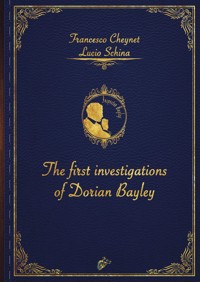
A young police officer moves in the dark and contradictory Victorian London to uncover those responsible of four heinous murders. For that he will need to use his acuity, virtue that will permit him to reconstruct refi ned plans and complex interactions.After the success of 'Th e secrets of Greystone' the Inspector Dorian Bayley returns with four stories that tell the origins of the character.- "Shadows" (Finalist of the Gold Crime Carlo F. De Filippis Award, 2020 edition)- "Checkmate"- "Th e Queen of Diamonds"- "Th e Dignity of the Oleanders" (Winner of the literary competition "Sulle orme di Agatha Christie", 2020 edition)
Das E-Book können Sie in Legimi-Apps oder einer beliebigen App lesen, die das folgende Format unterstützen:
Veröffentlichungsjahr: 2021
Ähnliche


















Shadows
Finalist of the “Gold Crime” Carlo F. De Filippis Award, 2020 edition
London, 1854
Friday, 3 March. 4 p.m.
Arnold Mason leapt out of the theatre like an animal on the run, aware that his life was in serious danger. The owner of the venue saw him swooping down on him as he was returning from an errand. He managed to avoid him by flinching and dropping some cardboard boxes he was holding onto the floor.
The actor walked up Emery Hill and turned left at the junction with Francis Street. He found himself immersed in a myriad of visitors crowding the fabric and antiques market, but he didn’t slow down. He tried to dodge as many as possible, cursing the organisers for putting on such a pointless event. A well-dressed man, looking at his pocket watch through his monocle, was hit and found himself lying on the vendor’s stall in a smash of objects falling to the ground.
As he exited Francis Street the streets became clearer, but his shortness of breath forced him to slow down. He was sure that a young, fit man would be able to pursue him without getting lost, so he decided not to give up and gathered the last of his strength. Although he was trying to keep his nerve, he could feel his irrational side growing stronger and more dominant.
He violated a no-entry sign, climbed over a gate and found himself inside a closed construction site. Before continuing, he bent down on his knees and tried to regain some energy. He was invaded by dark thoughts that hovered in his mind; he imagined himself under a pile of cold earth and a shiver of terror seized his stomach.
‘This wasn’t the way it was supposed to be, dammit!’ He imprecated with teeth clenched by a mixture of anger and resentment.
He surveyed the area, turning from time to time to make sure he was alone, then slowed his pace and entered a building under construction, where he tried to crouch in the darkest spot.
The site was a huge crater destined to become a commercial area; it seemed to have only one entrance and this, he thought, gave it a certain strategic advantage.
He looked at the ground looking for an idea or just hoping to get by.
‘Who is hiding here? Show your face,’ a man’s hoarse voice echoed in the building’s entrance; the sun behind him made him look like a massive black silhouette.
He peered silently at him, crouching down; as the man advanced with heavy steps, he was seized with panic. He decided then to be ready for a fight; he slipped his right hand into his pocket and the contact with the handle of the knife was the only foothold to keep from cutting off even the last thread of hope.
Friday, 3 March. 8:30 a.m.
The streets adjacent to Westminster Cathedral were buzzing with visitors. The fabric and antiques market, which would fill nearby Francis Street all day, had attracted the interest of many Londoners and traders from afar, looking for cheap, valuable pieces or an innovative twist on their textile production.
That morning the employees of the theatre company “Street to Wonder” were finalising preparations for the dress rehearsal of their new show. Posters on the walls of London promised to amaze audiences with the help of breathtaking special effects. The first stagehand, Weston Russell, was considered one of the most skilful in the business. With his less than state-of-the-art equipment, he was able to create light and sound effects that left the audience speechless.
Only the first actor was missing, and the fact that Arnold Mason was late was a source of great concern to colleagues and professionals alike. Arnold Mason’s short temper had already caused him trouble in the past, and the fear that he would get into trouble, as he usually played second fiddle, was beginning to grow. As well as being one of the leading actors, Arnold was also the impresario of the company, which he ran with his colleague Myron Hughes.
Without telling anyone, that morning Arnold decided to detour to St George’s Dr, where the nearest police station was located. The anonymous letter that a hotel waiter had given him the night before contained an explicit death threat. His background, and a gloomy feeling that had been enveloping his head like a fog bank for a few days, suggested that he should give credence to the contents of the letter.
‘We will send one of our men to check it out,’ the officer assured as he filled out the complaint.
‘I will be at The Mirror of Dionysus all day; we are debuting the new show in the afternoon and we are finalising the preparations,’ the actor replied before saying goodbye.
“The Mirror of Dionysus” was a large tearoom that could be used as a theatre if necessary. The managers of the place promoted emerging theatre companies; even with a minimal investment, it was possible to put on shows of various kinds, certain of a guaranteed average of at least fifty spectators per performance.
That Friday was the dress rehearsal for the opera “Shadows”, a noir that marked the absolute debut of the new tour; those who had won their tickets were to witness something far more shocking than Weston Russell’s sleight of hand.
Sergeant Naill sat down in the chair opposite the desk, feeling the usual twinge in his back, a tireless companion to his days. He read the report that the officer on the ground floor had compiled, then unfolded the paper he had been handed and concentrated on the letter he had received from Arnold Mason.
“You are aware of what you did. It could not be unpunished, I could not afford it. From tomorrow, you will be a dead man, or maybe just a dead man walking, then lying. Life always gives us an important choice; you have made yours, now it is my turn. Prepare to die!”
After folding it, he ordered his assistant to track down Dorian Bayley, a promising neighbourhood policeman who, on more than one occasion, had displayed a clear mind and keen intuition. When he knocked on the door, Naill was trying to ease the pain in his back by performing funny breathing exercises.
‘Officer Bayley, please come on in.’
He did not even give him time to close the door.
‘A certain Arnold Mason, an actor in a theatre company…’ he tried in vain to read his name on the complaint, ‘apparently received death threats. I want you to watch him for today.’
Although he felt that a simple escort service detracted from his ambitions, the officer took the files without objection and read the letter carefully.
‘Judging by what it is written, it seems to be a serious matter,’ he remarked in a low voice.
‘I have my doubts,’ replied the sergeant, ‘but I think an inspection is necessary.’
After about thirty minutes, having arrived in front of the place and read the sign, Dorian Bayley was reminded of The Mirror of Dionysus, which he had visited a couple of times in the past. On entering, however, it seemed to him to be completely different; stage requirements had transformed it into a small theatre, complete with dressing rooms, wings, stage and seats. The tables had gone who knows where and there were no waiters bustling about with trays and cups in hand. A man named Michael Land, who introduced himself as the owner of the place, greeted him with a fake smile like a porcelain elephant. He was talking to the director of the play, Charles Finnegan, who was hovering in front of him without even noticing the presence of a third man.
‘I’m supposed to meet Arnold Mason,’ Dorian Bayley asked, failing to qualify.
‘The company is gathered in that room,’ replied the owner, pointing with his index finger to a closed door.
‘Thank you very much.’
Inside the room were actors and technicians; Dorian Bayley introduced himself without explaining why he was there.
‘I am in charge of ensuring that everything is carried out safely,’ he simply informed.
A man of average height came forward and bowed. He was of slim build and had neatly trimmed hair of such a dark black that it seemed artificial. He wore a neat moustache and his manner was so obsequious as to appear artificial.
‘My name is Myron Hughes and I am one of the company’s impresarios, although I prefer the title of second actor. Allow me to introduce you to the rest of the company,’ he said, twisting an arm in a blatant gesture.
Those present arranged themselves in a semicircle.
‘Let’s start, by chivalry, with our lead actress, the lovely Alayna Ashton. Then we have Arnold Mason, another leading actor and my partner, who gave us a big scare today by being late for his appointment. To their right are two other excellent young actors, Nelson Tucker, who plays a Russian secret agent, and Irene Wood.’
Although it was difficult to memorise the names and tasks, Bayley was helped by the constant pauses of his interlocutor, who wanted each presentation, ending with a bow, to be given the right emphasis.
‘This is our trusted collaborator, Adam Miller. He is the one who manages the logistics and provides us with everything we need. Finally, this gentleman…’ he created a moment of anticipation as if he were about to introduce the most important guest at a gala evening ‘…is Weston Russell, our stagehand, or rather,’ he adjusted his moustache, ‘our lighting and sound wizard.’
Dorian Bayley registered the faces and asked to speak to each of them separately; considering that Arnold Mason was going to spend the whole day in the theatre, an insistent little voice suggested that the author of the letter might be hiding within the company.
Alayna Ashton was a young woman with an explosive charm, a combination of polite manners and expressive determination that did not leave even Dorian Bayley, known to his colleagues as an upstanding agent always focused on his work, unmoved.
‘Arnold Mason is a generous person, but he has a fiery temperament,’ said the actress in an almost amused tone. Immediately afterwards, however, she looked left and right to make sure no one was listening, and approached the agent, bringing her fan in front of her face to cover her mouth. ‘There was bad blood between him and Weston Russell, the first stagehand, in the past. Five years ago, Arnold married Lady Bell, a pretty girl who had previously had an affair with Weston himself. Although they were both incurable womanizers, Weston did not take it well at the time and strong tensions arose between them. It seems, however, that they have now put this whole affair behind them and are back on good terms.’
The past disagreements between the manager and the first stagehand had been confirmed by all the others.
Arnold Mason was tall and stocky, with a pronounced jaw and a contracted expression. Bayley asked him if he had any idea who the author of the letter might be.
‘No officer, I don’t see who would plot such a thing. I live a quiet life now. I meet a lot of women on the sly, it’s true, some of them are married, but I do it with extreme confidentiality and I don’t think anyone will suspect anything, least of all my wife.’
Adam Miller was an all-rounder; as well as being a second stagehand when needed, he was in charge of the costume and prop room. Short and stocky, he moved in jerks and always seemed alert to everything going on around him. He was almost bald despite having just turned thirty-five.
‘This letter business is not what we needed,’ he said, shaking his head and speaking quickly, ‘the success of the show depends largely on Weston; if he’s nervous and makes a mistake, it all falls apart.’
Dorian Bayley noticed that the man was anxious. His concern seemed exaggerated, as if he were making it personal.
‘Besides, we already have our own problems,’ he continued, gesticulating in jerks, ‘those two, you’ve seen them, all they do is throw cheap shots at each other, talk behind each other’s backs and plot against each other.’
‘Those two?’ asked Dorian Bayley.
Adam Miller lowered his tone of voice as if to reveal a dangerous confession.
‘Myron Hughes and Arnold Mason both would like to be the sole owners of the theatre company and seek any pretext to make the other look bad, so as to attract the dislike of the others.’
‘Are you telling me…that the only one who would benefit from Arnold Mason’s disappearance would be Myron Hughes?’
‘Advantage? I don’t know what you mean by advantage, but it would certainly benefit greatly from it, if you know what I mean.’
Friday, 3 March. 3:30 p.m.
The first act lived up to expectations. Although the much-vaunted scenic magic had yet to be seen, the actors proved to be brilliant and well-matched, managing to elegantly weave a story full of tension.
Dorian Bayley had been dreading the darkness that had descended on the room for some time; he had sat in one of the last rows, trying to pay attention to any unconscious gesture or suspicious movement on the part of a spectator or a member of the company. After about half an hour, however, he began to hope that his sixth sense had deceived him and that the letter was nothing more than a mythomaniac or someone in the mood for a macabre joke.
The information received that day, however, had not been reassuring; at least two people had good reason to hold a grudge against Arnold Mason. The man with the moustache, Myron Hughes, wanted to oust him from the ownership of the theatre company, and Weston Russell, the first stagehand, had previously fought over the same woman.
When the lights dimmed again, the spectators resumed their seats in an orderly fashion. This time the agent decided to sit at a side table where he could get a better view of the show and keep an eye on the audience.
In the darkness, the sound of lightning striking the ground was heard. After a short pause, a light rain began to fall from the suspended ceiling above the stage, causing a murmur of genuine amazement from the audience. The scene faithfully reproduced a cold and rainy London night. Two dilapidated buildings were drawn on the backdrop, divided by a narrow, dark alley that ended in the centre of the stage with a complex play on perspective. A streetlamp on the left illuminated the exit of a house in yellow, while on the opposite side, in a shadowy area illuminated by a faint beam of light projected from behind the scenes, a man wearing a long dark coat with his collar turned up was hiding behind the trunk of a tree, motionless and with both hands in his pockets. Two voice-overs, amplified by a megaphone, ceased as a man and a woman emerged from the left, bursting onto the stage as if seeking refuge somewhere. The woman stood under the lamppost, turning in terror to see if anyone was following them, while the man fiddled with a sharp object with which he tried to force the door. The silence in the room was deadly and everyone stared mesmerised at this revolutionary spectacle, which recreated reality as never before. The stagehand raised the level of a gas lamp positioned behind the assassin to the maximum, creating a conical beam of light with the use of a special lens. When the character played by Arnold Mason drew his revolver and pointed it in the direction of the second actor, the shadow of his arm appeared enlarged on the backdrop; the spectators held their breath until the scene closed with the sound of a shot and the victim slumped to the ground, beginning to bleed at heart level.
‘Damn!’ Officer Bayley exclaimed.
Until now, he had thought that the posters on the walls of London were just a publicity stunt to attract as many people as possible, but now that he saw the show, he could only agree with those who had promised an unusual experience for only 15 pence.
There was so much applause from the audience that all other noise in the room was drowned out by the din. Reality had been skilfully recreated; the woman, who had remained motionless with her face illuminated in yellow, began to scream, bringing her hands to her face, while the actor playing the murderer held out his arm for added effect.
‘My God, do something, he’s been shot!’
Even these last words were confused with the clamour of the clapping of hands and the shouts of the hall, full of admiration, which seemed never to cease.
‘Oh my God, he’s dead, he’s dead!’ The actress continued to curse before collapsing unconscious on the floor.
Officer Bayley had just stopped applauding when he heard a voice shouting a sudden order from backstage.
‘Close the curtain, quick, stop everything.’
Astonishment gave way to a strange feeling. The sound of the fake rain suddenly ceased and he felt a rush of adrenalin shoot down his neck and down his back; he grabbed his revolver and walked briskly towards the stage. As the curtain closed he caught a glimpse of the shadow of the arm stretched out at his side, then heard the dull thud of an object being dropped on the floor and someone leaving the stage in a hurry. He climbed up the side ladder, picked up the revolver and approached the man lying in a pool of blood. He screamed with all his voice and gave orders not to touch anything. The actress who had witnessed the murder was taken to the dressing room, while a bustle of actors, stagehands and technicians turned the stage into total chaos. Not knowing how to regain control, he grabbed Nelson Tucker by the arm and asked him to find the director immediately. He then approached the owner of the venue and ordered him to get the audience out, lock all the doors and report the murder at the nearest police station.
Inspector Edmund Brown came through a back door, followed by two uniformed officers. Michael Land led the way and led them backstage. It appeared to be quiet again, but the silence was unreal and the air tense. Waiting for them at the centre of the stage was Agent Bayley, busy reconstructing something. He seemed estranged from the context; he continued to walk around the perimeter of the stage, staring in various directions here and there, following his thoughts with the forefinger of his hand, with which he pointed to certain points in the void. On two occasions he had knelt down and slid his palm across the floor as if to test its consistency. Finally, he had lingered on the point where the shadow of the outstretched arm with the revolver in its hand had been cast.
The body had not been moved and was lying on the ground next to the lamppost. It was one of the officers who approached it to draw his attention.
‘I am Inspector Brown,’ he introduced himself as he approached the body, ‘Michael Land here has reported the murder of an actor. You were present at the time of the murder, can you tell me what happened?’
Constable Bayley wrote something down in his notebook, slipped it into the side pocket of his jacket and regained contact with reality.
‘The victim’s name was Myron Hughes; he was 32 years old and was not only an actor but also a partner in the company in which he acted. The shooter, on the other hand, is Arnold Mason, he is 34 years old and owns the other 50% of the company. I was here following a complaint that Arnold Mason had lodged this morning about alleged death threats.
‘Did you find them credible?’ The inspector asked, kneeling down to look closely at the fatal wound.
‘We had no reason to doubt it,’ Bayley replied dryly, ‘and Sergeant Naill ordered me on a discreet stakeout, out of uniform, so that no one would be aware of my presence in case they proved unfounded.’
‘Instead, it was Mason himself who did the killing in a clever move to throw off suspicion. Tell me about the murder.’
‘It happened at the beginning of the second part of the play. As you know, various mechanical devices are used in this performance to increase the realism of the scenes. The lights were low on the stage; thanks to a system of hydraulic pipes installed on the false ceiling, a light rain was falling at that moment. It was hard not to be impressed. Mason was on the right, hiding behind that log,’ he pointed, turning away, ‘and Myron Hughes was not far from where he fell. At one point, Mason drew a revolver, a Colt Paterson No. 5, and fired, killing him instantly. It took me a few seconds to figure out what was going on, then I headed for the stage, but the stagehand, named Weston Russell, who was backstage right, saw Mason fleeing towards the dressing rooms, where there is a side exit.’
The inspector reconstructed the sequence of the murder in his mind. Never in his life he had been confronted with a case so simple but so difficult to explain, where the murderer carried out his crime in front of sixty eyewitnesses and one police officer.
‘Only a madman could come up with such a plan; does Arnold Mason have the murder weapon with him?’
Officer Bayley pulled it out of a pocket and handed it to him.
‘He dropped it on the floor just before he fled; there is no doubt that it was the weapon he fired. There is one shot missing and you can still smell the gunpowder.’
‘I will give orders to all the men I have at my disposal to get on the trail of this criminal. He doesn’t even have an hour’s head start and he can’t have gone far. I want to catch him before dawn breaks.’
‘What are my orders inspector?’
‘Wait for the arrival of the coroner whom I have already sent for and in the meantime question all the company members, technicians and workers. Try to find out the motive, although I’ll bet you a bottle of good Irish whiskey that it’s purely about money. An officer will be at your disposal for the investigation. Tomorrow morning you can go to the police station for a full report,’ he concluded as he took his leave, putting on his hat and adjusting the buttons on his coat.
Friday, 3 March. 4:30 p.m.
‘What the heck, what the hell are you doing here?’
Although the tone of his voice was aggressive, Arnold Mason saw the possibility that he was just a construction worker. However, he kept a firm grip on the handle of the dagger.
‘My name is Mark...’ he lied, ‘Mark Stern and I thought I saw my dog come in.’
The man replied with a boisterous laugh, as if to underline something ridiculous in those words.
‘It’s a brown-coated Setter,’ he improvised.
‘This area is fenced off; you can’t be here for any reason, let alone a mangy beast,’ he taunted him, keeping his tone high.
‘Who are you?’ The actor asked.
‘I’m the construction manager and I don’t want any hassle on my site. Everything here is unsafe so get lost and don’t come around here again.’
The man stepped back, then turned his back and disappeared into the low sunlight, not without giving him one last threatening look.
Arnold breathed a sigh of relief and tried to regain a decent appearance; he adjusted his shirt, shook off the dust and went out. It occurred to him that an old friend of his lived in the area, Anthony Osborne. No one would have understood the situation better than him to offer him a safe haven before planning his escape from London. The fact that they had gone on trial for fighting in the past posed a huge risk, as he feared the police might be looking for him there, but he was convinced he had no other choice.
Anthony Osborne’s house was on the north side of St. James Park, an area too rich for the common street thug that Anthony had been at the time of their association. It was clear to him that his old partner in crime had taken the right turn, whereas he had preferred to take another route, one that seemed more congenial to the artist he thought he was.
When he opened the door, Anthony was taken by surprise but did nothing to conceal the pleasure this visit had given him.
‘Well, well, well, Arnold, how nice to see you again. Come in.’
As soon as he passed him, he gave him a vigorous pat on the shoulder.
‘Sorry to show up unannounced but I’m in trouble.’
Looking at the state of his friend, Anthony Osborne did not take long to realise the seriousness of the matter.




