


2,99 €
Mehr erfahren.
- Herausgeber: tredition
- Kategorie: Geisteswissenschaft
- Sprache: Englisch
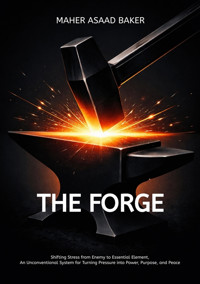
In the pursuit of peace, we have been taught to see stress as the enemy, a sign of malfunction, a flaw to be eliminated. But what if we have misunderstood the fire that forges us? This book challenges the modern myth of the stress-free life, arguing that pressure is not a defect in our design but a fundamental instructor. Drawing on the powerful metaphor of the forge, it reimagines stress as essential information, a primal language of urgency, significance, and potential. True resilience is not built by avoiding the heat, but by learning to work within it. Through an exploration of internal architecture, external dynamics, and integrated existence, this work offers a radical reframe: stress is the catalyst for focus, the sculptor of character, and the compass that points toward meaningful contribution. It is not the absence of pressure that defines a life well-lived, but the ability to meet it with clarity, purpose, and sovereignty. This is not a guide to eliminating hardship, but a masterclass in alchemy, transforming raw pressure into strength, insight, and unshakable peace. The forge awaits.
Das E-Book können Sie in Legimi-Apps oder einer beliebigen App lesen, die das folgende Format unterstützen:
Seitenzahl: 127
Veröffentlichungsjahr: 2026
Ähnliche










Maher Asaad Baker
The Forge
© 2025 Maher Asaad Baker
Verlagslabel: Maher Asaad Baker
Druck und Distribution im Auftrag des Autors:
tredition GmbH, Heinz-Beusen-Stieg 5, 22926 Ahrensburg, Deutschland
Das Werk, einschließlich seiner Teile, ist urheberrechtlich geschützt. Für die Inhalte ist der Autor verantwortlich. Jede Verwertung ist ohne seine Zustimmung unzulässig. Die Publikation und Verbreitung erfolgen im Auftrag des Autors, zu erreichen unter: Maher Asaad Baker, Main 1, 28195 Osterholz-Scharmbeck, Germany.
Kontaktadresse nach EU-Produktsicherheitsverordnung: [email protected]
Contents
The Foundation
The Internal Architecture
The External Dynamics
The Integrated Existence
About the Author
The Foundation
Stress has been understood so long as a red flag, as an indicator that something has gone awry, biological complaints that life is being mismanaged, but this ascription is neither neutral nor non-infectious, because the moment stress is construed as a sign that things have gone wrong, the mind instantaneously seeks, instead of comprehension, to avoid it, instead of remaining at the raw material trying to mingle it with the shape it is attempting to assume, and in so doing it confuses the pressure of transforming matter with the act of destroying it, the forge with the furnace, even though When the stress is re-imagined as not something divisive but something telling that something significant is happening and not something that interrupts the system but the system is mobilizing, this stress starts to be seen as the oldest partner in human development, something prior to any language, culture or abstraction, something that is deeply rooted in the nervous system as a way of mobilization and not a way of punishment, an internal alarm to move, not to be poorly enough. Our issue is not risk, however, but its narrative since stories construct orientation, and we become fractured when pressured tends to become structured.
In its most fundamental nature, stress is neither an emotion nor a thought or a subjective experience, it is a cascade of physiological events that serve to mobilize resources, focus on a single thought, sharpen perception, and temporarily override comfort in the name of survival and adaptation, and when one considers it in these terms, one must not be truly honest in calling it a defect, since it is the mechanism by which organisms react to uncertainty, threat and opportunity and to novelty, each of which cannot exist without the other. Stress response did not evolve to make life pleasant but to become possible and functions by producing systems that strengthen, speed up, tighten the alert and encode memory mechanisms so that, under its sway, the organism is more apt than less, provided that the signal is properly interpreted and the energy is organized and not opposed. To name stress as an enemy is to misconceive its role just as one would misconceive gravity by swearing at it because it complicates lifting something without realizing that it is the same power which facilitates walking, balance, and orientation since what is lifted may be what requires attention.
The forge metaphor does not serve to idealize poverty, it represents the situation in which merely raw material is transformed into something with integrity, purpose and robustness because a forge is not anarchy but ordered accidents, not ruination but refinements, nor cruelty but craftiness, and required recurrence to maintain structure. In a forge, material before it has been subjected to stress is brittle, inconsistent and unreliable and material that has been heated and worked acquires some coherence at the molecular level and internal structure that responds to repeated force becomes available to support weight without collapsing. Neither human beings nor in this respect are an exception as psychological coherence, emotional stability, and moral reliability are not formed by ease but by repeated meetings with hardship that demand a response not avoidance and cause the individual to marshal inner resources around an object that matters.
What our current levels of discourses tend to forego in taking note of is that stress is not a single unitary experience, but a language made out of signals through which it communicates mismatch, urgency, risk, and possibility, and in that way any language can be but misunderstood and mistranslated or disregarded, bringing about discord rather than peace. When stress is not taken as noise but as data, the person is deprived of an important feedback system, of where growth is needed, where attention is needed sharpened and where values are being tested, since when a person is stressed, what is revealed is structure itself, what is strong is revealed, what is weak is revealed, not only what is strong but what is weak, and the revelation is not an indictment, but an invitation to refinement. Stress as information does not inform a human being that s/he is broken, it merely informs the person that he/she is unfinished and that unfinished does not mean faulty, it only means alive and has the capacity to develop something more distinct.
The mass effort to do away with stress completely is based on the erroneous belief that lack of pressure causes safety, whereas in fact, lack of pressure causes vulnerability since a system that never gets stressed can never evolve and thus it crashes when the reality strikes unexpectedly. It is a fact of muscles and bones as it is of attention, identity and purpose in that capacity is not an abstract thing but the reaction to a condition, enlarging only where it is called upon to enlarge. Stress is no by-product to good living, that is, it is the state itself that enables capacity to develop, since there can be no signal to reorganize, no motive to sharpen the strategy and no stimulus to recapture hitherto undiscovered strength. It is potential, because it does contain this demand which brings about ability, and it is ability that has never been called forth that is theoretical, untested, unreliable.
Those misconceptions of stress as itself dangerous have also created the confusion of intensity with danger and the promotion of psychological withdrawal in seeking to level their experience, numb their sensitivity, and reduction of engagement so that they can avoid uncomfortable feelings without realizing they have also compromised meaning, intelligibility and direction. When well put into perspective intensity is not an enemy to wellbeing, but an indicator of a nearness to something that is important, since apathy does not induce stress, indifference does not stimulate the nervous system, and stagnation does not affect urgency. The existence of stakes, consequences of action, implicated values, and relevance make life full of stress, and a life unexposed to stress is therefore not a life of peace but a life of low relevance, where nothing is pressing enough to require the best or the probable.
Biological stress response does not elaborate interchangeably between what the phenomena threatens and challenges, rather it is a response to perceived significance, memory mobilizing energy accordingly to the extent of the stakes at hand, and this neutrality is essential, as it implies that stress is not some enemy that decided to act, but an energy that is responding to meaning. By creating an interpretation of importance, uncertainty or demand, the body is ready to face it and this preparation is neither bad nor good until the mind puts a narrative on it, as the same physiological sensations that come with fear come with excitement, anticipation and determination. It is not in the body that the difference is found but, in the tale, talked about what the body is undertaking and it is here that the alchemy has taken place since the choice of whether the energy in the stress can be turned into energy of focus or that of panic, into resolve or into paralysis occurs with interpretation.
Alchemy, in its primitive meaning was not the process of changing base substances into gold, but the process of changing by refining by heat, time, patient application, and this is exactly what is involved when adversity is not viewed as a problem to be eliminated, but as something to be leveraged on. Tragedy is the fire that burns the filthy, the demand that weakens, the practice that makes a habit firm, and without it the man is not proved, his own vision is not fastened, his own ideals are not proved. Stress is what empowers growth and condenses years of possible education into times of operation since when pressure is felt feedback is instant, effects are obvious, and delusions can be re-evaluated rapidly.
The perception that stress means failure may be again mostly a result of cultural misconception of comfort as a measure of success, where by as things get easy it also means success and as things get hard, it also means success, when in reality the harder the endeavor, the more significant it is. Mastery does not make things easy, but makes them harder, since as one gets more ability so do the stakes, the responsibility and the refinement of which actions are important, and along with this heightening of degrees comes an added note of stress, not as a reminder that one must not backtrack but as a reminder that one is in a territory where activities count. To desire a good life without being stressed is like to desire depth without pressure, structure without force, and transformation without heat the latter which are all counter to the fundamental dynamics of change.
As long as pressure is re-construed in terms of potential, we can find different questions in stressful times, and as with why is this happening to me, what is this requesting I, since any form of stress presupposes demand, and within that demand information is available on what needs to be reinforced, made clear, or abandoned. When the focus is disturbed in the state of pressure, the information can be that the focus should be trained, when values are eroded under pressure, the information can be that integrity has not yet been completely internalized, when the identity breaks down under pressure, the information can be that it had been constructed based on untried assumptions instead of living principles. Stress reveals these fault lines not to disgrace the individual but to give a chance of reconfigured, since there can be no correction where there is no exposure, nor reliability where there is no correction.
This reframing involves the need to reject the passive position of victimhood that sees stress as something that is done to it; instead, it embraces an active position of interpretation that sees stress as a result that occurs inside the overlay of perception, meaning, and expectation. It is the meaning of things, not the things per se, that trigger the nervous system and it follows that stress is not simply enforced by the reality but is also produced in partnership with its meaning, which is that, to the extent that stress is informational, it can be read, interrogated and controlled, and this insight is the one that recovers agency, as it is a fact that, to the extent that stress is informational in the first place, it can be read, interrogated and directed instead of just being endured. Pressure is made a message and not a threat and messages can be read between the lines.
This reconceptualization of stress as information also breaks down the fallacy of strength and sensitivity, as being sensitive does not mean one is weak, but is a trait of being able to notice certain small changes and act appropriately in relation to them, and stress makes one more sensitive, as it amplifies stimuli that would otherwise go undetected. Using this increased sensitivity, it becomes possible to learn more quickly, gain a clearer understanding, and make more accurate adjustments, turning the points of strain into the points of increased adaptation. The risk is not experiencing stress rather is misunderstanding it as evidence of inability since this will cause avoidance and avoidance will hinder the process of learning and consequently the belief that stress is unacceptable will be strengthened further thus creating a vicious cycle of fragility.
The fact that pressure is potential also suggests that not every stress is created equal since potential is dependent on direction and duration and recovery, as in a forge the heat must be applied intentionally and not randomly and material must be left to cool to stabilize its new form. Meaneless, meaningless, indefatigable chronic stress, without meaning, agency, or recovery, does not create a strong person, it destroys one, yet no stress in itself is bad, but information that is neither integrated within the whole becomes noise. It does not suffice that the stress is present but needs to be framed within a narrative of purpose execution, competence and development, otherwise the energy it generates is wasted in nervousness as opposed to being translated into structure. This difference is instrumental, as it ensures that suffering is not turned into a romanticized issue, but the importance of stress as part and parcel of change is retained.
In an alchemical approach to adversity, the inquiry is never in what way to get ourselves out of pressure, but in what way to improve our relationship to the pressure, in what way to be there without being brought into it, in what way to derive meaning without getting covered up, and in what way to transform intensity to a state of coherence. This involves being able and ready to live with discomfort to an extent that lessons about it are gained, without yielding to the urge to numb, distract or give way, as learning gets done on the border of toleration this allows sensation strong enough of arousal that it takes focus, but not so severe that it shatters capacity. The effectiveness of the forge is not in it destroying material, but it imparts just the amount of force sufficient to work it, and the skill lies in learning how to manage it within.
In this perspective stress thus proves not antithetically related to peace but constitutive of it, since peace that has never faced pressure is weak and reliant on circumstances, whereas peace that is faced by pressure is strong and mobile, and can make its own way and maintain itself even when things change. That tranquility created by avoidance is over when trouble strikes first whereas the tranquility created by facing and incorporating stress is uninterrupted because they are based on competence as opposed to denial. Therefore, the art that adversity teaches is not the exaltation of difficult times, but to realize that there can be no good strength, no tried values, no trustworthy contribution unless the hearth of anguish is burned.
On the most fundamental level, neither enemy nor essential element is ever re-expressed without a change in identity, a change in seeing oneself as something to be defended against reality to seeing oneself as something to be fashioned by it, since protection without engagement makes one stagnant, but engagement without interpretation burns one out, but engagement informed by interpretation grows one. Reality is expressed through stress, and addressing the demands made by it is what makes the difference between existence as a sequence of reactions and existence as a trajectory. The forge does not inquire as to whether the metal does or does not like the heat, it inquires as to whether the metal will withstand the pressure and it is then found that merely by learning to interpret pressure as information and the strain as a potential human beings can be fashioned into the form or structure that will outlive.




