INTRODUCTION
The
game of Go belongs to the class of games of which our Chess, though
very dissimilar, is an example. It is played on a board, and is a
game of pure skill, into which the element of chance does not
enter;
moreover, it is an exceedingly difficult game to learn, and no one
can expect to acquire the most superficial knowledge of it without
many hours of hard work. It is said in Japan that a player with
ordinary aptitude for the game would have to play ten thousand
games
in order to attain professional rank of the lowest degree. When we
think that it would take twenty-seven years to play ten thousand
games at the rate of one game per day, we can get some idea of the
Japanese estimate of its difficulty. The difficulty of the game and
the remarkable amount of time and labor which it is necessary to
expend in order to become even a moderately good player, are the
reasons why Go has not spread to other countries since Japan has
been
opened to foreign intercourse. For the same reasons few foreigners
who live there have become familiar with it.
On
the other hand, its intense interest is attested by the following
saying of the Japanese: “Go uchi wa oya no shini me ni mo awanu,”
which means that a man playing the game would not leave off even to
be present at the death-bed of a parent. I have found that
beginners
in this country to whom I have shown the game always seem to find
it
interesting, although so far I have known no one who has
[viii]progressed
beyond the novice stage. The more it is played the more its
beauties
and opportunities for skill become apparent, and it may be
unhesitatingly recommended to that part of the community, however
small it may be, for whom games requiring skill and patience have
an
attraction.
It
is natural to compare it with our Chess, and it may safely be said
that Go has nothing to fear from the comparison. Indeed, it is not
too much to say that it presents even greater opportunities for
foresight and keen analysis.
The
Japanese also play Chess, which they call “Shogi,” but it is
slightly different from our Chess, and their game has not been so
well developed.
Go,
on the other hand, has been zealously played and scientifically
developed for centuries, and as will appear more at length in the
chapter on the History of the Game, it has, during part of this
time,
been recognized and fostered by the government. Until recently a
systematic treatment of the game, such as we are accustomed to in
our
books on Chess, has been lacking in Japan. A copious literature had
been produced, but it consisted mostly of collections of
illustrative
and annotated games, and the Go masters seem to have had a desire
to
make their marginal annotations as brief as possible, in order to
compel the beginner to go to the master for instruction and to
learn
the game only by hard practice.
Chess
and Go are both in a sense military games, but the military tactics
that are represented in Chess are of a past age, in which the king
himself entered the conflict—his fall generally meaning the loss of
the battle—and in which the victory or defeat was brought about by
the courage
[xi]of single
noblemen rather than through the fighting of the common
soldiers.
Go,
on the other hand, is not merely a picture of a single battle like
Chess, but of a whole campaign of a modern kind, in which the
strategical movements of the masses in the end decide the victory.
Battles occur in various parts of the board, and sometimes several
are going on at the same time. Strong positions are besieged and
captured, and whole armies are cut off from their line of
communications and are taken prisoners unless they can fortify
themselves in impregnable positions, and a far-reaching strategy
alone assures the victory.
It
is difficult to say which of the two games gives more pleasure. The
combinations in Go suffer in comparison with those of Chess by
reason
of a certain monotony, because there are no pieces having different
movements, and because the stones are not moved again after once
being placed on the board. Also to a beginner the play, especially
in
the beginning of the game, seems vague; there are so many points on
which the stones may be played, and the amount of territory
obtainable by one move or the other seems hopelessly indefinite.
This
objection is more apparent than real, and as one’s knowledge of the
game grows, it becomes apparent that the first stones must be
played
with great care, and that there are certain definite, advantageous
positions, which limit the player in his choice of moves, just as
the
recognized Chess openings guide our play in that game. Stones so
played in the opening are called “Joseki” by the Japanese.
Nevertheless, I think that in the early part of the game the play
is
somewhat indefinite for any player of ordinary skill. On the
other
[x]hand, these
considerations are balanced by the greater number of combinations
and
by the greater number of places on the board where conflicts take
place. As a rule it may be said that two average players of about
equal strength will find more pleasure in Go than in Chess, for in
Chess it is almost certain that the first of two such players who
loses a piece will lose the game, and further play is mostly an
unsuccessful struggle against certain defeat. In Go, on the other
hand, a severe loss does not by any means entail the loss of the
game, for the player temporarily worsted can betake himself to
another portion of the field where, for the most part unaffected by
the reverse already suffered, he may gain a compensating
advantage.
A
peculiar charm of Go lies in the fact that through the so-called
“Ko”
an apparently severe loss may often be made a means of securing a
decisive advantage in another portion of the board. A game is so
much
the more interesting the oftener the opportunities for victory or
defeat change, and in Chess these chances do not change often,
seldom
more than twice. In Go, on the other hand, they change much more
frequently, and sometimes just at the end of the game, perhaps in
the
last moments, an almost certain defeat may by some clever move be
changed into a victory.
There
is another respect in which Go is distinctly superior to Chess.
That
is in the system of handicapping. When handicaps are given in
Chess,
the whole opening is more or less spoiled, and the scale of
handicaps, from the Bishop’s Pawn to Queen’s Rook, is not very
accurate; and in one variation of the Muzio gambit, so far from
being
a handicap, it is really an advantage to the first player to
give
[xi]up the
Queen’s Knight. In Go, on the other hand, the handicaps are in a
progressive scale of great accuracy, they have been given from the
earliest times, and the openings with handicaps have been studied
quite as much as those without handicaps.
In
regard to the time required to play a game of Go, it may be said
that
ordinary players finish a game in an hour or two, but as in Chess,
a
championship game may be continued through several sittings, and
may
last eight or ten hours. There is on record, however, an authentic
account of a game that was played for the championship at Yeddo
during the Shogunate, which lasted continuously nine days and one
night.
Before
taking up a description of the board and stones and the rules of
play, we will first outline a history of the game.
[
Contents]
I
HISTORY
OF THE GAMEThe
game of Go is probably the oldest of all known games. It was played
by the Chinese from earliest antiquity, and has been played in its
present form by the Japanese for over eleven centuries, but while
the
game originated in China, the Japanese have far surpassed the
Chinese
in skill at the game, and it has come to be regarded in Japan as
their national game.In
the old Chinese works three persons are named as the originators of
the game, but in Japan its invention is commonly attributed to only
one of these. This man is the Chinese emperor Shun, who reigned
from
2255 to 2206 B.C. It is said that this emperor invented the game in
order to strengthen the weak mind of his son Shang Kiun. By others
the invention of the game is attributed to the predecessor of Shun,
the emperor Yao, who reigned from 2357 to 2256 B.C. If this theory
is
correct it would make the game about forty-two hundred years old.
The
third theory is that Wu, a vassal of the Chinese emperor Kieh Kwei
(1818–1767 B.C.) invented the game of Go. To the same man is often
attributed the invention of games of cards. It would seem that this
last theory is the most credible, because it would make the
invention
more recent, and because the inventor is said to have been a vassal
and not an emperor.Whatever
may be the truth in regard to the origin of the
[2]game, it is
perfectly certain that Go was already known in China in early
antiquity. In old Chinese works, of which the oldest is dated about
a
thousand years before Christ, a game which can be easily recognized
as Go is mentioned casually, so that at that time it must have been
well known.We
are told also that in China somewhere about 200 B.C., poetry and Go
went hand in hand, and were in high favor, and a poet, Bayu, who
lived about the year 240 A.D., made himself famous through poems in
which he sang the praises of the game.It
is remarkable that in the old books it is stated that in the year
300
A.D. a man by the name of Osan was so skilled in Go that he could
take all the stones from the board after the game had been finished
and then play it over from memory. This is of interest also as
showing that in the course of time playing the game has had the
effect of strengthening the memory of Go players, because there are
now hundreds of players in Japan who can replace a game move for
move
after it has been disarranged. It is in fact the customary thing
for
a teacher of the game to play the game over in that way in order to
criticise the moves made by the student.Anecdotes
have come down to us from the old Chinese times in regard to the
game, of which we will mention only one, which shows how highly it
was esteemed.Sha
An, a man who lived in the time of the Tsin Dynasty (265–419 A.D.),
carried on a war with his nephew Sha Gen. Growing tired of taking
life, they left the victory to be decided by a game of Go, which
they
played against each other.
[3]The
esteem in which players were held in the old Chinese times is also
shown by the titles with which they were honored; to wit, “Kisei”
or “Ki Shing,” from “Ki,” meaning Go, and “Sei,” a holy
man, and “Shing,” magician or sage.In
the time of the Tang Dynasty (618–906 A.D.), and again during the
Sung Dynasty (960–1126 A.D.), the first books about Go were
written. The game then flourished in China, and there were then
many
distinguished players in that country.According
to the Japanese reckoning of time, Go was introduced into Japan in
the period Tem pyo, during the reign of the emperor Shomu, which
according to the Chinese records was the thirteenth year of the
period Tien Tao, and during the reign of the emperor Huan Tsung.
According to our calendar this would be about the year 735
A.D.A
man otherwise well known in the history of Japan, Kibi Daijin, was
sent as an envoy to China in that year, and it is said that he
brought the game back with him to Japan.Go
may have been known in Japan before that date, but at any rate it
must have been known about this time, for in the seventh month of
the
tenth year of the period Tem pyo (A.D. 738), we are told that a
Japanese nobleman named Kumoshi was playing Go with another
nobleman
named Adzumabito, and that in a quarrel resulting from the game
Kumoshi killed Adzumabito with his sword.On
its introduction into Japan a new era opened in the development of
the game, but at first it spread very slowly, and it is mentioned a
hundred years later that the
[4]number of Go
players among the nobility (and to them the knowledge of the game
was
entirely confined) was very small indeed.In
the period called Kasho (848–851 A.D.), and in Nin Ju (851–854
A.D.), a Japanese prince dwelt in China, and was there taught the
game by the best player in China. The following anecdote is told in
regard to this prince: that in order to do him honor the Chinese
allowed him to meet the best players, and in order to cope with
them
he hit upon the idea of placing his stones exactly in the same way
as
those of his opponent; that is to say, when his opponent placed a
stone at any point, he would place his stone on a point
symmetrically
opposite, and in that way he is said to have won. In regard to this
anecdote it may be said that the Chinese must have been very weak
players, or they would speedily have found means of overcoming this
method of defense.We
next hear that in the year 850 a Japanese named Wakino became
famous
as a great devotee of the game. He played continuously day and
night,
and became so engrossed in the game that he forgot everything else
absolutely.In
the next two centuries the knowledge of the game did not extend
beyond the court at Kioto. Indeed, it appears that it was forbidden
to play Go anywhere else than at court. At all events we are told
that in the period called Otoku (1084–1087 A.D.) the Prince of
Dewa, whose name was Kiowara no Mahira, secretly introduced the
game
into the province of Oshu, and played there with his vassals. From
that time not only the number of the nobility who played the game
increased rapidly, but the common people as well began to take it
up.
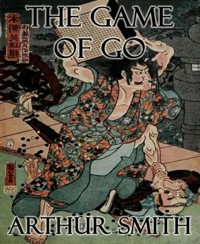
[5]Our
frontispiece illustrates an incident which is said to have occurred
about this time in the city of Kamakura. A samurai named Sato
Tadanobu, who was a vassal of Yoshitsune, a brother of Yoritomo,
the
first Shogun of Japan, was playing Go in his house when he was
suddenly attacked by his enemies, and he is depicted using the
“Goban” as a weapon wherewith to defend himself. The print is by
Kuniyoshi, and is one of a series the title of which might be
translated as “Our Favorite Hero Series.” The “Go ban,” “Go
ishi,” and “Go tsubo” look precisely like those which are at
present in use, but Kuniyoshi probably represented the type in use
in
his day and not in the time of Yoritomo, as it is pretty well
settled
that in the early times the board was smaller.There
is also a story which comes down from the Kamakura period in regard
to Hojo Yoshitoki. He is said to have been playing Go with a guest
at
the moment that news arrived of the uprising of Wada Yoshimori.
Yoshitoki is said to have first finished the game in perfect
calmness
before he thought of his measures for subduing the revolution. This
was in the first year of Kempo, or 1213 A.D.In
the beginning of the thirteenth century we find that Go was widely
known in the samurai class, and was played with zeal. At that time
everybody who went to war, from the most famous general down to the
meanest soldier, played the game. The board and stones were carried
with them to the field of battle, and as soon as the battle was
over,
they were brought out, and the friendly strife began. Many of the
monks and poets of that period also had a taste for Go, and several
of them are mentioned as celebrated Go players.
[6]All
three of the great Japanese generals, Nobunaga, Hideyoshi, and
Iyeyasu, were devotees of the game. It is related that Nobunaga
came
to Kioto in the tenth year of Ten Sho, 1582 A.D., and lived in the
Honnoji Temple. One night the celebrated Go player, Sansha, of whom
more hereafter, came and played with him until midnight. Sansha had
scarcely taken his departure when the uprising of Akechi Mitsuhide
broke out.In
the periods Genki (1570–1572), Ten Sho (1573–1591) until Keicho
(1596–1614), and Gen Wa (1615–1623), there were many celebrated
players among the monks, poets, farmers and tradespeople. They were
called to the courts of the daimios and to the halls of the nobles,
either in order that the nobility might play with them, or more
frequently merely to exhibit their skill at the game. This custom
existed up to the time of the fall of the Shogunate.That
the Japanese could find pleasure in merely watching a game that is
so
abstract in its nature and so difficult to understand is evidence
of
the fact that they were then a highly cultivated people
intellectually. We find nothing like it in this country except in
the
narrowest Chess circles.In
the beginning of the seventeenth century Go attained such a high
development that there appeared a series of expert players who far
surpassed anything known before. Of these the most famous were
Honinbo Sansha Hoin, Nakamura Doseki, Hayashi Rigen, Inouye Inseki,
and Yasui Santetsu.Sansha
was the son of a merchant of Kioto. When he was nine years old he
shaved his head, named himself Nikkai, and became a Buddhist monk
in
the Temple of Shokokuji, which was one of the principal temples of
the
[7]Nichi Ren
sect in Kioto. From his early life Sansha was very skilful at the
game, and upon giving up his profession as a monk, he obtained
permission to institute a school of Go players, and he then took
the
name of Honinbo Sansha. He was on terms of familiar intercourse
with
Nobunaga, Hideyoshi and Iyeyasu, often accompanied them on their
travels and campaigns, and was present at many of the battles of
that
troublous epoch.The
school of Go which Honinbo opened, however, was merely a private
undertaking. The first State institution in which Go was taught was
founded by Hideyoshi in the period Ten Sho (1573–1591), but it
seems to have had a short existence, and the permanent institution
which lasted until the fall of the Shogunate was founded by the
successor of Hideyoshi, Iyeyasu. Iyeyasu became Shogun in the year
1603, and the foundation of the Go Academy or “Go In,” as the
Japanese call it, must have occurred soon after he ascended the
throne. Honinbo Sansha, who was still the best Go player in Japan,
was named as the head of the institution. The other most skilful
masters were installed as professors with good salaries. To Honinbo
Sansha, the director, was given 350 tsubo of land (a tsubo is as
big
as two Japanese mats or tatami, and is therefore six feet square),
and an annual revenue of 200 koku of rice (a koku is a little more
than five bushels). Men of the best intelligence could now dedicate
themselves to the education of students and the further development
of the game, freed from the cares of earning a livelihood. In both
respects the institute was eminently successful. Its graduates were
much more skilful than the previous generation of Go players living
in the land. They devoted themselves entirely
[8]to the game,
and either found positions as players at the court of a daimio, or
traveled through the country (like the poets and swordsmen of that
period), playing the game and giving instruction in its mysteries
as
they found opportunity. If they came to a place which pleased them,
they often let their years of wandering come to an end and remained
there, making their living as teachers of the game.At
the time of the founding of the Academy, besides Honinbo, the
previously mentioned masters, Hayashi, Inouye, and Yasui, were
installed as professors. For some reason, Nakamura, who is
mentioned
above as one of the contemporaries of Honinbo, did not appear at
the
Academy. Each of the four masters above named founded his school or
method of play independently of the others, and the custom existed
that each teacher adopted his best pupil as a son, and thus had a
successor at his death; so the teachers in the Academy were always
named Honinbo, Inouye, Hayashi, and Yasui. (Lovers of Japanese
prints
are already familiar with this continued similarity of
names.)The
best players of the Academy had to appear every year before the
Shogun and play for his amusement. This ceremony was called “Go zen
Go,” which means “playing the game in the august presence,” or
“O shiro Go,” “Shiro” meaning “the honorable palace,” and
the masters of the game entered these contests with the same
determination that was displayed by the samurai on the field of
battle.An
anecdote has come down to us from the reign of the third Shogun,
Tokugawa Iyemitsu, showing how highly the Go masters regarded their
art. At that time Yasui Sanchi was “Meijin,” which, as we shall
see in a moment, meant the highest rank in the Go world, while
Honinbo
[9]Sanyetsu held
the rank of “Jo zu,” which was almost as high, but which,
according to the rules, would entitle him to a handicap of one
stone
from his expert adversary; and these two men, being the best
players,
were selected to play in the Shogun’s presence. Honinbo, feeling
conscious of his skill, disdained to accept the handicap, and met
his
adversary on even terms. The game was proceeding in the presence of
the court nobles before the Shogun had appeared, and among the
spectators was Matsudaira Higo no Kami, one of the most powerful
noblemen of that epoch. Yasui Sanchi was a favorite of Matsudaira
and
as he watched the play he remarked audibly that Honinbo would
surely
be defeated. Honinbo Sanyetsu heard the remark, and pausing in his
play, he allowed the stone which he was about to place on the board
to fall back into the “Go tsubo” or wooden jar that holds the Go
stones, gently covered the “Go tsubo,” and drawing himself up
with great dignity, said: “I am serving the Shogun with the art of
Go, and when we Go masters enter a contest, it is in the same
spirit
as warriors go upon the field of battle, staking our life, if
necessary, to decide the contest. While we are doing this we do not
allow interference or comments from any one, no matter how high may
be his rank. Although I am not the greatest master of the game, I
hold the degree of ‘Jo zu,’ and, therefore, there are few players
in Japan who are able to appreciate my plans, tactics, or strategy.
Nevertheless, the Prince of Higo has unwarrantedly prophesied my
defeat. I do not understand why he has done this, but if such a
comment were allowed to become a precedent, and onlookers were
permitted to make whatever comments on the game they saw fit, it
would be better
[10]that the
custom of the ‘O shiro Go’ should cease.” Having said this, he
raised himself from his seat. At this moment the court officers
announced the coming of the Shogun, and the noblemen who had
assembled to see the contest, surprised and confused by the turn
affairs had taken, earnestly persuaded Honinbo to reseat himself
and
continue the game. This he obstinately refused to do, and
endeavored
to leave the imperial chamber. Prince Matsudaira, taken aback,
scarcely knew what to do. However, he kotowed to Honinbo and,
profusely apologizing, besought the offended master to finish the
contest. Honinbo Sanyetsu was appeased, and resumed his seat at the
board, and both players, aroused by the incident, exerted every
effort to achieve victory. Honinbo Sanyetsu won, whereupon the
Prince
of Higo was greatly humiliated. Since then the name of Sanyetsu has
always been revered as one of the greatest of the Honinbo
family.In
the degenerate days toward the end of the Tokugawa Dynasty the “Go
zen Go” became a mere farce, and the games were all played through
and studied out beforehand, in order that the ceremony in court
might
not last too long. The custom was, however, maintained until the
fall
of the Shogunate in 1868.Honinbo
Sansha established at the time of the foundation of the Academy a
method of classifying the players by giving them degrees, which
still
exists, although no longer under the authority of the State. When a
man attained to a certain measure of skill in the game he received
the title “Shodan,” or, of the first degree. The still stronger
players were arranged as “Nidan,” “Sandan,” “Yodan,”
etc., or of the second, third, and fourth degrees. The
highest
[11]degree in
the series was “Kudan,” or the ninth degree. In order to attain
the first degree, or “Shodan,” the candidate must be an excellent
player, so good in fact that he could follow the game as a
profession. In other games such a graduated system of classifying
players would be scarcely possible, but among good Go players it is
feasible, because the better player almost invariably wins, even if
he be but slightly superior. If the difference in skill could not
be
equalized in some way the game would become tiresome, as the weaker
player would almost always be able to foresee his defeat. The
stronger player, therefore, allows his adversary to place enough
stones on the board as a handicap to make the adversaries
approximately equal.According
to the rules of the Academy, if the difference between the skill of
the players was only one degree, the weaker player would be allowed
the first move. If the difference was two degrees, the weaker
player
would be allowed to place a stone on the board, and the stronger
player would have the first move, and so on; in other words, the
difference between each degree might be called half a stone. Thus,
a
player of the fourth degree would allow a player of the first
degree
to place two stones on the board as a handicap, but would have the
first move. A player of the seventh degree would allow a player of
the first degree three stones, and a player of the ninth degree
would
allow a player of the first degree four stones. Four was the
highest
handicap allowed among the players holding degrees, but, as we
shall
see later, among players of less skill greater handicaps are
frequently given.A
player of the seventh degree also received the honorary title “Jo
zu,” or the higher hand. Those of the eighth
[12]rank were
called “Kan shu,” or the half-way step, and those of the ninth
degree were called “Mei shu,” the clear, bright hand, or “Mei
jin,” literally “celebrated man.” It is related that this last
appellation arose in the time of Nobunaga, who was a spectator of a
game played by Honinbo Sansha with some contemporary, and who
expressed his admiration of the skill of Honinbo by exclaiming “Mei
jin!” which thus became the title applied to players of the highest
skill.Since
the institution of this method of classifying Go players over three
hundred years ago, there have been only nine players who have
attained the ninth degree, and only fourteen players who have
attained the eighth degree. On the other hand, there have been many
more of the seventh, and many more still of each of the lower
degrees. In 1880, at the time Korschelt wrote the article
previously
referred to, there was only one player in Japan holding the seventh
degree, and that was the celebrated Murase Shuho. At present there
is
one player who holds the ninth degree. His name is Honinbo Shuyei,
and he is the only player who has attained the ninth degree during
the period called the “Meiji,” or since the fall of the Shogunate
forty years ago.This
arrangement of the players in degrees is unknown in China and
Korea.
On the other hand, it is in use in the Ryukyu or Loochoo
Islands.The
Japanese seem to have regarded the classification in degrees as an
absolute standard of measurement. Nevertheless, it must necessarily
have varied from time to time, and in the course of centuries the
standard must gradually have risen.
[13]Players
of high rank who are challenged by the improving players of the
lower
grades will instinctively desire to make it more difficult for the
new players to attain the higher degree, because their own fame,
which is their highest possession, depends upon the result of the
game; and assuming that all trial games could be conducted in an
impartial and judicial spirit, nevertheless, all the players would
become more expert from the hard practice, even if their skill in
relation to each other remained the same.Thus
a seventh degree player of to-day would be better in a year
although
he still remained in the seventh degree, and this constant raising
of
the standard must lead us to suppose that a player of the seventh
degree now is quite equal or perhaps superior to an eighth or ninth
degree player of a hundred or two hundred years ago. As an
illustration of this increase in skill, we only have to compare the
standard set in the Ryukyu Islands. They also established the
classification in degrees soon after the foundation of the Academy
in
Japan, and then the two institutions seem to have lost touch.
Korschelt relates that for the first time about the year 1880 a Go
player of the second degree from the Satsuma province visited those
Islands and tried his skill with their best players, and found that
he could easily defeat the players there classified as of the fifth
degree.The
position as head of the Academy was much coveted by Go players, but
it was generally held by the Honinbo family. One of the last
incidents in relation to the Academy tells of an attempt on the
part
of Inouye Inseki, the eleventh of that line, to obtain the headship
of the Academy when Honinbo Jowa, who was the twelfth Honinbo,
retired. Inseki was afraid he could not obtain
[14]the coveted
position by a contest, and therefore strove to obtain it by
intrigue
from the Shogun’s officer intrusted with the business of the
Academy. When Jowa retired he was not unaware of the desires of
Inseki, but it did not trouble him much, as he felt confident that
the fourteenth Honinbo, whose name was Shuwa, could successfully
defend his title. However, at last matters came to such a point
that
Jowa ordered Shuwa to present a petition to the Shogun requesting
that the title be settled by contest, but the Shogun’s officer, who
was in league with Inseki, returned the petition, whereupon all of
the Honinbo house rose and insisted on their rights in accordance
with custom and precedent, and at last their petition was granted.
It
was fixed that the title was to be decided by ten games, and the
first game began at the residence of the Shogun’s officer, Inaba
Tango no Kami, on the 29th of November, in the eleventh year of
Tempo
(about sixty-six years ago), and it ended the same year on the 13th
of December. There was an adjournment of four days, and on one
occasion the contest lasted all night. Therefore in all it took
nine
days and one night to finish the game.It
is unnecessary to say that both players put forth all their efforts
in this life and death struggle, and it is said that Inseki’s
excitement was so intense as to cause blood to gush from his mouth,
but he finally lost by four stones, and the other nine games were
not
played. Inseki, however, mortified by his defeat, again challenged
Shuwa. This game began on the 16th of May in the thirteenth year of
Tempo, and lasted two days. Inseki again lost by six stones. On
November 17th of the same year a third contest took place between
Shuwa and Inseki in the presence
[15]of the
Shogun in his palace at Tokio. Inseki again lost by four stones. In
all these contests Inseki as the challenger had the first move, and
he finally became convinced of his inability to win from the scion
of
the Honinbo family, and abandoned his life-long desire, and it is
related that thereupon the houses of Honinbo and Inouye became more
friendly than ever.In
the first half of the nineteenth century Go had a period of great
development. This occurred according to the Japanese calendar in
the
periods called Bun Kwa (1804–1818), Bun Sei (1818–1829), and
Tempo (1830–1844). The collection of specimen games of that time
are to-day regarded as models, and the methods of play and of
opening
the game then in use are still studied, although they have been
somewhat superseded. The best games were played by the Honinbos
Dosaku and Jowa and Yasui Sanchi.On
the fall of the Shogunate in the year 1868 the Go Academy came to
an
end, and with it the regulation of the game by the State. A few
years
later the daimios were dispossessed, and they did not feel an
obligation as private individuals to retain the services of the Go
players who had been in attendance at their courts. Thereupon
ensued
a sad time for the masters of the game, who had theretofore for the
most part lived by the practice of their art, and to make things
still worse, the Japanese people lost their interest in Go. Upon
the
opening of the country the people turned with enthusiasm to the
foreigners. Foreign things were more prized than native things, and
among the things of native origin the game of Go was
neglected.About
the year 1880, however, a reaction set in; interest in the old
national game was revived, and at the present
[16]day it is
fostered with as much zeal as in the olden times.Most
of the higher officials of the government, and also the officers in
the army and navy, are skilled players. The great daily newspapers
of
the capitals have a Go department, just as some of our periodicals
have a department devoted to Chess, and the game is very much
played
at the hot springs and health resorts, and clubs, and teachers of
the
art are found in all of the larger cities. Go has always retained
something of its early aristocratic character, and in fact, it is
still regarded as necessary for a man of refinement to possess a
certain skill at the game.During
the recent Russo-Japanese War the strategy employed by the Japanese
commanders certainly suggested the methods of play used in the game
of Go. Whether this was an accidental resemblance or not I cannot
say. At Liao Yang it seemed as if Marshal Oyama had got three of
the
necessary stones advantageously placed, but the Russians escaped
before the fourth could be moved into position. At the final battle
of Mukden the enveloping strategy characteristic of the game was
carried out with still greater success.At
the present time the division into the four schools of Honinbo,
Inouye, Hayashi, and Yasui, no longer exists, and Go players are
divided into the schools of Honinbo and Hoyensha. This latter
school
was established about the year 1880 by Murase Shuho, to whom
reference has already been made.The
Honinbo school is the successor of the old Academy, while the new
school has made one or two innovations, one of the most fortunate
being a rule that no game shall last
[17]longer than
twenty-four hours without interruption. The Hoyensha school also
recognized the degree “Inaka Shodan,” which means the “first
degree in the country,” and is allowed to a class of players who
are regarded as entitled to the first degree in their native town,
but who are generally undeceived when they meet the recognized
“Shodan” players of the metropolis.While
in Japan Go has attained such a high development, largely through
the
help of the government, as has been shown, it seems to be decadent
in
its motherland of China. The Japanese players assure us that there
is
no player in China equal to a Japanese player of the first degree.
In
Korea also the game is played, but the skill there attained is also
immensely below the Japanese standard.Having
now given an idea of the importance of the game in the eyes of the
Japanese, and the length of time it has been played, we will
proceed
to a description of the board and stones, and then take up the
details of the play.
















![Tintenherz [Tintenwelt-Reihe, Band 1 (Ungekürzt)] - Cornelia Funke - Hörbuch](https://legimifiles.blob.core.windows.net/images/2830629ec0fd3fd8c1f122134ba4a884/w200_u90.jpg)