


1,99 €
Mehr erfahren.
- Herausgeber: Quickie Classics
- Kategorie: Abenteuer, Thriller, Horror
- Sprache: Englisch
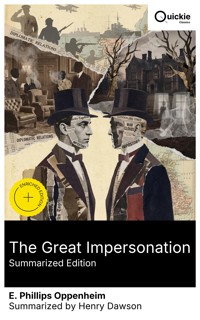
Set on the eve of the First World War, The Great Impersonation turns on a perilous exchange of identities: has Sir Everard Dominey returned from Africa reformed, or is he his German double, Leopold von Ragastein, sent to infiltrate English high society? Oppenheim's polished, brisk Edwardian prose fuses the doppelgänger tradition with invasion-scare espionage, moving from Mayfair salons to a haunted country estate. Elegant misdirection, clipped dialogue, and carefully staged revelations place the novel at the hinge between sensation fiction and the modern spy thriller. E. Phillips Oppenheim (1866–1946), hailed as the "Prince of Storytellers," transformed a merchant's cosmopolitan experience and voracious travel into more than a hundred thrillers. Attuned to prewar diplomacy, clubland rituals, and newspaper serial pacing, he crafted urbane intrigues where reputation and power trade hands. That preoccupation with social performance culminates here in a plot that treats identity as an asset subject to falsification, persuasion, and surveillance. Readers of Buchan, Childers, and early Greene will relish its taut construction and period atmosphere. Beyond its thrills, the novel offers a lucid lens on national paranoia and personal duplicity—an enduring study in how loyalty, class, and desire complicate the self. Quickie Classics summarizes timeless works with precision, preserving the author's voice and keeping the prose clear, fast, and readable—distilled, never diluted. Enriched Edition extras: Introduction · Synopsis · Historical Context · Brief Analysis · 4 Reflection Q&As · Editorial Footnotes.
Das E-Book können Sie in Legimi-Apps oder einer beliebigen App lesen, die das folgende Format unterstützen:
Veröffentlichungsjahr: 2026
Ähnliche




















The Great Impersonation (Summarized Edition)
Table of Contents
Introduction
At the nervy hinge between peace and catastrophe, The Great Impersonation turns identity into a weapon, asking how long a man—and a nation—can survive when allegiance, biography, and even the mirror’s evidence become tools in a shadow war, where a single face can open manor doors and cabinet rooms, where manners are passwords and silence a code, and where the smallest hesitation, the wrong reminiscence, or the unguarded glance can redraw borders, rupture households, and tilt a continent toward conflict while loyalty, love, and selfhood flicker under the pressure of disguise.
Published in 1920, E. Phillips Oppenheim’s novel stands as a classic of the spy thriller, locating its drama in the uneasy calm just before the First World War and following the consequences across country houses, London clubs, and the corridors of influence. Oppenheim, a prolific British writer of popular intrigue, shaped public appetite for tales of espionage and diplomatic maneuver during the early twentieth century. The Great Impersonation fits that lineage while sharpening it: the stage is recognizably Edwardian, the stakes unmistakably geopolitical, and the machinery of suspense powered not by gadgets or brute force but by social ritual, rumor, and a cultivated poise.
In a remote African outpost, two men meet who could be reflections of each other—one a worldly German officer, the other an English gentleman estranged from respectability—and an audacious plan takes shape that leads back to Britain. When a familiar figure steps into English society after years away, old acquaintances, wary officials, and intimate rivals must decide whether to welcome a prodigal or watch a saboteur. Oppenheim layers this setup with measured revelations, courtly conversations that double as interrogations, and sudden shifts of vantage. The novel invites readers to doubt every assurance, while rewarding attention to gesture, etiquette, and implication.
The prose favors precision over ornament, with crisp scenes that move from veldt to village to drawing room without fanfare, building suspense through contrast and restraint. Dialogue carries as much weight as action; people test each other with pleasantries, and the smallest social misstep can trigger alarm. The tone is urbane, tinged with menace, attentive to the choreography of servants, titles, and protocol that define who belongs. Yet the book is not merely mannered; it is driven by a steady acceleration of stakes, by the risk that a mask might slip in public, and by the ethical cost of duplicity.
Identity, in these pages, is both personal and political: Oppenheim shows how class markers, schooling, and accent can function as camouflage, and how national myths shape the roles people play. The novel explores loyalty under pressure—loyalty to country, to companions, to a past that may be shameful or invented—and pairs that with the intoxicating power of reinvention. It probes the seductions of privilege, the susceptibility of elites to flattery and fear, and the way institutions can be navigated by anyone fluent in their rituals. Above all, it interrogates whether truth can survive when performance becomes indistinguishable from reality.
Readers today will recognize the novel’s obsessions in contemporary debates about disinformation, deepfakes, and the ease with which identity can be forged and leveraged. Its vision of influence operations carried out through conversation, gossip, and access rather than spectacle feels startlingly current. The story also examines the psychological toll of sustained pretence, anticipating modern thrillers that treat espionage as a form of intimate theater. By tracing how reputations are manufactured, and how memory can be manipulated by those who speak with sufficient confidence, The Great Impersonation offers a bracing reminder that democracies and relationships alike depend on discerning audiences.
Approach this novel as both entertainment and artifact: a sleek, tightly wound story from the early twentieth century that still teaches how suspense can be built from manners and motive. Let its uncertainties work on you; the book is careful to keep crucial questions open and to allow competing interpretations to coexist until events force a reckoning. For new readers of Oppenheim, it provides an accessible entry into prewar espionage fiction. For seasoned fans, it remains a model of controlled tension, reminding us that the most dangerous agents may be those we invite into our homes.
Synopsis
E. Phillips Oppenheim’s The Great Impersonation (first published in 1920) opens in the African interior, where a disgraced English baronet and a formidable German aristocrat-soldier recognize their uncanny physical resemblance. The Englishman has fled debts and scandal; the German, sophisticated and purposeful, carries his nation’s ambitions on the eve of European upheaval. Amid heat, isolation, and rivalry, they measure each other’s character, comparing training, manners, and weaknesses. From this charged encounter emerges a perilous idea: one man might return to England wearing the other’s identity. The proposition promises redemption or strategic advantage, but it also invites moral peril and mortal risk.
Months later, an apparently reformed Sir Everard Dominey appears in London and at his neglected rural estate, composed, sober, and unnervingly competent. Society greets him with curiosity and doubt, remembering a violent episode, the disappearance of a rival, and his wife’s subsequent breakdown. The estate’s dark wood, whispered to be haunted, embodies the unresolved past. Servants, neighbors, and old acquaintances scrutinize the newcomer’s voice, gait, and habits, searching for reassurance or betrayal. He undertakes repairs, pays debts, and rehearses memories, building credibility piece by piece. Whether he is a chastened prodigal or a supplanter remains uncertain, lending every gesture layered tension.
In the capital he navigates drawing rooms and clubs where politics, commerce, and intelligence mingle. Courted by influential figures, he cultivates an image of patriotic steadiness while quietly assessing who watches whom. Across the Channel, powerful interests expect cooperation; a network of discreet intermediaries conveys requests for information and access. The returning gentleman manages encounters with practiced tact, avoiding commitments that could expose him. Meanwhile, he resumes his duties as a landowner, attempting to soothe his fragile wife and restore order at the estate. The domestic task mirrors the national one: calming fear, challenging superstition, and proving reliability.
Threats to his constructed identity soon arrive in the form of people who knew the German officer too well. A cosmopolitan woman, once intimately connected to that past life, recognizes mannerisms that society cannot see and presses him with private reminiscences. A cool strategist of clandestine operations demands concrete service and offers protection, treating the English estate as a forward base. Their tests are meticulous—probing language, reflexes, scars, and preferences—and their stakes are lethal. To survive, he must outwit those who would claim or expose him, even as he maintains credibility with British acquaintances whose suspicions are quietly awakened.
At the estate the psychological menace gathers. The vanished adversary from years before is said to stalk the perimeter; cries are heard by night; the wood exerts its sinister pull. The baronet’s wife lives under the shadow of that trauma, torn between terror and the hope that her husband’s transformation is genuine. The returning man confronts locked rooms, half-remembered incidents, and villagers’ lore, aware that any misstep could dissolve his cover. His measured kindness—ordering renovations, restraining servants’ gossip, arranging medical attention—begins to restore calm. Yet every improvement sharpens the central question of identity and makes the reckoning inevitable.
The espionage thread tightens as clandestine meetings, forged credentials, and financial channels converge on a strategic enterprise aimed at weakening Britain’s defenses. Information about armaments, shipping, and industrial capacity becomes currency, and the man at the story’s center is tasked with facilitating a pivotal operation. British officials, discreet rather than flamboyant, test him with responsibilities that would unmask an enemy or validate a loyal subject. Shadowing, countersigns, and traps proliferate. London’s bright salons and the countryside’s misty lanes host the same chess match, in which a single slip—of accent, memory, or motive—could shatter a persona and decide a nation’s safety.
Oppenheim fuses country-house gothic with prewar spycraft to explore duplicity, belonging, and the possibility of reinvention. Without disclosing the final revelation, the narrative moves toward a decisive unmasking that entwines the haunted wood, the fragile marriage, and the clandestine network’s final gamble. The novel’s enduring appeal lies in its elegant suspense and its portrait of a society sensing catastrophe while clinging to ritual and rank. Its doppelgänger premise, moral ambivalence, and measured social observation influenced later espionage fiction, demonstrating how intimate psychology and public danger can inhabit the same face. The story endures as a study in identity under pressure.
Historical Context
E. Phillips Oppenheim's The Great Impersonation appeared in 1920, speaking to British and American audiences processing the aftermath of the First World War while revisiting its prewar prelude. The story is set in the late Edwardian period, on the brink of 1914, shifting between London's political heart, the corridors of diplomacy, and an English country estate, with an opening in German East Africa. Institutions such as the Foreign Office, the aristocracy's social clubs, and Britain's emerging intelligence services provide the framework. Already a prolific purveyor of diplomatic intrigue, Oppenheim harnessed public fascination with espionage to examine loyalty and national character amid glittering stability and mounting international strain.
Britain's tense relationship with Imperial Germany frames the novel's atmosphere. From the 1898 and 1900 German Naval Laws to HMS Dreadnought's 1906 debut, an escalating arms race transformed European diplomacy. Public anxiety peaked in 1909, when newspapers championed the slogan 'We want eight and we won't wait', pressing for more capital ships to counter Admiral von Tirpitz's fleet program. Kaiser Wilhelm II's Weltpolitik and colonial ambition deepened suspicion, while the 1904 Entente Cordiale and the 1907 Triple Entente aligned Britain against Berlin's alliances. Oppenheim situates intrigue within this real contest for sea power, prestige, and security that made prewar society feel prosperous yet precarious.
Fears of covert enemies found institutional form in Britain's modern intelligence apparatus. The Secret Service Bureau was created in 1909, with a Home Section led by Vernon Kell (later MI5) and a Foreign Section under Mansfield Cumming (later MI6). Parliament strengthened secrecy laws through the Official Secrets Act of 1911, criminalizing unauthorized disclosures and espionage. Popular newspapers amplified rumors of German agents, encouraging vigilance but also sensationalism. Oppenheim draws on this environment: embassy receptions, discreet club rooms, and government offices become plausible settings for surveillance and counterintelligence, reflecting how prewar Britain balanced civil liberties, social openness, and intensifying state concern over clandestine threats.
The novel's opening in German East Africa evokes the imperial world created by the Scramble for Africa. Before 1914, Germany administered colonies in East Africa, Southwest Africa, Cameroon, and Togo, competing with British and French interests. German East Africa's administration, commerce, and settler communities—linked by railways and steamship lines—brought European rivals into daily contact. During the war, the region became famous for General Paul von Lettow-Vorbeck's guerrilla campaign, though Oppenheim's emphasis is prewar. By invoking colonial frontiers and resource-rich interiors, the book taps the period's fascination with overseas wilderness, ethnographic encounters, and the way imperial peripheries could serve metropolitan intelligence and rivalry.
Setting large portions of the action in an English great house and London clubs, the novel rests on Edwardian social architecture. The landed gentry still exercised political influence, and country estates functioned as venues where ministers, diplomats, financiers, and aristocrats mixed. The constitutional crisis of 1909-1911, culminating in the Parliament Act that curtailed the House of Lords' veto, highlighted tensions within Britain's ruling class. Simultaneously, contentious debates over Irish Home Rule and suffrage agitated public life. Against this backdrop, Oppenheim shows how ceremony, hospitality, and discretion in elite spaces could conceal bargains, loyalties, and vulnerabilities with national consequences.
Oppenheim wrote within a well-established tradition of British invasion and spy fiction that predated the war. Erskine Childers's The Riddle of the Sands (1903) presented German naval threat through amateur sleuthing and meticulous geography, while William Le Queux's The Invasion of 1910 (1906) stoked popular fear via Daily Mail serialization. Such works normalized the idea that foreign agents might infiltrate coasts, cables, and drawing rooms. By 1911-1913, 'spy fever' animated headlines and stage melodramas. The Great Impersonation adopts these conventions—cryptic meetings, hidden loyalties, and coded messages—yet grounds them in recognizable institutions and a Europe sliding, inexorably, toward diplomatic breakdown and war.
Published after the armistice and the 1919 Treaty of Versailles, the novel met an audience steeped in wartime propaganda and secrecy. Britain's War Propaganda Bureau at Wellington House (from 1914) and the Ministry of Information (1918) had cultivated narratives of vigilance against subversion. At home, the Aliens Restriction Act of 1914 and wartime regulations normalized scrutiny of foreigners and correspondence. Oppenheim's long-standing popularity—he had produced scores of diplomatic and crime tales—meant readers expected swift plots reflecting recent anxieties. By resetting tensions to 1913-1914, he offered catharsis and clarity: the enemy was identifiable, loyalties testable, and national service a dramatic imperative.




