


Erhalten Sie Zugang zu diesem und mehr als 300000 Büchern ab EUR 5,99 monatlich.
- Herausgeber: Al-Mashreq eBookstore
- Kategorie: Gesellschafts- und Liebesromane
- Sprache: Englisch
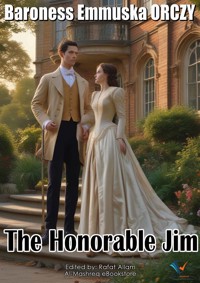
The Honorable Jim is a lively romance of honor, loyalty, and second chances. It follows Jim, a young English gentleman whose charm and impulsive nature often get him into trouble, yet whose heart remains true. When scandal threatens his reputation and love seems beyond reach, Jim must prove that beneath his lighthearted exterior lies courage, honor, and devotion. With Baroness Orczy's signature blend of romance, wit, and high society drama, the novel unfolds as both a redemption story and a celebration of steadfast love. Jim's journey from reckless youth to honourable man offers readers a tale of hope, growth, and the enduring power of character.
Sie lesen das E-Book in den Legimi-Apps auf:
Seitenzahl: 398
Veröffentlichungsjahr: 2025
Das E-Book (TTS) können Sie hören im Abo „Legimi Premium” in Legimi-Apps auf:
Ähnliche


















The Honorable Jim
Table of Contents
The Honorable Jim
Foreword
Book 1 - The Night Before the Storm
Chapter 1: A Family Affair
Chapter 2: The Wedding Day
Book 2 - The Storm
Chapter 3: The Roll of Thunder
Chapter 4: Chance Eavesdropping
Chapter 5: The Spy
Chapter 6: A Debt of Honor
Chapter 7: Naseby
Chapter 8: Thou Shalt Not Kill
Book 3 - The Aftermath
Chapter 9: The Spell of Broughton
Chapter 10: Blood Money
Chapter 11: Memories
Chapter 12: The Bargain
Chapter 13: The Cataclysm
Chapter 14: Sunset
Chapter 15: Looking My Love
Chapter 16: The Inevitable
Chapter 17: The Scarred Hand
Chapter 18: Heart o’ Mine
Chapter 19: A Life for an Ideal
Chapter 20: Let ’Em Come
Chapter 21: The Passing of the Storm
Epilogue
Landmarks
Table of Contents
Cover
Foreword
I have often wished to tell of those three—the woman, and the two men—playmates, enemies, lovers in turn—but my great difficulty was to get at the truth. It seemed well-nigh impossible to attempt the isolation of the one sentimental thread from the tangled skein of passions and of hate which seventeenth century England hath flung to us out of the whirlpool of civil war and of bitter strife.
Indeed, had it not been for the unremitting patience of my kind friend, Lord Saye and Sele, I doubt if the present chronicle of the adventures of his romantic forebear would ever have been written. In the midst of the modernisms and aggressive realism of to-day the life and doings of James Fiennes appear intangible, ununderstandable, a mere creation of fancy.
But at Broughton Castle where he lived, it is different. There between the splendid grey walls in the stately halls, and along the labyrinthine passages, the intriguing personality of the Honorable Jim at once loses its dream-like quality. In his own old home James Fiennes at once becomes Jim—a real Jim—alive! Oh! Very much alive. And not only he, but Mistress Barbara, and Squire Brent, General Fairfax and Colonel Scrope, they all live at Broughton Castle, as they lived three hundred years ago. Nay! One soon becomes conscious there that they are the real people, and we but puppets and shadows, that only haunt by sufferance those same historic places which are their own inalienable property.
The old pile rings now as it did then with the clash of arms and the jingle of spurs: the stones echo the clatter of horses’ hoofs, the champing of bits, the trumpet-blast, the roar and bombilation of men who are preparing to fight. And the lazy waters of the moat are gently stirred by the clap of oars wielded by unseen, but very real hands. And in June when the crimson roses emblazon the grey walls with vivid splashes of colour and the water-lilies mirror their white corollas in the moat, it is, in very truth, fair. Mistress Barbara, who wanders silent and thoughtful along the gravel-walks of the old-fashioned garden; she who gathers an armful of lilies to set in the big crystal bowl in the old Tudor hall: it is the man with the scarred hand, the mysterious haunter of the great castle who watches her movements from behind the clipped yew hedge, or who glides into the water like some amphibious monster and is lost amongst the reeds again. They are the real people who live at Broughton Castle and we are but the shadows: watchers permitted to gaze upon the moving pictures of their lives.
Book 1 - The Night Before the Storm
Chapter 1: A Family Affair
1
Lord Saye and Sele at Broughton Castle and Squire Brent over at Stoke Lark were still bosom friends when King Charles I came to the throne. They had been at University together, done a tour on the Continent together, and had not yet begun to quarrel over politics, King’s rights, rights of Parliament, illegal taxation and what not. These things were still in their infancy. Prophets said that the air was sultry, croakers added that things could not go on as they had begun, and pessimists concluded that sooner or later a devastating storm would break over this fair land of England, and then only God would know when it would stop and what havoc it would wreak.
But that was still for the future. For the nonce Lord Saye and Sele was content to express his advanced views and to call his old friend a fossil, or King’s lacquey, by way of a jibe, whilst Squire Brent retaliated by alluding to his lordship—always in good part of course—as “that damnable traitor.” But after a heated argument, wherein neither side succeeded in convincing the other, they would finish their bowl of punch together and part the closest of friends.
Lord Saye and Sele had married early—his wife was a Temple of Stow—and when his first boy was born he named him James and vowed that he should wed old Brent’s daughter, whenever that pliant King’s courtier decided to marry in his turn. Now every one in the country knew that when my Lord Saye and Sele set his mind on anything, sooner or later he would have his way. And sure enough the self-same year that Jim was born, Squire Brent did marry the daughter of Master Lame, the wool-prince of Fairford and with her obtained a mightily rich dowry. “Unto him that hath shall be given,” say the Scriptures, and therefore no one could find fault with the fact that the Squire being a wealthy man should wed a wealthy wife.
Of a truth my Lord Saye and Sele was the last to find fault with such an ordination of Providence. His boy Jim was a fine, healthy lad; he would one day be Viscount Saye and Sele, holder of one of the most ancient peerages in the country; he would own Broughton Castle, which had oft extended hospitality to Kings and Queens, but he would not have a deal of money. The future heiress of Stoke Lark, on the other hand, would own broad and vast acres in Oxfordshire and Northamptonshire and a heavy purse well-lined by her plebeian grandfather. And what could be more desirable I ask you than the alliance of an ancient name to a well-filled purse?
But it has been an acknowledged fact throughout the history of mankind that the best laid schemes of men do more often than not “gang agley.” And so it was in this case. Squire Brent married and became passing rich, but his poor wife died from the effects of a hunting accident before she had succeeded in presenting her lord with the future lady of Broughton Castle. It is a fact that Lord Saye and Sele was vastly upset at this untoward event: not only did he join in his friend’s grief, but he did not like Fate thus to interfere with his private schemes. He had set his heart on Jim marrying a rich heiress and bringing wealth and broad acres to the family name and he wanted to make sure that this wish would become an accomplished fact as quickly as may be. The betrothal was to have taken place as soon as the heiress was born, the marriage as soon as the bride reached the age of thirteen. It was unthinkable that such well-laid plans should all at once come to naught.
But not in vain did my lord Saye and Sele bear the reputation of a man who always knew his own mind, and always had his own way. Within twelve months of the death of Mistress Brent, he had persuaded his old friend the Squire that solitude and childlessness were very bad for any man, and that there were any number of comely female children in England, daughters of great families who had more than a quiverful, who were waiting to be legally adopted and by the stroke of a pen transformed into heiresses by wealthy and lonely widowers throughout the country.
So long and so persistently did my lord Saye and Sele counsel and argue, so much did he talk of the patter of tiny feet to liven the loneliness of Stoke Lark, that Squire Brent presently did feel the stirrings of a vague desire for young company, some one to cheer him presently, when old age came creeping on, and that he began to look about him for a suitable female child of rank whom he could adopt and in the course of time make his heiress.
His choice fell on the youngest of the four daughters of Sir Edward Cecil, Baron of Putney and Viscount Wimbledon, who was a near kinsman of his by marriage. The father had in truth a quiverful already, and would be hard put to it to find suitable dowries for all his daughters; he was therefore mightily pleased at this good fortune which would befall his little Barbara Frances then aged eleven months.
The lawyers were got to work and the deed of adoption was duly executed and signed. Little Mistress Barbara Frances Cecil became by the law of the land Barbara Frances Brent, the apple of her new father’s eye, and in due course, she being then a year and a half old, was betrothed, as was the custom of the time, to the Honorable James Anthony Fiennes, aged six and a half.
And on the 8th of June, 1638, those two were married at Ilmington Church, Mistress Barbara Frances being then thirteen and her new lord and master in his eighteenth year.
Chapter 2: The Wedding Day
1
Barbara Frances—or Babs as she was called by her doting father—felt that her wedding day was going to be the most miserable day she had ever spent in the whole course of her life. She woke up feeling wretched; for a few hours she had forgotten all about everything, for she had slept as soundly as ever she had done, but when she woke the whole thing came back to her with such forceful reality that she just sat up in bed and cried, hoping that nurse was still asleep and would not see her crying.
She was only thirteen—poor little Babs—and she hated the idea of being married. She liked Jim well enough when he was in one of his good moods, for then he would ask her to go roaming about with him in the woods and he would show her where the butcher-bird had his larder or where the tiny owl-fledglings had just opened their funny, big round eyes. In those days Jim was quite wonderful, he knew every bird-note, and always could put his hand on a nest. But at other times he would be sulky and silent—not speak for hours—and when he did open his mouth it would be to quote poetry, which either he had learned by heart or else declared—which Babs never believed—that he himself had written.
Then he had no notion of play, called hide-and-seek silly and vowed that girls bored him, because they had voices like shrikes which they used whenever a mouse or a spider or some other harmless little creature came in sight. He was also given to laughing at Babs over her love affair with Tubal, a matter about which Babs’ thirteen-year-old dignity was highly sensitive, and he had once told her in the course of wordy warfare between them over the merits and demerits of Tubal as a man and a swain, that when she was Mistress Fiennes she would have to Honor and obey her husband, and if he insisted that she should give up her intercourse with Tubal, who was not even a gentleman by the way, why, then she would have to obey, because all wives had to swear before God that they would obey their husbands in all things. And at the idea of obeying any one Babs’ whole soul rose in revolt. She had never done it in all her life. Left motherless almost as soon as she was born, then transferred to the loving care of an adopted father, who idolised her, Babs had ruled as a veritable little queen both at Stoke Lark and at Broughton Castle, where she was a constant little visitor. Everywhere her will had been law, and with the exception of Jim Fiennes she counted on twisting any and every man round her little finger. How then could she think of obeying that one exception to her golden rule? She could not. As for giving up Tubal, who loved her, she told Jim quite plainly that she would sooner die; whereat Jim laughed and became more odious than ever. And now the dawn had actually broken on this the last day of her sovereignty, of her independence, the last morning that she would be called Mistress Barbara Brent. After twelve o’clock to-day she would be Mistress Fiennes! How horrible!
Now was it not a shame to spend this last glorious morning in bed, just when the wild roses were thickest in the hedgerows beyond the pond and the meadowsweet was fragrant by the water’s edge? Just when the blackbird set up a singing and a whistling that was nearly deafening, and Dina, the little black and white spaniel, was yapping away for dear life down below?
A minute later Barbara was out of bed and clamorously demanding to be dressed.
“Impossible, Mistress Barbara!” nurse protested. “It is but six o’clock, and when I dress you anon, ’twill be in your wedding gown.”
“I will be dressed at this very instant and minute,” the little tyrant of Stoke Lark declared, “and in my blue woollen gown and leather shoes, so that I can go and have a last romp in the garden with Dina.”
Of course Babs had her way—she always had—and half an hour later she was running down the steps from terrace to terrace and then straight across the park, with Dina paddling at her heels.
Just on the other side of the boundary walls that enclosed the park there was a cottage; thatched and creeper-clad, with a garden around it all ablaze just now with wallflowers and forget-me-not. There was a low palisade around the garden, the gate of which was on the latch. Babs stood awhile beside the gate; then, stooping, she picked up a handful of gravel and threw it against one of the windows of the cottage, the one just above the porch.
Then she ran away. Nor did she halt until she came to the ornamental lake which was in the lower garden, in full view of the big house. Then she paused and looked at the house; not with a view to admiring its magnificent proportions and architectural beauties which were very great, but merely to glance—with an obviously contemptuous expression—at the windows of Jim’s room. He and his brothers and my lord Saye and Sele and her ladyship, and several other guests, including Babs’ own father and brothers, had arrived the day before at Stoke Lark, and Babs knew that Jim had the small corner room in the left wing, the one with the narrow pointed windows, the casement of which was wide open. Just for the space of a few seconds Babs hesitated. Jim could be very useful on occasions, for he always knew just where the missel thrush had built her nest, or how many fledglings the grey tit had hatched out. In that way he was more useful than Tubal, who preferred to fish for tadpoles and who was apt to break the eggs whenever he found a nest.
But Tubal was worth two of Jim as a playmate, for, though Tubal was older than Jim by a whole year, he was Babs’ slave and he would dance to her piping just like a great overgrown bear. Why didn’t Tubal come? She had called him by throwing the gravel against his windowpane. Babs wanted a playmate on this fine morning, the last she would enjoy before she became a wife; after that the days of play would be over. Somehow the thought of Jim had spoiled the morning. Babs felt out of tune with everything now—the whistling of the blackbird irritated her, Dina was tiresome and the wild roses out of reach. She sat down distinctly morose and peevish on the trunk of the old willow tree that overhung the pond, and she was just settling down to a good cry when suddenly there was Tubal, hot and breathless, having jumped into his clothes and run as fast as he could all the way from the cottage. His black hair was all tousled, and no doubt that he had not even stopped to wash his face, but Babs liked him all the better for the haste with which he had come when she called. He knelt down in the dewy grass beside her and put his arms around her shoulders. “Babs!” he murmured and she could see that he was crying. “Babs, darling! I shall surely die!”
Babs, being thirteen years old, felt thrilled at this heroic declaration. She knew quite well what Tubal meant when he said that he would die. Tubal was in love with her—so deeply in love that after to-day when she would be married to Jim he would not care to go on living. Babs felt very grown up and very important, conscious of her beauty, which had wrought such havoc in the poor lad’s heart. She felt like the princess in all the fairy tales that had ever been invented.
Tubal was the son of Master Longshankes, a yeoman farmer who lived at Shutford, a fine Manor House on my Lord Saye and Sele’s estate; therefore as Jim was wont to repeat so often and so spitefully, Tubal was not a gentleman. But his learning was wonderful and his gratitude to Lord Saye and Sele positively touching. My lord, in truth, had been passing kind to Tubal, for Tubal’s mother had been Lord Saye and Sele’s devoted nurse through a long and painful illness—indeed the physician had declared at the time that it was her devotion that had saved his life. Be that as it may, my lord requited that devotion by unremitting kindness to Tubal. He sent him to Reading grammar school and kept him there for nigh on six years, and Tubal being diligent and clever became a learned and accomplished scholar, versed in Latin and in music—ay! even in theology.
But no amount of learning or education could turn the son of Master Longshankes into a gentleman, and, that being so, he never, never could have aspired to the hand of the gentle heiress of Stoke Lark. But that made his love all the more romantic, since the poets have always sung the praises of hopeless passion. Whenever Babs went to Broughton Castle, Tubal lived only for her, for her entertainment, for her will and pleasure. He did not care how much he was ridiculed, or snubbed, or chided, and he took Jim Fiennes’ sarcastic jibes with the heroism of a martyr.
Babs loved him as much as she feared Jim—she did fear Jim a little—and when the day of her wedding was fixed she insisted that Tubal should come to Stoke Lark and see the last of her—since after she was married she might never be allowed to see him again, and to love Tubal once she was married to Jim Fiennes would be committing adultery and incurring the wrath of God. So Tubal was allowed to come to Stoke Lark for the wedding, and he lodged in the house of Master Topcoat, who was bailiff to Squire Brent and lived in the creeper-clad cottage outside the gates of the park, and at Babs’ call he had come out without stopping to wash his face in order to bid the lady of his dreams an eternal farewell. Soon Babs too was crying and swearing that whatever happened—adultery or no—her heart would always remain true to Tubal and she would always hate Jim Fiennes and never, never—she swore it most solemnly—would she allow him to kiss her.
And all the while Dina, with her ears flapping and her silky hair blown about by the breeze, was pretending to catch flies.
2
All of a sudden there was a tragedy. Some thirty yards from the willow tree where Babs and Tubal were sitting Dina had discovered a wasps’ nest, and the wasps had discovered Dina. In the instant they were buzzing around her, one of them had already stung her on the nose, the others were loudly clamouring—in the way that wasps and gnats and such like creatures have—trying to find a spot on poor little Dina’s body where her long hair would not be in the way of a comfortable sting. Dina, realising her danger, had quickly enough turned tail and was flying like the wind; unfortunately, however, she was running with the wind and not against it, and the wasps were buzzing round her, threatening what would certainly have meant death. Babs was the first to see the impending tragedy. She woke from her love-dream to see her dear little Dina surrounded by a thousand enemies who were intent on her destruction. Babs gave an agonised cry for help and jumped to her feet. Tubal did the same, but he did not scream. Indeed he did not lose his presence of mind; being a country-bred lad he knew the danger that would threaten any one who attempted to interfere on Dina’s behalf. Indeed what was a dog’s life worth under the circumstances? One might rush to its assistance and be blinded for life for one’s pains.
Therefore Tubal, self-possessed and cautious, took Babs by the hand and said with the authority of his nineteen years:
“Come, Babs. You will do no good by screaming and the dog is past help already.”
He was so strong and masterful and he held Babs so tightly by the wrist that she was forced to follow him. The whole thing had happened in far less time than it takes to tell. Babs felt miserable and helpless and, when Tubal ran on towards the house, she continued to run after him, even though he no longer held her by the wrist. But her heart ached for Dina and at one moment, like Lot’s wife, she looked back.
The scene had suddenly changed. There was Jim Fiennes—come Heaven knows when and whence—but there of a certainty, and at the very moment that Babs turned to look, she saw him stoop, pick up the dog, and, with it in his arms, run, as fast as any human creature could run, towards the lake. Babs had come to an abrupt standstill; she had not even the time to utter another scream, for the next instant Jim had taken a plunge and he and Dina disappeared beneath the water.
The next second he reappeared—that is to say his head emerged above the water and his hands holding up Dina. Babs at once started to run back towards him, but he shouted to her not to stir.
“Keep still on your life, Babs!” was what he said. “The brutes have lost us and will presently settle down.”
Babs thereupon came to a halt; indeed she had already found running difficult; her little knees were shaking under her, her hands felt clammy and her head hot. Tubal was some distance off at the top of the terrace steps. He probably had not an idea of what had happened, nor that Babs was no longer with him. But he must have heard Jim’s voice, for he turned at once and shouted to Babs to come.
But she did not move; she just stood and stared at Jim’s head with his hair all flattened round his head and dripping into his eyes and at Dina, whom he was holding out of the water and who looked for all the world like a big rat. And all at once she was seized with an uncontrollable desire to laugh. She sat down upon the wet grass and laughed and laughed till her sides ached and her temples began to throb. She had never seen anything quite so funny as Jim looked at the moment.
After that she did not exactly remember how it all happened. Presently she saw Jim wading out of the pond, with the water pouring away from his clothes. He had Dina under one arm and as soon as he reached the bank he flung her on the dry ground, cursing her for a “spiteful little brute,” which at once roused Babs’ indignation. She had thought at first to go up to Jim and perhaps help him to get safely on to the bank, but he was so horrid about the dog that she hardened her heart against him. Poor little Dina. What was the good of saving her from the wasps, only to risk her life by flinging her about like a bale of goods? Forgetful of Jim, Babs was fondling her dog, who, after shaking the water out of her hair and scattering showers about her, appeared ready for another adventure.
Then Tubal came running along and with his big, warm hands he rubbed Dina’s hair and stroked her ears because, as he said, there was nothing so dangerous as moisture in a dog’s ears; it produced canker, which was very painful and almost impossible to cure. Oh! he was marvellously thoughtful and Babs felt tears of gratitude come to her eyes whilst she watched him being so kind and gentle with the dog.
“I think,” he said after a while, “if I were you I would take little Dina back to the house now and have her thoroughly dried by the kitchen fire.”
Babs’ tears choked her, and she could only nod, smiling through her tears while Tubal fondled and patted the little creature with marvellous gentleness. It was most unfortunate that Dina, not realising how kind Tubal was being to her, should have chosen that very moment to turn on him and snap at him; indeed she bit him very severely in the left hand and the blood began to flow freely from the back of it. Babs had a tiny lace handkerchief in the pocket of her gown; she had it out in a moment and tied it round Tubal’s poor wounded hand. But what a contrast to Jim’s savage, unreasoning fury against the poor, innocent little dog. Tubal never uttered a word of complaint and never as much as slapped Dina; he just turned away from her, and when his wound, though tied up in a gossamer rag, continued to bleed, all he did was to drop on one knee and kiss Barbara’s hand.
“This handkerchief,” he vowed, “shall lie next my heart until I die.”
It really was beautiful! Babs watched Tubal’s tall figure till he was out of sight. Then only did she turn to look at Jim. He was lying flat on the bank, face downwards, and he kept on dipping his hands alternately in the water and then holding them up to his face. Barbara felt a twinge of remorse. Jim had risked being stung by the wasps even if he was unkind to Dina afterwards, and it had been cruel of her to laugh so, when first she saw his head bob up so funnily out of the water, so she went up to him and called him by name, quite gently, and when he didn’t say anything she knelt down beside him.
“Jim!” she called to him again.
He turned over on his back and then looked up at her; she almost screamed with horror: his shirt was stained with blood, one of his eyes was closed with a great swelling above it, his nose was shapeless, and he had a lip as thick as her thumb.
“Jim!” Babs cried again, full of remorse now and of pity, and threw her arms round his neck. “You’ve been stung!”
Quietly he disengaged his neck from her arm, then he pulled himself up to a sitting position and deliberately started taking off his shoes and turning the water out of them.
“Jim!” said Babs reproachfully.
“Well!” he queried in his slow way, but never once looked at her. “What is it?”
“You—you are hurt!” Babs said, and was ready to cry. “You’ve been stung whilst you—you—”
“Why, yes! I’ve been stung,” he said drily. “’Tis no use making a to-do about it. Go back to bed, Babs, and in Heaven’s name take that fool of a dog out of my sight!”
And that was the end of the incident. Obviously it was not for Babs to say anything more after that. She was—or rather had been—very grateful to Jim for what he had done. He had without a doubt saved Dina’s life—she was still very sorry that he had been so badly stung. But so had Tubal been hurt—badly hurt—a dog’s bite might turn to anything, and yet he had been so kind, so gentle, so chivalrous! But if Jim was going to be so spiteful about Dina, there was nothing more to be said. Wounded dignity only permitted the cold query:
“Is there anything I can do for you?”
Whereat he replied:
“No, thank’ee! I shall be all right.”
“I will ask Tubal to come back and look after you,” she said.
And I am sorry to have to put it on record that in answer to this amiable suggestion the Honorable Jim Fiennes actually swore:
“If you send that d——d fellow here, Babs,” he said, “I’ll—I’ll throw him in the pond.”
After which show of temper on Jim’s part what could Babs do but walk majestically away.
But here was a fine beginning for a wedding day!
3
Five hours later Babs, standing in her magnificent wedding robes by the side of Jim, might have thought that the whole incident had been nothing but a bad dream. She had one peep at his face as she went up the aisle of the church with Squire Brent and caught sight of her bridegroom waiting by the chancel steps. His face did not look quite normal; the features were still somewhat twisted, and the swelling on his lip had not quite gone down yet; it gave him such a funny expression that she was once more seized with a well-nigh uncontrollable desire to laugh. Fortunately, however, she did succeed in controlling herself, after which the solemnity of the proceedings reduced her to a state bordering on dreamland and all thoughts of Dina, of wasps’ nests and even of Jim and Tubal faded from her ken.
Ever after, the whole of that day—her wedding day—was as a nightmare to Babs.
She hated everything: the ceremony in the church, and the long sermon and the admonitions from old Mr. Jenkins which she did not understand. Then she hated her wedding gown. It was stiff and hard and uncomfortable. She could not have run in it if her life had depended on the swiftness of her movements, and when, just before going to church, she had wanted to throw her arms round the Squire’s neck, her huge padded sleeves had got in the way and that horrid corselet impeded her movements, and nurse, who was close by, at once said something about crushing her lace collar, or knocking off some of the pearls that adorned her satin skirt.
She hated the long, interminable meal which followed the marriage service, and all the guests who crowded round her, and who either kissed her or tweaked her ear, or patted her cheek, until she became quite giddy and everything that people said sounded so much gibberish in her ear. Above all she hated those long dull speeches, and all the noise that the guests made, and the wine she was expected to drink and the words of thanks she was expected to say, but which she invariably forgot. She could not eat properly, because the chair in which she sat was too high, because the horrid corselet pinched her and the starched collar tickled her, and because her hair had been pulled, and her shoes were too tight and, oh! because she wanted to scream and could not, and because she wanted to laugh and dared not.
From time to time she stole a glance at Jim; the swelling on his lip was certainly going down and his nose appeared quite normal again. But he took no notice of her; evidently he still felt wrathful with her because of Dina. Forsooth! As if Dina getting into a wasps’ nest had been her fault! Or was he still sulky because she could not help laughing at the time that his head came bobbing out of the water, with his hair all plastered around his face?
And then that awful banquet!
To Babs it seemed that it had lasted an eternity. At one time, in the middle of a terrible long speech from my lord Bladestone, she must have been asleep. The afternoon wore on—wearisome and interminable—through the huge bay-window immediately facing her she could see that the sun was slowly sinking toward Meon Hill.
No one now took any more notice of her. The little doll had played her part, she was no longer wanted; she missed Tubal horribly. Of course he had not been asked to sit at the table with his betters, nor could he be expected to mingle with the servants; Babs felt certain that he was eating out his heart and having no dinner out there in the creeper-clad cottage, whilst she was enduring a veritable agony of boredom and fatigue and longing for a sight of his dear face.
Her own father and Squire Brent and my lord Saye and Sele had started on one of their interminable political discussions as to the merits and demerits of His Majesty the King. Squire Brent and Sir Edward Cecil, being loyal subjects, naturally argued that the King could do no wrong; he held his crown by divine right and woe be to the traitor who dared to oppose him. At which my lord Saye and Sele openly laughed.
“The King,” he argued, “being a man and holding his crown by rights conferred on him by the people, should most undoubtedly be opposed if he abused those rights and used them in order to trample on the consciences and liberties of his people.”
Whereupon the arguments became fast and furious, some of the guests siding with Lord Saye and Sele, others loudly upholding Squire Brent’s views and vociferously proclaiming their loyalty to the King.
All of which after a while greatly wearied the youthful bride. Not that she did not understand what the subject was about; child though she was, she had been reared in loyalty to the King, and above all in thinking that whatever Squire Brent said and did was right and proper and quite beyond discussion. Wide-eyed she gazed on Nathaniel and John Fiennes, my lord Saye and Sele’s two younger sons; they did not hesitate to speak before their elders, and Nathaniel, who was two years younger than Jim, went so far as to declare that that traitor John Hampden—of whom Babs had been taught to think as of a devil incarnate—was a high-minded patriot for resisting the King’s unlawful demands for ship-money.
But Jim, though he was the eldest, said nothing at all. Every time that Babs had a peep at him he looked the same; his face was rather pale and his eyes partially closed; traces of the stings had almost vanished; but his face looked drawn and something about his whole attitude seemed mutely to be reproaching her, but for what she could not say. He took no part whatever in the discussion, and indeed he shrugged his shoulders and began whistling a silly tune when his younger brother John spoke with burning indignation of the King’s tyranny and the cruelties practised upon the martyred Lilburn, and he laughed loudly—just as if it were a huge joke—when Squire Brent, frowning with displeasure, brought his powerful fist crashing down upon the table till all the bumpers and dishes rattled and then said angrily, turning to Lord Saye and Sele:
“Take care, take care, my lord, that I do not rue the day when I gave my daughter’s hand to your son. An offence against the King’s Majesty, our sovereign lord by divine right, is in my sight like unto an offence against myself.”
Surely there was naught to laugh at in such a fine protestation of loyalty, and Barbara’s glance, which rested on her youthful lord and master, became one of wrath and contempt. Whereupon Jim lazily turned his head towards her and met her aggressively supercilious glance. It seemed, however, to cause him no manner of perturbation, only amusement; a merry twinkle lit up his somnolent grey eyes and suddenly he put out his arms and babbled half incoherently:
“Kiss me, Babs!”
An indignant exclamation escaped Barbara’s lips, and, throwing all dignity, all ceremonial to the winds, she jumped down from her chair, and before any one could stop her or inquire the cause of this extraordinary behaviour on the part of the bride she fled precipitately from the room.
Mistress Leake, her nurse, who had brought her up from babyhood and was always on the watch wherever Babs might be, or whatever she might do, followed her young mistress as quickly as she could. But already Babs had given her the slip, and was running, running as fast as her cumbersome clothes would allow her, out into the garden.
4
Half an hour later the bridegroom discovered his little bride sitting at her favourite spot, the slanting trunk of the old willow tree that overhung the ornamental lake at the far end of the terraced gardens—the scene of this morning’s adventure.
Urged thereunto by sarcastic speeches from his two brothers and finally commanded by his father and father-in-law to bestir himself, he had—apparently with reluctance—left the festive board and gone out of the room in search of his truant wife.
Babs saw him first as he stood for a moment at the top of the first terrace steps with his legs set wide apart and his hands buried in the pockets of his satin breeches. The whole length of the terraced garden lay between her and this boy whom she had begun to look on as an enemy. She had been very wrathful with him this morning when he was so unkind to Dina and so rough and rude to her—but ever since, after the religious ceremony, people had playfully spoken of him as her lord and master, she felt that she positively hated him. Now all that she wanted was to get away from him; so she gathered up her unwieldy skirt in her small hand and scrambled to her feet. For the space of two seconds she stood quite still, defying him in her mind, frowning at his approaching figure. For he had seen her now and came fast enough down the terrace steps, shouting to her as he came along.
Whereupon Babs started to run. She ran alongside the edge of the lake as fast as she could in her high-heeled shoes. She got hotter and more breathless; that horrid corselet nearly choked her, and once she got entangled in the folds of her gown and came down on her hands and knees on the soft muddy ground. She had had a good start at the beginning, but of course Jim had very long legs; though he did not run—Jim was always lazy—he seemed to cover a terrific deal of ground with those great limbs of his, and though he too had been decked out in wedding clothes, they did not hamper his movements as her own horrible hoops and skirts. And now he was fast gaining on her. Already he was shouting to her to stop. She was sure there was a note of command in his voice. He was already trying his ’prentice hand in the rôle of lord and master, expecting no doubt that she would obey him as she had sworn to do.
Babs came to a halt; not because she had been commanded to stop, but because she could not run any more. She who was as nimble as a young doe, as swift as a hare, was held in bondage by those abominable clothes. And the very next moment Jim was beside her. He still had his hands in his pockets and did not appear the least out of breath.
A while ago she had been quite sure that she had heard him shouting: “Babs! Babs! Stop!” She even thought that his voice had sounded hoarse and rough as if he were anxious or very cross. But now he stood in front of her quite, quite still, and Babs stood before him, proud and defiant. He looked down at her—strangely, she thought. The glow of the sunset was upon his face; it looked hot and flushed, and the unruly chestnut hair about his head had in it warm, ruddy glints. All traces of the wasp stings had certainly vanished; but his eyes she could not see, the heavy lids veiled them, and once or twice he passed his right hand across his forehead. The left hand he kept resolutely hidden from sight. Babs had often heard people say that James Fiennes would be quite nice looking if he had not such an obstinate self-willed look in his face; she herself had never paid much attention to his looks. But now she thought him positively ugly, for there was a mocking line round his mouth which she did not like.
No doubt that he was cross because she had given him a fright, but he was also laughing at her because she had been beaten in the race. Oh! he was positively odious!
She had come to a standstill because she simply could not run any more—not just for the moment. In a second or two she would start off again, away, away from Jim and from everybody else, even from her adopted father, who pretended to love her, and then just gave her away to this loutish, ill-mannered boy, just as if she were a bale of goods. She held her two hands against her breast, because the hammering of her heart well-nigh choked her.
Then all of a sudden Jim threw his arms round her and grasped her round the body so close, so close that she felt as if the last lingering breath was being pressed out of her, and she had not the strength even to struggle.
“Naughty Babs to run away like that!” he said. His face was quite close to hers, and very red and hot. Babs felt that she had never hated any one as she hated Jim at this moment.
“Kiss me, Babs!” he said, and in such an authoritative tone that the dignity of thirteen year old was outraged beyond hope of compromise. She shook her head vigorously, being still too breathless to speak.
“Kiss me,” he reiterated.
And she gasped out an emphatic “I won’t!”
Had she not sworn but a few hours ago that never, never would she allow Jim Fiennes to kiss her?
Whereupon he pressed his hot face against hers, and she felt a horrible burning sensation against her cheek, her eyes, her mouth.
She would have liked to scream, but was too indignant, too deeply humiliated to utter a sound. Some measure of strength returned to her and she fought and struggled with an energy equal to her pent-up fury. After a moment or two she succeeded in freeing herself, and once more started to run; not far this time, only as far as the very edge of the lake, there where the soft ground was already giving way; and the waters began to lap her feet just above her ankles. In fact she had to hold tightly onto a clump of strong reeds or she would have sunk knee-deep amidst the water-lilies. But even so Jim was already after her, stretching out his big, hot hands to seize her again.
“If you touch me again, James,” she said firmly, “I shall throw myself into the lake.”
All her excitement, her breathlessness had gone. She felt perfectly calm and quite sure of herself. If Jim attempted to kiss her again she would throw herself into the lake, and if he tried to jump in after her she would drag him down with her and hold his head under the water until he drowned. She hated him! Oh! how she hated him!
Already she felt herself sinking deeper into the mud. It was a horrible sensation, for though she knew how to swim, she had always, when she wanted to bathe, gone straight into the clear, deep waters of the mill-stream close by. This feeling of being sucked in by water-reeds and mud was awful and paralysing. But she did not flinch. She would drown before she allowed Jim to kiss her again. The glow of the sunset was no longer in his eyes; it came straight into hers, almost blinding her with its glory; and against the crimson and gold of the sky she saw his head like a dark patch with the unruly hair all about it; and what the expression of his face was at the moment she could not tell. He said nothing, however, and for a while she was conscious of nothing so much as of a great stillness above and around her, with the great crimson orb of the sun slowly sinking behind Meon Hill far away and outlining the myriads of tiny, fluffy, grey clouds in the sky with a blood-red glow.
Then suddenly Jim exclaimed:
“What a little vixen to be sure!” And he threw back his head and laughed; yes! laughed in that odious, sarcastic way of his, whilst she was slowly sinking into a cold and watery grave. He put out his hand to her, but though she knew that she would find it very difficult presently to wade out of the sticky mud, she waved his helping hand indignantly aside.
“Shall I send Tubal to get thee out of the pond?” he said without ceasing to laugh. Oh! was he not the most detestable creature on the face of the earth? Then as she preserved a haughty silence he just shrugged his shoulders, put his hands in the pockets of his breeches, swung round on his heel, and walked deliberately away in the direction of the house, leaving her to struggle out of her uncomfortable position as best she could.
She had stained her dress irretrievably, ruined her shoes and stockings and lost her beautiful lace cap; she had never felt so near crying since she was grown up, or so wretched or so hot or so wobegone. Jim had gone away whistling some silly tune; he was spiteful and she hated him. Fortunately he did not take the trouble to turn round and see how she was getting on, though once when she looked in his direction she thought—but no! she was surely mistaken: she hoped she was mistaken because, child though she was, she knew that she presented a pitiable spectacle and her feminine vanity urged her to go and hide herself somewhere where she could be quite sure no one would see her, or else to seek shelter in the arms of her adoring nurse. A moment or two later Jim had disappeared inside the house, and presently as if by magic Nurse arrived, and with many lamentations and not a few coaxings folded the frankly weeping Babs in her motherly arms, then carried her—consoled now and unresisting—to bed.




