


1,99 €
Mehr erfahren.
- Herausgeber: Quickie Classics
- Kategorie: Religion und Spiritualität
- Sprache: Englisch
The Kybalion distills modern Hermeticism into seven principles—Mentalism, Correspondence, Vibration, Polarity, Rhythm, Cause and Effect, and Gender—presented as tools for mental transmutation. Its lapidary, aphoristic prose alternates didactic exposition with catechetical recap, claiming descent from Hermes Trismegistus yet epitomizing the early twentieth-century occult revival. Relying on maxims like as above, so below, it elaborates crisp analogies and quasi-scientific metaphors, blending esoteric lineage with New Thought psychology and a popular metaphysics of lawful order. Published in 1908 under the collective pseudonym Three Initiates, the work is widely attributed to William Walker Atkinson, a prolific New Thought writer linked to the Yogi Publication Society. Trained in law and steeped in mental science, he used multiple pen names to circulate practical metaphysics; anonymity here heightens initiatory aura and didactic clarity. Chicago's vibrant milieu—Theosophy, Rosicrucianism, self-culture—shaped its synthesis and its promise that disciplined thought can shape fate. Recommended to students of Western esotericism, intellectual historians of self-help, and reflective practitioners alike, The Kybalion rewards close reading as a crafted bridge between ancient names and modern method. Read it not as a late antique relic but as a lucid twentieth-century primer whose elegant schemata invite application, critique, and experiment. Quickie Classics summarizes timeless works with precision, preserving the author's voice and keeping the prose clear, fast, and readable—distilled, never diluted. Enriched Edition extras: Introduction · Synopsis · Historical Context · Brief Analysis · 4 Reflection Q&As · Editorial Footnotes.
Das E-Book können Sie in Legimi-Apps oder einer beliebigen App lesen, die das folgende Format unterstützen:
Veröffentlichungsjahr: 2026
Ähnliche







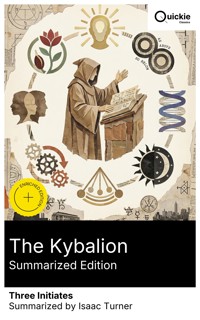
The Kybalion (Summarized Edition)
Table of Contents
Introduction
Between the restless currents of the human mind and the patterned order of the universe, The Kybalion proposes a disciplined way of seeing that promises to turn metaphysical insight into practical poise, asking readers to test whether reality is best grasped as a living continuum of principles rather than as scattered facts, whether causation, change, and duality can be navigated like tides instead of endured as accidents, and whether the ancient desire to know how things are made can coexist with the modern demand to make something of oneself in the world today.
Published in 1908 under the collective name Three Initiates, The Kybalion belongs to the early twentieth‑century current of esoteric and New Thought literature in the United States, presenting itself as a concise statement of Hermetic philosophy for modern readers. Rather than unfolding a narrative, it offers a systematic exposition of perennial ideas associated with the Hermetic tradition, framed for a popular audience at a moment when occult study, metaphysical healing, and self‑culture were gaining public attention. Its compact form and didactic posture situate it alongside handbooks and primers, yet its ambition is metaphysical breadth rather than sectarian doctrine.
The premise is straightforward: the text articulates a small set of governing principles and then illustrates how they apply across mental, physical, and spiritual domains, encouraging readers to consider both interpretation and application. The voice is authoritative without being scholastic, favoring taut definitions, examples, and reflective counsel over historical argument. The style is aphoristic and methodical, with a teacherly cadence that alternates declaration and clarification. The tone remains solemn but pragmatic, consistently returning abstract claims to matters of conduct, perception, and self‑regulation. The result is a brief, focused guide that reads more like a workshop in concepts than a treatise.
At its core, the book advances seven organizing ideas often treated as lenses: that mind underlies experience; that patterns recur across levels; that everything moves; that apparent opposites belong to a spectrum; that processes ebb and flow; that effects follow causes; and that generation permeates phenomena. Taken together, these themes treat reality as dynamic yet intelligible, inviting readers to convert passive observation into active equilibration. The emphasis is less on belief than on habit—how to think about change, contingency, and contrast so that confusion yields to orientation. Each principle functions as a handle, a way to grasp complexity without reducing it.
Contemporary readers encounter in these pages a portable framework for noticing patterns, managing inner weather, and situating personal effort within larger processes. In a culture saturated with data, distraction, and accelerating change, the text’s insistence on discernment, proportion, and rhythm can serve as a corrective to impulsiveness and fatalism alike. Its vocabulary differs from modern psychology or systems theory, yet its practical upshot—cultivated attention, measured response, and responsibility for one’s participation in causality—remains recognizable. The work’s persistence in occult and self‑help communities reflects not only curiosity about hidden lore but a desire for tools that organize experience without narrowing it.
Reading The Kybalion profitably means approaching it as both a historical artifact and a working manual. As a document of early twentieth‑century esotericism, it distills an effort to translate older metaphysical motifs into accessible, nonsectarian language; as a guide, it proposes exercises in reframing that readers can test against their circumstances. Its generality is deliberate: the principles are presented as flexible heuristics, not as technical proofs. This openness invites comparison with other traditions without requiring allegiance. The book rewards slow, iterative reading, in which claims are held up to experience, and techniques are measured by their steadiness, not their novelty.
What finally distinguishes The Kybalion is the way it treats existence as educable: if the universe exhibits order, then the mind can learn to cooperate with it without surrendering initiative. That wager—neither credulous nor cynical—gives the text its enduring poise. It does not ask readers to retreat from the world but to move through it with more finely tuned instruments, balancing perception with practice. For newcomers to esoteric philosophy and for veterans seeking a lucid refresher, this compact work offers a vocabulary for coherence at a time when coherence is scarce, and a discipline for agency when agency is contested.
Synopsis
The Kybalion, published in 1908 under the collective name Three Initiates, presents a concise introduction to Hermetic philosophy. Framed as a practical teaching, it arranges its material around seven general principles said to govern phenomena on physical, mental, and spiritual levels. The text positions these ideas as a method for interpreting experience and cultivating self-mastery, proposing a synthesis that speaks to religion, philosophy, and science without requiring adherence to any sect. Its stated aim is to provide a workable key: a way for students to read patterns in nature and in themselves, and to apply disciplined thought to everyday life.
Opening with the idea of an ultimate reality called the All, the book asserts that this source exceeds complete human comprehension while imbuing the universe with order. From this premise it develops the principle of Mentalism: the view that existence, as experienced, is fundamentally mental in character. Rather than demanding belief, the exposition is framed as a working hypothesis to guide inquiry and practice. The student is urged to consider thought as a formative power, to observe how mental states color experience, and to begin experimenting with mental transmutation, a disciplined redirection of attention and will to modify inner conditions.
It next expounds correspondence, the claim that patterns repeat across different orders of reality. By mapping likenesses between small-scale and large-scale processes, the reader is taught to reason analogically from the known to the unknown. This leads into a taxonomy of planes: broad divisions of physical, mental, and spiritual existence, each portrayed as having many degrees. The presentation emphasizes gradation rather than hard boundaries, suggesting that apparent contradictions arise from comparing phenomena on different levels. Using this key, the text proposes that disagreements in philosophy and science can be reframed as partial views, valid within their respective planes.
With the principle of vibration, The Kybalion describes motion as fundamental to all phenomena. Matter, energy, and thought are presented as distinguished primarily by their rates and modes of movement. The book borrows contemporary scientific language to illustrate this idea, while insisting that such metaphors serve an instructive, not definitive, role. In practice, students are counseled to alter inner conditions by changing their vibratory state through directed attention and will, learning to hold a steadier pitch amid external flux. The text maintains that detailed techniques must be approached gradually, and couches deeper methods in guarded, suggestive terms.




