


1,99 €
Niedrigster Preis in 30 Tagen: 1,99 €
Niedrigster Preis in 30 Tagen: 1,99 €
Mehr erfahren.
- Herausgeber: Booksell-Verlag
- Kategorie: Abenteuer, Thriller, Horror
- Sprache: Englisch
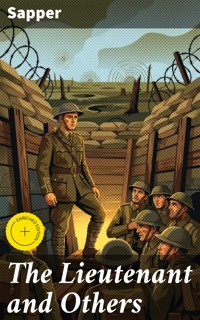
In "The Lieutenant and Others," Sapper masterfully weaves a collection of short stories set against the backdrop of World War I. This compilation captures the tribulations and triumphs of soldiers, exploring themes of bravery, camaraderie, and the horrors of warfare through vivid prose and a keen psychological insight. Sapper employs a direct yet evocative literary style that immerses readers into the heart of battle, employing a tone that balances tension with moments of human connection. Drawing from his own experiences and the broader societal unrest of the time, Sapper's narratives reflect the complexity of a world shaken by conflict. A pen name for Herman Cyril McNeile, Sapper was not only a soldier but a skilled writer whose firsthand knowledge of military life informs his work. Serving in the trenches during WWI, he infused his stories with authenticity, often mirroring the hardships faced by his fellow troops. Sapper's unique perspective allows him to portray a reality that far surpasses romanticized notions of war, making him a pivotal figure in war literature. Readers seeking a profound exploration of human resilience and the stark realities of war will find "The Lieutenant and Others" a compelling addition to their literary journey. With its rich characterization and poignant themes, this collection invites reflection on the sacrifices made during tumultuous times and remains relevant for contemporary audiences. In this enriched edition, we have carefully created added value for your reading experience: - A succinct Introduction situates the work's timeless appeal and themes. - The Synopsis outlines the central plot, highlighting key developments without spoiling critical twists. - A detailed Historical Context immerses you in the era's events and influences that shaped the writing. - A thorough Analysis dissects symbols, motifs, and character arcs to unearth underlying meanings. - Reflection questions prompt you to engage personally with the work's messages, connecting them to modern life. - Hand‐picked Memorable Quotes shine a spotlight on moments of literary brilliance.
Das E-Book können Sie in Legimi-Apps oder einer beliebigen App lesen, die das folgende Format unterstützen:
Veröffentlichungsjahr: 2021
Ähnliche















The Lieutenant and Others
Table of Contents
Introduction
This volume gathers together, in a single-author collection, the pieces commonly read under the title The Lieutenant and Others, by Sapper, the pen name of H. C. McNeile. The scope is deliberately compact: it is not an omnibus of the author’s full career, but a curated set of war writings that move across several modes while remaining anchored in a shared theatre and a shared historical moment. Read together, the items form a sustained introduction to the kind of narrative energy, observational detail, and directness for which Sapper became widely known.
The contents are predominantly short fiction and sketches, arranged as discrete items with their own subtitles, dedications, and dated settings. Alongside a prefatory note, the collection includes a multi-part sequence, “The Lieutenant: A Fortnight in France,” structured in numbered sections, and a series of shorter narratives such as “The End of ‘Wipers’,” “The Black Sheep,” and “The Aftermath.” The emphasis throughout is on the compressed scene, the anecdote shaped into story, and the immediacy of episodes that can be read independently while accumulating force in sequence.
Several pieces clearly signal their relation to lived military experience by naming places and dates, while the narration remains literary rather than documentary. The writing operates in the space between report and tale: it draws on the recognizable logistics of front-line life—movement, waiting, sudden crisis, improvised solutions—without presenting itself as a formal diary or official history. Subtitles that specify time and location serve as framing devices, giving each narrative a defined horizon and making the collection feel like a mosaic of moments rather than a single continuous plot.
The unifying subject is war as it is encountered by individuals and small groups: officers and men, comradeship and duty, fear and resilience, and the friction between personal temperament and military necessity. Titles such as “The Coward” and “Driver Robert Brown” indicate an interest in character under pressure, while others point to the odd, darkly comic intrusions of the unexpected into routine. Across the collection, the focus remains on how people speak, decide, and endure, and on how quickly ordinary categories of behavior are tested and redefined in extreme circumstances.
Sapper’s stylistic signatures are evident in the brisk pacing, the preference for concrete action over abstract meditation, and a tone that can pivot from grimness to sardonic humor without losing control of the scene. The presence of dedications and epigraph-like taglines gives the pieces a public-facing immediacy, as if they are addressed to specific comrades or to a broader community of readers attuned to sacrifice and service. Even when the premise is unusual, as in episodes involving mines or peculiar domestic remedies, the storytelling remains grounded in momentum and sharply sketched dialogue-driven situations.
As a collection, The Lieutenant and Others is held together by recurrent contrasts: the large scale of events against the small scale of individual tasks, the persistence of routine in the midst of danger, and the interplay of courage, error, and chance. The place-name “Wipers,” a soldiers’ pronunciation of Ypres, signals how language itself is altered by experience, becoming both shorthand and shield. Throughout, the narratives return to the bonds between people—formal ranks, informal loyalties, and the quiet obligations that persist when certainty fails and plans collapse.
The continuing significance of these pieces lies in their ability to convey how war is lived at human speed, one incident at a time, without requiring readers to approach them as a single thesis or a single hero’s journey. They offer a portrait of a particular kind of wartime storytelling in English: lean, scene-based, attentive to the moral weight carried by everyday decisions. Read now, the collection remains a record of how narrative can preserve the textures of endurance and loss, and how short forms can accumulate into a lasting, coherent vision.
Historical Context
H. C. McNeile, who wrote as “Sapper,” produced the stories gathered in The Lieutenant and Others out of the first phase of the First World War, when the British Expeditionary Force (BEF) transformed from a small professional army into a mass, volunteer-based force. Britain entered the war in August 1914 and by late 1914–1915 faced an industrialised conflict defined by trenches, artillery, and attrition. The collection’s settings and episodes reflect the BEF’s daily life under these conditions and the way new battlefield routines—rationing, fatigue parties, wiring, and constant shellfire—became the grammar of experience for soldiers and readers alike.
Several pieces are anchored in the Ypres Salient in Belgian Flanders, where British and German lines formed a dangerous bulge around Ypres (often rendered “Wipers” by troops). The Salient became synonymous with exposure, mud, and incessant bombardment as the front stabilised after the 1914 “Race to the Sea.” In spring 1915 the area was the scene of the Second Battle of Ypres (April–May 1915), which included the first large-scale German use of chlorine gas on the Western Front on 22 April 1915. This context illuminates the collection’s emphasis on strain, improvisation, and a fatalistic humour amid new forms of threat.
The dates embedded in the texts—Friezenburg on 30 April 1915 and a “fortnight in France” from 10 to 24 May 1915—place key narratives immediately after the major gas attacks and in the continuing crisis of the Salient. During this period the BEF held thin lines while grappling with protective measures that were initially crude, such as improvised respirators, before more effective anti-gas equipment was widely issued. The proximity to these events shaped a perspective attentive to confusion, contradictory rumours, and the gap between official communiqués and what men observed in trenches, dugouts, and shattered villages.
Warfare underground also frames the collection, aligning with the development of mining and countermining on the Western Front. By 1915 both sides were digging saps, galleries, and listening posts to place explosive charges beneath enemy positions, especially in sectors like Ypres and Artois. The mine stories correspond to a wider tactical struggle in which engineering skill, patience, and terror combined: sudden detonations could obliterate a trench line, while the waiting and listening created a distinct psychological burden. These conditions encouraged narratives focused on suspense, claustrophobia, and the unsettling impersonality of death delivered from unseen directions.
The autumn 1915 reference to Loos situates the collection within the broader British shift toward large offensives intended to break trench deadlock. The Battle of Loos (25 September–mid-October 1915) in Artois involved the first British use of poison gas and massed “New Army” divisions raised after Lord Kitchener’s recruitment appeal of 1914. Loos became emblematic of ambitious plans colliding with inadequate communications, artillery support, and inexperience at scale. In that light, the collection’s movement from local episodes to “aftermath” resonates with contemporary anxieties about sacrifice, leadership, and the price of learning modern war.
The social composition of the forces changed rapidly between 1914 and 1915, and this transformation helps explain the collection’s recurring attention to class, authority, and the bonding of small groups. As volunteers flooded in, officers and men often negotiated relationships under extreme pressure, while units absorbed replacements after heavy losses. Wartime censorship and the need to sustain morale encouraged writing that could convey authenticity without disclosing operational detail. Sapper’s soldierly voice—mixing sobriety with hard-edged comedy—aligned with a readership coping with casualty lists and a public rhetoric that still framed endurance as both duty and national character.
Technological and logistical realities further shaped the stories’ texture. Artillery dominated casualties; machine-guns enforced exposure; and transport depended on drivers, horses, and muddy roads that could collapse into chaos under shelling. The war’s material culture—sandbags, duckboards, ruined farms, trench mortars, and makeshift medical evacuation—created a setting where small decisions carried disproportionate consequences. Such conditions made themes of competence, nerve, and “luck” central to soldiers’ self-understanding. They also encouraged the sympathetic portrayal of ordinary roles, from drivers to grooms, that underpinned combat power but rarely appeared in pre-war heroic tradition.
The collection emerged while the war’s meaning was being contested in Britain: early expectations of a short conflict had faded, yet the full disillusionment associated with later years was not universal in 1915. Contemporary readers often sought writing that was recognisably “from the front,” balancing realism with restraint and a sense of purpose. Sapper’s perspective, informed by service and by the immediate aftermath of events like Ypres and Loos, met that demand by presenting war as grim, episodic, and morally complicated without abandoning comradeship or satire. The result is a context where personal anecdote becomes a credible lens on national mobilisation and industrial war.
Synopsis (Selection)
Preface
Positions the collection as frontline witness-writing: brief sketches meant to capture what official summaries and patriotic abstractions miss.
Sets a tone of dry, observant understatement that makes room for both mordant humour and sudden moral seriousness about endurance, loss, and comradeship.
I — The Lieutenant (A Fortnight in France, May 10 to May 24, 1915)
A linked wartime narrative follows an officer through a concentrated span at the front, tracking the grind of routine, risk, and responsibility as days blur into one another.
Understated, episodic scenes emphasise leadership under strain, the ordinariness of fear, and the way small practical choices carry outsized emotional and ethical weight.
II — The End of “Wipers” (A sketch written during the first week of May)
A short, immediate sketch captures a unit’s relationship to a battered place and the moment when familiarity with it is broken by events and orders.
The piece balances blunt observation with elegiac restraint, treating naming, memory, and dispossession as central wartime experiences.
III — The Black Sheep (Frizemburg, April 30, 1915)
A character-focused vignette centres on an outlier in the group whose reputation and behaviour test the unit’s tolerance and judgments.
With sharp, economical irony, it explores belonging and stigma, suggesting how wartime pressure can both magnify flaws and complicate easy moral labels.
IV — James and the Land Mine (A comparatively truthful account of an unpleasing episode)
A darkly comic account pivots on an encounter with hidden danger, using a specific incident to show how chance and procedure collide in trench life.
The tone mixes bravado and unease, highlighting the theme of impersonal mechanisms of war and the fragile confidence soldiers build to keep functioning.
V — The Sixth Drunk (To a very gallant Irishman, who died in November, 1914)
A tribute-tinged story uses a seemingly small episode involving drink and discipline to reveal character under stress and the bonds of men in extremis.
Behind the rough humour sits an elegiac current, focusing on courage’s everyday forms and the abruptness with which personality can be turned into memory.
VI — The Mine (Some are born Huns, and others have Huns thrust upon them)
A tense frontline sketch revolves around subterranean threat and the adversary’s unseen proximity, turning the ground itself into a source of dread.
It foregrounds the motif of invisibility—enemy, danger, outcomes—while its sardonic edge underscores how soldiers cope by reframing terror as routine.
VII — Driver Robert Brown (To the great army of those who have passed down the long vale, unsung, unhonoured)
A portrait of an ordinary serviceman elevates uncelebrated labour—driving, carrying, enduring—into the emotional centre of the war effort.
Plainspoken and commemorative, it stresses anonymity and sacrifice, reinforcing the collection’s recurring concern with the countless lives that never become official legend.
VIII — The Coward (Tout comprendre c’est tout pardonner)
A moral inquiry examines fear, reputation, and the social machinery of blame inside a fighting unit, asking what people mean when they label someone a coward.
Without preaching, it shifts toward psychological and ethical nuance, using restrained empathy to complicate simplistic judgments.
IX — Ebeneezer the Goat (No goat by any other name e’er smelt as much)
A comic interlude follows an animal mascot whose sheer physical presence and chaos briefly interrupt the war’s grim rhythms.
The humour is affectionate but edged, using absurdity to show how soldiers create pockets of normality and morale amid deprivation.
X — The Pepnotised Milk (Aunt A. is not her name, but I can vouch for the pepnotised milk, to say nothing of the moth balls)
A home-front-tinged anecdote collides with military life through a bizarre practical remedy, highlighting the mismatch between civilian well-meaning and frontline reality.
Its genial satire and sensory detail emphasise improvisation, superstition, and the small comforts that become disproportionately important in wartime.
XI — Will You Take Over His Horse, Sir? (To a pal. November, 1914. R.I.P.)
A seemingly administrative request becomes the doorway into a story about loss and the way the army turns personal absence into immediate logistics.
Spare and emotionally controlled, it uses the motif of an animal and its care to underscore comradeship, duty, and grief held in check.
XII — The Aftermath (Loos, October, 1915)
Set after a major action, this closing piece lingers on the physical and moral residue of battle rather than the clash itself.
More sober and reflective than the comic sketches, it gathers the collection’s motifs—mud, routine, sudden death, and muted loyalty—into a restrained reckoning with what remains.




