


1,99 €
Mehr erfahren.
- Herausgeber: Quickie Classics
- Kategorie: Gesellschafts- und Liebesromane
- Sprache: Englisch
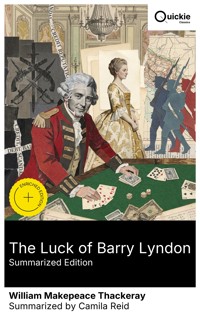
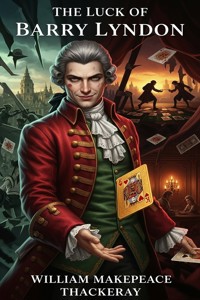
The Luck of Barry Lyndon adopts the self-justifying memoir of Redmond Barry, an Irish adventurer who styles himself Barry Lyndon. In a swaggering, blinkered voice he narrates duels, soldiering in the Seven Years' War, continental gambling rooms, and a calculated marriage to Lady Lyndon—before the inevitable fall. Thackeray's ironic pastiche of eighteenth-century narratives, first serialized in Fraser's Magazine (1844), fuses picaresque propulsion with forensic social satire, exposing the economies of honor, credit, and celebrity in Georgian Britain. Thackeray—journalist, satirist, and trained draughtsman—brought to the novel an intimate knowledge of gambling, debt, and social display. Born in Calcutta and educated in England, he lost much of his early fortune and turned to journalism, honing a skeptical, anti-heroic mode in Fraser's and later Punch. His devotion to Fielding and Smollett and his study of European courts supplied both the idiom and the cold eye that animate Barry's self-delusion. Recommended to readers of Vanity Fair and the classic picaresque, this is a sharp primer in unreliable narration and the psychology of ambition. It rewards scholars and general readers alike with historical bite, stylistic verve, and a chilling moral clarity. Quickie Classics summarizes timeless works with precision, preserving the author's voice and keeping the prose clear, fast, and readable—distilled, never diluted. Enriched Edition extras: Introduction · Synopsis · Historical Context · Author Biography · Brief Analysis · 4 Reflection Q&As · Editorial Footnotes.
Das E-Book können Sie in Legimi-Apps oder einer beliebigen App lesen, die das folgende Format unterstützen:
Veröffentlichungsjahr: 2026
Ähnliche









The Luck of Barry Lyndon (Summarized Edition)
Table of Contents
Introduction
Ambition, polished to a gleam and paraded as destiny, can look like virtue from a distance and fraud up close, and it is on that narrow margin—where luck, performance, and appetite for advancement mingle with codes of honor and the cash value of respectability—that this story stages its enduring drama, casting an unwavering light on the ways a manufactured persona can overtake a person, how elegance can be an armor for appetite, and how societies that revere rank and winnings alternately enable, admire, and punish the very chancers their own rules and fantasies so efficiently bring forth.
William Makepeace Thackeray’s The Luck of Barry Lyndon is a satirical picaresque set in the eighteenth century, following its protagonist across Ireland, Britain, and the Continent, and it first appeared as a serial in Fraser’s Magazine in 1844. Framed as a memoir supposedly written by its hero, the book blends adventure with social anatomy, using the conventions of rogue narratives to examine the theaters of war, gambling, and polite society. Read within the early Victorian moment that produced it, the tale looks backward to Enlightenment manners and forward to modern skepticism, occupying a shrewd vantage from which to survey class, conduct, and fortune.
At its outset, the novel introduces Redmond Barry, a young Irish gentleman of limited means, whose restless pride and fascination with gentility propel him from rural beginnings into wider European circuits of risk and reward. Circumstances carry him through martial service, gaming rooms, and drawing rooms, each new scene unfolding as an episode in self-transformation. The narrative moves briskly yet with a ceremonious gait, relishing duels of wit as much as contests of chance, and it keeps the reader alert to what is claimed and what is shown. The experience is by turns comic, caustic, and curiously intimate, even when events grow grand.
Thackeray crafts a first-person voice that is polished, defensive, and perpetually self-justifying, a rhetoric that flatters itself with noble motives while betraying, by emphasis and omission, the costs of its own ascent. The prose emulates eighteenth-century memoirs without pastiche for its own sake, using formal cadence, worldly aphorism, and punctilious etiquette to heighten the comedy of pretension. Irony emerges less from authorial interruption than from tonal dissonance, as the narrator’s proud catalog of triumphs is undercut by the social and moral shadows he cannot fully hide. The result is a controlled performance in which style becomes evidence, and charm an argument.
The novel’s central investigations concern social mobility as theater, the price of belonging, and the economies—of money, marriage, violence, and reputation—that structure a hierarchical world. Luck is treated not as pure chance but as a volatile currency circulated through bravado, timing, and networks of patronage. Codes of honor and masculinity prove both ladders and traps, binding personal feeling to ritualized conflict. Questions of national identity also inflect the story, as an Irish outsider measures himself against English and continental norms. Throughout, Thackeray probes how narratives of success domesticate aggression, and how self-belief can harden into a mask that others may applaud yet fear.
For contemporary readers, Barry Lyndon resonates as a study in self-branding and the narratives that power social ascent. Its portrait of a man who edits his own legend speaks to an age of curated profiles, reputation economies, and speculative risk dressed as inevitability. The book also tests the comforting myths of merit, asking how much of winning depends on opportunism, inherited advantage, or the ability to read a room faster than rivals. By dramatizing the trade between appearance and authority, it illuminates present-day debates about inequality, performance, and accountability without reducing its world to an allegory of our own.
Approached with an ear for its slippery eloquence and a steady skepticism for its claims, the novel rewards attention to detail: what the narrator dwells on, what he glides past, and how each polite scene conceals a negotiation of power. It is lively in movement and exacting in observation, capable of wit that sparkles and judgment that stings. Above all, it endures because it shows how a life can be made into a story—and how that story can, in turn, make a life—inviting readers to enjoy the swagger while measuring the costs that swagger seeks to hide.
Synopsis
William Makepeace Thackeray’s The Luck of Barry Lyndon is a nineteenth-century satirical novel, originally serialized in 1844. Presented as the autobiographical memoir of Redmond Barry, an Irishman who styles himself Barry Lyndon, the narrative follows his quest for rank and fortune across eighteenth-century Europe. The voice is suave, self-justifying, and persistently unreliable, inviting readers to weigh boast against evidence. Through scenes of dueling, soldiering, gambling, and courtship, the book examines the machinery of social ascent and the cost of maintaining appearances. Luck, in Barry’s telling, is merit’s ally, yet circumstance and character steadily test that conviction, exposing vanity, opportunism, and the era’s brittle codes.
The story begins in rural Ireland, where young Redmond Barry grows up among minor gentry, proud ancestry, and limited means. He becomes infatuated with his cousin Nora Brady, a feeling that proves combustible when a wealthier rival appears. A quarrel escalates into a duel that propels Barry from his home and into the wider world. He frames his departure as noble, insisting on honor and destiny, yet the episode reveals a pattern of impetuous choices and self-flattering recollection. From this first flight, the novel establishes its interest in how status is negotiated through ritual, bravado, and the theatrics of gentlemanly conduct.
Barry enlists in the British army and sees service during the Seven Years’ War, a campaign he romanticizes even as he registers its tedium, danger, and coercion. Military life provides him with uniforms, acquaintances, and opportunities to reinvent himself, but also confronts him with desertion, punishment, and the thin line between courage and folly. Thackeray depicts the mechanisms that recruit, move, and discard men, while Barry recounts encounters that test his nerve and ingenuity. A bid to extricate himself from the ranks leads to new constraints, reminding him that mobility in wartime Europe often depends less on valor than on surveillance and leverage.
Under Prussian authority, Barry is compelled into a stricter regime that prizes obedience and utility. Tasked with watching others as much as fighting, he learns the uses of disguise, report-writing, and calculated charm. This phase introduces the Chevalier de Balibari, an expatriate gambler whose cosmopolitan graces contrast with barracks brutality. Assigned to observe the Chevalier, Barry gravitates toward him, willingly absorbing lessons in play, poise, and profitable deception. The partnership reframes war as a backdrop for games of information and risk, situating Barry within a Europe where borders are porous, allegiances negotiable, and fortune smiles most readily on the dexterous.
Together, Barry and the Chevalier move through courts and spas, thriving in salons and gaming rooms where wit, nerve, and manipulation yield income and access. Thackeray dwells on the rituals of cards and credit, detailing how honorific language coexists with marked decks and silent collusion. Barry perfects a performance of gentlemanliness—dress, address, and dueling competence—that both conceals and enables sharp practice. The episodes expose a society addicted to spectacle and indebtedness, in which reputations are currencies to be spent and replenished. While Barry celebrates his knack for reading faces and managing affronts, the narrative hints at liabilities accruing beneath the glitter.
Returning to the British Isles, Barry seeks a more durable elevation than winnings can supply. He identifies marriage as the surest instrument and aims at Lady Lyndon, a wealthy aristocratic widow whose rank and fortune would secure his transformation. Courting becomes a campaign conducted with calculated tenderness, conspicuous bravery, and relentless social positioning. Barry presents his pursuit as gallantry; the scenes also suggest strategic pressure, attentive to gossip, guardians, and legal safeguards. By aligning sentiment with advantage, he advances into the precincts of title and estate, confident that lineage can be acquired through ceremony as handily as money through play.
Installed within the Lyndon household, Barry presides over spending, hospitality, and displays of taste designed to cement his status among the great. The costs mount alongside expectations, with retainers, artists, and creditors forming a chorus around the family. Domestic life proves volatile. Barry’s temper and devotion to gaming strain his marriage, while his stepson, Lord Bullingdon, resists the intruder’s authority and questions his conduct. The resulting antagonisms make drawing rooms resemble battlegrounds, governed by protocols as rigid as military drill. Thackeray shows how patriarchal pride and social surveillance turn private disagreements into public performance with repercussions.
As ventures multiply, so do vulnerabilities. Debts and favors lace Barry into networks of obligation that no feat of swordsmanship can sever. Challenges arise in clubs and courts, where affronts are measured, witnesses assembled, and narratives contested. Politics offers avenues for prestige, yet patronage demands steadiness he finds hard to maintain. Public bravado and ostentatious generosity win applause and provoke alarm. The novel deepens its study of image management, as a man living by daring maneuvers must keep refreshing the story that sustains him, even while rivals and kin become more practiced at contesting it.
By withholding simple moral endorsement while exposing self-serving rhetoric, the book invites readers to question how luck, merit, and identity are narrated. Barry’s voice projects inevitability onto choices that are often reckless, embodying a culture that confuses display with character and credit with virtue. Thackeray examines a system that rewards audacity, yet entangles participants in debts of money and meaning. Class, nationalism, and masculinity are illuminated as roles performed under pressure. The novel endures for its dissection of ambition and its skeptical take on memoir, reminding us that the stories people craft about themselves can both advance and imperil their lives.
Historical Context
William Makepeace Thackeray published the serial The Luck of Barry Lyndon in Fraser’s Magazine in 1844, later issuing it as The Memoirs of Barry Lyndon, Esq. in 1856. Its action ranges across mid-eighteenth-century Ireland, Britain, and continental Europe, a world governed by aristocratic privilege, military hierarchy, and a pervasive culture of gambling and dueling. Framed as a self-justifying memoir, the narrative echoes popular eighteenth-century confessional and picaresque models. The setting coincides with the Georgian era, when lineage, land, and patronage determined status. Thackeray situates his antihero amid formal institutions—peerage, army, courts, and gaming houses—that regulated advancement while rewarding display, audacity, and calculated alliances.
Eighteenth-century Ireland was dominated by the Anglo-Irish ascendancy, a Protestant landowning elite that controlled Parliament and local administration. Penal laws, enacted chiefly from the late seventeenth century and modified only gradually after 1778, restricted many civil, political, and property rights for Catholics and certain dissenters, shaping patterns of ownership and education. Ambitious members of the rural gentry navigated a society where lineage claims, rents, and patronage governed prospects. Dueling, an entrenched mechanism for defending reputation, was widespread and later famously codified in the Irish Code Duello at Clonmel in 1777. This environment supplies the novel’s initial milieu of precarious honor and disputed status.
In Georgian Britain, social ascent typically depended on inheritance systems such as primogeniture and entails, which concentrated estates in a single male line. Marriage settlements, dowries, and jointures structured alliances, while the doctrine of coverture vested a married woman’s property in her husband. In England and Wales, the Marriage Act of 1753 required Anglican ceremonies and parental consent for minors, curbing clandestine unions. Gentlemen could purchase commissions in the British Army, linking military rank to wealth and connections until reforms in the nineteenth century. London’s elite clubs and gaming houses around St James’s fostered high-stakes play, speculation, and reputational contests central to elite sociability.
The Seven Years’ War (1756–1763) reshaped European power, pitting Britain and Prussia against France, Austria, and Russia across continental and colonial theaters. Wartime mobilization opened channels for advancement through soldiering, plunder, and patronage, while exposing recruits to harsh discipline and frequent desertion. Prussia, reorganized under Frederick William I and led in war by Frederick the Great, used the canton system to supply regiments and enforced severe penalties for indiscipline. Officers were expected to exhibit aristocratic bearing, whereas common soldiers faced corporal punishment and rigid drill. This military order provides a backdrop for cross-border service, shifting loyalties, and careerist opportunism.




