


0,00 €
Mehr erfahren.
- Herausgeber: Photocosmological Press
- Kategorie: Abenteuer, Thriller, Horror
- Sprache: Englisch
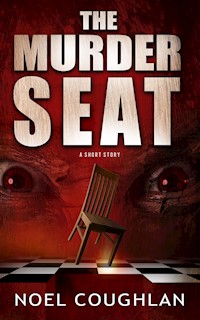
Dr. Herbert Marriott has a problem that only murder can solve. Luckily for him, the perfect weapon is locked away in his rundown museum, one too incredible for any court to accept. The cursed chair kills all who rest upon it. But will Herbert’s victim be so easily drawn to her fate?
A four and half thousand word short story.
Das E-Book können Sie in Legimi-Apps oder einer beliebigen App lesen, die das folgende Format unterstützen:
Veröffentlichungsjahr: 2016
Ähnliche



















The Murder Seat
Noel Coughlan
Contents
The Murder Seat
A Word From The Author
Acknowledgments
About Noel Coughlan
THE MURDER SEAT
Copyright © 2016 Noel Coughlan
All rights reserved. No part of this book may be reproduced in any form or by any electronic or mechanical means, including information storage and retrieval systems, without written permission from the author, except in the case of a reviewer, who may quote brief passages embodied in critical articles or in a review.
This is a work of fiction. Names, characters, places, and incidents either are the product of the author’s imagination or are used fictitiously, and any resemblance to actual persons, living or dead, events, or locales is entirely coincidental.
Cover by Venanzio
Edited by Finish The Story
Additional Proofreading by Proofed to Perfection
Published by Photocosmological Press
Epub Edition: ISBN:978-1-910206-12-6
The Murder Seat
1984, Dublin
Dr. Herbert Marriott gazed upon the austere wooden chair idly placed inside the windowed cabinet. Fifty years of dust lay upon it. A half-century had passed since its evil had been imprisoned behind glass, sentenced forever to be an untouched exhibit in his museum.
Its murderous history began in 1847, at the height of the Great Famine. One of Major Mackleton’s tenants, recently evicted, visited his residence to beg for her home back. The major invited the old woman briefly into the reception hall to remind her of the money she still owed. Incensed by this humiliation, she laid a curse upon him. Within a fortnight, his two strapping sons were found dead, thrown from their horses on the same hunt. Soon after, the major’s wife died of grief. Even his favorite dog succumbed to the malediction. The major himself lasted another month before he, too, died of some unspecified ailment. According to legend, he departed this world screaming.
His servants blamed these calamities on the chair the major had sat upon when the old woman laid her curse. They claimed that to rest upon it invited death.
The Roycroft-Smythe family, the major’s cousins, scoffed at this superstitious claptrap when they inherited his property. Within a year, they, too, had died. A succession of unfortunate owners suffered the same ill fate, until one canny individual, William Boyce, donated it to the Dublin Museum of Culture and Art. Yet his wit did not save him. The day after the chair arrived at the museum, Boyce’s house collapsed, killing him and all whom he loved.
The Murder Seat, as more lurid elements of the press dubbed it, remained in storage until its infamy had somewhat mellowed. In the thirties, the then curator, Henry Tyrwhitt, desperate to finance the museum, exhibited the chair as a means of drawing in less-refined patrons. At first, the gambit succeeded. People from all over Ireland came to see the notorious chair. A few braver souls even sat upon it to test the curse. The museum’s takings from this most unusual exhibit exceeded Tyrwhitt’s wildest hopes. But then people began to turn up dead…
Of course, no court found the museum culpable for these deaths. They were unfortunate accidents. The fact that all the victims had sat on the Murder Seat was coincidental. But in 1934, Tyrwhitt was moved to protect the public from itself by locking the chair away in a glass cabinet, just before he drowned in the Liffey.
Exactly five decades later, Herbert, his current successor, now held the key to the Murder Seat’s prison in his quivering hand.
He had a problem he hoped the chair might solve, and her name was Concepta Ryan. His secretary. And his lover.
Their affair had begun so innocently, but now it threatened to wreck his marriage and ruin his good name. She demanded the impossible. He could never leave his wife. He loved Margaret. But Concepta had made less than subtle threats that she would destroy what she could not possess. The action Herbert contemplated wasn’t murder, merely self-defense.
Besides, the curse might be merely happenstance and exaggeration fabricated by macabre imaginations. Concepta might survive sitting upon the chair. The thought stirred anxiety as much as it eased his conscience. If the Murder Seat failed him, what then?
He pushed the little key into the keyhole and tried to turn it. For an agonizing moment, the lock refused to budge. He applied more pressure until it clicked open. The cabinet trembled dangerously as he swung open the squealing glass doors.
He gazed upon the intended means of Concepta’s demise. The plainness of the chair only added to its menace. It was of a type found in many historic houses. Indeed, most chairs in the museum’s offices were exact replicas—a tasteless joke made by a previous curator. Even Herbert had been forced to use one since his ten-year-old swivel chair broke.
He patiently waited for the cleaner to pass by. The regular lady was on leave, so some sullen youngster had temporarily taken her place. Of course, the new girl knew little of the museum or its exhibits—a detail to Herbert’s advantage. After all, he needed her help. He couldn’t risk touching the Murder Seat himself.
The metallic creak of her bucket echoed down the corridor before her. She wore the soiled white coat typical of her profession. She stank of cheap perfume and bleach. Peroxide-blond hair, sternly pulled back into a ponytail, emphasized the plainness of her face.
“You are here late,” she observed with ill-concealed annoyance.
“Hello, my dear,” he said. “Can you help me?”
She gave him a suspicious scowl as she halted and laid down her bucket and mop.
He pointed to the chair. “I need this moved to my office. I suffer from backaches, you see.” He illustrated his point by grimacing and rubbing the small of his back.
Her cheeks puffed with irritation. She seized the chair and lifted it from the cabinet. “You can carry the mop and bucket.”
“My back,” he pleaded, wincing in an effort to play the part of an invalid to avoid arousing suspicion.
Her natural scowl deepened, but mercifully she kept silent. Herbert led her down the shabby corridor to his office and asked her to plant the Murder Seat in front of his mahogany desk.
“You wouldn’t mind giving it a wipe, would you?” he asked with a nervous chuckle. “It’s a bit dusty.”




