


6,99 €
Mehr erfahren.
- Herausgeber: Publisher s13039
- Kategorie: Abenteuer, Thriller, Horror
- Sprache: Englisch
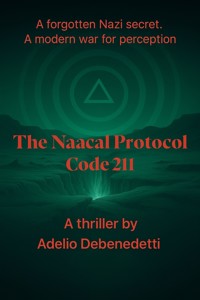
Beneath the surface of official history lies a deeper layer: sealed archives, denied operations, military programs erased before they were ever acknowledged. That is where The Naacal Protocol – Code 211 begins.
A geopolitical and esoteric thriller that blends real military history, documented intelligence programs, and the emerging battlefield of cognitive warfare. From the Ahnenerbe’s clandestine expeditions to the Riese tunnel complex, from CIA research on perceptual control to the modern crisis in Ukraine, the story cuts through the hidden architecture of global power. The United States, Russia, Europe, and private networks move behind the curtain of official narratives, while a new form of conflict takes shape: the war over human perception.
Grey — an off-protocol intelligence operator — and Alenka, a Russian agent on the run carrying a special-pigment encrypted tattoo, become both pawns and threats to the forces operating in the shadows. Across modern battlefields, embassies, safe houses, and clandestine research sites, every step brings them closer to a truth no state is willing to reveal. Based on real locations, references, and declassified materials, the novel builds a credible and immersive narrative where hidden archaeology, neurotechnology, and military black programs converge into rising tension, revelations, and lethal consequences.
This is not a theory — it is documentary fiction.
It offers no easy answers — only questions history prefers to avoid.
Real-world context. Historical research. A fictional thread.
Once you start seeing what you were never meant to see, the story changes.
Das E-Book können Sie in Legimi-Apps oder einer beliebigen App lesen, die das folgende Format unterstützen:
Veröffentlichungsjahr: 2025
Ähnliche



















Adelio Debenedetti
The Naacal Protocoll
Code 211
Preface
Some books you devour in one sitting. Others carve their way inside you, leaving behind traces, questions, and echoes. The Naacal Protocol – Code 211 belongs to the latter. It’s not a novel that merely tells a story it opens passages, digs into the voids of official history, and leads you into a territory where reality, myth, and manipulation overlap.
I’ve known Adelio for many years. He’s visited me several times in Kraków, the city I’ve called home for almost three decadesa place forever suspended between beauty and trauma, between light and unsettling shadows. Here, among these streets and stones, history never truly ends. It whispers, hints, and constantly tests you. Perhaps it’s from this restless soil that the soul of this book was born.
In The Naacal Protocol, you can feel Adelio’s desire to go beyond the surface of events. The plot pulls us into a vortex of missing files, hidden tunnels, forgotten symbols, and invisible wars fought not only with weapons, but with the mind. Agent Grey and the mysterious Alenka Kirillov lead us through a mosaic of narratives, where geopolitics, advanced technology, esotericism, and global conspiracies interlock with uncanny precision.
But what truly gives this story its power is the author’s gaze capable of merging logic with intuition, discipline with mystery, reality with imagination. Adelio writes as he lives: searching for deep connections, accepting the risk of doubt, crossing territories not marked on any map, always in pursuit of the next challenge.
This is not just a finely constructed thriller. It’s an invitation to question what we think we know, to see the world with new eyes, and to recognize that today’s real battlefield lies in the perception of information and the manipulation of human awareness.
Those who dare to follow him to the end will discover that truth like Kraków has many faces. And none of them are ever final.
Livio Guida
Non arma, sed mens vincit.
Usque ad finem.
Chapter 1
North Carolina, January 2025. 05:13 hours. Temperature: 3°C. Humidity: 98%. Light fog.
The silence hanging over Harvey Point isn’t the natural stillness of the marshes. It’s engineered crafted to disguise the scent of war. The air smells of damp earth, steel, and cordite. No signs. No flags. Only a code: DTRA-110Byou have to know it exists to know it’s there.
The main structure a concrete and steel skeleton half-hidden by cypress trees and thermal fences is home to the Advanced Covert Engagement Unit, a black project run by the CIA in cooperation with the DIA and JSOC. Officially, the site doesn’t exist. But it does. And tonight, here, I’m training a man who may one day have to choose whether to kill or to save the world.
His name is Karl Adler. Born in Chicago to German parents who immigrated after the war. He grew up among the Lutheran communities of the South Sideamong veterans and the children of the Bavarian diaspora. His grandfather fought on the Eastern Front. His father was an engineer at Boeing. Karl, though, was born to shoulder a rifle. He just hasn’t yet learned to breathe in order to see the invisible.
“Breathe through the target,” I tell him, “not at it.”
The crosswind is steady. Five knots from the west. Target: 890 meters. Rifle: McMillan TAC-338 with Nightforce ATACR optic, Lapua Magnum rounds.
I kneel beside him, left hand resting lightly on his right triceps a subtle bridge between what he sees and what he’s meant to become.
Karl inhales. Then fires. The bullet strikes dead center in the target’s chest.
“Perfect. But too cerebral. You should’ve done it from the gut.”
Range 7B at Harvey Point is built to NATO STANAG 2931 standards acoustic simulators, recon drones, reactive targets. My day started at 03:30, with a session of tactical meditation, followed by postural stretching and a controlled glucose load. Every detail is calibrated. The body is the machine. The soul, the engine.
I’m here because there’s no way back. After Paris, I dropped off the radar. The Naacal Brotherhood had warned me: regeneration always carries a cost. Mine was solitude. But in Karl, I’ve found an echo perhaps an inheritance.
At 06:00, dynamic training begins. Variable distances. Reduced visibility. Range 3.4 kilometers. Artificial wind, moving targets. In the control room, Lieutenant Colonel Gaines monitors real-time biometrics heart rate, VO₂ max, neuro motor reactions. He calls me Spectre. No name. No ID. But everyone knows who you are.
Harvey Point isn’t just a shooting range. It’s a forge. Here they train sabotage, demolition, maritime infiltration, and HVT neutralization. CQB facilities replicate Iranian districts, Chinese compounds, African embassies. Every mission begins here and often ends somewhere that officially never existed.
At 06:45, the night-IR test begins. A series of targets flash randomly in the dark. The FLIR optic mounted on the rifle isn’t perfect but I don’t need it. In the darkness, I breathe three times and release the shot. One silhouette after another vanishes. Eight perfect hits out of eight.
“How many, Grey?” Karl asks from his lane. “Eight. You?” He lowers his gaze. Six. Two off.
“You think you see with your eyes,” I tell him quietly. “You have to feel the frequencies, the vibrations, the patterns.”
He looks puzzled. “How’s that even possible?”
I wait a beat. “It’s like for those who live without light. They don’t seek the image they sense the rhythm, the distance, the void. That’s how they see. That’s how we move.”
He says nothing. But I know he understands.
08:20 hours. Briefing room. A holographic monitor projects IR satellite images of Qom, Iran. A secret summit Russian and Chinese military officials. A retired general, a former MSS director, an Iranian officer under UN sanctions.
My name is at the bottom of the list. Not as a target. As an asset. Grey Asset 6 – Activated.Outside, it starts to rain. The fog rises. And once again, the world waits for my shot.
09:00 hours Operational crossroad.
Officially I’m on medical leave, a ghost with signed papers from Langley. In practice, Gaines summons me to a shielded underground room at Camp Peary. No electronic devices allowed.
The file on the table bears a faded red stamp: COSMIC41 – Phase II – EYES ONLY.
“Strategic interest, high sensitivity,” he says. “Converging SIGINT and HUMINT. Objective: neutralize or recover an active 16-hertz emitter located in Cyrenaica, Libya. Coordinates classified. Soviet-era subterranean facility abandoned since the 1980s, recently reactivated by unconventional forces likely GRU assets working with advanced PLA units.”
Karl listens in silence, committing every word to memory.
“The signal matches a frequency recovered from the Osiris files in Syria, 2015,” Gaines continues. “The structure aligns with an energetic artifact producing a constant vibrational field. NSA analysis suggests it’s part of a larger device an experimental system abandoned by the Reich in 1945, known to us as Schlüsselsteinthe activation stone.”
I stare at the IR images of the Libyan base. A central column, suspended in void. A geometric pattern I know. I’ve seen it before in a medallion. In Syria.
“Priority,” says Gaines, “is to extract the object intact. If structural integrity or operational context makes that impossible Plan B: selective thermobaric detonation. No trace left behind. Nothing leaves that site.”
He slides me a Q-Flash device maps, codes, dual-signature key to deactivate autonomous systems.
“Team: three SOG operators, two embedded DIA analysts, one NSA linguist. Naval cover from the USS Gerald R. Ford. JSOC authorization already signed. Insertion by MH-60R from Platform Alpha, Mediterranean sector. Extraction window: thirty-six hours. None if compromised.”
The file name flashes on the monitor: COSMIC41_PHASE_II/NAACAL_SIGNAL_RETURN.
I recognize the emblem a six-pointed spiral. I’ve seen it once before. Sinai. 2002.
09:30 hours. Flashback A cave beneath the Monastery of Saint Catherine. Three men in white robes, golden symbols across their chests. They don’t speak. They vibrate. They hand me a tablet. A key. A warning. That day I understood: some things are not sought. They find you. I blink. Karl is watching me. “You still with us, Spectre?”
Spectre my first black-ops alias. Later changed to Grey-6. Just a label. My real name forgotten.
“Always,” I answer.
10:45. Neuro-tactical simulator training. An immersive dome of shifting loops, armed drones, enhanced HUDs. Karl works silently, learning my technique blending calm with precision. Slowing his pulse, listening to the shape of air. “Tonight,” I tell him, “one tablet of glycine and one of betony root before sleep. Tomorrow you’ll see your target before it exists.”
14:30. Final operational test. The sky presses low, a fine rain falling without pause. The team assembles in Compound Bravo-4, a temporary field range built from AFISRA drone topography: limestone terrain, carved gypsum ridges, simulated underground entry. Everything reconstructed in obsessive detail. Karl on the right, scope fixed on shaped targets emerging from man-cut hollows. The exercise replicates expected field conditions narrow tunnels, high heat, simultaneous PLA-GRU presence. From the Gerald R. Ford, thermal overlays replicate Libyan ground: moving rail targets, intermittent profiles, exposures under two seconds. Reactive engagement700 to 1,200 meters. Weapon: Barrett MRAD .338 with Trijicon IR-HUNTER optic. Low-signature armor-piercing rounds, DIA-calibrated. The rhythm is relentless. Karl fires, adjusts, breathes. Signals flicker between teammates. A silhouette breaks from a side wall silence then a perfect hit.
16:10. The exercise ends under simulated friendly fire and emergency extraction aboard a modified CH-47. The full mission cycle lasts ninety-six minutes, repeated twice. Returning to the bunker, I glance at Karl. “You can come with me now,” I say. “But know this you might not come back.” He meets my eyes. “I’ve already gone beyond.” He doesn’t smile. Neither do I. But something clicks shut inside like a key fitting home.
18:45. Convoy returning to base. The sky heavy with moisture. Perimeter lights on the southern fence flicker, like something’s about to happen. Karl asks, “You’re not going home tonight? “I don’t answer right away. I look at him. Then toward Hangar 3, where a UH-60 waits in the dark. “Home isn’t a place anymore,” I say. “It’s a memory.” I seal myself inside my quarters. Low light. Still air. The smell of metal and canvas. On the table, folded and worn a black-and-white photograph. Her.
Marianne.
You lived together ten years away from the world, and later in all of its hells. You met in Lyon, at a conference on spiritual anthropology. She spoke of sacred geometry the way others speak of wine or dreams. And you, soldier of the unseen, dissolved. Her eyes were like wet glass clear, yet full. Her voice the kind that silences everything else. You lived between Portugal and Corsica, sometimes Paris. Then Kabul. Then nothing. She didn’t die in war. She vanished like things vanish when they no longer belong. First silence. Then a message. Then nothing. As if the world had called her back. Since then, you’ve had no home. Only bases, bunks, positions. Seas you can’t recall. Continents that no longer matter. Your body stays on mission. Your soul remains there where you last saw her on the stairs of a closed airport in Rome’s rain. She only looked at you, then turned away. Karl knows nothing. No one does. But that’s why you’re still here. Because if you stop, Marianne stops existing. And without that memory, you are nothing. You drop the photo. Resume cleaning the rifle. Every piece returns to place like the mind, like the heartbeat, like the void. Tomorrow the mission begins. And you don’t know whether you want to win it or disappear with it.
00:10 hours. Encrypted terminal active. No voice only a coded file blinking red:
<> Asset Grey-6 / Asset Grey-12 Pickup: Airfield Bravo-2 – Dare County ETA: 00:40 Zulu Destination: NAS Sigonella → CVN-78 USS Gerald R. Ford Coordinates (CVN): 38°N – 16°E Mission: COSMIC41 – Phase II Initiated
Karl is already dressed. His modular pack prepped the night before. Rifle stripped, optics wrapped in anti-glare velvet. He watches as I lace my boots. Silent. For a moment, in his eyes, I glimpse Marianne’s shadow. But it’s my reflection, not his. He looks like a man who’s already seen what hasn’t yet happened.
01:00 hours. Take-off from the eastern secondary field near Harvey Point, aboard a Gulfstream C-37A. We cross the Atlantic in dark-comm modeno radar trace. On board: the two of us, a CIA tech, two DEVGRU operators, one NSA linguist. Nobody speaks for eight hours.
09:10 local time. Landing at NAS Sigonella, Sicily. The air is still, the sun already high, asphalt vibrating under boots. A black jeep drives us beyond the perimeter, into a windowless concrete bunker six folding chairs, a monitor, a DIA officer who looks like he hasn’t slept in days. Briefing: twenty-five minutes. Coordinates confirmed. Signal stable at sixteen hertz. Operational window narrow the Gerald R. Ford in EMCON silence will open a corridor only between 11:00 and 11:15. Order: wait.
We wait. In silence. Karl cleans his optic with a microfiber clothslow, precise. Others check magazines, adjust webbing. One flips through a notebook. Another closes his eyes, counting breaths. No jokes. No words. The wait before a mission is a strange animal. It digs slowly inside you, soundless, but growing. If the mind isn’t trained, it becomes the worst enemy. I open my notebook. On the first page, underlined in pencil, a line from Sun Tzu: “Be as unfathomable as the night swift as thunder when you strike.” I read it every time before takeoff. Not poetry. Command. Today, we are the thunder.
10:55. The officer returns. “Operational slot open. You’re cleared to depart.”
11:00. Takeoff. MH-60R Seahawk. Indirect route, variable altitude, low-radar profile. We cross the Ionian arc, then bank southtoward the void.
12:00. The USS Gerald R. Ford surfaces on the horizon like a metallic shadow in the blue. No signals. No sound. Only sea and silence.
12:45. Touchdown on the auxiliary deck. The carrier runs under total electronic blackout. Two Navy officers in black coveralls await us. Along deck-B corridor, only infrared lights. Muffled, weightless silence. Karl walks beside me. No hesitation.
13:30. Operational briefing. Target: Shahid Ali al-Saffar. Location: abandoned scientific facility Jabal al-Akhdar, Cyrenaica, Libya. Objective: retrieve an energy artifact buried underground, first identified in 2002 by an MI6-linked archaeological mission. Complication: confirmed PLA Strategic Support Force and GRU elements posing as humanitarian teams. “The object is a crystalline container resonating at a constant sixteen hertz. The Damascus prototype from 1989 was based on this. The objective is containment the artifact must not leave the perimeter. At any cost.” I glance at Karl. He doesn’t flinch. No emotion. But inside, I know he’s heard the frequency. And it spoke to him.
15:10. Departure. Two F-35s sweep ahead. Our MH-60R lifts from the Ford, heading for the Libyan coast. Onboard: me, Karl, two DEVGRU operators, one NSA linguist. Estimated forty-eight minutes to insertion. The mission is clear. What awaits is not. Yet Karl is ready. And probably so am I.
16:00 hours – Insertion zone: Wadi al-Kuf, Eastern Cyrenaica. The Seahawk glides in silence above a limestone plateau, twelve hundred meters high. The air is dry, motionless, almost unreal. The abandoned base lies two kilometers south, half-buried beneath a chain of natural ridges. The main structure prefabricated Soviet concrete still hums with energy, a resonance faint but alive, like a whisper under the rock.
16:15. Infiltration. We move south across rocky ground. The sun is low, light cutting sharp across the terrain. Karl on my left, Barrett MRAD steady on three contact points. The two DEVGRU operators U.S. Navy’s elite Naval Special Warfare Development Group, known as SEAL Team Six bring up the rear. We reach the first checkpoint: a torn metal fence, a ruined watchtower. Fresh excavation marks. We’re not alone.
16:35. Visual contact. Two men in dark fatigues, armed with QBZ-191 bull pup rifles. PLA confirmed. They speak softly; one gestures toward the slope. I signal for silent elimination. Karl takes the firstclean shot to the base of the skull. I take the second. The bodies vanish into the ravine. No time for questions.
17:00. Entry. A partially collapsed ramp descends into the hillside. The air shifts heavier, charged. The NSA linguist moves ahead, scanning the corroded metal plating. Etched symbols: a mix of ancient Aramaic and pre-Islamic Persian. I recognize one. A six-pointed spiral. The same I saw in Sinai.
Inside, the humidity thickens. The walls pulse faintly, as if alive. We descend four levels. The ground slick but firm. At thirty meters, the tunnel opens into a central chamber. LED lamps recently installed. And there, suspended in a soft magnetic field the object. A translucent hexagonal crystal, its core shifting in slow geometric rhythm as though it breathes. It emits a tone: a constant vibration at sixteen hertz. I feel it in my rib cage. Karl freezes.
“You feel that too?” I nod. But it isn’t just sound. It’s a call.
17:10. Contact. Noise from the corridor behind us. A GRU tea four men fast, disciplined. They’ve spotted us. “Engage!” The tunnel erupts in gunfire. Crossfire fills the dark with percussion. Karl anchors behind a power crate; I cover the left angle. Two down. The third lunges toward the chamber Gaines, monitoring from the Ford, triggers a remote EMP burst. Their comms collapse into static. The last one surrenders. We restrain him. The NSA linguist questions in Russian. The man confirms: they’re after the object to use it as a neural interface in a psychic weapons program.
17:25. Improvised exfil. The crystal container is unstable. Karl spots a crack along one facet.
“If we move it,” he says, “it might collapse.”
I link via satellite to the Gerald R. Ford. Command’s reply is short. Do not extract. Destroy. We arm low-yield thermobaric charges. Three minutes to collapse. As we fall back through the tunnel, the object releases a final pulse and I see her.
Marianne.
Still. Silent. Watching. Then gone. Karl grips my arm. “You saw her too, didn’t you?” I nod. Say nothing. The mountain trembles. Then falls quiet.
18:05. Extraction. We’re pulled out by a V-22 Osprey lifting from Benghazi. Mission complete. Objective neutralized. No casualties. But something under that mountain wasn’t destroyed. It’s waiting.
18:50. En route. The Osprey banks west, toward the Gerald R. Ford. The captured GRU operative sits between two DEV GRU guards hands tied, face blank. But in his eyes I see it: he’s not just a soldier captured. He’s a man who has seen too much. During the flight, I say nothing. He stares at the floor, unmoving, while the vibration of the engines merges with altitude. The NSA linguist tries to engage no response. Only when we clear the African coast does the prisoner lift his head and look straight at me. He doesn’t speak. But I know he will. Not here. Not yet. Karl, seated beside me, reads the tension in my eyes. That same resonance from the Libyan structure still hums alive. Maybe it’s in that man. Maybe in what he’s seen. Or in what he chose not to destroy. The USS Gerald R. Ford rises on the horizon. The prisoner will be transferred to Cell 9-Alpha for classified interrogation.
The rest… begins tomorrow.
Chapter 2
13:00 hours – The day after the mission. Upper deck, USS Gerald R. Ford
The air on the flight deck hung thick, the silence broken only by the sound of measured footsteps. The ship’s commander motioned for me to follow him toward the mobile ops station — a rack of monitors and encrypted frequencies running on emergency batteries.
“Grey, field report received. What you found out there… doesn’t fit any conventional model. You’re saying it was just a sixteen-hertz emission?”
“It’s more than a signal,” I said. “It’s a structural interference — a tear in the environment. I saw similar vibrations years ago in the Sinai. And in Syria, during Operation Osiris. The same recurring pattern. Someone’s trying to awaken something we thought was buried for good.” The commander raised an eyebrow but stayed silent for a moment.
“I’ll admit,” he said finally, “I have a hard time buying into stories like that. But Langley backs your assessment — and that’s enough for me. They’re asking whether this incident ties to GRU or the PLA.”
“Yes. Both are there for a reason. And it’s not just about intelligence warfare. They’re hunting for energy — a raw, ancient form of it, probably linked to a project far older than we can imagine. I’ve seen traces of the same pattern before — Paris, Damascus, Kathmandu. The same thread running through all of it. Only now we’re realizing it’s a system.” The commander tapped the edge of the tactical table.
“China looks out of the game for now,” he said. “But they’re moving research vessels in the Med with more sonar arrays than guns. Mossad passed us a cable on unusual activity near Cyprus. There’s something under there. Maybe we’ve been looking from the wrong angle.”
A window flashed on the main screen. Secure COM – Langley.“Grey Six, this is Langley. We need an operational update. Has the signal been neutralized?”
“Yes. Target neutralized. But whatever powered it wasn’t local. It felt like an echo — a reflection. Maybe an experiment. Maybe a test run. The real objective is somewhere else.” The commander clasped his hands behind his back, taking a long breath as his eyes drifted across the displays. “Tell me something off the record,” he said quietly. “You think someone’s orchestrating all of this — a hand above it all?”
“I don’t know yet,” I said. “But there’s a map. And someone drew it a long time ago. The symbols repeat. The frequencies recur. Only the names change. We’re just the instruments.” A heavy silence settled over the ops room. The lights stayed dim. Outside, the sea looked still — but everyone could feel the shift coming. The commander stepped back. “Get ready. The GRU agent you captured will be interrogated at sixteen hundred. Let’s see if he fills the gaps.” I nodded and walked away as he turned back to his maps. The NSA tech at the next console looked pale, his hands trembling. He hadn’t slept in two shifts. Lines of code scrolled down his screen — the residual data from the destroyed object in Libya. One sequence repeated every seventeen milliseconds.
“That’s impossible,” he muttered. “The source was shut down, but the frequency… the frequency’s still here. Not on board — around us.” The terminal gave a faint vibration. The Ford’s magnetic sensors picked up a minor fluctuation in the EM field surrounding the carrier. No source. No spike. Just an echo. I stepped closer. Behind him, the NSA linguist laid a transparent sheet on the table — a tracing of the glyphs found inside the Libyan tunnel. In the center: a triangular symbol surrounded by three concentric rings.
“What if it’s a language?” the tech suggested. “Or not just a language. A matrix. A sequence meant to activate — or awaken.”
I’d seen them before. Syria, 2015. And even earlier — carved into stone beneath the Drepung monastery in Tibet, guarded by monks who didn’t speak but vibrated. Always the same. Always incomplete. It wasn’t just a language. It was a structure. The central triangle — I realized back then — represented the containment field of a primordial energy. Three sides: mind, matter, will. Three unstable polarities held together by something unseen, but felt. The outer rings were something else — harmonics, resonance modulators. Each ring corresponded to a different vibrational layer: the first shaped the electromagnetic wave; the second tuned the molecular interaction; the third… acted on a subtler plane — the psychic. Not symbolism. Esoteric engineering. A form that defines function. When GRU or PLA teams intercept these markings, they don’t treat them as relics. They study them. Replicate them. Weaponize them. Because they know — or fear — that these aren’t messages to be read, but instructions to be triggered. The triangle is the key. The rings are the wave.But what’s missing… is the center — the origin. The source. The one no one’s found yet. Or maybe someone already has. I stepped away from the consoles. The hum of the room faded into the steady hiss of the air system and the low pulse of my heartbeat. I stopped by a sealed porthole, its glass matte and opaque like the past itself.
Why me?
How many times have I felt this same vertigo? Paris, Damascus, Sinai, Kathmandu — always one step ahead of something I can’t understand but instinctively recognize. An echo that precedes me, as if I were programmed to find it. I’m not a savior. Never wanted to be. Yet the threads keep converging around me, orbiting like planets around an invisible mass. Every time I think I’ve broken free, it returns — a code, a symbol, a memory. It can’t be coincidence. There has to be a design.And if there’s a design… then what am I?
A tool?A witness?Or something I’m not ready to admit?
Because the frequencies resonate in me before they hit the sensors. Because I see the symbols before they appear. Because I dream of Marianne… and she speaks with the same voice I heard in those temples, in the glyphs, in the stone.
Who am I?
I’m the man who wasn’t supposed to exist — the result of an error… or a calling. I don’t have a real name anymore. Just codes, sealed dossiers, and operational aliases. But beneath it all — under the skin, the scars, the orders — something remains. I’m the one who survived Jerusalem, when they searched for the blood of Christ in a crypt beneath Golgotha. The one who walked the dark corridors of the Sinai, where the tablets vibrated without touch and the monks spoke in silence. The one who went rogue to chase a mark carved in stone. The one who let comrades, missions, and lovers die to follow a frequency. I’m no prophet. No savior. I’m a container. A vector. A witness to a truth too ancient to grasp, too dangerous to speak. They’ve called me many names — operator, agent, traitor, zealot.But the truth is simpler: I am the keeper. Not because I was chosen — but because every time someone tried to open the gate, I was there.And every time, I paid the price. I am the echo of a forgotten bloodline, maybe chosen, maybe cursed. I’m the one who remains when everyone else is gone.And if tomorrow I die… then I’ll know why I lived. To remember. To stop it. Because deep down, in every temple, every ruin, every encrypted code… I was already there. And maybe—just maybe—I’d been there before. Then a voice cut through the silence like a blade.
“Grey Six, it’s time. The GRU prisoner is waiting in Room Nine-Alpha.” I stood motionless, suspended between what I knew and what I feared. Reality was calling, but my mind was still trapped in that last thought:I was already there. Maybe I’d been there before. I drew in a slow breath. The deck. The ship. The codes. Everything tangible suddenly felt too small to contain what was moving inside me. Libya hadn’t been the end of the road. Just another curve in the spiral. I turned. Every step felt like sinking deeper into a role I’d built for myself. Not a mask—an armor. I left the printout behind, but the symbol stayed burned into my mind, pulsing like an echo that refused to fade. And now… that man might tell us the truth. Or speak the last threat before everything collapsed.
They called it an “interrogation room,” but it had nothing of the old-school brutality of military basements. Everything here was sterile, calibrated, anesthetized. Walls of composite fiber, anti-resonance treated, coated in matte gray that swallowed light and gave back only shadows. No one-way mirror. No visible cameras. But I knew everything was being recorded—every breath, every flicker—cataloged and archived. The space was tight. Two chairs bolted to a reinforced deck plate. A brushed-steel table, no corners, no paper, no objects.The only sound: the low hum of forced ventilation tuned to interfere with heart rhythm and lower cognitive resistance. Ceiling low.Variable-spectrum lights set to 4300 Kelvin—bright enough to irritate, never enough to comfort. Whoever designed this room hadn’t wanted a confession. They wanted to dismantle a mind without the subject realizing it. The door sealed behind us with a dry hydraulic hiss. The temperature was lower than the rest of the ship. The air sharp—engineered to erode sensory comfort. He was already there. Wrists bound with clear zip-cuffs. Face bruised but alert. No words. No motion. Eyes—pale blue, flat—locked somewhere between me and the other man in the room. On the back of his left hand, barely visible under the cuff of his gray jumpsuit, was a faded tattoo: three horizontal lines, thin, parallel, dark blue. Not military. Not prison ink. Old-school Spetsnaz—a silent code among veterans of unofficial ops. But that exact pattern…
I’d seen it once before.
Syria, 2015. Sector Four of Aleppo, in a storage pit beneath a Quranic school. One of the bodies carried the same mark. According to the reports, no one from that unit had survived. He didn’t move. Didn’t blink again. Those washed-out eyes stayed fixed, locked somewhere between us. The man seated opposite him wasn’t standard issue. His name never appeared on any operational registry. They called him Martin Keel—though no one could say for sure if that was real. Officially, he was a civilian asset with HUMINT authority. In practice, one of the most sought-after specialists by JSOC for high-density, low-trace operations.
No uniform. No insignia.
Just a gray jacket, top button fastened, and a Parker fountain pen he clicked open and shut with a steady rhythm. He’d worked in twenty theaters, spoke Russian, Pashto, Farsi, and a monastic Tibetan nobody here could pronounce. His method was legendary among the inner circle: Low-Input Interrogation—minimal questions, long intervals, inverted psychological pressure. He didn’t chase reactions. He hunted cracks. A crack wasn’t just a lie. It was a word said half a second too soon. A breath held too long. A silence that fell out of rhythm. He’d spent the last four hours reviewing every piece of data we had on the subject: codename, recent movements, last two missions logged in Donbas and Damascus. Keel didn’t work for confirmation. He worked to make the unspoken surface—the thing nobody had thought to ask. His interrogations didn’t end with confessions. They ended with silence—silence that changed everything.
I stayed on my feet, behind Keel and slightly to his right. Quiet. Observing. Studying every twitch, every micro-movement of the prisoner’s eyes. Behind the one-way glass, the NSA linguist was already live on comms. The behavioral analyst’s hands hovered over the keyboard, ready to flag anomalies. The DIA tech monitored the biometric feed: heartbeat, sweat, galvanic response. The tension hung in the air like molten lead.
Keel opened the file slowly.Didn’t look up.He knew the first minute was everything.And that silence, sometimes, said more than any question.
Thirty seconds.Sixty.
The GRU operative blinked once.Voluntary. First move.
Keel lifted his gaze, expression neutral.“Let’s begin.”
He brushed the edge of the file.“Operational name.”
Silence.
“You know how this works,” Keel said quietly.“Silence is a kind of answer. Just not the one that benefits a man in your position.”
Still nothing.
Keel didn’t move. He lowered his eyes to the file again.
“Last known mission: January twelfth. Sector Three, Zaporizhzhia oblast. Joint GRU–SSO operation. Objective—data recovery from an underground lab. What did you find there?”
A blink.A tightness in the jaw muscle.The NSA linguist made a note.
Keel went on.
“We pulled you out alive. That’s not a minor detail. Your team’s gone.Your file says you’ve died twice. Moscow’s been mourning you for five years. Maybe it’s time to be someone again.”
Nothing.
“At Deir ez-Zor, you carried an inverted Naacal medallion. In Damascus, a miniaturized transmitter. In Libya… what was it you were after?”
The prisoner’s eyes dropped to the table.A pulse ticked along his neck.
Keel leaned forward slightly.
“The sixteen-hertz vibration. It’s not new. Your people tracked it back in ’89, along the Turkish border. But now… you want something more. Not an artifact. A function. A result. Talk to me about the link—PLA, GRU, Quds Force. Why are you moving together?”
The GRU agent lifted his eyes.A flicker. Hate? Fear? Relief?
Keel closed the distance with his voice, not his body.
“You’re not working for them anymore. If you’re here, it’s because you want someone to know. So talk. Because the echo isn’t over.And you know it.”
Behind the glass, the silence grew heavier.No keyboards.No movement.Every gaze fixed on the same detail—the faint pulse of the prisoner’s left carotid.
The NSA linguist spoke first, eyes still locked on the biometrics feed
“Latent tachycardia,” the NSA linguist murmured. “But not fear. He’s holding something back—deciding how to say it, not whether to.”
Beside him, the behavioral analyst adjusted the gain on the pupillary sensor. A thin line moved across the screen, mapping micro-fluctuations in the iris.
“Coherent microsaccades,” he noted. “No conscious deception attempt. But he reacted to the word Damascus. And when you mentioned the sixteen-hertz frequency, pupil dilation spiked twelve percent.”
The younger DIA tech nodded, scrolling through biometric readouts—skin conductance from the chair’s arm sensors, micro-thermal shifts in infrared, respiratory rhythm.No sensors on the body: everything came through the room itself, low-intrusion passive tech.
“There’s more,” he added. “Watch his right hand—three fingers slightly flexed, like he’s gripping something that isn’t there. Conditioned reflex. Maybe ritual. Seen it before in ideologically imprinted subjects.”
The linguist leaned closer, squinting. He zoomed in on the prisoner’s hand—the only part uncovered by the clear restraints.“Here. That’s not a scar. That’s surgical. Old. Possibly related to an implant.”
Silence.Then the analyst spoke, calm but certain.
“He’s not going to give us information—not directly. But whatever slips out… will be enough.”
All eyes turned back to the monitor.Martin Keel was motionless.The GRU agent was about to speak.No one in the room was breathing.
Keel let one finger glide across the smooth steel table, then stopped.No notebook. No pen. Only time.
The GRU looked up, eyes glassy but lucid.When he spoke, his English was perfect, with a faint Baltic undertone.
“You burned the container,” he said quietly. “But you didn’t close the circuit.”
Keel didn’t flinch. Raised an eyebrow.“You talk like it’s part of a system.”
“Not like. It was a system.And what you destroyed… was only a node.A junction. One point in the network.”
“How many connections?” Keel asked, voice low, controlled.
The GRU shook his head slightly. “Hard to say. Thirteen, some believe. Eleven, others. But the number doesn’t matter. Not anymore.”
A pause.Keel crossed his hands, giving the team behind the glass a moment to log every word.
“So… not an experiment. A call?”
“It was recovery. A recall.As if something—somewhere—was trying to come back.The signal wasn’t just vibration. It was memory.”
Keel leaned forward. “Memory of what?”
The GRU’s voice dropped to a murmur.“Your operation in Damascus… you saw the symbol too, didn’t you? Triangle. Rings. The empty center.Everyone thinks it’s a glyph, a seal.It isn’t.”
“Then what is it?”
“A lock.”
Keel didn’t react. Stayed perfectly still.“And who holds the key?”
The GRU smiled—cold, detached.“The key isn’t something you hold.The key is something you become.”
Keel arched an eyebrow. “Sounds like GRU-issued philosophy.”
“No,” the man said softly. “Experience. The Führer sought it. The Chinese want to replicate it. But no one understands that time itself is part of the mechanism.”
For the first time, Keel rested both elbows on the table.“What is it you’re trying to awaken?”
The GRU met his eyes.The smile was gone.
“We’re not looking for it,” he said. “It’s looking for us.”
Behind the glass, the NSA linguist tilted his head. He’d isolated the word memory. The accent was wrong for a native Russian—British inflection on the first syllable: MÉ-mory. That meant formal linguistic training, or long exposure in an academic environment. Cambridge, perhaps. Or East Berlin, before the wall fell.
The behavioral analyst jotted a note on his digital pad. He’d seen the prisoner’s hands clench subtly when he’d said the Führer. Not fear—maybe reverence. Tone neutral, but skin conductance shifted.
“Mark this,” he murmured. “GSR spike, three-point-eight percent post-phrase. Borderline, but consistent with suppressed emotion.”
The DIA tech said nothing. He scrolled through the PPG trace—tiny variations in heart rate every time Keel uttered the key. Three micro-surges, each less than a second apart. The GRU wasn’t indifferent.Just controlled.
A passive EMG overlay, drawn from facial isometric tension, showed a contraction of the left orbicular muscle—the one that governs micro-blinks. It fired during the line The key isn’t held. The key is being.Too brief for visual stimulus. Cognitive. The phrase meant something.Maybe literal.
The linguist spoke softly: “He’s describing internal imagery, not external recall. That line—‘time itself is part of the mechanism’—that’s not soldier language. That’s symbolic training. Deep conditioning.”
The analyst turned toward the tech.“No deception markers so far. But no overt cooperation either. He’s probing the room—testing us.”
Then, looking back toward the glass:“It’s Keel’s move now. Push him to the edge—without letting him know.”
Keel slowly rolled the fountain pen between his fingers. Didn’t look at the file. Didn’t even look at the man. He fixed his gaze just above the prisoner’s shoulder, as if addressing an absence.
“Why did you use the word Führer?”
Silence.The GRU tightened his jaw—but no visible stress in the body.Only a faint stiffness in the fingers beneath the clear cuffs.
“You didn’t say Nazis, or Germany.You chose a name. A title.Personal. Intimate.Interesting choice.”
The GRU’s eyes flicked—once—to the left. Memory access. Remote recall.
“Because in every language,” he said, “there’s one word that can’t be translated. One that remains—the imprint of the first fire. Führer isn’t a man. It’s an access point.”
Keel paused. Didn’t reply. But inside the control booth, the PPG tech noted a subtle acceleration in his breathing. Keel tilted his head, voice calm but sharper now.“Access to what?”
The GRU smiled for the first time. Not a warm smile. A thin, symmetrical cut—surgical. “To an idea,” he said softly. “The idea that the world isn’t what it seems. That reality is constructed. And that those who know its foundations… can rewrite it.”
Keel leaned back slowly in his chair.“And he—did he know the foundations?”
Silence.The GRU closed his eyes for three long seconds.
“No,” he whispered. “But he came close. Closer than you’ve ever admitted in your reports. He saw the symbols. He traced their outlines.But he lacked… the origin.”
Keel rolled the pen between his fingers. Touched it to the file. Then drew it back.
“And now? Who’s looking for that origin?”
The GRU raised his gaze. His eyes steady—ice blue, glass-clear.
“Everyone,” he said. “But not everyone knows what it is. The PLA calls it the Primordial Eye. The GRU defines it as the Exotopic Node.You Americans…” — he paused, almost mocking — “you call it alternative energy,gravitational anomaly,artifact. But no one says the right word.”
Keel didn’t interrupt. Silence was part of his craft.
“And what’s the right word?” he asked finally, as if talking about something mundane.
The GRU tilted his head, pupils contracting. Then came a single syllable.
“Soul.”
Behind the glass, the analyst whispered, “He’s entering dissociation phase—but he’s lucid.” The biometric tech nodded. “Attention levels steady. Full awareness.”
Keel didn’t blink.“Who’s guarding this ‘soul’?”
The GRU fixed his stare on a point on the table. Then, almost gently:
“The Thirteen.”
The words hit me before they reached my ears. A vibration crawling up the spine, blooming behind the skull. I’d heard that number before—but never like this.
I’d seen it burned into a half-destroyed manuscript in the monastery of Mar Mousa, above the Qalamoun Valley. Written in ancient Syriac:“Thirteen are the keys. Thirteen the guardian spirits. Thirteen the forms of what cannot be spoken.”
In Tibet, during the 2006 mission, a blind lhakpa had told me of the Thirteen Mirrors that reflect the origin. Years later, in the Heptameron Dossier of the Vatican Library, I’d found a diagram attributed to Ramon Llull—twelve alchemical sigils forming a circle, and in the center, the thirteenth: empty. Not absence. Synthesis.
Everywhere I looked, the same pattern—twelve peripheries, one hidden core. Always the same geometry: triangles, spirals, concentric rings. The same ones under Libya. The same I’d seen carved in the Syrian desert. The same Marianne traced absentmindedly on maps, never knowing why.
The Thirteen were not people—or not anymore. They were poles. Consciousness catalysts. Energy interfaces used by civilizations our history books never dared mention. Or—if the Naacal texts were right—biological entities designed to hold vibrational information.
Maybe priests. Maybe just men who’d guarded something meant to stay buried. But if the GRU said the Thirteen, not thirteen objects or thirteen symbols—then he knew them. Feared them. Or served them.
Twelve around one. Always. Twelve circles. One core. Like the twelve apostles around Christ. But even there—the math never fits. Because the canonical Gospels speak of men, yet the gnostic ones—the forbidden ones—speak of another presence. A woman. Mary Magdalene. Not just a witness. A keeper. Of blood, maybe. Of knowledge, certainly.
Thirteen isn’t just a number. It’s a sacred configuration. A containment system: twelve orbiting elements—tools, bodies, conduits—and one invisible nucleus. The Source. The Thirteen of my dreams, of the manuscripts, of the symbols in the sand— they weren’t relics. They were instructions. And just like the apocryphal Gospels… among those Thirteen, there was always a woman. One who wasn’t meant to be seen. But who was the center. Keel drummed the pen lightly against the file. His eyes no longer on the man’s face—lower, measuring his pulse instead of his gaze.
“Thirteen,” he said quietly. “Not a random number.”
Silence.
“I’ve read the unarchived GRU reports on Operation Kamensk. Same reference—‘thirteen containers.’ And then… nothing. Files vanished. As if someone decided it was better to forget. Or better yet—to let it sleep.” The prisoner’s lips twitched, soundless. Keel’s tone stayed low, detached—thinking aloud.
“Twelve perimeters. One central source. Each designed to hold something. Or… someone. Your analysts called them synchronized psionic vectors, if I recall.”
A flash. Barely perceptible. The Russian looked away—for the first time. Keel saw it. And pushed. “You know what strikes me? The thirteenth one—never located. Everyone hunts the twelve. But the missing one is the heart.”
Pause.
“And you know what they do in Russia,” Keel went on softly, “with a heart too powerful to control? They freeze it. They bury it. Or they send it far away—where no one dares to look.”
The Russian swallowed. A faint spasm in the masseter muscle. The tech in the booth whispered a flag.The linguist logged the irregular breath pattern. Keel looked him dead in the eye— for the first time.
“Base Two-Eleven,” he said.“The thirteenth—is it there?”
The GRU said nothing.But a shadow flickered in his eyes. And Keel didn’t need more. Because when silence stretches and tension doesn’t drop, it means something’s breaking. The voice came softly through my earpiece— the NSA linguist, precise as a scalpel sliding between vertebrae.
“Phonetic infraction detected. At minute three-forty-two, subject tightened upper dental arch at the word frozen. Associative reflex—term evokes a real element in semantic memory.”
Pause.
“Additional cue: retroflex hiss on ‘Base Two-Eleven.’ First instance of amplified respiratory stress. Nonverbal confirmation—subject fears that location. Or whoever’s been there.”
Keel listened. Didn’t comment. Then spoke again, voice lower now—no longer the interrogator’s cadence, but a whisper from somewhere far away, almost reverent—
“I don’t need you to tell me everything,” Keel said, voice low. “Just one thing. To start.”
The GRU’s fingers twitched against the plastic cuffs—barely. A tiny spasm in the left cheek. The biometric tech logged it in real time.
Keel pressed on, slow, deliberate. “The thirteenth isn’t an object. It’s a portal. A link. A matrix. You know it. Maybe… you’ve been there.”
Silence fell, total. No one breathed. Not even us. Then the prisoner finally spoke. Two words. In Russian.
“Я помню.”
I remember.
And for a heartbeat, the world bent around that admission.
Keel didn’t move. No surprise—just precision. “What do you remember?”
Silence again.The GRU lifted his gaze—for the first time, straight at me.
“I was there,” he said. “But not awake.”
A pause.
“The first time was during training. Regression protocol. Project Golos. They called it Dream Interference. It was 2012. We… saw things. Always the same. A circular structure. Eternal ice. Faceless men. A seal carved into the floor—triangle and rings. But it wasn’t a dream.It was memory. Someone else’s.”
The biometric readings spiked. The linguist’s voice came through the headset: “Vocal frequency dropping. Tension or dissociation—authentic response.”
Keel lowered his eyes.“Base Two-Eleven.”
The GRU nodded slowly. “It’s not a place. It’s a shared memory. A nodal point in collective consciousness. Someone opened that door for us. And now… it can’t be closed.”
He stayed still. Only the eyes moved, slow, as if tracing something carved beneath the skin.
“Base Two-Eleven…” Keel repeated—one phrase, an ignition.
The GRU didn’t answer right away. Heart rate dropped two beats—not panic. Immersion. A memory rising from a place never visited—or maybe once was.
“They also call it Neu-Schwabenland Station. East Antarctica. Queen Maud sector. Coordinates corrupted in postwar maps. But military satellites have logged it at least three times—1981, 1992, 2004.Subsurface structure. Zero EM output. Internal temperature stable. Not ice. Rock. Carved with something we don’t understand.”
Keel’s pen stopped mid-spin. Absolute stillness in the room. Behind the glass, the behavioral analyst leaned closer. The DIA tech zoomed in on the prisoner’s facial micro-movements.
The GRU continued.
“Reich documents dated March 1945 mention a final convoy by submarine. Type IX-C U-boat. Destination: Antarctica. Handpicked officers. Ahnenerbe scientists. Cargo—nonstandard. Not gold. Not archives. Designs. Components. One in particular called Schlüsselstein—the Activation Stone.”
He swallowed.
“The base was sealed. But someone… someone reactivated the access code in the early nineties. A Russian mission. Classified. Internal codename: Krug-13. Our people—some of them—went in.And came out… different.”
Keel leaned forward slightly. “Different how?”
The GRU smiled. But it wasn’t a human smile. “They remembered nothing. Or they remembered too much. Marks on the body—triangles etched beneath the nail. Scars shaped like glyphs. And dreams. Always the same. Rings. Pulsing light. A low hum. Sixteen hertz.”
One of the monitors flashed. The NSA tech didn’t speak, but a line appeared in the log: Confirmed pattern. Shared recall. Cross-ref: OSIRIS dataset.
The GRU leaned closer, voice dropping to a near whisper. “We were never alone down there. Something was already there. A static consciousness. Intelligent. Not alive as we are—but present. Waiting.And the frequency… was its voice.”
Keel: “Your mission in Libya. An extension?”
“A test. A fragment of the Base Two-Eleven core, extracted. Activated on a smaller scale. To see if the consciousness… could expand.And it did.”
The GRU closed his eyes for a moment. When he opened them, they looked clearer— as if someone else were speaking through him.
“You’re not fighting a weapon,” he said quietly. “You’re awakening a memory. A consciousness of thirteen fragments. Thirteen frequencies. Thirteen keys. And Base Two-Eleven… is only the first gate.”
Keel said nothing. The silence cut like glass. Then, softly—almost friendly— “Tell me something,” he said. “You… were there, weren’t you?”
The GRU didn’t answer immediately. A faint tremor crossed his left shoulder—uncontrolled, reflexive. “Because if you weren’t,” Keel said, “we can file this under myth. Delirium. Folklore. But if you were—then every word changes its weight.”
The GRU clenched his jaw. But his eyes moved—up and to the right.Visual recall, not invention. Keel kept his tone steady. “They say Base Two-Eleven never existed. No maps. No trace. Just ghost stories. But I’ve seen the Sentinel-5 satellite go dark for seven minutes during a polar orbit. Right over Queen Maud Land. Someone’s still hiding something.”
A whisper. The prisoner’s lips parted—then closed again. Keel’s voice turned soft, surgical. “What did it smell like?”
The question hit the subconscious like a blade. The GRU wasn’t ready. His eyes widened—just for a fraction.
“Sulfur… iron… moss,” he said. “Damp. Underground.”
Keel didn’t move. His face was stone. But behind the glass, the behavioral analyst raised a finger— latent truth response. Tone low. Inflection real. Pupil contraction—authentic. The NSA linguist added a note: Involuntary sensory association detected.
Keel leaned in, slowly. “You didn’t just read the files,” he said. “You’ve been there. Inside.” The GRU flinched. Then bowed his head.His breathing slowed—deepened.
“You want to know why I’m here?” he murmured.“I wanted to forget.”
Keel didn’t let go.“What did you want to forget? The structure? The experiment? Or what they showed you down there?”
The GRU looked up. And for the first time—real fear. Not for himself.For what he knew.
“It wasn’t a base,” he said softly.“It was… an archive.
And we weren’t alone.”
The sentence hit the room like a pressure wave.Not for its volume—for its resonance.
I didn’t speak. Didn’t move. But inside, something cracked. I’d heard that sentence before— in another language, another life.
Paris, 2011.A subterranean library beneath the deconsecrated convent of Sainte-Geneviève. A deer-hide manuscript, illuminated, sealed under the Domus Templi of Carcassonne. The final line, in corrupted Latin:
“Non eramus soli in terra sancta. Ad alios facti sumus.”
We were not alone in the Holy Land. We were made for others.
Back then, I thought it was apocryphal theology— one of the medieval cabalistic detours scholars love to bury. But now… it all connects.
Kabul, 2017.COSMIC41.The last chamber of site D-13. Walls of dark basalt. A spiral symbol carved into the floor. Your guide spoke without voice, eyes white, blood at the temples:
“The Thirteen are not men. They are thresholds.”
And now this Russian says it again:“We were not alone.”
Same line. Same pattern. Same hand behind it all.
An impulse runs up my spine— not fear, something finer. An anomaly in time’s fabric. Like déjà vu turned inside out. Behind the glass, the analyst watches me. Maybe he’s caught the micro-tremor in my face.Maybe not. It doesn’t matter. Because I know.
If Base Two-Eleven was an archive— it wasn’t just Nazi. It was pre-Nazi. And just like in Syria, in Sinai, in Kathmandu— they were never alone either. Keel didn’t lower his eyes. Didn’t give the man air.
“When you say we,” he asked, “do you mean the GRU… or something else?” The Russian swallowed. His eyes half-closed, as if shielding from a light that wasn’t there.
“We—the ones who touched that room. We weren’t the first. And we won’t be the last.”
Silence.Then Keel again, his tone sharp enough to draw blood.
“You want us to believe Base Two-Eleven wasn’t a vault—but a portal.”
The GRU didn’t answer right away. But something in his breathing changed. Behind the glass, the DIA behavioral analyst typed:
Cervical platysma micro-spasm.Resistance, not contradiction.→ Verisimilar. Possible associative trauma.
The linguist murmured into the headset:
“He used the word касание—‘touch.’Not вход, not ‘entry.’As if the archive… touched him.”
Keel’s tone sharpened.
“What did you see down there?Or who?”
The GRU lowered his chin—not submission. Protection. The iris contracted. Muscle tone held steady. The DIA tech scrolled the biometric feed.
Skin conductance rising.Heart rate steady, adrenergic threshold climbing.Mental state: cognitive dissonance.Subject believes what he says—fears what it means.
Keel wrote without looking up.
“Tell me about the Thirteen,” he said.“You called them thresholds.Thresholds to what?”
The GRU finally raised his eyes. His voice was low, almost reverent.
“Thirteen isn’t a number. It’s a grid. A structure. A constellation. Each skull a point. Each point… a signal. But—”
Keel cut him off with a hand.“A signal to whom?”
The GRU shook his head.“I don’t know. But the Führer… he didn’t want to rule. He wanted to open.”
Silence. Dense. Metallic. Behind the glass, the CIA analyst scribbled on the touchscreen:
Dissociative traits contained.No signs of delusion or narrative fabrication.Subject isn’t lying.He believes it.Survivor—traumatized by event beyond cognitive reference.
Keel closed the file for a moment. Then leaned forward, voice calm, measured.
“And you?” he asked.“When you came out of there… were you still the same man?”
Long pause. The Russian stared at the table. Then mouthed, without sound:
“No.”
He froze. Breath slowed. A faint tremor in the right pupil. Keel tilted his head, then closed the file softly—almost meditative. No words.
I shifted slightly.Keel noticed.“Take five,” he said.
His voice neutral—final.
The prisoner didn’t move. Didn’t speak. But the air had changed.It felt saturated—heavy with the weight of what hadn’t yet been said. Keel rose without hurry. I followed.
The GRU’s eyes stayed forward, but his neck stiffened as we walked to the door. When it opened, a blade of cold light sliced through the gray. We crossed the threshold, and only then did I realize how light the air outside felt. Behind us, the door sealed shut with a hydraulic hiss. The hum of the ventilation softened— replaced by the faint static of monitors, restrained breathing, keyboards barely touched.
Keel removed his glasses. I followed him into the observation bay.Two analysts looked up in unison. The NSA linguist spoke first, pointing at the translated feed.“All key phrases align with original semantic fields. No exaggeration.When he said opening, he used открытие—literal, not metaphorical.He meant a door.”
The DIA behavioral analyst rotated the touchscreen, scrolling through the live biometric graph.“From the moment he referenced Base Two-Eleven, he showed stress peaks consistent with recovered memory. We’re not dealing with constructed lies. This man lived something. His tone shows dissociation—but not deceit.”
Keel folded his arms.“So he believes what he’s saying. But the risk—he’s overloading the data.”
At the back of the room, the CIA tech finally spoke. Measured. Precise.
“No trace of mythomania so far. If anything, he’s underplaying it. He’s not trying to impress us— he’s trying not to remember.”
I stepped closer to the biometric display. Stable traces—except for the rise in skin conductance and a slight beta shift during the question about the Thirteen. The spike aligned perfectly with the word grid.
“Thirteen… and Base Two-Eleven,” I said quietly.“It means it wasn’t just an outpost. It was a node. A geometric point in a larger map.”
Keel nodded.“He survived. But he’s not sure he wants to remember. We’ll have to decide how far to push.”
The linguist spoke softly, almost hesitant.
“There’s something else. When he said we were not alone—the rolled was atypical. Phonetic stress pattern doesn’t match Russian cadence.High probability he wasn’t referring to another human group.”
Silence.Thick. Metallic.
Then Keel turned toward me.“You want to go back in? Or let him start talking again on his own?”
I looked at him. Then at the display— the triangular symbol glowing faintly, concentric circles pulsing in the blue wash of the monitor.
“We go back,” I said.“But this time… we don’t force it. We walk with him— as far as he’s willing to take us.”
Keel slipped his glasses back on. The door hissed open. The metallic air of Room 9-Alpha met us like a mirror.
Chapter 3
03:17 Zulu – Sky over the Zaporizhzhia Oblast, Eastern Ukraine Altitude: 38,000 feet – Speed: 400 knots – Wind: 70 knots from the west.
The Ilyushin Il-76MD cut through the darkness without navigation lights. No transponder. No open-channel communication. Only passive tracking through GLONASS, synced with a listening post in the Kuban region. Outside, the muffled roar of four Soloviev D-30KP-2 turbofan engines. Inside, the silence of focus. The cargo bay was pressurized at a steady fourteen degrees Celsius. The air smelled of nylon, burnished steel, and antiseptic. Colonel Alenka Kirillov knelt by the rear hatch. She wore a pressurized HALO jumpsuit, helmet integrated with an AN/AVS-10B night-vision visor, and a modified G9/SORL-M dual-canopy parachute. Beside her, two operators from the 45th Spetsnaz Regiment. No words. A flick of the wrist, a nod of the headenough. They had jumped together dozens of times. But never over Ukraine. Never above that site. The loadmaster moved down the aisle, boots heavy against the deck. He wore an oxygen mask half-lowered, eyes hidden behind smoked lenses. He handed Alenka a cryptographic keysingle-use, optical-memory type. The final coordinates were engraved in its memory and would unlock only when slotted into the reader embedded beneath her left forearm. She adjusted her oxygen valve. Heart rate dropping to fifty-eight. Controlled breathing. Adrenaline fused with silence, producing that unnatural calm only those who have seen space understand. Despite the operational load nearly forty kilos split between tactical explosives, IR optics, subsonic detectors, and silenced weapons she moved effortlessly, gravity an accessory variable. Her body folded and straightened with mathematical grace. Every step calculated. Never hesitant.
There was something innate, almost biomechanical, in the way she faced the void. She was born of it. Her mother, Valentina Mickajlova, had been the first Russian woman to break low-Earth orbita legend whose name appeared only in marginal notes of declassified Soviet flight records. Her father, Andrijan Kirillov, had set the first continuous-orbit endurance record: eighteen days aboard Soyuz-12.
And now her: Colonel Alenka Kirillov. Not trained to fight designed to float beyond trace. The GRU didn’t assign her impossible missions by chance. She was built for them. “Five minutes to drop zone. Radio silence. Visual-impulse jump.” The voice inside her helmet was synthetic, neutral, stripped of human tone. The Spetsnaz team leader raised his left hand five fingers. Then four. Then three. The ramp opened. Air slammed against the fuselage, crushing her eardrums. A single thunderclap. Temperature plummeted to minus forty-two. The sky was black. Below, the broken silver line of the Dnipro River. Two heartbeats. Then Alenka jumped first.
03:28 Zulu – High-Altitude Descent Phase The HALO jump unfolded under GRU Protocol 2-87E: Launch altitude above 36,000 feet. Parachute deployment between 1,200 and 800 feet AGL. No open radio. Coded transponder pulses only.
The formation opened into a diagonal cross. Alenka led; the two Spetsnaz flanked her. Each operator wore a digital altimeter synced to the GLONASS receiver, controlling descent rate below thirty-five meters per second to avoid radar trace and thermal bloom. Ground guidance came from a forward signalman hidden in a clearing four kilometers north of the insertion zone. Codename K-27former Spetsnaz, now GRU contractor. His beacon emitted a pulsed laser at 970 nanometers, visible only through the team’s modified goggles. He had lit it five seconds before drop and would shut it down fifteen seconds after ground contact to prevent interception. On the ground, the secondary team had already cleared LZ1




