


1,99 €
Niedrigster Preis in 30 Tagen: 1,99 €
Niedrigster Preis in 30 Tagen: 1,99 €
Mehr erfahren.
- Herausgeber: Booksell-Verlag
- Kategorie: Wissenschaft und neue Technologien
- Sprache: Englisch
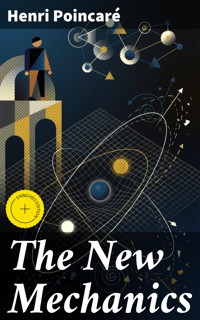
In "The New Mechanics," Henri Poincar√© pioneers the foundations of modern physics with his revolutionary exploration of dynamical systems and celestial mechanics. Written in the early 20th century, this work deftly interweaves advanced mathematical theory with a profound philosophical inquiry into the nature of scientific laws. Poincar√©'Äôs intricate prose balances rigorous mathematical exposition with an accessible narrative style, making complex concepts such as determinism, chaos theory, and the three-body problem comprehensible to both scientists and the intellectually curious layperson. The book stands as a significant milestone in the transition from classical to modern physics, illuminating the profound implications of mechanics on our understanding of time and space. Henri Poincar√©, a polymath renowned for his contributions to mathematics and theoretical physics, approached "The New Mechanics" with a deep-seated fascination for the philosophical underpinnings of scientific inquiry. His ability to synthesize diverse fields'Äîfrom topology to mathematical physics'Äîreflects his rich educational background and his profound commitment to exploring the relationships between different scientific disciplines. This work was inspired not only by his extensive research into mechanics but also by a desire to make science more comprehensible and interconnected. For those seeking to deepen their understanding of the modern scientific paradigm, "The New Mechanics" is an essential read. Poincar√©'Äôs insights are not only foundational for students and scholars in physics and mathematics, but they also resonate with anyone interested in the philosophical implications of scientific knowledge. This text offers a compelling narrative that encourages critical thinking and reflection on the nature of the universe. In this enriched edition, we have carefully created added value for your reading experience: - A succinct Introduction situates the work's timeless appeal and themes. - The Synopsis outlines the central plot, highlighting key developments without spoiling critical twists. - A detailed Historical Context immerses you in the era's events and influences that shaped the writing. - An Author Biography reveals milestones in the author's life, illuminating the personal insights behind the text. - A thorough Analysis dissects symbols, motifs, and character arcs to unearth underlying meanings. - Reflection questions prompt you to engage personally with the work's messages, connecting them to modern life. - Hand‐picked Memorable Quotes shine a spotlight on moments of literary brilliance. - Interactive footnotes clarify unusual references, historical allusions, and archaic phrases for an effortless, more informed read.
Das E-Book können Sie in Legimi-Apps oder einer beliebigen App lesen, die das folgende Format unterstützen:
Veröffentlichungsjahr: 2021
Ähnliche












The New Mechanics
Table of Contents
Introduction
A quiet revolution unfolds when the laws that seem to govern every motion are revealed to depend, in part, on how we choose to describe them.
The New Mechanics is regarded as a classic because it captures a decisive moment in modern thought: the reconsideration of the foundations of mechanics by one of the most influential mathematicians and philosophers of science of his era, Henri Poincaré, presented to English readers through the work of George Bruce Halsted. Its lasting power lies not in plot but in argument, style, and intellectual daring. The book treats scientific ideas as living structures—built, revised, and clarified—so that later generations could return to its pages not merely for results, but for a model of rigorous, reflective reasoning about nature.
Henri Poincaré wrote at a time when physics and mathematics were undergoing rapid development, and when questions about the meaning of fundamental concepts—space, time, force, and measurement—were newly urgent. Halsted, known for bringing major continental mathematical works to an English-speaking audience, helped establish this text as part of a broader conversation across languages and disciplines. Together, author and translator make accessible a mode of scientific writing that is at once technical and philosophically attentive, inviting readers to see mechanics not only as computation, but also as interpretation.
The book’s central premise is that mechanics, while extraordinarily successful, rests on principles whose status requires careful examination. Rather than treating the basic laws as self-evident, Poincaré approaches them as principles whose meaning, scope, and justification must be analyzed with precision. This involves attending to how we define quantities, how we connect mathematics to experience, and how certain foundational statements function within theory. The result is a work that asks readers to distinguish between what is observed, what is inferred, and what is adopted as a guiding framework.
What makes this a classic is its literary impact within scientific prose: it demonstrates how conceptual clarity can be pursued with elegance and restraint. Poincaré’s method is to pose pointed questions, refine distinctions, and proceed by careful argument rather than by rhetorical force. That style has influenced how later writers in the philosophy of science, theoretical physics, and mathematics present foundational issues—showing that deep technical matters can be discussed in a way that remains readable, structured, and intellectually candid, even for those who must work to follow every step.
The enduring themes of The New Mechanics center on the relationship between mathematical form and physical meaning. Poincaré examines how equations become claims about the world, and how the choice of a framework shapes what counts as an explanation. He treats measurement and reference as integral to theory, not mere afterthoughts, and he emphasizes the need to understand what our fundamental notions commit us to. These themes have remained fertile because they recur whenever science confronts the limits of older concepts and the pressures of new evidence or new methods.
In its influence on later writers, the book stands as an early, prominent instance of a scientist addressing foundational problems with explicit philosophical intent. It helped normalize a reflective stance toward basic principles—encouraging later authors to discuss not only what mechanics predicts, but also what its key statements mean and how they function. The book also illustrates how translation and editorial mediation can shape reception: Halsted’s role signals the importance of circulation and interpretation in creating an international intellectual canon around major scientific ideas.
Key context matters for reading it well: this is not a laboratory narrative, nor a step-by-step textbook in the narrow sense, but a sustained inquiry into fundamentals. Its questions arise from the state of mechanics and mathematical physics in Poincaré’s period of composition, when established formalisms were powerful yet open to conceptual scrutiny. The book proceeds by examining principles and the reasoning that supports them, aiming to show where certainty comes from, where assumptions enter, and why the structure of mechanics has the form it does.
Without revealing outcomes beyond the initial setup, it is enough to say that Poincaré guides the reader through a reconsideration of familiar laws and concepts as they appear within classical mechanics, stressing their roles within a coherent theoretical system. The discussion focuses on what it means to apply a law, how one identifies invariants and regularities, and how mathematical representation interacts with empirical practice. The reader is invited to see that the strength of mechanics is inseparable from the careful articulation of its conceptual foundations.
The New Mechanics also endures because it dramatizes a tension that is permanently relevant: the desire for universal laws versus the dependence of those laws on definitions, conventions, and methods of comparison. Poincaré does not treat this tension as a flaw to be concealed, but as a feature to be understood. By doing so, the book provides a disciplined vocabulary for discussing scientific objectivity without ignoring the human work of choosing coordinate systems, establishing standards, and linking symbols to observations.
For contemporary readers—whether scientists, students, or philosophers—the book offers a way to think responsibly about models and their interpretation. In an age of increasingly sophisticated mathematics in physics and of computational modeling across disciplines, questions about assumptions, representations, and the meaning of foundational terms remain central. Poincaré’s approach encourages intellectual humility alongside rigor: one can use powerful formalisms while still asking what, exactly, they assert and how they connect to the world they aim to describe.
Its lasting appeal comes from this combination of authority and inquiry. Written by Henri Poincaré and made accessible in English through George Bruce Halsted, The New Mechanics remains a touchstone for anyone who wants to understand not only how mechanics works, but how its concepts are constructed and justified. By returning to fundamentals without reducing them to slogans, it helps readers face a modern challenge that never disappears: reconciling the precision of mathematics with the complexity of experience, and finding in that reconciliation a durable form of understanding.
Synopsis
The New Mechanics by Henri Poincaré, presented in an English version associated with George Bruce Halsted, introduces readers to the conceptual reorientation of mechanics that emerged around the turn of the twentieth century. Rather than treating mechanics as a fixed, self-evident structure, the work frames it as a discipline whose principles must be examined, justified, and related to the way measurement and calculation are actually carried out. The opening movement situates “new” mechanics as a response to tensions between classical formulations and evolving scientific practice, preparing the reader for a systematic review of foundational assumptions.
paragraphs
Early chapters develop the idea that mechanical laws are not isolated statements but parts of an interconnected framework linking geometry, timekeeping, and physical reference frames. Poincaré’s treatment emphasizes the role of definitions and conventions in setting up the language of mechanics, clarifying what is meant by positions, motions, and forces before any equations can be applied. This methodological focus places attention on how one identifies inertial motion and how one decides which idealizations are permissible. The argument proceeds by showing that familiar classical notions gain their power from coordinated choices in description and measurement.
paragraphs
As the discussion moves forward, the book considers how experiments and observations bear on mechanical principles. The narrative stresses that experience constrains theories, yet does not mechanically dictate a single formulation, because data must be interpreted within a chosen conceptual scheme. This section explores the boundary between what is directly observed and what is inferred through models, underscoring the practical reasons scientists adopt certain principles that simplify computation and unify phenomena. The “new mechanics” thereby appears not as a rejection of earlier mechanics but as a refined understanding of how its statements function in scientific reasoning.
paragraphs




