


1,99 €
Mehr erfahren.
- Herausgeber: Quickie Classics
- Kategorie: Gesellschafts- und Liebesromane
- Sprache: Englisch
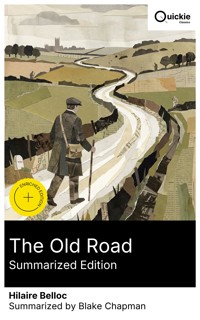
The Old Road is Hilaire Belloc's topographical meditation on the Pilgrims' Way from Winchester to Canterbury, reconstructed through walking, charters, place‑names, and the lie of the land. Part travelogue, part antiquarian inquiry, it reads the route as a palimpsest of prehistoric track, Roman alignment, and medieval pilgrimage. In brisk, epigrammatic prose, often accompanied by Belloc's maps, the book joins Edwardian debates over origins, access, and the disruptions of enclosure and rail. Belloc—French-born, English-educated at Balliol, a celebrated walker since The Path to Rome—treated roads as the grammar of civilization. His Catholic historical imagination and draughtsman's habit of verification shape every page: archives are tested against hedgerows, ridgeways, and fords, and modern evasions of continuity are challenged by what his feet and eye record. Scholars of medieval pilgrimage, historical geographers, walkers planning the Winchester–Canterbury traverse, and readers of robust prose will find lasting value here. The Old Road offers a vivid argument for reading England underfoot—part guide, part polemic, and wholly attentive to how paths store memory—making it an indispensable, provocative companion for study and for the road. Quickie Classics summarizes timeless works with precision, preserving the author's voice and keeping the prose clear, fast, and readable—distilled, never diluted. Enriched Edition extras: Introduction · Synopsis · Historical Context · Brief Analysis · 4 Reflection Q&As · Editorial Footnotes.
Das E-Book können Sie in Legimi-Apps oder einer beliebigen App lesen, die das folgende Format unterstützen:
Veröffentlichungsjahr: 2026
Ähnliche












The Old Road (Summarized Edition)
Table of Contents
Introduction
At once a journey and a recovery, The Old Road unfolds the persistent tension between a living landscape shaped by centuries of human passage and a modern consciousness tempted to forget how roads, rituals, and communities once bound place to memory, inviting readers to follow a walker who tests what can still be known by foot, sight, and patience, and to weigh the fragile seams where tradition endures within hedgerows and parish bounds against the restless pull of newer lines of movement, asking whether continuity can be traced not by documents alone but by the very contours that stitch England’s past to its present.
The book is a work of travel writing and historical topography by Hilaire Belloc, first published in the early twentieth century, and set along the ancient route commonly called the Pilgrims’ Way between Winchester and Canterbury in southern England. Belloc approaches the road as a cultural artifact as much as a path, moving through downs, villages, and river crossings while considering how routes emerge, fade, and reappear. Written for readers of his time yet addressed to any age, it mixes observation with concise historical reflection, rooting its inquiry in the landscape rather than in archival minutiae or antiquarian detachment.
Belloc’s premise is disarmingly simple: he undertakes to trace, as faithfully as conditions allow, the course of an old road across England, letting the ground itself suggest where it once ran. The narrative proceeds as a sequence of stages, each shaped by walking, looking, and testing alternatives, so that the reader feels the method as much as the motion. The voice is confident, curious, and occasionally combative; the style blends crisp description with reflective argument; the tone alternates between celebratory warmth and sober caution. The result is a focused, companionable book that asks for alert attention rather than passive sightseeing.
At its core lies a meditation on continuity: how a society remembers itself through routes that outlast regimes, tastes, and technologies. The old road functions as both material trace and metaphor, pointing to an England whose identity has been assembled not only in capitals but along paths linking cathedral, market, and farm. Belloc explores the pressures that recast such lines—legal changes, new priorities in travel, shifting patterns of settlement—without allowing the past to become merely picturesque. He is interested in the human scale of geography, in how communities orient themselves, and in how pilgrimage, whether devout or cultural, gives purpose to movement.
For contemporary readers, the book offers a disciplined alternative to hurried travel and a primer in reading landscapes as repositories of shared work and care. Its attention to footpaths, wayfinding, and local continuity speaks to current debates about sustainable mobility, access to the countryside, and the stewardship of historical environments. Beyond policy, it invites urban and rural audiences alike to consider how memory is embedded in everyday routes and how walking can renew civic imagination. The Old Road remains a reminder that heritage is not a static exhibit but a living network of connections that become legible when traversed attentively.
The craft of the book lies in method as much as in observation: Belloc assembles a route by noticing gradients, alignments, and practical necessities that would have guided long-distance walkers before modern infrastructure. He balances general principles with local exceptions, acknowledging ambiguities while arguing for a coherent line that can still be felt underfoot. The prose is lucid and vigorous, turning from physical description to concise historical inference without fuss. Digressive yet disciplined, it trusts the reader to weigh evidence and to imagine how decisions at a crossroads might have been made when weather, time, and terrain ruled the traveler.
Approached on its own terms—as a serious walk and a meditation on belonging—The Old Road rewards slow reading and welcomes pauses to consult maps of one’s own or to notice local traces where one lives. It offers the satisfactions of a quest without depending on high drama, and it culminates in a sense of arrival that need not be prefigured here. What matters is the clarity with which Belloc shows that places are intelligible when we apprentice ourselves to them. In an age crowded with signals and shortcuts, this book restores the dignity of attention, direction, and the shared ground beneath us.
Synopsis
The Old Road is Hilaire Belloc’s early twentieth‑century study of the ancient track commonly identified as the Pilgrims’ Way between Winchester and Canterbury. Combining travel narrative with topographical inquiry, Belloc sets out on foot to recover a continuous line obscured by modern changes. He presents the book as a disciplined search: read the land, test maps against ground, and rebuild a route from overlapping traces. From the outset he advances a central contention—that an older, pre‑Roman track, later adopted by medieval pilgrims to the shrine at Canterbury, can still be followed—while promising to demonstrate it by practical observation rather than romantic conjecture.
In opening chapters, Belloc states the criteria by which an ancient English road reveals itself. The Old Road, he argues, avoids heavy clay, keeps to the firm chalk or along the spring‑line beneath the North Downs, finds passes through ridges, and uses fords where rivers must be crossed. He emphasizes continuity of direction over exact paving, expecting minor local shifts where enclosures or new lanes intervened. Ordnance Survey sheets, parish boundaries, earthworks, and the survival of hollow ways are treated as cross‑checks. This method, he insists, can distinguish a persistent track from later turnpikes that pursue speed rather than perennial habit.
Beginning at Winchester, long a royal and ecclesiastical center, Belloc justifies the city as a natural western terminus for travelers bound east. He describes leaving its precincts to gain higher ground and trace the line toward the chalk uplands, seeking the long, dry shoulder that skirts the Weald. The narrative alternates between firm identifications and cautious hypotheses, especially where hedges, fields, and modern roads have overridden earlier lines. He explains how parish marches and old commons often preserve the course, and he notes how streams, mills, and crossings constrain the logic of the march as he advances toward the Surrey heights.
Across the Surrey country, the book becomes a running test of principle against relief. Belloc follows the ridge and spring‑line eastward, checking the road’s alignment whenever a river or valley obliges descent, and regaining height as soon as the ground permits. He marks the places where chapels, hilltop sites, or long‑used footpaths corroborate the direction, and he remarks on stretches where railway cuttings or turnpikes have confused the reading. The prose dwells on broad views, recurring spurs, and the sequence of downs that guide a walker’s eye. Throughout, the argument remains practical: a serviceable path links necessary points with least effort.




