


0,49 €
Niedrigster Preis in 30 Tagen: 1,99 €
Niedrigster Preis in 30 Tagen: 1,99 €
Mehr erfahren.
- Herausgeber: Booksell-Verlag
- Kategorie: Gesellschafts- und Liebesromane
- Sprache: Englisch
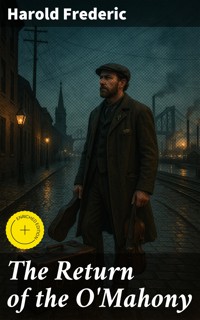
In Harold Frederic's novel, "The Return of the O'Mahony," readers are immersed in a compelling narrative that intertwines themes of identity, belonging, and the struggle between tradition and modernity. Set against the backdrop of 19th-century America, the book utilizes a rich, descriptive literary style that evokes the era's complexities, drawing heavily on Frederic's nuanced understanding of both Irish immigrant culture and American societal dynamics. The story follows the protagonist, an Irish-American man grappling with his dual heritage as he returns to his roots, embodying a broader exploration of cultural assimilation and the quest for self-discovery. Frederic, an American author born to Irish descent, brings a unique sensibility to his writing, informed by his own experiences as a journalist and a resident of England. His intimate understanding of the challenges faced by immigrants, particularly during a time of social upheaval, undoubtedly influenced his portrayal of the O'Mahony family's struggles and triumphs. Frederic's dual perspective enables him to bridge worlds, reflecting the cultural tensions that defined his era. For readers interested in literature that probes the depths of human experience and cultural dislocation, "The Return of the O'Mahony" offers a captivating exploration of identity and belonging. Frederic's deft storytelling and profound character development make this novel a compelling read that resonates with contemporary discussions about immigrant experiences and the enduring search for one's place in the world. In this enriched edition, we have carefully created added value for your reading experience: - A succinct Introduction situates the work's timeless appeal and themes. - The Synopsis outlines the central plot, highlighting key developments without spoiling critical twists. - A detailed Historical Context immerses you in the era's events and influences that shaped the writing. - A thorough Analysis dissects symbols, motifs, and character arcs to unearth underlying meanings. - Reflection questions prompt you to engage personally with the work's messages, connecting them to modern life. - Hand‐picked Memorable Quotes shine a spotlight on moments of literary brilliance. - Interactive footnotes clarify unusual references, historical allusions, and archaic phrases for an effortless, more informed read.
Das E-Book können Sie in Legimi-Apps oder einer beliebigen App lesen, die das folgende Format unterstützen:
Veröffentlichungsjahr: 2019
Ähnliche











The Return of the O'Mahony
Table of Contents
Introduction
The Return of the O’Mahony turns on the magnetic power of a storied name—how the aura of lineage and the narratives built around it can remake a destiny, reorder a community’s expectations, and reveal the uneasy boundaries between authenticity, performance, and belief.
Harold Frederic, an American novelist and journalist of the late nineteenth century, brings to this work a realist’s eye for social detail and a reporter’s sense of momentum. First appearing in the 1890s, the novel belongs to the period’s vibrant transatlantic fiction, where questions of identity, reputation, and cultural inheritance were pressing concerns. Its world is shaped by the imaginative pull of Irish history and by the modern forces—urbanization, mass media, and public spectacle—that reframed old loyalties and traditions. Readers encounter an artful blend of social observation and narrative verve, attentive to how private desires and public stories intersect.
Without venturing into spoilers, the premise is spare and compelling: the reemergence of an O’Mahony—real, perceived, or contested—becomes the catalyst for a chain of encounters that test ideals and expose motives. Rather than relying on melodrama, the book advances through shrewd scenes and revealing conversations, inviting readers to judge what can and cannot be trusted in the social theater it stages. The experience is brisk yet reflective, poised between irony and sympathy. Frederic’s control of pace and atmosphere steers attention to the telling gesture or phrase, so that suspense arises less from sensation than from shifting loyalties and competing versions of truth.
At its thematic core, the novel examines the uses and misuses of heritage. It asks how claims of descent and continuity can inspire solidarity, confer authority, or be repurposed as currency in a modern marketplace of fame and influence. Alongside questions of legitimacy stand issues of class mobility, the seductions of public attention, and the uneasy traffic between private conscience and collective myth. The book is alert to the ways communities narrate themselves into being, and to the costs individuals bear when they shoulder—or exploit—such narratives. The result is a study of identity under pressure, animated by curiosity rather than dogma.
Stylistically, Frederic favors lucid prose, firm characterization, and a quietly satiric edge. The dialogue-driven scenes create an intimate vantage on social maneuvering, while the descriptive passages keep the focus on telling details rather than ornament. The tone moves confidently between comedy of manners and moral inquiry, allowing wit to sharpen, not soften, the stakes. Readers can expect a steadiness of craft that privileges clarity over display: a clean line of storytelling, a keen ear for speech, and an eye for the atmospheres—club, salon, street, parlor—in which ambitions are announced, reputations are made, and masks are tested.
For contemporary readers, the book’s concerns feel strikingly current. It probes how names function as brands, how media amplify or distort reputations, and how communities negotiate the tension between cherished tradition and pragmatic present needs. It raises questions about the ethics of representation—what we owe to the past we invoke, and what we risk when we turn ancestry into a spectacle. It also speaks to migratory histories and the enduring pull of imagined homelands, suggesting that identity is both inheritance and invention. In this, the novel offers not answers but a framework for thinking about belonging in an age of publicity.
Approached as a work of realist fiction with a satiric gleam, The Return of the O’Mahony offers the pleasures of close observation and the provocations of moral debate. It rewards readers who enjoy character-driven narratives that treat belief and skepticism as twin engines of plot. Rather than hinging on grand revelations, it accumulates insight through nuance, balancing empathy with scrutiny. Read with attention to how stories circulate—who tells them, who believes them, and who benefits—you will find a narrative that illuminates its time while asking questions that echo beyond it, about the ties that bind and the names we live by.
Synopsis
Harold Frederic’s The Return of the O’Mahony follows an Irish-American whose unexpected claim to an old Gaelic lineage draws him from bustling American stages to the coastal villages of Ireland. The novel opens with a tone of curiosity and spectacle, as rumors and relics elevate a man of talent and charm into a potential clan figurehead. Set in the late nineteenth century, the story uses this premise to explore how legend, ancestry, and public appetite for pageantry can reshape an ordinary life. The narrative proceeds from uncertainty to opportunity, tracing how a personal story becomes entangled with communal hopes and historical memory.
Early chapters sketch the protagonist’s American life: a resourceful performer, adept at mimicry and tales, who navigates theaters, press agents, and casual celebrity. Chance encounters and a tantalizing newspaper story link him to the storied O’Mahony name. A relic, a document, and a chorus of believers propel a tentative inquiry into heritage. With skepticism matched by curiosity, he allows the possibility to grow, encouraged by promoters who sense a marketable romance of return. The decision to travel is framed as both an adventure and an experiment, balancing ambition with the risk of public exposure and private disillusionment.
Upon arrival in Ireland, the narrative slows to observe landscape, custom, and social layers along the southwestern coast. Local memory of the O’Mahony line proves lively, if fragmented, and the visitor’s presence revives dormant loyalties and rivalries. The countryside is shaped by the land question, where tenant hardship and landlord authority coexist with clerical influence and nationalist agitation. Public welcome alternates with wary scrutiny. The protagonist recognizes how ceremonies and greetings can be performances, yet he also senses a weight of expectation that exceeds theatrical charm. The book moves from novelty toward a test of belonging and trust.
Key figures gather around the claimant: a measured parish priest urging caution; a fervent organizer drawing him toward political meetings; a scholarly antiquarian who demands proofs; and a perceptive woman from the local gentry who reads both manners and motives. Each engages him differently—some as symbol, some as tool, some as puzzle. These relationships frame competing paths forward: devotion to clan myth, integration into contemporary politics, submission to documentary verification, or retreat into private life. The plot balances exchanges in parlors and roadside crowds, positioning the newcomer at a crossroads where personal identity meets communal narrative.
Ceremonies of acknowledgment follow, including feasts, toasts, and impromptu speeches where the visitor displays wit and ease. The pageantry is affectionate but also strategic, as supporters translate lineage into leverage. The protagonist’s stage training helps him adapt to roles thrust upon him, while hints of uncertainty deepen. Frederic emphasizes the mechanics of acclaim—how banners, songs, and carefully told histories confer status. Yet the book keeps questioning whether applause confirms truth or merely rehearses a desired story. Gradually, the stakes rise: influence at stake becomes material, affecting rent disputes, reputations, and ambitions, pushing the claimant from entertainer to figure of consequence.
Official attention increases. Magistrates and constables appear at gatherings, and discreet inquiries track the provenance of seals, signatures, and diaries. Press coverage oscillates between romance and ridicule, amplifying every gesture. Voices from America resurface, raising questions about past alliances and debts. The protagonist confronts a practical dilemma: retaining his newfound position requires proof that may be elusive, while stepping back could abandon those who have invested hope. Rumors of forged papers and competing heirs add pressure. A public challenge forces him to weigh expedient narratives against verifiable facts, testing how far performance can support a claim.
A personal thread emerges as companionship ripens into a restrained courtship, casting the heritage quest in domestic terms. Union with an admired local woman suggests reconciliation between past and present, tradition and change. Yet this prospect also sharpens scrutiny, since marriage would affirm status. Correspondence and witnesses arrive from across the Atlantic, some helpful, some compromising. An old acquaintance hints at the cost of reinvention. The protagonist’s private doubts, though carefully concealed, shape choices in meetings and interviews. The story foregrounds competing loyalties—self-preservation, communal welfare, and the ethics of candor—without resolving them prematurely.
Tension culminates in a crowded encounter—part festival, part tribunal—where hospitality and interrogation intermingle. The claimant must act swiftly to avert harm as tempers and expectations crest. A revelation reshapes the field, clarifying certain records while complicating others. Alliances shift; public voices recalibrate their tales; and the protagonist’s next step becomes a statement about what matters most. Frederic stages the moment as both social drama and moral decision, emphasizing outcomes that touch livelihoods and memories. Without exhaustive disclosure, the narrative signals that the difference between legend and life cannot be indefinitely managed by charm alone.
The closing movement concentrates on consequences rather than spectacle. Some ties loosen, others strengthen in quieter forms, and the protagonist accepts limits alongside possibilities. The book’s central message concerns authenticity in a world fond of ceremonial stories: ancestry can inspire, but it cannot substitute for responsibility or truth. Frederic portrays Ireland and its diaspora with attention to the pressures of modernity, the uses of myth, and the pull of performance. The Return of the O’Mahony ends by aligning character with conduct, suggesting that identity is less a heraldic claim than a practiced, accountable way of living.
Historical Context
Harold Frederic’s The Return of the O’Mahony is set in the late Victorian period, primarily the 1880s and early 1890s, when Ireland remained part of the United Kingdom of Great Britain and Ireland under Dublin Castle administration. The geographical canvas suggested by its title and themes encompasses rural Munster—especially West Cork, historic seat of the O’Mahony sept—as well as Dublin’s political milieu and the transatlantic nodes of London, Liverpool, and New York. Steamship routes through Queenstown (Cobh) linked emigrants and returnees, while railways threaded estates, market towns, and ports. The novel’s world is one of landlord demesnes, tenant smallholdings, Catholic parish networks, and the noisy pressrooms and committee rooms where national questions were daily contested.
The backdrop begins with the Great Famine (1845–1852), when Phytophthora infestans ruined successive potato crops, causing approximately one million deaths and mass eviction. Between 1845 and the mid-1850s, roughly two million emigrated, many through Queenstown or Liverpool, creating durable Irish communities in Boston and New York. By the 1890 U.S. census, nearly 1.9 million Irish-born resided in the United States, channeling remittances and politics back home. This demographic rupture transformed rural society, labor structures, and inheritance patterns. The novel’s concern with a “return” is legible against this diaspora: the figure who comes back, in name or body, confronts a homeland economically altered by famine memory, absenteeism, and the social vacuum emigration left behind.
The Land War (1879–1882) defined late-century rural politics. Michael Davitt founded the Irish National Land League at Castlebar on 21 October 1879, recruiting Charles Stewart Parnell as president. Its program—fair rent, fixity of tenure, and free sale—collided with landlord authority. Boycotting, named after Captain Charles Boycott in County Mayo in 1880, became a famous tactic. Gladstone’s Land Law (Ireland) Act 1881 created land courts, yet coercion followed; Parnell was imprisoned in 1881 before the Kilmainham Treaty (May 1882). The Phoenix Park assassinations of Chief Secretary Lord Frederick Cavendish and T.H. Burke on 6 May 1882 shocked Britain. The novel echoes this agrarian cauldron in its attention to tenantry grievances, local solidarities, and the volatile politics of rent and eviction.
The Home Rule movement moved the constitutional question to Westminster. Isaac Butt’s Home Government Association (1870) evolved into the Home Rule League, and Parnell’s leadership (from 1877) forged the Irish Parliamentary Party (IPP) into a disciplined bloc. The IPP held the balance after the 1885 general election, prompting William Ewart Gladstone’s First Home Rule Bill (introduced 8 April 1886). Its defeat on 8 June 1886 by 343–313 split the Liberals and birthed the Liberal Unionists. Transatlantic support—Patrick Ford’s Irish World and American Land League fund-raising—sustained agitation. The novel mirrors these cross-currents in characters who negotiate between constitutional ambition and practical survival, and in the way transatlantic money and rhetoric refract local Irish aims.
Crisis followed with the Parnell–O’Shea scandal. After the divorce verdict of 17 November 1890 named Parnell, Gladstone indicated he could not work with him; the IPP split in December 1890 into Parnellites and anti-Parnellites under Justin McCarthy. Parnell died on 6 October 1891. In the 1892 election, anti-Parnellites won roughly 72 seats and Parnellites about 9, while the Second Home Rule Bill of 1893 passed the Commons (347–304) but was crushed in the Lords (419–41) on 8 September. Concurrently, Chief Secretary A.J. Balfour’s policy (1887–1891) combined coercion with reforms—the Ashbourne (1885) and Balfour (1891) land purchase acts and a Congested Districts Board (1891). The book registers this era’s disillusioned realpolitik and the strain between heroic myth and bureaucratic “kindness.”
Revolutionary nationalism also shaped the era. The Irish Republican Brotherhood (IRB) formed in 1858 under James Stephens, with its American arm—the Fenian Brotherhood—founded the same year in New York by John O’Mahony and Michael Doheny. The failed rising of 1867 and the executions of the “Manchester Martyrs” reverberated into the 1880s, when Clan na Gael factions and Jeremiah O’Donovan Rossa championed a “skirmishing” or dynamite campaign (1881–1885) in Britain. American newspapers and subscription networks financed activism and prisoners’ families. By the 1890s, this militant inheritance coexisted uneasily with constitutionalism. The novel’s very title, invoking an ancient Gaelic name, engages this tension between romantic insurgent lineage and the sobering politics of late-Victorian Ireland.
A cultural-national movement paralleled politics: the Gaelic revival. The Gaelic Athletic Association was founded in Thurles on 1 November 1884 by Michael Cusack and Maurice Davin to foster indigenous games, while Conradh na Gaeilge (the Gaelic League) was launched on 31 July 1893 by Douglas Hyde and Eoin MacNeill to revive the Irish language. Hyde’s 1892 address on “De-Anglicising” articulated a cultural program that complemented Home Rule. West Cork, historic stronghold of the O’Mahony—castles at Rosbrin, Dunlough (Three Castle Head), and Dunmanus—fed antiquarian interest and genealogical pride. The novel’s “return” trope resonates with this revivalist impulse: reclaiming language, lineage, and place as moral counterweights to colonial standardization and to diaspora amnesia.
As social and political critique, the book exposes the layered injustices of landlordism, the precarity of smallholders, and the coercive instruments of imperial governance, while probing the seductions and perils of nationalist leadership. It dramatizes class fissures between Anglo-Irish proprietors, middlemen, and Catholic tenants, and it weighs diaspora fantasies against the lived constraints of rural Ireland. Parliamentary brinkmanship, factional splits, and philanthropic “cures” are shown to leave unresolved structural inequalities. By invoking an ancestral name in a modern setting, the narrative interrogates performative identity and opportunism, suggesting that authentic renewal requires more than rhetoric: it demands equitable land relations, accountable politics, and cultural agency for the majority.




