


0,49 €
Niedrigster Preis in 30 Tagen: 0,00 €
Niedrigster Preis in 30 Tagen: 0,00 €
Mehr erfahren.
- Herausgeber: DigiCat
- Kategorie: Poesie und Drama
- Sprache: Englisch
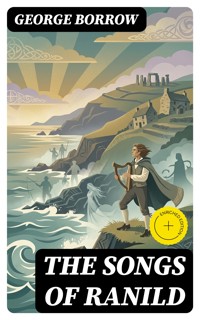
In "The Songs of Ranild," George Borrow delves into the rich tapestry of Cornish folklore, presenting a collection of lyrical narratives that intertwine myth, history, and emotion. Borrow's style is characterized by its romanticism and vivid imagery, reflecting the beauty and complexity of the natural landscape as well as the human experience. The work resonates with themes of longing and cultural heritage, echoing the Victorian fascination with the pastoral and the primitive, while simultaneously showcasing Borrow's affinity for the supernatural elements inherent in folk traditions. George Borrow was a prolific writer and philologist, deeply engaged with the cultures he encountered during his travels throughout England and Wales. His interest in folk customs and traditions, combined with his mastery of language, propelled him to write this collection. Influenced by his personal encounters with Cornish society and his earlier works that explore the intersections of language and culture, Borrow's creative journey is a testament to his belief in the power of storytelling to transcend local boundaries. For readers fascinated by folklore, linguistics, and the poetic exploration of human experiences, "The Songs of Ranild" is an essential addition to any literary collection. It invites reflection on the mystique of tradition and the enduring power of song, making it a profound experience for those seeking to understand the cultural nuances of the British landscape.
Das E-Book können Sie in Legimi-Apps oder einer beliebigen App lesen, die das folgende Format unterstützen:
Veröffentlichungsjahr: 2022
Ähnliche




The Songs of Ranild
Table of Contents
Introduction
The Songs of Ranild brings together four verse narratives by George Borrow, presented as a single-author collection unified by their shared ballad-like manner and their interest in traditional Northern European story material. The scope of this volume is deliberately focused: it is not a survey of Borrow’s entire literary career, but a compact gathering of related poetic texts that can be read as a coherent sequence. Read together, these pieces show Borrow working within inherited forms while shaping them through his own vigorous English idiom and narrative drive.
The contents include three pieces titled simply “Song the First,” “Song the Second,” and “Song the Third,” followed by “Child Stig and Child Findal.” The generic label “song” points to their kinship with lyric and ballad traditions, yet each work operates as a self-contained narrative poem rather than as a conventional modern song. In collecting them in one place, this edition emphasizes their shared tonal and formal features: a plain-spoken intensity, a forward-moving story rhythm, and a preference for dramatic incident rather than reflective exposition.
Borrow is widely known as a nineteenth-century English writer with a strong engagement in languages and in the transmission of traditional literature; these poems belong to that side of his work, where translation and adaptation stand close to original composition. The collection’s purpose is to make visible how he handles tales that circulate beyond a single national boundary, rendering them into English with an ear for cadence and an attention to the stark clarity that ballad narrative often demands. The result is verse that reads at once antiquarian and immediate in impulse.
Across the four items, the unifying interest is not in psychological interiority but in the public, fateful texture of story: named figures, decisive actions, and turns of fortune carried by event rather than explanation. Borrow’s treatment aligns with the ballad’s habit of presenting crucial moments with economy, trusting the reader to feel the pressure of what is left implicit. Even when the poems vary in pacing or emphasis, they share a preference for the direct presentation of scene and deed, with a diction that aims at force and intelligibility over ornament.
The collection also highlights Borrow’s stylistic signature as it appears in his verse: an energetic plainness, a taste for older narrative shapes, and a responsiveness to the music of spoken English. The “songs” are not essays about folklore; they are crafted literary objects that keep close to the momentum of oral story-telling while remaining firmly written texts. Their austerity is part of their effect, and their restraint helps preserve the sense that these narratives belong to an older repertoire of tale and counter-tale, carried forward by repetition and re-voicing.
Read as a set, these poems invite attention to how a nineteenth-century author negotiates between fidelity to traditional material and the demands of an English poetic line. The volume does not ask the reader to treat the pieces as isolated curiosities; instead, it frames them as examples of Borrow’s sustained interest in the movement of stories across languages and audiences. The poems’ continuing significance lies in this mediation: they offer one writer’s serious attempt to keep traditional narrative alive through literary transmission without converting it into mere decorative pastiche.
The Songs of Ranild is therefore best approached as a concentrated encounter with Borrow’s ballad-minded imagination. It offers narrative poetry that is compact, eventful, and shaped by the discipline of inherited forms, while also bearing the stamp of an individual writer attentive to sound, pace, and the integrity of story. For readers of Borrow and for readers interested in the English reception of traditional Northern narratives, the collection provides a clear point of entry: four texts that demonstrate how cultural material can be preserved, re-formed, and made newly readable within a distinct authorial voice.
Historical Context
George Borrow (1803–1881) published several translations and imitations of Scandinavian and other northern ballads during the early Victorian decades, when Britain’s reading public showed renewed appetite for “popular antiquities.” The Songs of Ranild belongs to that climate: a period shaped by Romantic-era folklore collecting, antiquarian scholarship, and the belief that old songs preserved a nation’s earliest character. Borrow’s ballads, including the pieces here, draw on Danish and broader Nordic materials circulating in English translation and scholarly editions. Their emphasis on fate, kinship, and violent honor reflects the period’s fascination with pre-modern social codes.
This interest had strong precedents in Europe. Thomas Percy’s Reliques (1765) helped make traditional ballads respectable, while in Scandinavia collectors such as Anders Sørensen Vedel and Peder Syv had earlier printed Danish songs, and later Romantic scholarship elevated them as national treasures. In Britain, Walter Scott’s Minstrelsy of the Scottish Border (1802–03) demonstrated how ballad editing could serve literature and national history at once. Borrow inherited this editorial-literary model, treating ballad narratives as both art and evidence. The collection’s terse episodes and formulaic diction echo this cross-European project of rescuing “oral” culture for print.
The Napoleonic era and its aftermath also mattered. Denmark’s crisis after the bombardment of Copenhagen (1807) and the loss of Norway (1814) intensified Scandinavian cultural nationalism, encouraging the study and dissemination of medieval and early modern vernacular traditions. Those developments reached Britain through periodicals, travel writing, and the expanding market for translated literature. Borrow’s northern balladry thus arrived not as isolated curiosities but as artifacts from societies reasserting identity through language and legend. The themes of contested loyalty, feuds, and household sovereignty in these songs resonated with contemporary discussions of nationhood and historical continuity.
Borrow’s formation as a linguist and wanderer shaped his approach. Associated with the British and Foreign Bible Society in the 1830s, he traveled in Russia and the Iberian Peninsula while cultivating a reputation for unusual language skills and sympathy for marginal peoples. That experience encouraged him to treat vernacular speech as a primary vessel of belief and character, a view that carries into his ballad work. The directness of dialogue, the recurring oaths, and the moral ambiguity of retaliation reflect his preference for unpolished voices over refined moralizing, aligning with Romantic primitivism rather than Victorian didacticism.
The early Victorian print economy amplified such projects. By the 1830s–1840s, cheaper books and magazines expanded audiences for translations, “ancient poetry,” and exotic lore, while university and gentlemanly antiquarian networks supplied editions and commentary. Borrow’s ballad publications circulated in a world where editors openly debated fidelity versus poetic effect, and where readers often welcomed vigorous paraphrase if it captured a perceived “spirit” of the original. This context helps explain the collection’s blend of archaic atmosphere with English metrical habits. Contemporary reception frequently valued vividness and strangeness as marks of authenticity.
Religious and moral sensibilities also framed how these narratives were read. Victorian Britain, influenced by Evangelical reform and campaigns against violence and sexual impropriety, sometimes viewed older ballads as troublingly frank. Yet the same society consumed medievalism in art and literature, finding in it a stage for exploring passion, sin, and punishment at a safe historical distance. In these songs, conflicts over marriage choice, family authority, and vengeance operate as moral tests without modern legal mediation. Borrow’s presentation could therefore attract both antiquarian admiration and ethical unease, depending on a reader’s tolerance for grim or fatalistic storytelling.
Broader intellectual currents reinforced the appeal of “northern” material. The comparative philology of the nineteenth century—linking Germanic languages and reconstructing earlier stages of speech—made Scandinavian texts relevant to British scholars and cultivated readers. Interest in Norse and Danish antiquity, visible in translations of sagas and studies of Germanic myth, encouraged the sense that northern Europe shared deep cultural roots. Borrow’s ballads participate in that imagined kinship by emphasizing stark landscapes, rigid honor, and supernatural or providential turns. The collection thus contributed to a Victorian map of origins in which Scandinavia served as a mirror for Britain’s own past.
Finally, the ballads’ specific narrative patterns—abduction or coercion, testing of fidelity, deadly misunderstandings, and the collision of personal desire with clan obligation—reflect structures typical of Danish medieval balladry as preserved in later collections. Borrow’s era prized these patterns as evidence of communal memory rather than individual authorship, reinforcing his stance as mediator rather than creator. At the same time, his name on the title-page situated the work within a market that valued strong literary personalities. The Songs of Ranild therefore sits at the intersection of Romantic nationalism, Victorian publishing, and evolving scholarly ideas about folklore and tradition.
Synopsis (Selection)
The Songs of Ranild (SONG THE FIRST–SONG THE THIRD)
A sequence of ballad-like songs centered on Ranild, unfolding through vivid scenes that privilege mood, voice, and emblematic action over plot complexity. The tone is stark and lyrical, with an oral-tradition cadence that foregrounds honor, attachment, and the pressure of communal judgment.
Across the three songs, recurring motifs of journeying, vows, and fateful meetings link personal desire to social duty, while natural and domestic imagery repeatedly mirrors inner conflict. The style favors compressed storytelling and refrains, creating a cumulative, intensifying effect as each song refracts the same world from a slightly different angle.
CHILD STIG AND CHILD FINDAL
A dramatic narrative ballad focused on two youthful figures whose bond and rivalry are tested by duty, reputation, and the hazards of decisive choices. It moves with swift, scene-to-scene momentum, maintaining a grave, plaintive tone characteristic of traditional heroic song.
Themes of loyalty, kinship, and the costs of pride are emphasized through recurring signals like challenges, promises, and public consequence, keeping the focus on moral pressure rather than interior explanation. Compared with the Ranild sequence, it feels more confrontational and event-driven, yet shares the same spare diction and fatalistic atmosphere.




