


0,49 €
Niedrigster Preis in 30 Tagen: 1,99 €
Niedrigster Preis in 30 Tagen: 1,99 €
Mehr erfahren.
- Herausgeber: DigiCat
- Kategorie: Abenteuer, Thriller, Horror
- Sprache: Englisch
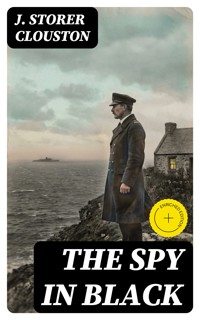
In J. Storer Clouston's gripping novel, "The Spy in Black," the narrative unfolds with an intricate blend of espionage and psychological drama set against the backdrop of World War I. Clouston employs a vivid literary style, infused with a sense of immediacy and atmospheric tension, as he delves into the lives of characters enmeshed in loyalty and betrayal. The plot focuses on a British naval officer tasked with uncovering a German spy, weaving together themes of duty, deception, and the moral ambiguities of war, all while reflecting the period's anxieties and uncertainties. Clouston, a skilled storyteller hailing from the early 20th century, was a contemporary of the tumultuous world events that inspired much of his work. His experiences traveling and engaging with various cultures likely shaped his worldview, imbuing "The Spy in Black" with authentic insights into the psychological landscapes of wartime. Clouston's background as an editor and novelist allowed him to fuse elements of genre fiction with a rich, character-driven narrative, elevating the work beyond mere entertainment. This compelling novel is a must-read for aficionados of historical fiction and espionage literature. Clouston's sharp prose and complex characters are sure to captivate readers, inviting them to ponder the ethical dilemmas faced by those in the shadows of war. Prepare to be drawn into a world of intrigue and moral complexity that will leave you questioning the true nature of loyalty. In this enriched edition, we have carefully created added value for your reading experience: - A succinct Introduction situates the work's timeless appeal and themes. - The Synopsis outlines the central plot, highlighting key developments without spoiling critical twists. - A detailed Historical Context immerses you in the era's events and influences that shaped the writing. - A thorough Analysis dissects symbols, motifs, and character arcs to unearth underlying meanings. - Reflection questions prompt you to engage personally with the work's messages, connecting them to modern life. - Hand‐picked Memorable Quotes shine a spotlight on moments of literary brilliance. - Interactive footnotes clarify unusual references, historical allusions, and archaic phrases for an effortless, more informed read.
Das E-Book können Sie in Legimi-Apps oder einer beliebigen App lesen, die das folgende Format unterstützen:
Veröffentlichungsjahr: 2022
Ähnliche


















The Spy in Black
Table of Contents
Introduction
In a world where war turns truth into camouflage, The Spy in Black examines how trust becomes the rarest currency, identity a tactical costume, and survival the art of reading silence, misdirection, and the faintest ripple of intent across sea, land, and human face, as opposing loyalties circle one another in darkness, each measuring the other’s nerve, patience, and appetite for risk, while the cold discipline of duty presses against private scruple, and every gesture, accent, and glance can serve as both invitation and trap, until the boundary between patriotism and self-preservation narrows to a perilous, shifting thread.
J. Storer Clouston’s The Spy in Black is an espionage thriller set during the First World War, unfolding against the stark coasts of wartime Scotland and the strategic waters surrounding Scapa Flow in the Orkney Islands, where the British Grand Fleet anchored and vigilance was a way of life. First published while the conflict still raged, the novel occupies an early, formative moment in modern spy fiction, when clandestine operations shifted from melodramatic cloak-and-dagger spectacle to grounded narratives of intelligence and counterintelligence. Its tight focus on a single, high-risk mission and its atmospheric island setting place it firmly within the tradition of maritime-inflected wartime intrigue.
At its outset, the novel follows a German naval officer tasked with a clandestine assignment that brings him ashore on a remote Scottish island, where the proximity of the British fleet makes every cottage, lane, and headland feel perilously exposed. His objective requires contact with covert collaborators, careful reconnaissance, and the nerve to pass among watchful locals without stirring suspicion. Clouston builds the situation from ordinary details—weather, ferries, routines—until the familiar feels treacherous. The initial setup reveals only what the protagonist can confirm, maintaining a taut uncertainty that invites the reader to weigh every gesture and inference as if their own safety depended on it.
Stylistically, the narrative keeps close to the operative’s perceptions, favoring restrained description and procedural clarity over sensational flourish. Clouston’s sentences move with a mariner’s economy, attentive to bearings, schedules, and small irregularities that may signal a trap. The tone is cool yet not detached, allowing the reader to feel both the discipline of training and the prickling uncertainty of unfamiliar ground. Pacing is methodical, as reconnaissance must be, and then punctuated by abrupt turns that reframe the risks already taken. The effect is immersive rather than flashy, a slow tightening of perspective that rewards patience and close attention to seemingly minor cues.
Among its central themes is the instability of identity under pressure: names, uniforms, and manners become instruments to be tuned, not truths to be trusted. The book considers how information moves—by rumor, signal, and careful observation—and how power accrues to those who can sift noise from pattern without losing moral bearings. It treats landscape as an adversary and accomplice, the island’s channels and tides shaping what can be seen, heard, or concealed. Equally present is the tension between duty and conscience, as professional obligation collides with impulse and habit, raising questions about honor that espionage can expose but never easily resolve.
Read today, the novel’s preoccupation with ambiguity and inference feels strikingly contemporary, reflecting a world where conflicts seldom announce themselves cleanly and where misinformation can travel faster than ships. Its attention to surveillance, counter-surveillance, and operational security anticipates the protocols of later intelligence fiction and resonates with modern concerns about data, privacy, and the gray zones between war and peace. By following an adversary on his own ground, the book complicates simple binaries, encouraging readers to examine motives rather than slogans. That perspective—skeptical, humane, and rigorous—remains valuable in an era that often rewards speed over scrutiny and certainty over doubt.
For new readers, the book offers a compact, carefully engineered experience: a few vivid settings, a limited cast, and a sequence of risks that escalate through observation rather than spectacle. Its restraint is a strength, letting atmosphere and calculation do the heavy lifting while events slide into place with understated inevitability. Approached with attention to its period context and maritime details, it yields both suspense and insight into how intelligence work compresses the ordinary into crisis. As an early entry in modern espionage storytelling, it remains accessible and bracing, a study in controlled tension that rewards alertness on every page.
Synopsis
The Spy in Black by J. Storer Clouston, published in 1917, is a World War I espionage novel set among the Orkney Islands, within sight of Scapa Flow, the base of the British Grand Fleet. It opens with a German naval operative sent covertly to the remote archipelago to gather intelligence that could enable a crippling blow against British sea power. The austere landscape, close-knit communities, and military precautions create a taut field of watchfulness. Against this backdrop, the narrative establishes the agent’s careful assumption of a civilian identity, the stringent limits on movement and talk, and the high stakes attached to every observation and message.
The operative’s arrival requires a meticulous construction of credibility. He adopts a plausible trade, adopts local habits, and studies timetables, patrol paths, and coastal features without drawing attention. Orders focus him on discerning patterns in harbor usage, signaling routines, and the presence or absence of key warships. Wartime blackouts and restrictions both shield and constrain him, allowing cover stories to blend with the island’s enforced reticence. From the outset, the mission’s timeline is compressed and unforgiving, and the smallest misstep—an accent, a question asked too casually—threatens exposure in a community where any stranger is promptly discussed.
Under cover of night and fog, the agent makes contact with a supposed ally on the islands who offers shelter, guidance, and prescribed methods for transmission. This collaborator, playing a risky double life among neighbors, introduces the tradecraft that drives the plot: agreed signals, prearranged meeting points, and simple but robust ciphers. Weather and tides become active participants in the story, complicating plans and enforcing delays. The operative oscillates between professional caution and anxious impatience, aware that every hour may change the disposition of ships at anchor. Tension grows as trust must be extended without certainty.
Gathering intelligence requires the agent to reconnoiter discreet vantage points and listen for scraps of news in harbors and lanes. He notes the rhythm of patrols, the comings and goings of auxiliaries, and the outlines of floating defenses. To preserve cover, he blends observation with rumor, letting isolated facts accrete into usable patterns. When the first small message is relayed offshore by predetermined light signals, the response confirms higher authorities are watching closely. Security tightens in step: random searches, stricter checkpoints, and suspicious eyes make routine movements fraught, and the operative must constantly revise routes and tactics.
British counterintelligence becomes a looming, if often unseen, presence. Quiet watchers spot discrepancies, and official notices hint that leaks are suspected. The operative senses the possibility of traps—decoys, staged movements, and misleading chatter designed to draw spies into revealing themselves. His collaboration grows more strained as misgivings about timing and reliability mount. Professional pride compels him to press on, yet flashes of doubt surface about the human costs of a successful strike. The narrative dwells on the psychology of secrecy: the fragility of trust, the distortions of fear, and the way isolation magnifies every hint of danger.
As the operation’s decisive window approaches, urgency reorders priorities. A planned movement of ships promises an opportunity that may not recur, and the intelligence in hand must be completed, packaged, and sent with precision. Surveillance tightens further, and minor slips threaten to cascade into catastrophe. Signals are arranged for a final rendezvous, while the possibility of double games hangs over each exchange. The story’s momentum compresses into a sequence of nocturnal journeys, shadowed meetings, and narrowly avoided encounters, culminating at a remote shoreline where perception, timing, and nerve determine whether the mission alters the balance at sea.
Without disclosing its final turns, the novel’s power lies in its blend of credible tradecraft, atmospheric setting, and moral ambiguity. Clouston’s wartime tale captures the strategic weight of Scapa Flow and the anxious vigilance of a home front exposed to invisible threats. It helped shape British spy fiction by foregrounding patient observation over melodrama and by honoring the intelligence contest as a battle of wits and will. First published during the conflict it depicts, it retains contemporary resonance as a study of deception and national security. Its later, notable 1939 screen adaptation underscores its enduring grip on the espionage imagination.
Historical Context
The Spy in Black, by the Orcadian author J. Storer Clouston, appeared in 1917, in the midst of the First World War. Its action draws on the strategic importance of the Orkney Islands, off northern Scotland, where the Royal Navy’s Grand Fleet was concentrated at Scapa Flow. Britain’s maritime institutions, from the Admiralty to coastal defense commands, shaped daily life in these waters. The novel’s espionage premise reflects the urgency of safeguarding anchorages, shipping lanes, and communications. Clouston’s familiarity with island settings and North Sea shipping routes lends specificity to a story framed by wartime regulations, naval routines, and the pressures of total mobilization.
From August 1914, Scapa Flow served as the principal base of the Grand Fleet, whose task was to contain the German High Seas Fleet in the North Sea. Admiral John Jellicoe commanded until late 1916, when Admiral David Beatty succeeded him. The Battle of Jutland (31 May–1 June 1916), the war’s largest naval engagement, left the strategic situation unchanged but confirmed British control of the North Sea’s exits. Scapa Flow’s vast, sheltered anchorage and remoteness made it ideal, and it was ringed with defenses and support facilities that extended across Orkney’s islands, harbors, and channels.
In 1917 Germany resumed unrestricted submarine warfare, aiming to sever Britain’s supply lines by sinking merchant shipping without warning. Losses surged in the spring of 1917, prompting the Admiralty to adopt escorted convoys from May that year, a measure that markedly reduced sinkings. U-boats operated around the British Isles, including the northern approaches and the turbulent Pentland Firth near Orkney, where vital routes converged. The submarine campaign sought to counter the Royal Navy’s surface blockade of Germany and to strain British morale, logistics, and industrial output—pressures acutely felt in regions surrounding fleet anchorages and strategic straits.
Scapa Flow’s defenses reflected evolving anti-submarine doctrine. The entrances were obstructed with blockships, booms, and steel nets; minefields guarded approaches; and patrols by destroyers, trawlers, and drifters enforced a constant watch. Coastal artillery, searchlights, and observation posts ringed key headlands. Naval air patrols over the northern waters expanded during the war, supporting reconnaissance and anti-submarine efforts. Strict controls governed anchorages, signaling, and pilotage to prevent infiltration. These systems formed a layered barrier intended to deter or trap hostile vessels—a practical backdrop for any tale centered on clandestine movement, false identities, and the perilous margins of Britain’s main fleet base.
The war at sea unfolded alongside an intense war of intelligence. The Admiralty’s Naval Intelligence Division, led by Admiral Reginald “Blinker” Hall, oversaw Room 40, which broke German naval ciphers and decoded the Zimmermann Telegram in early 1917. Intelligence gleaned from intercepts, traffic analysis, and surveillance aided operations against U-boats and raiders. On the home front, MI5, created in 1909, expanded counter-espionage, while police and postal censors monitored communications. Early cases, notably the arrest and 1914 execution of German spy Carl Hans Lody at the Tower of London, shaped British perceptions of clandestine threats along coasts and railways.
Wartime law and administration underpinned this security environment. The Official Secrets Act (1911) criminalized unauthorized disclosure, while the Defense of the Realm Act (from August 1914) empowered authorities to censor news, control lighting, restrict photography, and regulate movement near military sites. Prohibited and controlled areas were established around sensitive coastal zones, and enemy aliens were registered or interned under Aliens Restriction measures. Postal and telegraph censorship curtailed the flow of potentially valuable information to adversaries. Tightened port procedures, identity checks, and permits were routine—conditions that shaped how civilians, sailors, and travelers interacted in Britain’s northern maritime corridors.
Orkney’s communities were transformed by militarization. The influx of thousands of naval personnel brought rapid construction of piers, camps, roads, and depots. Local prices rose, housing was scarce, and civilian services strained, even as wartime employment expanded. National rationing of staples such as sugar, meat, and fats was introduced in 1918, and blackout rules and curfews affected ports and villages. Fishing and coastal trade were constrained by patrol zones and minefields. Lighthouse operations, overseen by the Northern Lighthouse Board, were coordinated with naval requirements. Ferries and mail steamers operated under Admiralty priorities, knitting civilian life to fleet logistics.
Clouston’s novel belongs to a lively wartime and prewar tradition of British spy fiction, from Erskine Childers’s The Riddle of the Sands (1903) to John Buchan’s The Thirty-Nine Steps (1915). The Spy in Black channels 1914–1918 anxieties—vulnerable coasts, secret signals, compromised guides—into a narrative grounded in real naval geography and procedures at Scapa Flow. Its emphasis on deception, countermeasures, and the fragility of information aligns with contemporary intelligence practice and home-front vigilance. By situating clandestine maneuver within Britain’s sea-power strategy and supply crisis, the work reflects and critiques the era’s fixation on security, preparedness, and the moral strains of total war.




