


1,99 €
Mehr erfahren.
- Herausgeber: Quickie Classics
- Kategorie: Gesellschafts- und Liebesromane
- Sprache: Englisch
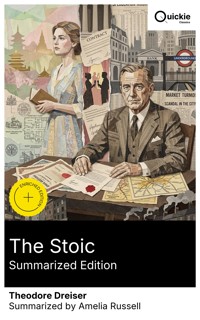
The Stoic concludes Dreiser's Trilogy of Desire, tracing financier Frank Cowperwood's last campaign as he shifts to London to consolidate a traction empire. In Dreiser's documentary naturalism, market maneuvers, courtroom feints, and intimate entanglements carry equal, unsentimental weight. Cowperwood's death arrests the design, and the narrative pivots to Berenice Fleming, whose disillusionment and eastern travels enlarge the scope from acquisition to conscience; she returns resolved to redirect wealth toward organized relief for the urban poor. The novel's unadorned cadence, panoramic scenes, and moral ambiguity place it within American naturalism's critique of Gilded Age capitalism while extending it into a meditation on renunciation. Dreiser—journalist-turned-novelist, raised in Midwestern hardship and long preoccupied with the mechanics of money and fate—modeled Cowperwood on traction magnate Charles T. Yerkes. Composed late and issued posthumously in 1947, the book reflects a lifetime of observing speculative cycles, transatlantic finance, and the limits of individual will; his battles over censorship and his travels sharpened his distrust of genteel moralities and his faith in impersonal forces. Readers of Balzac, Zola, and Wharton will value this unsparing anatomy of power and its humane coda, where ambition yields to ethical awakening. Quickie Classics summarizes timeless works with precision, preserving the author's voice and keeping the prose clear, fast, and readable—distilled, never diluted. Enriched Edition extras: Introduction · Synopsis · Historical Context · Author Biography · Brief Analysis · 4 Reflection Q&As · Editorial Footnotes.
Das E-Book können Sie in Legimi-Apps oder einer beliebigen App lesen, die das folgende Format unterstützen:
Veröffentlichungsjahr: 2026
Ähnliche














The Stoic (Summarized Edition)
Table of Contents
Introduction
At the center of The Stoic lies a relentless contest between the boundless drive that builds empires and the colder discipline that might govern it, a drama played out across fevered markets and ordered drawing rooms, where calculation, appetite, and the hope of self-mastery press against one another, testing whether wealth, influence, and organization can convert restlessness into poise or only enlarge its echo, whether public works can secure private meaning, and whether a life trained to appraise value can finally price its own desires without remainder, across an age of expansion and anxiety.
Published posthumously in 1947, The Stoic concludes Theodore Dreiser’s Trilogy of Desire, an ambitious sequence of American naturalist novels examining money’s operations and the characters shaped by it. Set chiefly in the late nineteenth and early twentieth centuries, the book moves through major urban centers, with particular attention to transatlantic finance linking New York and London. Within this milieu, Dreiser places the machinery of franchises, banks, and syndicates alongside salons, museums, and hotels, composing a panoramic business novel anchored in concrete processes rather than melodrama. The result is both historical chronicle and psychological study, attentive to systems as much as to individuals.
At its outset, the novel follows Frank Cowperwood, a seasoned financier whose earlier conquests have prepared him for new ventures that extend beyond familiar American markets. Seeking opportunities in public transit and related enterprises, he enters an intricate field of franchises, laws, and personalities, where entrenched interests resist and unexpected allies emerge. The narrative builds through meetings, letters, contracts, and social calls, tracing the steady labor of persuasion and the rhythms of capital formation. Dreiser’s voice is patient and cool, favoring cumulative detail over flourish, so that the reader experiences ambition not as sudden spectacle but as slow, exacting work.
Dreiser writes in a third-person perspective that can telescope from panoramic cityscapes to the tight calculation within a single mind, always keeping social forces in view. His style blends statistical sobriety with sensory specificity—leases, share offerings, and legislative schedules sit alongside fabrics, façades, and paintings—so that money’s abstraction continually meets the weight of matter. The tone is unsentimental and analytic, allowing readers to judge motives while observing how circumstances constrain them. Scenes unfold with measured continuity, emphasizing process, repetition, and consequence, and the book’s moral pressure arises less from authorial verdicts than from the friction between desire, opportunity, and time.
Key themes emerge with clarity. The novel probes the moral economy of ambition—how ends justify means in the language of modern enterprise, and how that language shapes people’s sense of virtue. It studies the entanglement of private gain with public infrastructure, asking what it costs a city when its arteries are built by competing visions of profit and progress. It tests the idea of self-mastery invoked by the title, weighing restraint against compulsion in business, art, love, and reputation. It also considers aging and legacy, measuring what can be secured by contracts and collections against what eludes calculation altogether.
These concerns remain strikingly current. Contemporary capitalism still turns on cross-border finance, the monetization of infrastructure, and the uneasy fit between private risk and public need. The novel’s portraits of negotiation, public messaging, and image-building anticipate today’s executive celebrity and the performative dimensions of leadership. Its attention to regulatory friction and municipal bargaining echoes debates over transit, housing, and utilities that define many cities now. By dramatizing how institutions channel individual aims, The Stoic offers a vocabulary for thinking about inequality, civic responsibility, and the narratives we tell to reconcile prosperity with principle in an era of constant expansion.
As the concluding volume of a long project, the novel rewards patient attention to pattern and proportion: parallel scenes, recurring negotiations, and shifting valuations gradually compose an argument about how lives are priced and how cities are made. Readers encounter not a simple cautionary tale, but a study of competing logics—market, legal, social, aesthetic—each persuasive on its own terms and none sufficient on its own. In this balance lies the book’s lasting force. It invites consideration of what can and cannot be bought, how power translates into form, and what kind of steadiness is possible amid perpetual appetite.
Synopsis
The Stoic, published posthumously in 1947, concludes Theodore Dreiser’s Trilogy of Desire and follows the later career of Frank Cowperwood, the relentless American financier introduced in The Financier and The Titan. The novel resumes with Cowperwood firmly established yet increasingly constrained by public scrutiny and political reform. Dreiser’s naturalistic lens returns to questions of appetite, power, and the social machinery that supports great fortunes. The narrative’s focus widens from private calculations to the public consequences of speculative enterprise, tracing how reputations are made and tested. Through steady, reportorial prose, Dreiser sets the stage for a final examination of ambition pressed against new geographies, societies, and ethical pressures.
Cowperwood, seasoned by earlier battles, surveys the American scene with a tactician’s eye. Regulatory pushback, reformist zeal, and a wary press narrow domestic options, even as his confidence and appetite remain undimmed. In his personal sphere, the long, complicated bond with Aileen—once a source of daring and defiance—now reveals fissures born of time, shifting expectations, and social weariness. Business calculations and intimate negotiations intermingle: alliances are cultivated, loyalties tested, and appearances managed. Dreiser situates Cowperwood at the point where sheer will must contend with changing institutions, suggesting that the next move will require not only capital but also a recalibration of place, method, and entourage.
The search for a wider field leads Cowperwood to London, where urban transit modernization promises scope equal to his ambition. Dreiser renders the British financial world with documentary attention: prospectuses and syndicates, committees and commissions, and the wary dance between Parliament, the press, and private capital. The established order is neither naive nor welcoming; it appraises the brash American through the filters of class, tradition, and self-interest. Cowperwood studies the map—literal and figurative—of routes, rights, and franchises, seeking leverage where technical innovation and bureaucratic complexity intersect. The city’s scale and its entrenched networks present an arena in which calculation must account for culture as much as for cash.
Amid this repositioning, Berenice enters as a new presence—poised, observant, and alert to dimensions of life that business often excludes. Her temperament contrasts with Aileen’s embattled pride and with Cowperwood’s combative certainty. Berenice moves through drawing rooms and galleries with tact, building social capital that is less transactional yet not without consequence. Dreiser traces her sensitivity to art, conversation, and the subtle codes of acceptance, showing how companionship can shape public perception in ways boardrooms cannot. She becomes a witness to the financier’s reach and a mirror to his limits, noticing what wealth includes and what it leaves untouched.
As Cowperwood advances in London, the campaigns acquire Dreiser’s typical granularity. There are negotiations over leases and rights-of-way, tussles with rival groups, calculations about electrification and rolling stock, and appeals crafted for investors and the general public. The narrative details how opinion is cultivated—through publicity, speeches, and the visible promise of progress—and how setbacks force tactical shifts. Dreiser emphasizes procedure: the minute steps by which bold visions move, stall, or are repackaged. The work’s energy resides in this ceaseless motion, where personality, mathematics, and municipal policy press upon one another at every stage.
Parallel to the public drive runs the private drama of companionship and aging ideals. Aileen’s arc reflects the strain of long partnership with a man whose main loyalty is to enterprise itself. Social standing, once an adventure, becomes a precarious trophy; rooms that once signified triumph now echo with comparisons and recriminations. Dreiser treats these scenes with sober sympathy, not sentimentalizing anyone’s position. He underscores how the costs of ambition are often tallied in quiet rooms—through pride, disappointment, and the effort to retain dignity as circumstances evolve. The household, like the market, reveals its own cycles of expansion, consolidation, and loss.
The contest intensifies under mounting pressure: formal inquiries test the legitimacy of deals; markets wobble; allies demand proof; opponents circulate doubts. Dreiser tracks Cowperwood’s response with the same analytical steadiness afforded his ascent. The financier still trusts nerve, speed, and an instinct for timing, yet the environment grows less forgiving. The city, portrayed as organism and opportunity, exerts a counterforce of fatigue and contingency. Reflections on art and collecting hint at desires beyond accumulation, even as deadlines and contracts reassert priority. The prose slows to register strain without melodrama, attentive to the limits of calculation when time and circumstance tighten.
Berenice’s perspective broadens as she encounters, with unguarded attention, lives distant from salons and subscription lists. Scenes of poverty and ordinary endurance—in London and beyond—challenge the assumptions embedded in the circles she frequents. She considers whether refinement without responsibility becomes mere ornament, and whether sympathy can be translated into action that is neither performative nor naive. Dreiser follows her attempts to articulate a path that honors feeling without abandoning clear sight. The novel’s compass thus widens from finance to questions of social duty and personal vocation, introducing horizons that lie outside the arithmetic of success.
Without disclosing its final turns, The Stoic closes the trilogy’s long inquiry into whether domination of systems yields a stable meaning for the individual. Dreiser’s title signals a posture of endurance, self-command, and acceptance before forces larger than any one will. The book’s enduring significance lies in its unsentimental mapping of modern capitalism’s promises and limits, and in its attention to how private relationships absorb the shocks of public ambition. As culmination and summation, it leaves readers with a measured resonance: that power, however formidable, must answer to time, to society’s claims, and to the human need to connect purpose with consequence.
Historical Context
The Stoic is set in the late nineteenth and early twentieth centuries, when industrial capitalism reshaped urban life in the United States and Britain. Its locales—Philadelphia, Chicago, New York, and especially London—were financial and transportation hubs driven by stock exchanges, municipal councils, and private traction companies. Electric power, mass transit, and steel construction enabled unprecedented metropolitan growth. City charters and parliamentary acts governed railway franchises, while business syndicates assembled capital across borders. Dreiser's narrative unfolds against this transatlantic network of institutions, where public needs—the movement of workers and goods—intersected with private risk-taking. The period's scale and volatility inform the novel's emphasis on ambition and consequence.
In American cities, the Gilded Age and its aftermath saw fierce competition for street-railway franchises, often brokered through city councils and courts. Speculation on securities tied to transit systems flourished, and scandals over bribery and "boodle" politics were widely reported in Chicago and elsewhere. Dreiser drew on the career of Charles Tyson Yerkes (1837–1905), a traction magnate whose rise, indictment, and strategic reinvention made him emblematic of the era's rough commerce. Yerkes's maneuvering around franchise terms, fare limits, and consolidation parallels widespread practices among urban utilities. This environment of high finance under lax regulation provides the novel's legal, political, and ethical backdrop.
Across the Atlantic, London entered a transformative phase in urban transport. Deep-level electric "tube" railways followed the pioneering City and South London Railway (opened 1890), spurring plans for interconnected lines. In 1902, the Underground Electric Railways Company of London was formed to finance and coordinate multiple routes, drawing heavily on American capital and managerial methods. Parliamentary committees and the Board of Trade reviewed bills, safety, and standards, while the London Stock Exchange enabled large bond and share issues. The intensive building years of 1906–1907 opened several lines, establishing the modern Underground. These developments frame the novel's focus on cross-border finance and infrastructure.
Reform currents shaped both sides of the Atlantic. In the United States, the Progressive Era pressed for cleaner city government, civil service rules, and tighter oversight of utilities. Chicago's prolonged "traction question" in the 1890s and early 1900s revolved around franchise duration, fare policy, and municipal control, issues litigated in courts and fought in referenda. In Britain, the London County Council (established 1889) promoted public improvements and clashed with private operators over transit priorities. Journalists and civic groups exposed graft and monopolistic practices. The resulting contests over ownership, regulation, and service standards form key pressures on the business strategies depicted in the novel.
The period also featured intense social display and philanthropy among industrial fortunes. American millionaires cultivated European art collections, endowed libraries and museums, and sought legitimacy through cultural patronage, while British elites navigated Edwardian social codes of rank and reputation. Transatlantic travel expanded with steamship lines, making London a stage for American wealth seeking entree into established circles. Philanthropic foundations multiplied, channeling private capital to public causes in education, science, and urban improvement. These practices situate characters' aspirations within recognizable rituals of status and benevolence, and spotlight the interplay between money, taste, and moral self-justification that marked upper-class life on both sides of the ocean.
Theodore Dreiser emerged from journalism in the 1890s and became a central figure in American literary naturalism. Sister Carrie (1900) and later works confronted urban poverty, sexual double standards, and the coercive force of money with an unsentimental style influenced by scientific determinism. Naturalist writers depicted individuals shaped by environment and social systems rather than moral choice alone. Dreiser's familiarity with reporters' exposés, courtrooms, and corporate news lent specificity to his business settings and public controversies. This background informs The Stoic's attention to institutions, documents, and negotiations, treating finance and city building as processes embedded in law, custom, and media scrutiny.
The Stoic was published posthumously in 1947 as the concluding volume of Dreiser's Trilogy of Desire, following The Financier (1912) and The Titan (1914). The series adapts episodes from the life of Charles T. Yerkes to examine the making of a modern capitalist. Its late appearance placed it before readers who had lived through the Great Depression and the New Deal's expansion of financial regulation and social welfare. That context sharpened attention to questions of speculation, public risk, and private gain already central to the trilogy. The book thus bridges Gilded Age practices and mid-twentieth-century reassessments of market power and responsibility.
Historically grounded in municipal franchises, capital markets, and reform politics, The Stoic scrutinizes how private ambition commandeered public necessities like transit. Its scenes of negotiation, publicity, and social striving reflect real mechanisms by which infrastructure was financed and legitimated in the era. Dreiser's naturalist method resists moral melodrama, instead charting the systemic pressures—law, credit, class, and reputation—that channel individual choices. The work thereby critiques a model of modernization built on asymmetric information, political access, and the conversion of privilege into enduring status. While sparing judgment about particular outcomes, it exposes the costs and bargains that underwrote metropolitan progress on both continents.
Author Biography
Theodore Dreiser (1871–1945) was a major American novelist and journalist, widely identified with literary naturalism. Writing during the rapid industrial expansion of the United States, he examined how social forces, economic pressures, and desire shape individual lives. His narratives favored unsentimental observation over ornament, challenging genteel conventions of the early twentieth century. Dreiser’s best-known novels include Sister Carrie and An American Tragedy, books that probed ambition, mobility, and the costs of success in modern cities. Though his prose style was sometimes criticized as heavy or uneven, many critics and writers acknowledged his power to register the textures of urban life and the workings of fate.
He grew up in the Midwest and briefly attended Indiana University in the late 1880s before leaving for financial reasons. In the 1890s he worked as a reporter and feature writer for newspapers and magazines in the Midwest and New York, a training that sharpened his eye for social detail and institutional life. Dreiser read widely in European realism and naturalism, especially Émile Zola and Honoré de Balzac, and absorbed contemporary ideas associated with Darwin and Herbert Spencer. These influences encouraged a deterministic, cause-and-effect approach to fiction, locating private aspiration within broad material conditions rather than in isolated acts of will.
Sister Carrie appeared in 1900 after a difficult path to publication. The book’s frank attention to desire, consumption, and urban opportunity unsettled prevailing moral expectations, leading to limited promotion and a muted initial reception. Although some reviewers admired its breadth and realism, others considered it improper. The controversy stalled Dreiser’s early novelistic career, and he returned for a time to editorial work in magazines. Over subsequent decades, however, Sister Carrie came to be seen as a landmark of American realism and naturalism, notable for its portrayal of the metropolis as a dynamic arena where economic structures shape choices and outcomes.
Dreiser reestablished his momentum with Jennie Gerhardt (1911) and launched a large-scale project on finance and power with The Financier (1912) and The Titan (1914), later concluded posthumously by The Stoic (1947). He also published The Genius (1915), which faced censorship pressures in the United States, and wrote for the stage in The Hand of the Potter (1918). His range extended to short and biographical sketches in Twelve Men (1919) and to travel and cultural observation in A Traveler at Forty (1913) and A Hoosier Holiday (1916). Across these works he pursued the interplay of money, status, desire, and institutional constraint.
An American Tragedy (1925) consolidated Dreiser’s reputation. Drawing on contemporary reportage about crime and social aspiration, the novel examined the entanglements of ambition, class, and moral judgment in modern America. It was both a critical and commercial success, and it circulated widely through stage and screen adaptations that broadened his audience. Readers often noted the book’s documentary reach—its attention to labor, leisure, media, and the legal system—alongside a relentless analysis of motive and circumstance. The novel’s scale and social focus placed it at the center of debates about American modernity, earning Dreiser a durable position in the national literary canon.
Beyond fiction, Dreiser wrote essays and reportage that confronted inequality, censorship, and the culture of business. He visited the Soviet Union in the late 1920s and published Dreiser Looks at Russia (1928), recording observations of economic planning and social policy. Autobiographical volumes such as Dawn (1931) and Newspaper Days (1931) revisited his youth and entry into journalism, highlighting the experiences that informed his realism. He frequently defended literary freedom during controversies over alleged obscenity, and sympathetic critics, including H. L. Mencken, argued for the seriousness of his aims. Dreiser’s public stances reflected a consistent interest in social justice and institutional power.
In later years Dreiser lived primarily in California while continuing to write essays and working on the manuscript that became The Stoic, published after his death. He was publicly associated with left-wing causes and, shortly before he died in 1945, joined the Communist Party USA, a step consistent with his long-standing critique of unregulated capitalism. Dreiser died in 1945 in Hollywood. His legacy endures in the tradition of American naturalism and in later writers who drew on his social vision and narrative amplitude. His novels remain widely studied for their portraits of urban modernity, mobility, and the pressures that shape American lives.




