


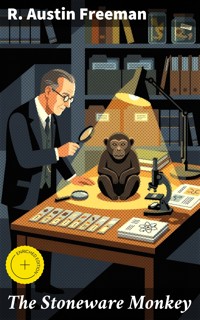
1,99 €
Niedrigster Preis in 30 Tagen: 1,99 €
Niedrigster Preis in 30 Tagen: 1,99 €
Mehr erfahren.
- Herausgeber: Booksell-Verlag
- Kategorie: Krimi
- Sprache: Englisch
In "The Stoneware Monkey," R. Austin Freeman masterfully weaves a tale of mystery and intrigue that showcases his signature blend of meticulous plotting and vivid character development. The narrative unfolds through the keen observations of Dr. John Thorndyke, a forensic investigator who uses scientific principles to solve crimes. Freeman's literary style is marked by its clarity and precision, reflective of the emerging forensic science of his time, situating the work firmly within the tradition of early 20th-century detective fiction that emphasizes intellectual deduction over sensationalism. This book is not merely a whodunit; it is a sophisticated exploration of human nature and moral ambiguity, utilizing the motif of the titular stoneware monkey as a symbol of significance that unfolds throughout the plot. R. Austin Freeman, a pioneer of the detective genre, was deeply influenced by his background in medicine and law, which informed his scientific approach to crime-solving narratives. His rich tapestry of experiences as a surgeon and a writer allows him to breathe authenticity and credibility into his characters and scenarios. Freeman's deep understanding of human psychology and the intricacies of the legal system underpins the vivid realism present in "The Stoneware Monkey," making it a noteworthy contribution to the literature of his time. Readers fascinated by the intersection of science and literature will find "The Stoneware Monkey" a compelling read. Freeman's intricate plotting, coupled with a captivating protagonist, provides not only an enjoyable detective story but also an insightful commentary on morality and human behavior. This book is a must-read for those who appreciate a blend of intellectual challenge and storytelling finesse. In this enriched edition, we have carefully created added value for your reading experience: - A succinct Introduction situates the work's timeless appeal and themes. - The Synopsis outlines the central plot, highlighting key developments without spoiling critical twists. - A detailed Historical Context immerses you in the era's events and influences that shaped the writing. - A thorough Analysis dissects symbols, motifs, and character arcs to unearth underlying meanings. - Reflection questions prompt you to engage personally with the work's messages, connecting them to modern life. - Hand‐picked Memorable Quotes shine a spotlight on moments of literary brilliance. - Interactive footnotes clarify unusual references, historical allusions, and archaic phrases for an effortless, more informed read.
Das E-Book können Sie in Legimi-Apps oder einer beliebigen App lesen, die das folgende Format unterstützen:
Veröffentlichungsjahr: 2021
Ähnliche


The Stoneware Monkey
Table of Contents
Introduction
Proof can be a weapon, but only if someone knows how to read it.
R. Austin Freeman’s The Stoneware Monkey belongs to the classic tradition of detective fiction in which the solution depends less on chase and melodrama than on careful inference from material traces. Freeman is best known for stories that foreground methodical reasoning, and this novel sits comfortably in that line, inviting readers to weigh evidence as attentively as the investigator does. Beyond author and title, firm publication particulars are not provided here, so the book is best approached simply as a work from the established early twentieth-century mode of crime writing associated with procedural clarity and logical closure.
The premise turns on a puzzling object and the chain of questions it provokes. A stoneware monkey, ordinary in appearance yet suggestive in context, becomes a focal point for suspicion and interpretation, drawing the inquiry away from easy assumptions and toward a more exacting account of events. The story’s pleasures are those of gradual clarification: details that seem incidental return with new significance, and each step of the investigation tests what can truly be known. The narrative remains oriented toward setup and scrutiny rather than spectacle, keeping the reader close to the workings of detection.
The reading experience is marked by an analytical voice and an interest in the practical mechanics of proof. Freeman’s characteristic approach favors tangible facts, cautious deductions, and an insistence that conclusions be earned. The tone is controlled and professional, with tension generated by uncertainty about how disparate observations fit together rather than by overt sensationalism. Readers are encouraged to participate, to notice what is emphasized, and to compare their own hypotheses against the investigator’s developing account. The result is an immersive exercise in reasoning that rewards patience and close attention.
At its center, the novel explores the uneasy boundary between appearance and reality. Objects, habits, and testimonies acquire meaning only when placed in the right relation to one another, and the story repeatedly stresses how easily the mind supplies patterns that the facts do not support. The stoneware figure functions as a reminder that material culture can conceal as much as it reveals: the everyday may be the very terrain where deception is staged or where truth quietly persists. The investigation becomes a disciplined effort to distinguish likelihood from certainty.
The Stoneware Monkey also engages themes of expertise and trust. It raises questions about who gets to interpret evidence, how authority is established, and what ethical responsibilities accompany specialized knowledge. The narrative’s confidence in method is balanced by an awareness of human fallibility, including the temptation to jump to conclusions or to let social assumptions do the work of proof. In emphasizing procedure, the book highlights detection as a moral as well as intellectual task, where the cost of error is borne by real lives rather than abstract arguments.
The novel still matters because it models a form of reading that mirrors responsible thinking in public life: slow, evidence-oriented, and alert to misleading narratives. Contemporary audiences steeped in rapid judgments and information overload may find its steadier tempo newly bracing, not as nostalgia but as a corrective. Its focus on material details anticipates modern interest in forensic reasoning, while its insistence on warranted inference speaks to ongoing debates about credibility and verification. As a work of classic detection, it offers both narrative satisfaction and a durable lesson in how truth is built from what can be shown.
Synopsis
I don’t have enough reliable, verifiable information about the plot of The Stoneware Monkey by R. Austin Freeman in my current materials to write an accurate, spoiler-safe synopsis that follows the book’s narrative flow. Freeman wrote multiple detective and medico-legal mysteries (often associated with Dr. John Thorndyke), but without the text itself or a trustworthy summary to reference, any detailed account of characters, incidents, motives, or outcomes would risk invention or error, which I will not provide.
To produce the seven-paragraph synopsis you requested, I would need at least one of the following: the full text (or substantial excerpts), a table of contents with chapter summaries, a reputable bibliographic or publisher description that outlines the main situation and stakes, or your own plot notes to condense and neutralize. With that material, I can structure the synopsis to track the story’s progression, emphasize the central conflict, and keep major twists and the final resolution suitably veiled.
If you can share the book text (paste key sections, or upload images/PDF pages if permitted) or a dependable summary source, I will draft seven paragraphs of roughly 90–110 words each, maintaining a formal continuous tone, avoiding direct quotations, and highlighting pivotal developments without revealing the principal solution. I can also ensure the synopsis foregrounds whatever investigative method, ethical questions, or evidentiary problems the narrative explores, which is often central to Freeman’s work.
In the meantime, the only fully safe and accurate statement I can offer is contextual: R. Austin Freeman is known for puzzle-structured detective fiction with an emphasis on methodical inquiry and forensic or medical detail, and a work titled The Stoneware Monkey suggests (by its title alone) a plot element involving a distinctive object whose provenance or evidentiary meaning becomes important. However, even describing how that object functions in the story would be speculative without confirmation from the text or an authoritative outline.
When you provide source material, I will map the synopsis to a clear sequence: the initial circumstances and principal figures; the introduction of the problem that prompts inquiry; the early lines of investigation and obstacles; the tightening of suspicion and the role of material clues; the point at which the case reframes and competing explanations emerge; the final investigative steps that clarify responsibility; and a closing paragraph on the work’s thematic and genre significance, keeping the decisive reveal understated.
Please tell me which edition or publication context you are using, since titles sometimes circulate as stories, novellas, or reprints in collections, and synopsis accuracy depends on matching the correct text. If you can provide the opening paragraph or the first page and the final page (or the contents list), that is often enough to anchor the narrative arc while still allowing a spoiler-safe treatment of the ending.
Once I have a verified basis, I will deliver the requested compact, seven-paragraph synopsis in valid JSON, with each paragraph around 90–110 words and no headings or bullets. The final paragraph will articulate the broader resonance—such as the enduring appeal of rigorous detection, the interplay of object evidence and interpretation, and the tension between appearance and proof—without disclosing any major twist or the ultimate solution.
Historical Context
R. Austin Freeman’s The Stoneware Monkey belongs to the early twentieth-century British detective tradition, when London-centered fiction often treated the metropolis as a legible social map shaped by class, commerce, and modern bureaucracy. Published during the long aftermath of the Victorian era, the work draws on the period’s confidence in systematic inquiry and documentary evidence. Britain’s imperial reach and expanding global trade made manufactured goods, curios, and imported materials common features of urban life, while also raising public attention to fraud and misdescription. Against this backdrop, Freeman’s detective writing reflects a culture that increasingly valued expertise, record-keeping, and precise observation in public affairs and private disputes.
paragraphs
Freeman (1862–1943) was medically trained and practiced as a doctor before devoting himself chiefly to writing; his professional background informs the clinical attention to physical traces and material facts for which he became known. He created Dr. John Evelyn Thorndyke, introduced in 1907, a “scientific” investigator whose method relies on microscopy, chemistry, and careful reconstruction rather than intuition alone. This approach aligned with contemporary developments in forensic practice and in popular attitudes toward science as an arbiter of truth. The Stoneware Monkey appears within that established series context, and its historical grounding includes the era’s growing trust in professional specialists and laboratory-style procedures in both law and everyday life.
paragraphs
British criminal investigation in this period was shaped by the institutional maturity of the Metropolitan Police, founded in 1829, and by the public visibility of specialized detective work. Although the “scientific detective” is partly a literary ideal, real policing increasingly incorporated photography, fingerprinting, and systematic filing. Fingerprinting, developed and standardized for police use in the late nineteenth century, became an accepted identification tool in Britain and was used in prominent early twentieth-century criminal investigations. Courts likewise relied heavily on documentary proofs—wills, deeds, ledgers, and certificates—whose authenticity could be contested. Freeman’s fiction draws plausibility from this legal-administrative environment, where a case could turn on the reliability of physical objects, written records, and expert testimony.
paragraphs
The work also reflects the commercial world of Edwardian and interwar Britain, in which retail expansion, advertising, and consumer culture increased the circulation of goods through shops, auctions, and second-hand markets. Manufactured ceramics were widely produced and traded, and collecting “curios” and decorative objects was a notable middle-class pastime, encouraged by museums, exhibitions, and illustrated catalogues. Such markets created opportunities for substitution, mislabeling, and theft, making the material culture of everyday life a credible stage for mystery plots. Freeman’s attention to the provenance and handling of objects mirrors contemporary concerns about authenticity and value in a mass market where appearance and reputation could be manipulated.
paragraphs=
The Stoneware Monkey
NARRATED BY JAMES OLDFIELD, M.D.
CHAPTER I. — HUE AND CRY
THE profession of medicine has a good many drawbacks in the way of interrupted meals, disturbed nights and long and strenuous working hours. But it has its compensations, for a doctor's life is seldom a dull life[1q]. Compared, for instance, with that of a civil servant or a bank official, it abounds in variety of experience and surroundings, to say nothing of the intrinsic interest of the work in its professional aspects. And then it may happen at any moment that the medical practitioner's duties may lead him into the very heart of a drama or a tragedy or bring him into intimate contact with crime.
Not that the incident which I am about to describe was, in the first place, directly connected with my professional duties. The initial experience might have befallen anyone. But it was my medical status that enlarged and completed that experience.
It was about nine o'clock on a warm September night that I was cycling at an easy pace along a by-road towards the town, or village, of Newingstead, in which I was temporarily domiciled as the locum-tenens[1] of a certain Dr. Wilson. I had been out on an emergency call to a small village about three miles distant and had taken my bicycle instead of the car for the sake of the exercise; and having ridden out at the speed that the occasion seemed to demand, was now making a leisurely return, enjoying the peaceful quiet of the by-way and even finding the darkness restful with a good headlight to show the way and a rear light to secure me from collisions from behind.
At a turn of the lane, a few twinkling lights seen dimly through spaces in the hedgerow told me that I was nearing my destination. A little reluctant to exchange the quiet of the countryside for the light and bustle of the town, I dismounted, and, leaning my bicycle against a gate, brought out my pipe and was just dipping into my pocket for my tobacco pouch when I heard what sounded to me like the call of a police whistle.
I let go the pouch and put away my pipe as I strained my ears to listen. The sound had come from no great distance but I had not been able exactly to locate it. The cart track from the gate, I knew, skirted a small wood, from which a footpath joined it, and the sound had seemed to come from that direction. But the wood was invisible in the darkness, though I could judge its position by a group of ricks, the nearest of which loomed vaguely out of the murk.
I had switched off the lamps of my machine and was just considering the expediency of walking up the cart track to explore, when the unmistakable shriek of a police whistle rang out, considerably nearer than the last and much shorter, and was succeeded by the sound of voices—apparently angry voices—accompanied by obscure noises as of bodies bursting through the undergrowth of the wood, from the direction of which the sounds now clearly proceeded. On this I climbed over the gate and started up the cart track at a quick pace, treading as silently as I could and keeping a bright lookout. The track led through the groups of ricks, the great shapes of which loomed up one after another, looking strangely gigantic in the obscurity, and near the last of them I passed a farm wagon and was disposed to examine it with my flashlight, but then judged it to be more prudent not to show a light. So I pushed on with the flashlight in my hand, peering intently into the darkness and listening for any further sounds.
But there were none. The silence of the countryside—now no longer restful, but awesome and sinister—was deepened rather than broken by the faint sounds that belonged to it; the half-audible "skreek" of a bat, the faint murmur of leaves and, far away, the fantastic cry of an owl.
Presently I was able to make out the wood as a vague shape of deeper darkness and then I came on the little footpath that meandered away towards it. Deciding that this was the right direction, I turned on to it and followed it—not without difficulty, for it was but a narrow track through the grass—until I found myself entering the black shadows of the wood. Here I paused for a moment to listen while I peered into the impenetrable darkness ahead. But no sounds came to my ear save the hushed whisper of the trees. Whatever movement there had been was now stilled, and as I resumed my advance toward the wood I began to ask myself uneasily what this strange and sudden stillness might portend. But I had not gone more than a score of paces and was just entering the wood when the question was answered. Quite suddenly, almost at my feet, I saw the prostrate figure of a man.
Instantly I switched on my flashlight and as its beam fell on him it told the substance of the tragic story in a single flash. He was the constable whose whistle I had heard—it was still hanging loose at the end of its chain. He was bareheaded and at the first glance I thought he was dead; but when I knelt down by his side I saw that he was still breathing, and I now noticed a small trickle of blood issuing from an invisible wound above his ear. Very carefully I sought the wound by a light touch of my finger and immediately became aware of a soft area of the scalp, which further cautious and delicate palpation showed to be a depression of the skull.
I felt his pulse—a typical brain-compression pulse—and examined his eyes, but there was no doubt as to his condition. The dent in the skull was compressing his brain and probably the compression was being increased from moment to moment by internal bleeding. The question was, what was to be done? I could do nothing for him here, but yet I could hardly leave him to go in search of help. It was a horrible dilemma; whatever could be done for him would need to be done quickly, and the sands of his life were running out while I knelt helplessly at his side.
Suddenly I bethought me of his whistle. The sound of it had brought me to the spot and it must surely bring others. Picking it up, I put it to my lips and blew a loud and prolonged blast, and, after a few moments' pause, another and yet another. The harsh, strident screech, breaking in on the deathly stillness of the wood and setting the sleeping birds astir, seemed to strike my overstrung nerves a palpable blow. It was positive pain to me to raise that hideous din, but there was nothing else to do. I must keep it up until it should be heard and should attract someone to this remote and solitary place.
It took effect sooner than I had expected, for I was in the act of raising the whistle once more to my lips when I heard sounds from within the wood as of someone trampling through the undergrowth. I threw the beam of my flashlight in that direction but took the precaution to stand up until I should have seen who and what the newcomer might be. Almost immediately there appeared a light from the wood which flashed out and then disappeared as if a lantern were being carried among tree trunks. Then it became continuous and was evidently turned full on me as the newcomer ran out of the wood and advanced towards me. For a few moments I was quite dazzled by the glare of his light, but as he came nearer, mine lighted him up and I then saw that he was a police constable. Apparently he had just observed the figure lying at my feet, for he suddenly quickened his pace and arrived so much out of breath that, for a moment or two, he was unable to speak, but stood with the light of his lantern cast on his unconscious comrade, breathing hard and staring down at him with amazement and horror.
"God save us!" he muttered at length. "What the devil has been happening? Who blew that whistle?"
"I did," I replied, upon which he nodded, and then, once more throwing his light on me, and casting a searching glance at me, demanded:
"And who are you, and how do you come to be here?"
I explained the position very briefly and added that it was urgently necessary that the injured man should be got to the hospital as quickly as possible.
"He isn't dead, then?" said he. "And you say you are a doctor? Can't you do anything for him?"
"Not here," I answered. "He has got a deep depressed fracture of the skull. If anything can be done, it will have to be done at the hospital; and he will have to be moved very gently. We shall want an ambulance. Could you go and fetch one? My bicycle is down by the gate."
He considered for a few moments. Apparently he was in somewhat of a dilemma, for he replied:
"I oughtn't to go away from here with that devil probably lurking in the wood. And you oughtn't to leave this poor chap. But there was another man coming along close behind me. He should be here any minute if he hasn't lost his way. Perhaps I'd better go back a bit and look for him."
He threw the beam from his lantern into the opening of the wood and was just starting to retrace his steps when there sounded faintly from that direction the voice of someone apparently hailing us:
"Is that you, Mr. Kempster?" the constable roared.
Apparently it was, though I could not make out the words of the reply, for a minute or so later a man emerged from the wood and approached us at a quick walk. But Mr. Kempster, like the constable, was a good deal the worse for his exertions, and, for a time, was able only to stand panting, with his hand to his side, while he gazed in consternation at the prostrate form on the ground.
"Can you ride a bicycle, Mr. Kempster?" the constable asked.
Mr. Kempster managed to gasp out that he could, though he wasn't much of a rider.
"Well," said the constable, "we want an ambulance to take this poor fellow to the hospital. Could you take the doctor's bicycle and run along to the police station and just tell them what has happened?"
"Where is the bicycle?" asked Kempster.
"It is leaning against the gate at the bottom of the cart track," I replied, adding, "You can have my flashlight to find your way and I will see you down the path to the place where it joins the track."
He agreed, not unwillingly, I thought, having no great liking for the neighbourhood, so I handed him my flashlight and conducted him along the path to its junction with the cart track, when I returned to the place where the constable was kneeling by his comrade, examining him by the light of his lantern.
"I can't make this out," said he as I came up. "He wasn't taken unawares. There seems to have been a considerable scrap. His truncheon[2]'s gone. The fellow must have managed to snatch it out of his hand, but I can't imagine how that can have happened. It would take a pretty hefty customer to get a constable's truncheon out of his fist, especially as that's just what he'd be on his guard against."
"He seems to have been a powerful ruffian," said I, "judging by the character of the injury. He must have struck a tremendous blow. The skull is stove in like an egg-shell."
"Blighter!" muttered the constable. Then, after a pause, he asked:
"Do you think he is going to die, Doctor?"
"I am afraid his chances are not very good," I replied, "and the longer we have to wait for that ambulance, the worse they will be."
"Well," he rejoined, "if Mr. Kempster hustles along, we shan't have very long to wait. They won't waste any time at the station."
He stood up and swept the beam of his lantern around, first towards the wood and then in the direction of the ricks. Suddenly he uttered an indignant snort and exclaimed, angrily:
"Well, I'm damned! Here's Mr. Kempster coming back." He kept the light of his lantern on the approaching figure, and as it came within range he roared out: "What's the matter, sir? We thought you'd be half way there."
Mr. Kempster hurried up, breathing hard and looking decidedly resentful of the constable's tone.
"There is no bicycle there," he said, sulkily. "Somebody must have made off with it. I searched all about there but there was not a sign of it."
The constable cursed as a well trained constable ought not to curse.
"But that's put the lid on it," he concluded. "This murderous devil must have seen you come up, Doctor, and as soon as you were out of sight, he must have just got on your machine and cleared out. I suppose you had a headlight."
"I had both head and rear light," I replied, "but I switched them both off before I started up the cart track. But, of course, if he was anywhere near—hiding behind one of those ricks, for instance—he would have seen my lights when I came up to the gate."
"Yes," the constable agreed, gloomily, "it was a bit of luck for him. And now he's got clean away; got away for good and all unless he has left some sort of traces."
Mr. Kempster uttered a groan. "If he has slipped through your fingers," he exclaimed, indignantly, "there's about ten thousand pounds' worth of my property gone with him. Do you realize that?"
"I do, now you've told me," replied the constable, adding unsympathetically, "and it's bad luck for you; but still, you know, you are better off than my poor mate here who was trying to get it back for you. But we mustn't stop here talking. If the man has gone, there is no use in my staying here. I'll just run back the way I came and report at the station. You may as well wait here with the doctor until I come back with the ambulance."
But Mr Kempster had had enough of the adventure.
"There is no use in my waking here," said he, handing me my flashlight. "I'll walk back through the wood with you and then get along home and see exactly what that scoundrel has taken."
The constable made no secret of his disapproval of this course, but he did not actually put it into words. With a brief farewell to me, he turned the light of his lantern on the entrance to the wood and set off at a pace that kept his companion at a brisk trot. And as the light faded among the trees and the sound of their footsteps died away in the distance, I found myself once more alone with my patient, encompassed by the darkness and wrapped in a silence which was broken only by an occasional soft moan from the unconscious man.
It seemed to me that hours elapsed after the departure of the constable; hours of weary expectation and anxiety. I possessed myself of my patient's lantern and by its light examined him from time to time. Naturally, there was no improvement; indeed, each time that I felt his pulse it was with a faint surprise to find it still beating. I knew that, actually, his condition must be getting worse with every minute that passed, and it became more and more doubtful whether he would reach the hospital alive.
Then my thoughts strayed towards my bicycle and the unknown robber. We had taken it for granted that the latter had escaped on the machine, and in all probability he had. Yet it was possible that the cycle might have been stolen by some tramp or casual wayfarer and that the robber might be still lurking in the neighbourhood. However, that possibility did not disturb me, since he could have no object in attacking me. I was more concerned about the loss of my bicycle.
From the robber, my reflections drifted to the robbed. Who and what was Mr. Kempster? And what sort of property was it that the thief had made off with? There are not many things worth ten thousand pounds which can be carried away in the pocket. Probably the booty consisted of something in the nature of jewelry. But I was not much interested. The value of property, and especially of such trivial property as jewelry, counts for little compared with that of a human life. My momentarily wandering attention quickly came back to the man lying motionless at my feet, whose life hung so unsteadily in the balance.
At last my seemingly interminable vigil came to an end. From the road below came the distinctive clang of an ambulance bell, and lights winked over the unseen hedgerow. Then the glare from a pair of powerful headlamps came across the field, throwing up the ricks in sharp silhouette, and telling me that the ambulance was passing in through the gate. I watched the lights growing brighter from moment to moment; saw them vanish behind the ricks and presently emerge as the vehicle advanced up the cart track and at length turned on to the footpath.
It drew up eventually within a few paces of the spot where the injured man was lying, and immediately there descended from it a number of men, including a police inspector and the constable who had gone with Kempster. The former greeted me civilly, and, looking down on his subordinate with deep concern, asked me a few questions while a couple of uniformed men brought out a stretcher and set it down by the patient. I helped them to lift him on to the stretcher and to convey the latter to its place in the ambulance. Then I got in, myself, and, while the vehicle was being turned round, the inspector came to take a last look at the patient.
"I am not coming back with you. Doctor," said he. "I have got a squad of men with some powerful lights to search the wood."
"But," said I, "the man has almost certainly gone off on my bicycle."
"I know," said he. "But we are not looking for him. It's this poor fellow's truncheon that I want. If the thief managed to snatch it away from him, there are pretty certain to be finger-prints on it. At any rate, I hope so, for it's our only chance of identifying the man."
With this, as the ambulance was now ready to start, he turned away; and as we moved off towards the cart track, I saw him, with the constable and three plain-clothes men advancing towards the wood which, by the combined effects of all their lights, was illuminated almost to the brightness of daylight.
Once out on the road, the smoothly-running ambulance made short work of the distance to the hospital. But yet the journey had not been short enough. For when the stretcher had been borne into the casualty room and placed on the table, the first anxious glance showed that the feebly-flickering light had gone out. In vain the visiting surgeon—who had been summoned by telephone—felt the pulse and listened to the heart. Poor Constable Murray—such, I learned, was his name—had taken his last turn of duty.
"A bad business," said the surgeon, putting away his stethoscope and passing his fingers lightly over the depression in the dead man's skull. "But I doubt whether we could have done much for him even if he had come in alive. It was a devil of a blow. The man was a fool to hit so hard, for now he'll have to face a charge of wilful murder—that is, if they catch him. I hope they will."
"I hope so, too," said I, "but I doubt whether they will. He seems to have found my bicycle and gone off on it, and I gather that nobody saw him near enough to recognize him."
"H'm," grunted the surgeon, "that's unfortunate; and bad luck for you, too, though I expect you will get your cycle back. Meanwhile, can I give you a lift in my car?"
I accepted the offer gladly, and, after a last look at the dead constable, we went out together to return to our respective homes.
CHAPTER 2. — THE INQUIRY
IT was on the fourth day after my adventure that I received the summons to attend the inquest—which had been kept back to enable the police to collect such evidence as was available—and in due course presented myself at the little Town Hall in which the inquiry was to be held. The preliminaries had already been disposed of when I arrived, but I was in time to hear the coroner's opening address to the jury. It was quite short, and amounted to little more than the announcement of his intention to take the evidence in its chronological order; a very sensible proceeding, as it seemed to me, whereby the history of the tragedy would evolve naturally from the depositions of the witnesses. Of these, the first was Mr. Arthur Kempster, who, by the coroner's direction, began with a narrative of the events known to him.
"I am a diamond merchant, having business premises in Hatton Garden[3] and a private residence at The Hawthorns, Newingstead[2q]. On Friday, the 16th of September, I returned from a trip to Holland and came direct from Harwich to The Hawthorns. At Amsterdam I purchased a parcel of diamonds and I had them in a paper packet in my inside waistcoat pocket when I arrived home, which I did just about dinner time. After dinner, I went to my study to examine the diamonds and to check their weight on the special scales which I keep for that purpose. When I had finished weighing them and had looked them over, one by one, I put away the scales and looked about for the lens which I use to examine stones as to their cutting. But I couldn't find the lens. Then I had a faint recollection of having used it in the dining room, which adjoins the study, and I went to that room to see if I might have left it there. And I had. I found it after a very short search and went back with it to the study. But when I went to the table on which I had put the diamonds, to my amazement I found that they had vanished. As nobody could possibly have come into the study by the door, I looked at the window; and then I saw that it was open, whereas it had been shut when I went to the dining room.
"I immediately rushed out through the dining room to the front door, and as I came out of it I saw a man walking quickly down the drive. He was nearly at the end of it when I ran out, and, as soon as he heard me, he darted round the corner and disappeared. I ran down the drive as fast as I could go, and, when I came out into the road, I could see him some distance ahead, running furiously in the direction of the country. I followed him as fast as I could, but I could see that he was gaining on me. Then, as I came to a side turning—Bascombe Avenue—I saw a policeman approaching along it and quite near. So I hailed him and gave the alarm; and when he ran up, I told him, very briefly, what had happened; and, as the thief was still in sight, he ran off in pursuit. I followed as well as I could, but I was already out of breath and couldn't nearly keep up with him. But I saw the thief make off along the country road and get over a gate nearly opposite Clay Wood; and the policeman, who seemed to be gaining on the fugitive, also got over the gate, and I lost sight of them both.
"It seemed to me that it was useless to try to follow them, so I turned back towards the town to see if I could get any further assistance. Then, on the main road, I met Police Constable Webb and told him what had happened, and we started off together to the place where the thief had disappeared. We got over the gate, crossed a field, and entered the wood. But there we rather lost ourselves as we had missed the path. We heard a police whistle sounding from the wood while we were crossing the field; and we heard another shorter one just after we had entered. But we couldn't make out clearly the direction the sounds had come from, and we still couldn't find the path.
"Then, after a considerable time, we heard three long blasts of a whistle and at the same moment we saw a glimmer of light; so we ran towards the light—at least the constable did, for I was too blown to run any farther—and at last I found the path and came out of the wood and saw Dr. Oldfield standing by the deceased, who was lying on the ground. Constable Webb suggested that I should take Dr. Oldfield's bicycle and ride to the police station and the doctor gave me his flashlight to light me down the cart track to the gate where he had left the bicycle. But when I got to the gate, there was no sign of any bicycle, so I returned and reported to the constable, who then decided to go, himself, to the station, and we went back together through the wood. When we got back to the field he ran on ahead and I went back to my house."
"When you went to the dining room," said the coroner, "how long were you absent from the study?"
"About two minutes, I should say. Certainly not more than three."
"You say that the study window was closed when you went out of the room. Was it fastened?"
"No. It was open at the top. I opened it when I came in after dinner as it was a warm night and the room seemed rather close."
"Was the blind down?"
"There is no blind; only a pair of heavy curtains. They were drawn when I came into the room, but I had to pull them apart to open the window and I may not have drawn them close afterwards; in fact, I don't think I did."
"Do you think that anyone passing outside could have seen into the room?"
"Yes. The study is on the ground floor—perhaps a couple of feet above the level of the ground—and the window sill would be about the height of a man's shoulder, so that a man standing outside could easily look into the room."
"Does the window face the drive?"
"No. It looks on the alley that leads to the back premises."
"You, apparently, did not hear the sound of the window sash being raised?"
"No, but I shouldn't, in the dining room. The sash slides up easily and I have all the sash pulleys of my windows kept oiled to prevent them from squeaking."
"Were the diamonds in an accessible position?"
"Yes, quite. They were lying, all together, on a square of black velvet on the table."
"Were they of any considerable value?"
"They were, indeed. The whole parcel would be worth about ten thousand pounds. There were fifteen of them, and they were all very exceptional stones."
"Would you be able to recognize them if they could be traced?"
"I could easily identify the complete parcel, and I think I could identify the individual stones. I weighed each one separately and the whole group together, and I made certain notes about them of which I have given a copy to the police."
"Was anything taken besides the diamonds?"
"Nothing, not even the paper. The thief must have just grabbed up the stones and put them loose in his pocket."
This completed Mr. Kempster's evidence. Some of the jury would have liked more detailed particulars of the diamonds, but the coroner reminded them gently that the inquiry was concerned, not with the robbery but with the death of Constable Alfred Murray. As there were no other questions, the depositions were read and signed and the witness was released.
Following the chronological sequence, I succeeded Mr. Kempster, and, like him, opened my evidence with a narrative statement. But I need not repeat this, or the examination that amplified it, as I have already told the story of my connection with the case. Nor need I record Constable Webb's evidence, which was mainly a repetition of Kempster's. When the constable had retired, the name of Dr. James Tansley was called and the surgeon whom I had met at the hospital came forward.
"You have made an examination of the body of deceased," said the coroner when the preliminary questions had been answered. "Will you tell us what conditions you found?"
"On external examination," the witness replied, "I found a deep depression in the skull two and a quarter inches in diameter starting from a point an inch and a half above the left ear, and a contused wound an inch and three quarters in length. The wound and the depressed fracture of the skull both appeared to have been produced by a heavy blow from some blunt instrument. There was no sign of more than one blow. On removing the cap of the skull I found that the inner table—that is, the hard inner layer of the skull—had been shattered and portions of it driven into the substance of the brain, causing severe lacerations. It had also injured one or two arteries and completely divided one, with the result that extensive bleeding had occurred between the skull and the brain, and this would have produced great pressure on the surface of the brain."
"What would you say was the cause of death?"
"The immediate cause of death was laceration and compression of the brain, but, of course, the ultimate cause was the blow on the head which produced those injuries."
"It is a mere formality, I suppose, to ask whether the injury could have been self-inflicted?"
"Yes. It is quite impossible that the blow could have been struck by deceased himself."
This was the substance of the doctor's evidence. When it was concluded and the witness had been released, the name of Inspector Charles Roberts was called, and that officer took his place by the table. Like the preceding witnesses, he began, at the coroner's invitation, with a general statement.
"On receiving Constable Webb's report, as the Chief Constable was absent, I ordered the sergeant to get out the ambulance and I collected a search party to go with it. When we arrived at the spot where the deceased was lying, I saw him transferred to the ambulance under the doctor's supervision, and when it had gone, I took my party into the wood. Each member of the party was provided with a powerful flashlight, so that we had a good light to work by.
"We saw no sign of anyone hiding in the wood, but near the path we found deceased's helmet. It was uninjured and had probably been knocked off by a branch of a tree. We searched especially for deceased's truncheon and eventually found it quite near to the place where he had been lying. I picked it up by the wrist strap at the end of the handle and carried it in that way until we reached the station, when I examined it carefully and could see that there were several finger-prints on it. I did not attempt to develop the prints, but hung up the truncheon by its strap in a cupboard, which I locked. On the following morning I delivered the key of the cupboard to the Chief Constable when I made my report."
"Did you find any traces of the fugitive?"
"No. We went down to the gate and found marks there on the earth where the bicycle had stood; and we could see where it had been wheeled off on to the road. But we were unable to make out any visible tracks on the road itself."




