


1,99 €
Mehr erfahren.
- Herausgeber: Quickie Classics
- Kategorie: Gesellschafts- und Liebesromane
- Sprache: Englisch
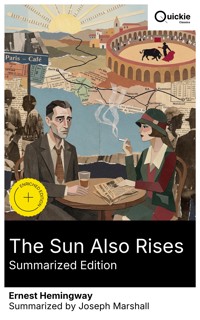
Set in postwar Paris and Pamplona, The Sun Also Rises follows Jake Barnes, a war-wounded expatriate, and his companions—Brett Ashley, Robert Cohn, Mike Campbell, and Bill Gorton—through cafés, trout streams, and the San Fermín fiesta. Hemingway's pared prose enacts the iceberg theory: dialogue and omission carry the weight of desire, impotence, and drift. Framing bullfighting's afición as ethic and aesthetic, the novel pairs modernist minimalism with a portrait of the Lost Generation's disillusion. Hemingway wrote from experience: wounded World War I ambulance driver, Toronto Star reporter, and 1920s Paris apprentice among Stein's circle. The 1925 Pamplona trip supplied scenes, characters, and the epigraphic 'lost generation.' His fascination with Spanish ritual and codes of courage—later theorized in Death in the Afternoon—shapes the book's ethics, while journalistic observation and disciplined omission produce its tensile clarity. Readers of modernism, cultural history, and studies of gender and war will find the novel enduringly fresh. It rewards close attention to what is unsaid, to ritual as meaning, and to the ache of intimacy after rupture. Whether first encounter or renewed study, The Sun Also Rises offers a bracing, exacting education in style, character, and the costs of a century learning to live with loss. Quickie Classics summarizes timeless works with precision, preserving the author's voice and keeping the prose clear, fast, and readable—distilled, never diluted. Enriched Edition extras: Introduction · Synopsis · Historical Context · Author Biography · Brief Analysis · 4 Reflection Q&As · Editorial Footnotes.
Das E-Book können Sie in Legimi-Apps oder einer beliebigen App lesen, die das folgende Format unterstützen:
Veröffentlichungsjahr: 2026
Ähnliche


The Sun Also Rises (Summarized Edition)
Table of Contents
Introduction
In a world stunned by war and starved for meaning, The Sun Also Rises traces a group of restless expatriates as they move from cafés and boulevards to rivers, mountain passes, and bullrings, pursuing pleasure, companionship, and a code of conduct that might hold their desire, jealousy, and grief in check, even as the bright surfaces they chase—wine, speed, ritual, spectacle—throw back the darker truths they carry, wounds that cannot be named, intimacies that cannot be fulfilled, and a stubborn hope that, amid motion and ceremony, living honestly might still be possible.
Published in 1926, Ernest Hemingway’s modernist novel unfolds across post–World War I Europe, beginning in Paris and moving into Spain during a famous summer festival and a season of bullfighting. Its characters are American and British expatriates who live by night as much as by day, drifting through cafés, hotels, and trains with money that spends easily and emotions that do not. The book helped define the literature of the so‑called Lost Generation, capturing a milieu shaped by dislocation, changing morals, and a thirst for experience that feels at once glamorous, precarious, and stripped of illusions.
Jake Barnes, an American expatriate in Paris, narrates in the first person with reserve, wit, and a precise eye for surfaces. His circle includes the magnetic Lady Brett Ashley and friends whose loyalties, flirtations, and resentments give the novel its charge. After nights of drinking and talk, they decamp for Spain, where fishing in the mountains and the explosive ritual of a festival concentrate unspoken tensions. The voice is cool and rhythmic, the humor dry, the pain indirect. Readers encounter an immersive itinerary: cafés, trains, inns, arenas, landscapes that seem simple until their patterns begin to echo inward.
Central themes emerge without declaration: the allure and limits of pleasure, the strain between freedom and responsibility, and the search for a personal ethic in a world with frayed rules. Masculinity and performance are tested in sport, rivalry, and endurance, while femininity appears newly mobile, independent, and judged. Money oils the nights but cannot buy ease. Ritual—especially in the corrida—suggests that danger and beauty can create temporary order, yet the cost of spectacle complicates admiration. Friendship, too, is a testing ground, where loyalty and competition share a table. Throughout, desire meets constraint, and meaning flickers in gestures rather than speeches.
Hemingway’s prose here is pared yet musical, favoring short declarative movements, concrete nouns, and the suggestive weight of omission. Dialogue does heavy lifting, exposing fault lines through tone, repetition, and what goes unsaid. Scenes often open in medias res, accumulate detail through action, and end just before catharsis, letting implication do the work of commentary. Place is rendered with tactile clarity—the feel of a glass, the tilt of a street, the light in late afternoon—so that sensation becomes a way of thinking. The result is a reading experience both swift and resonant, deceptively simple and quietly architectural.
For contemporary readers, the novel’s restlessness will feel recognizable: people commuting between countries and identities, curating nights out and adventures while negotiating exhaustion, loneliness, and the ethics of looking at cultures not their own. It speaks to ongoing conversations about gender expectations, emotional restraint, and the costs of performing toughness. It also asks how communities form when institutions fail, and whether ritual—art, sport, travel—can offer meaning without becoming exploitation. The book’s clear-eyed attention to trauma’s afterlife, to drinking as both solace and trap, and to love constrained by circumstance keeps it urgent beyond its historical moment.
Approached as a story of travel and romance, the novel is pleasurable and swift; approached as a study of endurance and value, it deepens with each scene. It does not resolve experience into lessons so much as frame it, letting readers weigh behavior, admiration, and harm. Newcomers can expect a lucid surface, captivating company, and an undercurrent that gathers power quietly. Beneath the itinerary lies a meditation on how to live after rupture: how to keep faith with friends, with one’s work, with beauty, and with oneself, when certainty has gone but the sun, indifferent and steady, still rises.
Synopsis
Ernest Hemingway’s The Sun Also Rises, published in 1926, follows a group of American and British expatriates in the 1920s as they drift between Paris and Spain. Narrated by Jake Barnes, an American journalist and World War I veteran, the novel depicts a world of cafés, late nights, and frayed loyalties. Its measured, economical prose keeps events close to lived experience, emphasizing what is seen and left unsaid. The book sets up a contrast between surfaces and depths, showing characters who appear sophisticated while carrying private scars. Against this backdrop, friendship, love, and pleasure become tests of character amid a fragile social equilibrium.
In Paris, Jake moves through a circuit of writers, artists, and hangers-on, including Robert Cohn, an insecure former boxer struggling with success and restlessness. Cohn’s dissatisfaction fuels a longing to escape, while Jake observes with mixed sympathy and skepticism. Lady Brett Ashley, a charismatic and independent Englishwoman, enters and becomes the social fulcrum around which desires pivot. She and Jake share a genuine bond complicated by his war injury, which constrains intimacy and deepens the novel’s sense of loss. Their chemistry exposes the distance between affection and fulfillment, while the city’s exuberance masks unresolved tensions, jealousies, and the weariness of lives in perpetual motion.
As tempers simmer, plans for travel promise diversion and purpose. Cohn talks of distant journeys, but the group converges on a more immediate destination: Spain. Bill Gorton, Jake’s witty companion, arrives from the United States, embodying camaraderie and deflecting seriousness with humor. Brett’s fiancé, Mike Campbell, turns up as well, genial yet embittered by debts and uncertainties. Drinking frames their interactions, sometimes blurring loyalties and motives. When itineraries harden, Jake and Bill set off first, intent on fishing in the hills of Navarra before the fiesta in Pamplona. The decision shifts the novel’s rhythm, replacing urban bustle with anticipation of ritual and landscape.
The fishing trip to Burguete offers a pastoral interlude and a measure of clarity. Jake and Bill hike into cool forests, rent simple rooms, and pass unhurried days by clear water. Jokes, tall tales, and practical routines establish a steady tempo that contrasts with Parisian whirl. The countryside’s quiet allows unforced reflections on money, work, and belief without heavy declaration. Hemingway’s focus on meals, gear, and small courtesies suggests a code of conduct grounded in restraint and skill. This pause in the action does not solve anything, but it steadies the men and primes the narrative for the intensity awaiting them in Pamplona.
Pamplona introduces a different order of experience: the festival of San Fermín, a choreography of processions, music, and the running of the bulls. The group reconvenes, and Jake’s knowledge of bullfighting becomes a guide to readers and friends alike. He values afición, a felt understanding of the art that separates spectatorship from devotion. Amid crowded streets and exuberant drinking, a young matador, Pedro Romero, emerges as a figure of poise and courage. Through Jake’s spare observations, the bullring’s ritual promises a form of meaning rooted in grace under pressure, setting a counterpoint to the party’s chaos and the characters’ fraying self-control.
As the fiesta intensifies, the group’s fault lines widen. Mike’s taunts, Cohn’s persistence, and Brett’s magnetism combine with alcohol to provoke quarrels that test stamina and loyalty. Personal histories—financial strain, past romances, pride—push private frustrations into public scenes. The running and the fights repeatedly reset the day, but each reset carries the last night’s residue. In the ring, discipline and danger create a clear, exacting measure of courage; outside it, resentment and desire rarely find such clarity. Jake navigates competing claims on friendship and duty, weighing what can be said against what must be endured. The strain foreshadows consequences none can easily manage.
Romero’s presence crystallizes the novel’s concerns with authenticity, skill, and honor. His calm amid risk impresses even the most cynical observers, and his interactions with the group reveal contrasting ideals of masculinity and freedom. Admiration shades into entanglement as boundaries blur between spectator and participant, art and life. Jake’s role becomes that of observer-mediator, his empathy checked by hard-earned reticence. Choices made under festival pressure unsettle the fragile equilibrium among friends, raising questions about responsibility and the costs of desire. The ethical terrain tightens: what does loyalty require, and who decides when admiration becomes interference? Outcomes unfold with quiet, consequential force.
After the fiesta, movement replaces revelry. The characters disperse across Spain, seeking rest or resolution: seaside idleness in San Sebastián, hurried trips by train, and a subdued Madrid. Messages summon Jake to help at a delicate moment, and he goes without dramatics, following a private compass the novel never spells out. The pace slows to conversations that circle choices and limits rather than grand declarations. Weariness clears space for candor, though not for simple solutions. By holding to understatement, the narrative leaves room for readers to weigh what has changed and what endures, as bonds are tested against circumstances no one can undo.
The Sun Also Rises endures as a portrait of a generation unsettled by war, modernity, and shifting codes of love and honor. Its style—spare description, charged dialogue, and meaningful silence—lets ordinary scenes carry moral weight. The contrast between hedonistic drift and disciplined ritual frames a search for authenticity, while Spain’s landscapes and bullfights pose the possibility of order within danger. The novel’s closing movements reaffirm ambiguity rather than verdict, suggesting that dignity may lie in recognizing limits without surrendering to despair. In tracing damaged affection and provisional loyalties, Hemingway offers an unsentimental meditation on resilience and the hard-won grace of living on.
Historical Context
The Sun Also Rises emerges from the unsettled aftermath of the First World War (1914–1918). The Treaty of Versailles in 1919 ended hostilities but left social and psychological scars across Europe and among veterans and civilians. Demobilization, casualties, and the experience of trench warfare produced widespread disillusionment and what contemporaries called shell shock. In the mid-1920s, many Anglophone writers and artists gathered in continental capitals, especially Paris, seeking affordable living, artistic freedom, and distance from postwar conventions. Hemingway situates his characters in this milieu, where personal identities and loyalties were tested amid shifting norms, lingering trauma, and a search for meaning after cataclysm.
In the early to mid-1920s, Paris—especially the Left Bank neighborhoods of Montparnasse and the Latin Quarter—was a hub of expatriate life. Cafés and brasseries functioned as informal institutions for writing, correspondence, and patronage, while English-language bookstores such as Shakespeare and Company facilitated publishing networks and lending libraries. Gertrude Stein’s salons, and the presence of writers like Ezra Pound and Ford Madox Ford, fostered modernist experimentation. Because the French franc had depreciated, Americans could live relatively cheaply. At the same time, U.S. Prohibition (1920–1933) encouraged drinking and travel abroad, shaping patterns of leisure and sociability that inform the novel’s urban scenes.
Ernest Hemingway, born in 1899 in Oak Park, Illinois, brought firsthand war experience to his fiction. In 1918 he served as a Red Cross ambulance driver on the Italian front and was seriously wounded. After the war he worked as a reporter, and in 1921 moved to Paris as a correspondent for the Toronto Star. There he refined a terse, reportorial prose influenced by journalism and by mentors including Stein and Pound. Hemingway traveled to Spain several times beginning in 1923, observing bullfights and festivals. The Sun Also Rises, written after a 1925 trip, was published by Charles Scribner’s Sons in 1926.
The novel’s Spanish settings draw on the festival of San Fermín in Pamplona, held annually in early July, famous for its encierro (running of the bulls) and bullfights. In the 1910s and 1920s, matadors such as Juan Belmonte modernized the art with a closer, riskier style, heightening its drama and cultural prestige. Pamplona lay in Navarre, a region with strong Catholic traditions and Basque influence. Under General Miguel Primo de Rivera’s dictatorship (1923–1930), Spain emphasized order and public spectacle, while welcoming foreign visitors. Rail links and hotels made the fiesta increasingly accessible to international travelers whose presence shaped its cosmopolitan atmosphere.




