



1,90 €
Mehr erfahren.
- Herausgeber: Lebooks Editora
- Kategorie: Gesellschafts- und Liebesromane
- Serie: Thomas Mann Essential
- Sprache: Englisch
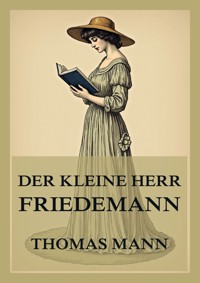
Selected Short Stories by Thomas Mann brings together some of the author's most significant early works — Gladius Dei, Little Herr Friedemann, The Blood of the Walsungs, and Tonio Kröger — offering a rich introduction to the themes that would define his literary career. These stories explore the tension between artistic sensitivity and bourgeois life, portraying characters who feel isolated from ordinary society because of their refined or troubled inner worlds. In Little Herr Friedemann, Mann depicts the tragic life of a physically fragile and emotionally sensitive man who withdraws from society to protect himself from suffering. His quiet existence is disrupted by a passionate and destructive attraction that reveals the vulnerability hidden beneath his self-control. The story is a subtle psychological study of pride, loneliness, and humiliation. Gladius Dei presents a sharp and ironic portrait of artistic fanaticism in a modern city. The protagonist, a rigid moralist devoted to a severe ideal of beauty, denounces what he sees as the corruption and decadence of contemporary art. The story reflects Mann's early interest in the conflict between tradition and modern culture. In The Blood of the Walsungs, Mann explores themes of aestheticism and decadence through the relationship between twin siblings belonging to an aristocratic family in decline. Their refined sensibility and fascination with myth and music suggest a world detached from reality, revealing both the attraction and the danger of excessive artistic self-absorption. The collection culminates in Tonio Kröger, one of Mann's most famous works, which portrays a writer torn between the disciplined world of the bourgeoisie and the restless sensitivity of the artist. Through Tonio's inner conflict, Mann expresses a central idea of his work: that the artist often stands at a distance from life, loving it yet never fully belonging to it. Together, these stories reveal Thomas Mann's early mastery of psychological insight and symbolic storytelling, offering a profound reflection on art, identity, and the complex relationship between creativity and ordinary existence.
Das E-Book können Sie in Legimi-Apps oder einer beliebigen App lesen, die das folgende Format unterstützen:
Seitenzahl: 236
Veröffentlichungsjahr: 2026
Ähnliche















Thomas Mann
THOMAS MANN SELECTED SHORT STORIES
Contents
INTRODUCTION
THOMAS MANN SELECTED SHORT STORIES
GLADIUS DEI
LITTLE HERR FRIEDEMANN
THE BLOOD OF THE WALSUNGS
TONIO KRÖGER
INTRODUCTION
Thomas Mann
1875 – 1955
Thomas Mann was a German writer and essayist, considered one of the greatest authors of twentieth-century literature. In 1929 he received the Nobel Prize in Literature. His work is characterized by profound psychological analysis, a strong philosophical dimension, and reflection on the conflicts between art, society, and the individual.
Childhood and Education
Thomas Mann was born in Lübeck, Germany, into a prosperous bourgeois family. After his father’s death, he moved with his family to Munich, where he began to devote himself to writing and journalism. From a young age, he showed interest in literature, music, and philosophy, elements that would shape his entire body of work.
Works and Themes
Among his most famous works are “Buddenbrooks”, the novel that brought him international recognition, “The Magic Mountain”, “Death in Venice”, and “Doctor Faustus”. In his books Mann explores themes such as the decline of the bourgeoisie, the conflict between spirit and practical life, the relationship between art and illness, and the moral crisis of modern man.
His writing combines intellectual rigor and psychological depth, expressed in an elegant and often symbolic style. Mann’s characters are frequently divided between discipline and passion, rationality and creative impulse.
Influence and Legacy
Thomas Mann had an enormous influence on twentieth-century European literature. His works are studied for their thematic complexity and for their ability to represent the cultural and political tensions of his time. During the Nazi regime he lived in exile and became an important voice against totalitarianism.
Thomas Mann died in Zurich in 1955.
His work remains a fundamental reference point of the modern novel and one of the highest expressions of twentieth-century European narrative.
About the work
Selected Short Stories by Thomas Mann brings together some of the author’s most significant early works — Gladius Dei, Little Herr Friedemann, The Blood of the Walsungs, and Tonio Kröger — offering a rich introduction to the themes that would define his literary career. These stories explore the tension between artistic sensitivity and bourgeois life, portraying characters who feel isolated from ordinary society because of their refined or troubled inner worlds.
In Little Herr Friedemann, Mann depicts the tragic life of a physically fragile and emotionally sensitive man who withdraws from society to protect himself from suffering. His quiet existence is disrupted by a passionate and destructive attraction that reveals the vulnerability hidden beneath his self-control. The story is a subtle psychological study of pride, loneliness, and humiliation.
Gladius Dei presents a sharp and ironic portrait of artistic fanaticism in a modern city. The protagonist, a rigid moralist devoted to a severe ideal of beauty, denounces what he sees as the corruption and decadence of contemporary art. The story reflects Mann’s early interest in the conflict between tradition and modern culture.
In The Blood of the Walsungs, Mann explores themes of aestheticism and decadence through the relationship between twin siblings belonging to an aristocratic family in decline. Their refined sensibility and fascination with myth and music suggest a world detached from reality, revealing both the attraction and the danger of excessive artistic self-absorption.
The collection culminates in Tonio Kröger, one of Mann’s most famous works, which portrays a writer torn between the disciplined world of the bourgeoisie and the restless sensitivity of the artist. Through Tonio’s inner conflict, Mann expresses a central idea of his work: that the artist often stands at a distance from life, loving it yet never fully belonging to it.
Together, these stories reveal Thomas Mann’s early mastery of psychological insight and symbolic storytelling, offering a profound reflection on art, identity, and the complex relationship between creativity and ordinary existence.
THOMAS MANN SELECTED SHORT STORIES
GLADIUS DEI
I.
Munich was aglow. Above the festive squares and white columned temples, the antique-style monuments and baroque churches, the dancing fountains, palaces, and gardens of the Residenz, a sky of blue silk stretched out radiantly, and its broad and light, green-surrounded and well-calculated perspectives lay in the sun-drenched haze of a beautiful first day of June.
Birdsong and secret jubilation filled the streets. ...And in the squares and streets, the unhurried and amusing bustle of this beautiful and leisurely city rolls, surges, and hums. Travelers of all nations ride around in small, slow cabs, looking up at the walls of the houses on the right and left with indiscriminate curiosity, and climb the steps of the museums...
Many windows are open, and from many of them music sounds out onto the streets, exercises on the piano, the violin, or the cello, honest and well-intentioned amateur efforts. In the ‘Odeon’, however, as one hears, serious study is taking place on several grand pianos.
Young people whistling the Nothung motif and filling the back rows of the modern theater in the evening wander in and out of the university and the state library with literary magazines in the side pockets of their jackets. A court carriage stops in front of the Academy of Fine Arts, which spreads its white arms between Türkenstraße and Siegestor. And at the top of the ramp, models, picturesque old men, children, and women in the traditional dress of the Albanian mountains stand, sit, and lounge in colorful groups.
Casualness and leisurely strolling in all the long streets of the north... People there are not exactly driven and consumed by greed for gain, but live for pleasant purposes. Young artists, round hats on the backs of their heads, with loose ties and no sticks, carefree fellows who pay their rent with color sketches, go for a walk to let this light blue morning affect their mood, and watch the little girls, those pretty, stocky types with their brunette hair bands, their slightly too large feet, and their unassuming manners. ...Every fifth house has studio windows glinting in the sun. Sometimes an artistic building stands out from the row of bourgeois ones, the work of an imaginative young architect, broad and flat-arched, with bizarre ornamentation, full of wit and style. And suddenly, somewhere, the door of an overly boring facade is framed by a bold improvisation, with flowing lines and sunny colors, bacchantes, mermaids, rosy nudes...
It is always a delight to linger in front of the displays of the art carpenters and the bazaars for modern luxury items. How much imaginative comfort, how much linear humor in the design of all things! Everywhere are scattered the small sculpture, frame, and antique shops, from whose shop windows the busts of the Florentine Quattrocento women gaze out at you with noble piquancy. And the owner of the smallest and cheapest of these shops talks to you about Donatello and Mino da Fiesole as if he had received the reproduction rights from them personally...
But up there on Odeonsplatz, in front of the enormous loggia, in front of which the spacious mosaic surface spreads out, and diagonally opposite the regent's palace, people crowd around the wide windows and display cases of the large art magazine, the spacious beauty shop of M. Blüthenzweig. What joyful splendor in the display! Reproductions of masterpieces from all the galleries of the world, set in precious, exquisitely tinted and ornamented frames in a taste of precious simplicity; illustrations of modern paintings, sensual fantasies in which antiquity seems to be reborn in a humorous and realistic way; Renaissance sculptures in perfect casts; naked bronze bodies and fragile decorative glasses; earthen vases of steep style, emerging from baths of metal vapors in a shimmering coat of color; magnificent volumes, triumphs of the new art of decoration, works by fashionable poets, wrapped in decorative and elegant splendor; in between, portraits of artists, musicians, philosophers, actors, poets, the public's curiosity about personal matters on display... In the first window, next to the adjoining bookstore, there is a large picture on an easel in front of which the crowd is gathering: a valuable photograph in reddish-brown tones in a wide, old gold frame, a sensational piece, a reproduction of the highlight of the year's major international exhibition, which is advertised on advertising columns, between concert programs and artistically designed recommendations for toiletries, with archaic and effective posters inviting visitors to attend.
Look around you, into the windows of the bookshops. Your eyes encounter titles such as ‘The Art of Living since the Renaissance’, ‘The Education of the Sense of Color’, ‘The Renaissance in Modern Arts and Crafts’, ‘The Book as a Work of Art’, ‘Decorative Art,’ 'The Hunger for Art' — and you must know that these wake-up calls are bought and read thousands of times, and that in the evenings, these very same subjects are discussed in front of packed auditoriums...
If you are lucky, you will encounter one of the famous women in person whom you are accustomed to seeing through the medium of art, one of those rich and beautiful ladies with artificially created Titian blonde hair and diamond jewelry, whose beguiling features have been immortalized by the hand of a brilliant portraitist, and whose love lives are the talk of the town — queens of the artists' festivals during Carnival, a little made up, a little painted, full of noble piquancy, vain and adorable. And look, there's a great painter driving up Ludwigstraße in a carriage with his lover. People show each other the carriage, they stop and look after the two of them. Many people greet them. And it's not long before the police form a guard of honor.
Art flourishes, art reigns supreme, art stretches its rose-entwined scepter over the city and smiles. There is universal respectful sympathy for its prosperity, universal diligent and devoted practice and propaganda in its service, a sincere cult of line, ornamentation, form, the senses, and beauty prevails... Munich shone.
II.
A young man walked up Schellingstraße; surrounded by cyclists, he walked in the middle of the cobblestones toward the broad façade of St. Ludwig's Church. Looking at him, it was as if a shadow had fallen over the sun or a memory of difficult times had fallen over the mind. Did he not love the sun that bathed the beautiful city in festive splendor? Why did he remain introverted and turned away, his eyes fixed on the ground as he walked?
He wore no hat, which no one took offense at in this easy-going city with its lack of dress codes, but instead had pulled the hood of his wide, black coat over his head, shading his low, angular forehead, covering his ears, and framing his gaunt cheeks. What pangs of conscience, what scruples, and what self-abuse had hollowed out those cheeks? Isn't it gruesome to see sorrow dwelling in the hollows of a person's cheeks on such a sunny day? His dark eyebrows thickened strongly at the narrow root of his nose, which protruded large and humped from his face, and his lips were strong and full. When he raised his brown eyes, which were set fairly close together, transverse wrinkles formed on his angular forehead. He looked with an expression of knowledge, limitation, and suffering. Seen in profile, this face resembled exactly an old portrait by a monk's hand, preserved in Florence in a narrow and harsh monastery cell, from which once a terrible and devastating protest against life and its triumph emanated...
Hieronymus walked up Schelling Street, slowly and steadily, holding his wide coat together with both hands from the inside. Two little girls, two of those pretty, stocky creatures with hair bands, oversized feet, and innocent manners, arm in arm and adventurously skipping past him, bumped into each other and laughed, leaned forward and started running with laughter at his hood and his face. But he paid no attention to them. With his head bowed and without looking to the right or left, he crossed Ludwigstraße and climbed the steps of the church.
The large wings of the central door stood wide open. In the consecrated twilight, cool, stuffy, and filled with the smoke of sacrifice, a faint reddish glow was visible somewhere in the distance. An old woman with bloodshot eyes rose from a pew and dragged herself between the columns on crutches. Otherwise, the church was empty.
Hieronymus wet his forehead and chest at the basin, knelt before the high altar, and then stood in the nave. Was it not as if his figure had grown here inside? He stood upright and motionless, his head raised freely, his large, hooked nose seeming to protrude with an imperious expression above his strong lips, and his eyes no longer directed toward the ground, but looking boldly and straight ahead into the distance, toward the crucifix on the high altar. He remained motionless for a while; then he bent his knee again as he stepped back and left the church.
He walked up Ludwigstraße, slowly and steadily, his head bowed, in the middle of the wide, unpaved road, toward the mighty loggia with its statues. But when he reached Odeonsplatz, he looked up, causing wrinkles to form on his angular forehead, and slowed his pace, his attention drawn to the crowd gathered in front of the displays of the large art store, the spacious beauty shop owned by M. Blüthenzweig.
People went from window to window, showing each other the treasures on display and exchanging opinions, looking over each other's shoulders. Hieronymus mingled with them and began to look at all these things himself, examining everything, piece by piece.
He saw the replicas of masterpieces from all the galleries of the world, the precious frames in their simple bizarreness, the Renaissance sculptures, the bronze bodies and decorative glasses, the iridescent vases, the book decorations and the portraits of artists, musicians, philosophers, actors, poets, looked at everything and turned his attention to each object for a moment. Holding his cloak tightly together with both hands from the inside, he turned his hooded head in small, short turns from one thing to the next, and under his dark eyebrows, which were thick at the bridge of his nose and which he raised, his eyes gazed at each thing for a while with a strange, dull, and coolly astonished expression. He reached the first window, the one under which the sensational picture was located, looked for a while over the shoulders of the people crowding in front of him, and finally made his way to the front, close to the display.
The large, reddish-brown photograph, framed with the utmost taste in old gold, stood on an easel in the middle of the window space. It was a Madonna, a thoroughly modern work, free of any convention. The figure of the holy mother was enchantingly feminine, naked and beautiful. Her large, sultry eyes were dark-rimmed, and her delicate, strangely smiling lips were half open. Her slender fingers, grouped a little nervously and convulsively, embraced the hips of the child, a naked boy of distinguished and almost primitive slenderness, who was playing with her breast while keeping his eyes fixed on the viewer with an intelligent sidelong glance.
Two other young men stood next to Hieronymus and talked about the painting, two young men with books under their arms that they had taken from or were bringing to the State Library, humanistically educated people, well versed in art and science.
“The little one has it good, damn it!” said one.
“And he obviously intends to make one jealous,” replied the other... “A dangerous woman!”
“A woman to drive one mad! One becomes a little confused about the dogma of the Immaculate Conception...”
“Yes, yes, she makes a rather touching impression... Have you seen the original?”
"Of course. I was quite moved. She looks even more aphrodisiacal in color... especially the eyes.“
”The resemblance is actually quite striking.“
”Why?“
”Don't you know the model? He used his little milliner for it. It's almost a portrait, only stylized to the point of corruption... The little girl is more harmless.“
”I hope so. Life would be too exhausting if there were many like this mater amata...“
”The Pinakothek bought it.“
”Really? Look at that! She knew what she was doing, by the way. The treatment of the flesh and the flow of the lines of the garment are truly eminent.“
”Yes, an incredibly talented guy."
“Do you know him?”
“A little. He'll make a career for himself, that's for sure. He's already been to dinner with the regent twice...”
They said the last words as they began to take their leave of each other.
“Will we see you at the theater tonight?” asked one. “The drama club is performing Machiavelli's ‘Mandragola’.”
“Oh, bravo. That promises to be fun. I was planning to go to the variety show, but I'll probably end up preferring the brave Nicolò. Goodbye...”
They parted, stepped back, and went their separate ways to the right and left. New people took their place and looked at the successful picture. But Hieronymus stood motionless in his place; he stood with his head stretched forward, and one could see how his hands, with which he held his coat together from the inside at his chest, were clenched convulsively. His eyebrows were no longer raised with that cool and slightly spiteful expression of astonishment; they had lowered and darkened, his cheeks, half covered by the black hood, seemed more hollow than before, and his thick lips were completely pale. Slowly his head bowed lower and lower, so that he finally held his eyes fixed on the work of art from below. The wings of his large nose quivered.
He remained in this position for a good quarter of an hour. The people around him dispersed, but he did not move from his place. Finally, he slowly, slowly turned on the balls of his feet and walked away.
III.
But the image of the Madonna went with him. Whether he was in his cramped and harsh little room or kneeling in the cool churches, it stood before his indignant soul, with sultry, rimmed eyes, with enigmatic smiling lips, naked and beautiful. And no prayer could dispel it.
But on the third night, a command and call came from above to Hieronymus to intervene and raise his voice against light-hearted wickedness and insolent conceit of beauty.
In vain, like Moses, he turned his stupid tongue;
God's will remained unshakeable and demanded loudly of his timidity that he make this sacrifice among the laughing enemies.
So he set out in the morning and, because God willed it, walked to the art gallery, to M. Blüthenzweig's great beauty shop. He wore his hood over his head and held his coat together with both hands from the inside as he walked.
IV.
It had become muggy; the sky was pale, and a thunderstorm was threatening. Once again, crowds of people besieged the windows of the art shop, especially the one displaying the Madonna painting. Hieronymus glanced at it briefly, then pressed the handle of the glass door covered with posters and art magazines. “God wills it!” he said and stepped into the store.
A young girl who had been writing in a large book at a desk somewhere, a pretty brunette with hair bands and oversized feet, approached him and asked him kindly how she could help him.
“Thank you,” said Hieronymus quietly, looking seriously into her eyes, wrinkles crossing his angular forehead. “I don't want to speak to you, but to the owner of the shop, Mr. Blüthenzweig.”
Hesitating a little, she stepped back from him and resumed her work. He stood in the middle of the shop.
Everything that was on display outside in individual examples was piled up twentyfold and lavishly spread out here inside: a wealth of color, line, and form, of style, wit, good taste, and beauty. Hieronymus slowly looked to both sides, and then he pulled the folds of his black coat tighter around himself.
There were several people in the shop. At one of the wide tables that ran across the room, a gentleman in a yellow suit with a black goatee sat looking at a portfolio of French drawings, over which he sometimes let out a bleating laugh. A young person with an air of low pay and a plant-based diet served him, bringing new portfolios for him to look at. Diagonally opposite the bleating gentleman, an elegant old lady was examining modern embroidery, large fairy-tale flowers in pale tones, standing vertically next to each other on long, stiff stems. An employee of the shop was also attending to her. At a second table sat a careless Englishman with a travel cap on his head and a wooden pipe in his mouth. Durably dressed, clean-shaven, cold and of indeterminate age, he was choosing among bronzes that Mr. Blüthenzweig was personally bringing him. He held the delicate figure of a naked little girl, immature and delicately built, who crossed her hands coquettishly over her chest, by the head and examined it closely, slowly turning it around.
Mr. Blüthenzweig, a man with a short brown beard and bright eyes of the same color, moved around him, rubbing his hands and praising the little girl with every word he could muster.
“One hundred and fifty marks, sir,” he said in English; “Munich art, sir. Very lovely indeed. Full of charm, you know. It is grace itself, sir. Really extremely pretty, cute, and admirable.” Then something else occurred to him, and he said, “Highly attractive and enticing.” Then he started all over again.
His nose lay a little flat on his upper lip, so that he constantly sniffed at his mustache with a slight hissing sound. Sometimes he approached the buyer in a stooped posture, as if sniffing him. When Hieronymus entered, Mr. Blüthenzweig examined him briefly in the same manner, but soon returned his attention to the Englishman.
The elegant lady had made her choice and left the shop. A new gentleman entered. Mr. Blüthenzweig sniffed him briefly, as if to gauge his purchasing power, and left it to the young accountant to serve him. The gentleman purchased only a faience bust of Piero, son of the magnificent Medici, and left. The Englishman also began to take his leave. He had befriended the little girl and departed amid Mr. Blüthenzweig's bows. Then the art dealer turned to Hieronymus and stood in front of him.
“You wish...” he asked without much humility.
Hieronymus held his coat together with both hands from the inside and looked Mr. Blüthenzweig in the face almost without batting an eyelid. He slowly parted his thick lips and said:
“I have come to you because of the picture in that window there, the large photograph, the Madonna.” His voice was hoarse and without modulation.
“Yes, quite right,” said Mr. Blüthenzweig briskly and began to rub his hands together: “Seventy marks in the frame, sir. It is unchangeable ... a first-class reproduction. Highly attractive and appealing.”
Hieronymus remained silent. He bowed his head in his hood and slumped a little while the art dealer spoke; then he straightened up again and said:
"I should point out in advance that I am neither able nor willing to buy anything. I'm sorry to disappoint your expectations. I feel sorry for you if that causes you pain. But first of all, I am poor, and secondly, I don't like the things you have for sale. No, I can't buy anything.“
”No... so no,“ said Mr. Blüthenzweig, sniffing loudly.
”Well, may I ask...“
”As I believe I know you,“ Hieronymus continued, ”you despise me because I am unable to buy anything from you..."
“Hmm...” said Mr. Blüthenzweig. “Not at all! Only...”
“Nevertheless, I ask you to listen to me and give weight to my words.”
“Give weight. Hmm. May I ask...”
“You may ask,” said Hieronymus, "and I will answer you.
I have come to ask you to immediately remove that picture, the large photograph, the Madonna, from your window and never display it again."
Mr. Blüthenzweig stared silently at Hieronymus's face for a moment, with an expression as if he were challenging him to be embarrassed by his adventurous words. But since this did not happen, he sniffed sharply and said:
“Would you be so kind as to tell me whether you are here in any official capacity that authorizes you to give me orders, or what actually brings you here...”
“Oh no,” replied Hieronymus, “I have neither office nor dignity from the state. Power is not on my side, sir. What brings me here is my conscience alone.”
Mr. Blüthenzweig moved his head back and forth, searching for words, sniffed loudly into his mustache, and struggled to find the right words. Finally, he said:
“Your conscience... Well, then, please... take note... that your conscience is... a completely irrelevant institution for us!”
With that, he turned around, walked quickly to his desk at the back of the store, and began to write. The two shop assistants laughed heartily. The pretty young lady also giggled over her account book. As for the yellow-skinned gentleman with the black goatee, it turned out that he was a stranger, for he apparently understood nothing of the conversation, but continued to occupy himself with the French drawings, occasionally letting out his bleating laughter.
“Would you mind helping that gentleman?” Mr. Blüthenzweig said over his shoulder to his assistant. Then he continued writing. The young man with the look of being underpaid and eating a plant-based diet approached Hieronymus, trying to refrain from laughing, and the other salesman also approached.
“Can we be of any other assistance?” asked the poorly paid man gently. Hieronymus kept his suffering, dull, yet penetrating gaze fixed on him.
“No,” he said, “you cannot. I ask you to remove the image of the Madonna from the window immediately, and forever.”
“Oh... Why?”
“It is the Holy Mother of God...” said Hieronymus softly.
“Indeed... But you hear that Mr. Blüthenzweig is not inclined to grant your request.”
“One must remember that it is the Holy Mother of God,” said Hieronymus, and his head trembled.
“That's right. And what else? Are we not allowed to display Madonnas?
Are we not allowed to paint them?”
“Not like that! Not like that!” said Hieronymus, almost whispering, as he sat up straight and shook his head violently several times. His angular forehead under the hood was furrowed with long, deep wrinkles.
“You know very well that it is vice itself that a man has painted there... naked lust! I heard with my own ears two simple and uneducated people who were looking at this Madonna painting say that it confused them about the dogma of the Immaculate Conception...”
“Oh, allow me to say that this is not the issue,” said the young salesman with a superior smile. In his spare time, he had written a brochure on the modern art movement and was quite capable of carrying on an educated conversation.
“The painting is a work of art,” he continued, "and it must be judged by the standards it deserves.
It has received the highest acclaim from all sides. The state has purchased it...“
”I know that the state has purchased it,“ said Hieronymus. ”I also know that the painter has dined twice with the regent. The people talk about it, and God knows how they interpret the fact that someone becomes a highly honored man for such a work. What does this fact testify to? To the blindness of the world, a blindness that is incomprehensible unless it is based on shameless hypocrisy. This creation was born of sensual pleasure and is enjoyed in sensual pleasure... is this true or not? Answer me; answer me too, Mr. Blüthenzweig!"
There was a pause. Hieronymus seemed to demand an answer in all seriousness and looked with his suffering and piercing eyes alternately at the two salesmen, who stared at him curiously and puzzled, and at Mr. Blüthenzweig's round back. Silence reigned. Only the yellow gentleman with the black goatee, bent over the French drawings, let out his bleating laughter.
“It's true!” Hieronymus continued, and a deep indignation trembled in his hoarse voice... "You don't dare deny it! But how is it possible, then, to seriously celebrate the creator of this image as if he had increased the ideal goods of humanity?




