


Erhalten Sie Zugang zu diesem und mehr als 300000 Büchern ab EUR 5,99 monatlich.
- Herausgeber: Paraclete Press
- Kategorie: Sachliteratur, Reportagen, Biografien
- Sprache: Englisch
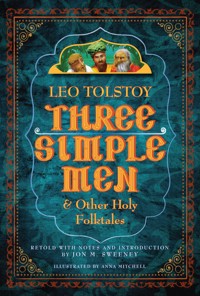
You've met the characters in these stories before. We meet them in folktales from all around the world. There is the simple, wise old man who understands far more than he knows; the pompous religious expert who discovers his folly before it's too late; nosey neighbors and petty relatives; and a fight between good and evil in which, by story's end, good and evil almost seem to switch places. These classic folktales, made popular a century ago by Leo Tolstoy, are retold here for a new generation, beautifully illustrated in this gorgeous book designed for reading out loud, reading over and over again, and giving to friends.
Sie lesen das E-Book in den Legimi-Apps auf:
Seitenzahl: 59
Veröffentlichungsjahr: 2015
Das E-Book (TTS) können Sie hören im Abo „Legimi Premium” in Legimi-Apps auf:
Ähnliche






“Of all the works this great man and artist has written,his short stories have made the strongest impression upon me.I regard them as the most perfect tales ever written.”
—ELISABETH OF WIED, Queen consort of Romania (1881–1914)
“The Russian great was considered mad by some and a geniusby others. He was a radical and a saint. A noble-turned-asceticwanderer. No wonder so many were fascinated withhis life and stories.”
—WRITING GOODER, a blog of the Young Writers Society for teenagers and young college students
“One of Tolstoy’s greatest gifts—and also a source of torment—was his addiction to the question of the meaning of life. Henever ceased asking himself why and how he should live, andwhat was the point of all his money and fame.”
—ROMAN KRZNARIC, cofounder of The School of Life in London; author of How Should We Live?
“As in the most abstract of narrators, what counts in Tolstoy iswhat is not visible, not articulated.”
—ITALO CALVINO, twentieth-century Italian novelist and short story writer
LEO TOLSTOY
THREESIMPLEMEN
& Other HolyFolktales
RETOLD WITH NOTES AND INTRODUCTIONBY JON M. SWEENEY
ILLUSTRATED BY ANNA MITCHELL
2015 First printingThree Simple Men: And Other Holy FolktalesText copyright © 2015 by Jon M. SweeneyIllustrations copyright © 2015 by Anna Mitchell
ISBN 978-1-61261-586-8
Scripture quotations marked NRSV are from New Revised Standard Version Bible, copyright © 1989 National Council of the Churches of Christ in the United States of America. Used by permission. All rights reserved.
Scripture quotations marked ESV are from the ESV® Bible (The Holy Bible, English Standard Version®), copyright © 2001 by Crossway, a publishing ministry of Good News Publishers. Used by permission. All rights reserved.
The Paraclete Press name and logo (dove on cross) are trademarks of Paraclete Press, Inc.
Library of Congress Cataloging-in-Publication DataTolstoy, Leo, graf, 1828-1910.
[Short stories. Selections. English]
Three simple men : and other holy folktales / Leo Tolstoy ; retold with notes and introduction by Jon M. Sweeney ; illustrated by Anna Mitchell.
pages cm
Summary: “You’ve met the characters in these stories before. We meet them in folktales from all around the world. There is the simple, wise old man who understands far more than he knows; the pompous religious expert who discovers his folly before it’s too late; nosey neighbors and petty relatives; and a fight between good and evil in which, by story’s end, good and evil almost seem to switch places. These classic folktales, made popular a century ago by Leo Tolstoy, are retold here for a new generation, beautifully illustrated in this gorgeous book designed for reading out loud, reading over and over again, and giving to friends”— Provided by publisher.
ISBN 978-1-61261-586-8 (paperback)
1. Tolstoy, Leo, graf, 1828-1910–Translations into English. 2. Tales–Russia. 3. Religious fiction. I. Sweeney, Jon M., 1967- II. Mitchell, Anna, illustrator. III. Title.
PG3366.A15S94 2015 891.73'3—dc23
10 9 8 7 6 5 4 3 2 1
All rights reserved. No portion of this book may be reproduced, stored in an electronic retrieval system, or transmitted in any form or by any means—electronic, mechanical, photocopy, recording, or any other—except for brief quotations in printed reviews, without the prior permission of the publisher.
Published by Paraclete PressBrewster, Massachusettswww.paracletepress.com
Printed in China
I SAID THAT I WAS SAVED FROM DESPAIR BY COMING TO SEE THE TRUTH.—LEO TOLSTOY, FROM A LETTER WRITTEN TO HIS WIFE, SONYA,December 1851
CONTENTS
INTRODUCTION
THREE SIMPLE MEN
A GODSONLEARNS TO FIGHT EVIL
ONE NEGLECTED SPARKMAY BURN DOWNA HOUSE
AUTHOR’S NOTES
ENDNOTES
INTRODUCTION
A genuine work of art must mean many things. . . . It is there not so much to convey a meaningas to wake a meaning.
—GEORGE MACDONALD, from his 1893 essay“The Fantastic Imagination”
WE LIVE IN A TIME WHEN FAITH IS REDISCOVERING the power of stories and storytelling. Stories are, of course, what have always preceded (and seeded) faith, but in most traditions, the living communication of personal experience, narrative, images, and spirituality was once too easily dampened by more didactic forms of teaching. No longer.
Stories are where faith begins. Before there was Torah, there were Jews telling stories, and then telling stories about stories. Before there was Gospel, there was Jesus speaking in parables and preaching by the Sea of Galilee, followed by his friends telling other friends what they remembered hearing Jesus say. So it is in every spiritual tradition. Stories create the tone, convey the message, communicate the character, and are the meaning of what becomes faith. Storytelling carries the day long before catechism is formed.
Stories are how a faith is renewed. Rarely are hearts moved by doctrine, but they are moved easily by stories that strike, like smoldering sticks on fresh kindling, sparking the flames of faith. Then, stories warm us. They illumine us. We see their light and we are able to imagine once again our lives participating in their ardor and glow.
Who are the storytellers? In the beginning, they were the first inspired ones. Who is the storyteller today? Inspired ones who are not supplanting, but supplementing, the work of priests, rabbis, and pastors. Storytelling is not sacramental or ritual work, but storytellers may be the primary conveyers of meaning and inspiration for the future.
The best thing you can do for your fellow, next to rousing his conscience, is—not to give him things to think about, but to wake things up that are in him; or say, to make him think things for himself.
So said George MacDonald in the essay on the imagination quoted above. That is how every great story is meant to pierce the hearts of its listeners/readers. Not coincidentally, Holy Scripture does this too. Surely that is why tales such as the three in this book are being rediscovered as we look for old/new ways of religiosity and faith today.
The tales we hear in the crib and the playroom stick with us throughout our lives. Those early stories can seem odd to us later in life, but their strangeness is also their genius. Mysteries of identity and personal boundaries begin taking shape when we hear “Goldilocks and the Three Bears.” Vagaries of life and death are introduced to our imaginations by “Hansel and Gretel,” in which an old woman ends up in an oven. And somehow it makes more sense to us as children than it does later as adults. This is one purpose of our oldest stories—folktales, fairy tales, and legends: to stimulate our capacities to understand what we will experience as we grow older.
There are those who choose to distinguish between fairy tales as creations of a fanciful imagination and folktales as somehow more rooted in history. But this is a false distinction




