



0,49 €
Niedrigster Preis in 30 Tagen: 1,99 €
Niedrigster Preis in 30 Tagen: 1,99 €
Mehr erfahren.
- Herausgeber: Booksell-Verlag
- Kategorie: Für Kinder und Jugendliche
- Sprache: Englisch
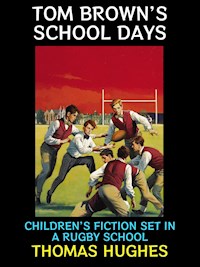
In his quintessential novel, "Tom Brown at Rugby," Thomas Hughes masterfully intertwines the themes of boyhood, camaraderie, and moral development within the setting of the prestigious Rugby School. Written in an engaging narrative style that blends sentimental realism with vivid characterizations, the book serves as both a coming-of-age story and a critique of Victorian educational practices. Inspired by Hughes' own experiences at Rugby, the story illustrates the importance of character-building and the value of sportsmanship, reflecting larger societal concerns of the time regarding the cultivation of young men's virtues in an increasingly industrialized world. Thomas Hughes, a progressive educator and social reformer, drew upon his own formative years at Rugby School to create this semi-autobiographical work. His advocacy for educational reform and his belief in the uniting power of sports are evident throughout the novel. Hughes was motivated by the desire to portray an idealized yet relatable experience that would resonate with both young readers and their guardians, infusing the narrative with lessons that extend beyond the confines of the school. "Tom Brown at Rugby" is a must-read for those interested in the evolution of educational literature and the representation of youth in Victorian England. Hughes' compelling storytelling and moral undertones offer readers profound insights into the complexities of growing up, making this work not only a chronicle of boys' school life but also a lasting commentary on personal integrity and social responsibility. In this enriched edition, we have carefully created added value for your reading experience: - A succinct Introduction situates the work's timeless appeal and themes. - The Synopsis outlines the central plot, highlighting key developments without spoiling critical twists. - A detailed Historical Context immerses you in the era's events and influences that shaped the writing. - A thorough Analysis dissects symbols, motifs, and character arcs to unearth underlying meanings. - Reflection questions prompt you to engage personally with the work's messages, connecting them to modern life. - Hand‐picked Memorable Quotes shine a spotlight on moments of literary brilliance. - Interactive footnotes clarify unusual references, historical allusions, and archaic phrases for an effortless, more informed read.
Das E-Book können Sie in Legimi-Apps oder einer beliebigen App lesen, die das folgende Format unterstützen:
Veröffentlichungsjahr: 2021
Ähnliche













Tom Brown at Rugby
Table of Contents
Introduction
A boy’s character is forged where youthful loyalties, rough games, and moral tests collide. Thomas Hughes’s Tom Brown at Rugby invites readers into a formative world in which a school’s routines become the arena for conscience and courage. Known for its boisterous energy and earnest moral interest, the novel treats play, punishment, and companionship as crucibles of integrity. Its appeal lies in the way it transforms everyday incidents—lessons, practices, dormitory chatter—into decisive steps toward adulthood. Without sensationalism or sentimentality, Hughes shows how habit, example, and choice shape a young person long before grand achievements or public recognition ever arrive.
Tom Brown at Rugby is a Victorian school story and coming‑of‑age novel by Thomas Hughes, first published in 1857. Set at Rugby School in Warwickshire during the early nineteenth century, it evokes the atmosphere associated with the headmastership of Dr. Thomas Arnold. Drawing on Hughes’s own experience as a former Rugby pupil, the book offers a grounded portrait of English public-school life in an era preoccupied with education, discipline, and reform. Its mix of documentary detail and moral reflection helped establish a template for later school narratives, situating the genre within the broader concerns of mid‑Victorian society and its ideals of citizenship.
The premise is simple and inviting: Tom Brown leaves home for his first terms at Rugby and encounters the customs, hierarchies, and freedoms of a large boarding school. Episodes unfold briskly—games, lessons, house life—showing how a novice learns the unwritten rules as much as the printed ones. The narrative voice, genial and direct, blends anecdote with authorial commentary, producing a tone at once lively and reflective. Readers can expect a realistic, episodic story rather than a tightly plotted melodrama, with humor and pastoral interludes offset by moments of sternness, all aimed at portraying how character is tested in ordinary schoolboy circumstances.
Hughes explores themes of moral growth, the responsibilities of leadership, and the tension between independence and belonging. Friendship, loyalty, and the courage to resist cruelty are treated as learned practices, honed in dormitories as much as on playing fields. The book is often associated with the Victorian ideal sometimes called muscular Christianity, in which physical vigor and ethical seriousness reinforce one another. Yet the emphasis falls less on preaching than on habit—the daily disciplines that nurture fair play, honesty, and compassion. By tracing how boys influence one another for good or ill, the novel examines mentorship, peer pressure, and the making of conscience.
Rugby School functions as a microcosm of society, where authority and self‑governance coexist. The prefect system, house loyalties, chapel, and classroom provide a structure within which boys learn to act for themselves while answering to a community. Hughes presents institutional order not as an end in itself but as a framework for personal responsibility. The headmaster’s presence symbolizes moral leadership rooted in example and trust. This setting reflects contemporary debates about discipline and reform, yet the portrayal remains grounded in lived routine—roll call, matches, and study—so that larger questions about justice, mercy, and duty emerge from the texture of everyday school life.
For modern readers, the novel’s relevance lies in its clear-eyed view of adolescence inside a demanding institution. It raises questions that remain urgent: What should education form beyond intellect? How do communities confront bullying and apathy? When does loyalty strengthen a group, and when must it yield to principle? Its depiction of sport as character training invites reflection on competition, teamwork, and inclusion. By showing how small choices accumulate into durable habits, the story speaks to contemporary concerns about leadership, integrity, and the social environments that shape young people long before their adult roles are fixed.
Approached today, Tom Brown at Rugby offers a spirited blend of youthful adventure, social observation, and moral inquiry. The prose is accessible and vigorous, the episodes vivid without excess, and the overall mood earnest yet humane. Readers interested in the history of education, the origins of the school‑story tradition, or the formation of character under institutional pressure will find a compelling exemplar here. Without leaning on spectacle, Hughes crafts a portrait of growth that rewards close attention and invites dialogue about what schooling should cultivate. It remains a touchstone for understanding Victorian ideals and their continuing resonance in debates about upbringing and citizenship.
Synopsis
Thomas Hughes’s Tom Brown at Rugby follows the early life and schooling of Tom Brown, a spirited boy raised in the English countryside. His childhood in the Vale of the White Horse fosters energy, independence, and a rough-and-tumble sense of fair play. Family influences emphasize honesty, courage, and loyalty, establishing a foundation for the moral trials ahead. The narrative begins by contrasting rural freedom with the discipline of formal education, preparing readers for Tom’s transition to public school. This opening frames his character as generous and headstrong, setting the stage for a journey where companionship, competition, and conscience shape his development.
Tom’s arrival at Rugby School introduces a storied institution under the reforming leadership of Dr. Thomas Arnold. Hughes presents the school as a microcosm of society, organized into houses with their own hierarchies and traditions. The curriculum of classics and chapel instruction is balanced by a strong emphasis on character. Tom must navigate rules, expectations, and the complexities of communal living. The atmosphere is brisk, competitive, and moralizing, designed to channel youthful vigor into self-control and public spirit. The narrative highlights the physical spaces, routines, and discipline that define Rugby, establishing the setting for Tom’s education in both mind and manners.
Early experiences immerse Tom in the school’s customs. He encounters the fagging system, the authority of older boys, and the unwritten codes that govern conduct. Friendships form quickly amid shared trials; Tom’s bond with the lively East provides support and companionship. Classroom lessons, chapel services, and dormitory nights create a rhythm in which mischief, diligence, and loyalty are tested. Games and field practices offer release and instruction in teamwork. Hughes presents these scenes in sequence to illustrate how a newcomer adapts, learns the boundaries of courage, and begins to differentiate bravery from bravado within Rugby’s demanding yet cohesive community.
A central challenge emerges in the figure of an older bully whose behavior personifies the school’s darker edges. Hazing, intimidation, and small acts of cruelty force Tom to confront the gap between rough play and real injustice. Faculty oversight and prefect authority provide counterweights, while Dr. Arnold’s influence advocates moral seriousness over mere obedience. Tom’s initial impulsiveness leads to scrapes and punishments, but each episode clarifies the cost of bravado. The narrative traces the growth of conscience through conflict, showing how peer pressures, house loyalties, and institutional discipline converge to press boys toward more deliberate choices about courage and integrity.
Tom’s circle widens with the arrival of George Arthur, a gentle, studious boy whose piety contrasts with schoolboy swagger. Their friendship introduces new dimensions of responsibility and care. Tom’s protective instincts are awakened, and he begins to weigh strength not solely by physical prowess but by steadiness and kindness. Lessons and chapel gain deeper significance as example and influence intertwine. The narrative emphasizes the effect of character upon character: the strong learning restraint, the timid gaining assurance, and both finding a broader moral compass. This relationship becomes a measure of Tom’s progress from impulsive daring to more thoughtful leadership.
Hughes places sports at the heart of Rugby’s education, especially the great winter football matches and strenuous runs across the countryside. These events test stamina, teamwork, and fair play, reinforcing the school’s ideals with vivid action. The big games carry house pride and personal stakes, offering Tom opportunities to shine and to learn from near-failure. Crisis moments on the field mirror moral tests off it, binding boys together through shared effort. The narrative’s pacing quickens around these contests, presenting scenes of mud, noise, and strategy that forge character and camaraderie without losing sight of the ethical lessons undergirding play.
Tensions with the bullying element escalate toward a decisive confrontation that clarifies the school’s standards. Tom and his friends must balance personal courage with proper channels of authority, weighing impulsive retaliation against principled action. The episode becomes a turning point, affirming that discipline and justice can prevail when conscience and community align. Hughes avoids sensational detail in favor of demonstrating how institutional order, peer solidarity, and moral resolve work together. The immediate outcome reshapes the social climate around Tom, and the experience deepens his understanding of responsibility, setting him on a steadier path as he moves into positions of trust.
As Tom advances, he assumes greater duties, guiding younger boys and embodying the values he has been taught. Academic expectations intensify, but the real measure of progress comes through steady conduct and care for others. Illness and recovery test loyalty and perseverance; farewells and transitions underscore the fleeting nature of school life. Tom learns to temper enthusiasm with judgment, balancing spirited games with disciplined study and daily devotions. The narrative closes his Rugby years with an emphasis on preparedness for the wider world, showing how habits formed in chapel, classroom, and field equip him for future responsibilities beyond school.
The book’s overall message centers on the formation of character through community, conflict, and guidance. Hughes presents Rugby as a training ground where youthful energy is shaped by duty, friendship, and fair play. Dr. Arnold’s reforms—linking moral seriousness to everyday routines and games—provide the framework for growth without didacticism overtaking the story. By tracing Tom’s progression from heedless courage to principled leadership, the narrative highlights how influence, example, and shared endeavor build integrity. Without dwelling on final outcomes, the synopsis reflects the novel’s essence: education as a lived experience, preparing boys to serve with honesty and resolve.
Historical Context
Thomas Hughes sets Tom Brown at Rugby in the early 1830s at Rugby School, Warwickshire, during the headmastership of Thomas Arnold (1828–1842). The setting straddles the late Georgian and early Victorian moral climate: a rural market town linked by coaching roads, a stratified boarding school society governed by prefects and rituals, and an Anglican culture of chapel, sermons, and Sunday discipline. Daily life is marked by rough games, corporal punishment, and the fagging system, all tempered by a growing emphasis on character. Although published in 1857, the narrative looks back to a formative moment when elite schooling was being reshaped to meet a modern nation’s needs.
The decisive historical force shaping the book is Arnold’s reform program at Rugby. Appointed headmaster in 1828, Arnold curbed endemic bullying, gambling, and drunkenness by empowering the Sixth Form, tightening masters’ oversight, and linking discipline to religious and civic duty. He broadened the classical curriculum by giving status to history and modern subjects, and made chapel and sermons central to moral formation. A Broad Church Anglican, he opposed the rising Oxford Movement after 1833, favoring a national, not sectarian, Christianity. These policies, pursued until his death in 1842, transformed Rugby into a model for elite education. In the novel, Arnold appears as an active moral authority: the expulsion of the bully Flashman, the elevation of trustworthy prefects, and the insistence on truthfulness dramatize his reforms’ ethical aims.
Beyond Rugby, a public-school reform trajectory unfolded nationally. The Clarendon Commission (1861–1864) investigated abuses and governance at nine leading schools, and the Public Schools Act 1868 reorganized seven of them, including Rugby, by modernizing constitutions and curbing headmasters’ unchecked powers. Though set three decades earlier, Hughes’s 1857 portrait of school life—fagging, prefect authority, house loyalties, chapel routine—furnished the public with vivid evidence of the strengths and perils of elite schooling. Its implicit endorsement of principled prefect leadership and masterly oversight anticipated and influenced debates that culminated in Clarendon’s data-driven recommendations, ensuring Rugby’s reforms became a national template for balancing tradition with accountability.
The narrative sits amid Britain’s Industrial Revolution and transport surge. The Liverpool and Manchester Railway opened in 1830, and the London and Birmingham Railway reached Rugby in 1838, turning the town into a strategic junction in the 1840s. In Tom’s schoolboy years, travel is still mostly by coach, but creeping industrial modernity frames the setting: market expansion, faster communications, and the first signs of national integration. The book’s emphasis on punctuality, order, and system reflects these wider transformations. Rugby’s later railway prominence highlights how a once-quiet county school became physically connected to the nation whose political and administrative elite it educated.
The Great Reform Act of 1832 reshaped political expectations by abolishing many rotten boroughs and modestly widening the English and Welsh electorate to roughly 650,000, while the Municipal Corporations Act 1835 democratized urban governance. These Whig reforms encouraged ideals of public service and civic responsibility among the gentry and middle classes. Arnold’s ethos of forming Christian gentlemen ready for leadership aligns with this moment. Hughes, writing in 1857, retrospectively links schoolroom virtues—truthfulness, fair play, self-command—to the post-1832 political order. Tom’s progression from impulsive boy to responsible leader mirrors a national narrative in which reform required moral character to guide newly legitimized institutions.
Two intertwined mid-century movements—muscular Christianity and Christian Socialism—shaped Hughes’s aims. Associated with figures like Charles Kingsley and F. D. Maurice, muscular Christianity in the 1850s promoted disciplined bodies and fortitude as vehicles for Christian virtue; Christian Socialism (1848–1854) sought cooperative, ethical responses to industrial dislocation, founding the Working Men’s College in London in 1854. Hughes was a founder and teacher there, a public advocate of cooperatives, and later a Liberal MP for Lambeth (1865–1868) and Frome (1868–1874). The novel connects by idealizing courage, honesty, and service, especially in team games and prefect duty. Its school culture models the moral citizenship these movements prized: manliness allied to compassion, leadership bound to social responsibility.
The codification of team sports, especially Rugby football, is a signal historical thread. School lore dates the game’s distinctive handling to William Webb Ellis in 1823, while the first written Rugby rules were drafted by pupils in 1845; divergent codes crystallized with Cambridge rules in 1848 and the formation of the Rugby Football Union in 1871. The book’s football episodes—house matches, captains enforcing fair play, endurance against foul tactics—stage the emergence of the Victorian games ethic: teamwork, self-sacrifice, and regulated competition as moral training. By dramatizing fair play versus brutishness, the narrative helped popularize Rugby’s culture, projecting its discipline into broader civic and imperial contexts.
As social and political critique, the book exposes the casual brutality of fagging, the complicity of silence in bullying, and the moral risks of privilege. It indicts idleness, alcohol abuse, and cowardice while insisting authority must be earned through integrity and service. The narrative’s sympathy for outsiders and younger boys registers concern about power’s abuses, even as it affirms hierarchical order. Its insistence that leadership be moral—embodied in Arnold’s reforms and responsible prefects—presses for reform within tradition, echoing contemporary debates about governance after 1832. By dramatizing how character formation can resist cruelty and class arrogance, it calls the elite to justify status through ethical conduct.
Tom Brown at Rugby
INTRODUCTION.
In these days of zealous reform in school methods, it is well to keep in mind the true aim of all education,—the right development of character[1q]. It is important that our children acquire extensive knowledge, and sound habits of thought; it is imperative that they become honest, steadfast, and manly. Dr. Arnold[1], as head-master of Rugby School, was eminently successful in attaining this object. In "Tom Brown's School Days," Mr. Hughes has caught, and immortalized, the spirit of his old teacher's work. While the book emphasizes the peculiar moral earnestness of Dr. Arnold's pupils, it is free from all suspicion of cant. Those who enjoy its pages should read also Dean Stanley's admirable life of the great schoolmaster. We trust that it will be many years before we cease to read the life of Mr. Hughes in his daily works of goodwill to his fellow-men.
The notes have been prepared for children in the grammar school, as explained in Mr. Ginn's preface to the "Lady of the Lake," in this series.
A few passages have been omitted from the original text, in the belief that it will thus be better adapted for the use of American schoolboys; and the typographical errors of former editions have been corrected.
N. L. R.
Canton, N.Y.,October 20, 1888.
THOMAS HUGHES.
Thomas Hughes is a native of the royal county of Berkshire, England. From the nursery windows of the old farmhouse in Uffington, where he was born, in 1823, he delighted in looking out on that famous White Horse Hill which he describes in the opening chapters of "Tom Brown's School Days."
His father was such an English squire as he represents Tom's father to be, and his grandfather was vicar of the parish, and therefore a man of a good deal of local influence. When a child, young Hughes must have become familiar with the old parish church, which dates almost from the time of William the Conqueror, and which has within it some Roman brickwork which carries one back to the days when Agricola's legions were building walled towns in Britain.
Thus the lad's earliest recollections would naturally be of these two landmarks—the ivy-grown church, with its twenty and more generations buried round it, and the great chalk hill whose rudely carved White Horse can be seen gleaming in the sunshine full ten miles away, just as it did when Alfred the Great cut it to commemorate his victory over the Northmen a thousand years ago.
Thomas had a brother George, who was a little older than he, and who was his opposite in many respects. From him he learned many lessons which helped to shape his after life. George was quick to turn his hand to anything, and a lover of all out-door sports; if they had a spice of danger in them, so much the better. Thomas, on the other hand, was naturally both awkward and timid; the sound of a gun frightened him; and a pet pony soon found that, while George was his master, he was Thomas's, and meant to keep so. Thomas was ashamed of what he called his two left hands, with which he never seemed to get the right hold of anything the first time. He was still more ashamed of his timidity. That feeling of fear he could not prevent. Eventually, however, he did better; he so mastered it that he could bravely face what he feared, so making duty stand him in the stead of that mere physical courage, which is often but another name for insensibility to danger.
When he reached the age of seven he went to Twyford to school. Here he found how easy it is to get a nickname, and how hard it is to get rid of it. One of his first lessons related to Greek literature and to the history of Cadmus, who was said to have "first carried letters from Asia to Greece." Instead of asking the question in the book, the master demanded, "What was Cadmus?" This new way of questioning disconcerted the class, who were prepared to tell who Cadmus was, but not what he was. But young Hughes, remembering the letter-carrier at Uffington, suddenly jumped up and shouted out, "I can tell! Cadmus was a postman, sir!" From that day the boy was christened "Cadmus" by his companions, a name which, for convenience' sake, was soon shortened to "Cad,"—a particularly aggravating abbreviation, since in England a "cad" is the exact opposite of a gentleman. Then all sorts of ingenious and mischievous changes were rung on it until poor "Cadmus" was in a fair way of being driven wild with torment. Wherever he went the walls echoed with the jeering cry. But luckily for him his brother George happened to hear a big fellow teasing the lad, and rushing up with clenched fist and blazing eyes, thrashed the bully so soundly that after that Thomas enjoyed entire immunity from the objectionable title.
After about three years at Twyford, the two brothers were sent to the school at Rugby, then under the mastership of Doctor Arnold, who proved himself to be the ablest teacher in England; not because he taught his boys more than any other educator, but because more than any other he awakened in them the true spirit of manhood. "Tom Brown's School Days" is a record of the eight happy years that the lads spent under the Doctor's influence. From Rugby they went to Oxford, where Thomas Hughes graduated at Oriel College in 1845. The timid "Cadmus" of Twyford not only passed through Rugby with credit to himself in foot-ball, in Greek verses, and in the manly art of self-defence, but he got a "Double First[2]" at Oxford—that is, the highest honors in the mathematics and the classics—and was elected captain of the 'Varsity Crew and captain of the University Eleven at cricket as well.
It was while young Hughes was at Oriel that the corn law agitation reached its height. A heavy duty on all imported grain had made bread so dear that thousands of English workmen, with their families, were brought to the verge of starvation. John Bright earnestly espoused their cause and urged Parliament to repeal a tax that enriched a few at the expense of a suffering multitude. Elliott, the "Corn Law Rhymer[3]," stirred the feelings of the masses with his impassioned appeals in verse, so that all over the country hollow-cheeked artisans were repeating the lines,—
"England! what for mine and me, What hath bread-tax done for thee?
Cursed thy harvest, cursed thy land, Hunger-stung thy skill'd right hand."
Thomas Hughes became a convert to the Liberal movement, which shortly after succeeded in repealing a tariff that had been the cause of such wide-spread misery. From that day his sympathies have always been with those classes who are called to earn the least and endure the most; and when in 1848 he was admitted to the bar at Lincoln's Inn, London, he had got the name of being a radical and a reformer in politics—a name, then, rather more dreadful to steady-going, conservative English country gentlemen of the "Squire Brown" type than that of mad dog.
But long before this the young man had got over his dread of opprobrious names, and his fear of those who have nothing harder to hurl.
With a few other resolute spirits he set himself to work to organize those joint-stock industries and business enterprises which have since developed into the colossal co-operative stores of London and the cotton mills of Oldham, representing many millions of capital, the combined savings of thrifty artisans and other persons of small means.
In all this, Mr. Hughes's avowed object has been "to make England the best place for workingmen to live in that the sun ever shone upon." Whether that can be done or not in this age of the world is certainly open to question, but it is equally certain that there can be no possible harm in making the attempt. That the workingmen have appreciated the effort is evident from the fact that they elected Mr. Hughes to Parliament in 1865. It is said that ordinarily the expense of getting into the House of Commons—an unpaid body—averages about $75,000, which the candidate or his friends must be prepared to spend. But in Lambeth, a district of London, inhabited almost wholly by poor men, two hundred of Mr. Hughes's admirers came forward and worked night and day without receiving a single shilling of any man's money, solely with the determination of seeing their candidate succeed.
Since then, the writer of "Tom Brown's School Days" would certainly have broken down from overwork if he had not been, as he says, an "Angular Saxon" and a muscular Christian as well. During his nine years' pull in the political harness he earned the double honor of helping forward the cause of the people and at the same time he so won the regard of the Crown that he received the appointment of Queen's Counsel. While member of Parliament Mr. Hughes was likewise carrying on a large and lucrative law practice, acting as president of the Workingmen's College, which he was instrumental in founding; serving as referee in disputes between manufacturers and their employees in such a way as to get the respect and good-will of both; serving also as director in co-operative banks, coal mines, cotton mills, machine shops, grocery stores, land and building associations; besides being chief manager of the Crystal Palace company, and colonel in a volunteer rifle corps.
Yet well known as Mr. Hughes is for his manifold political and philanthropic services, he is still better known by his books. Though with him literature has been rather a recreation than a vocation, yet his fame seems destined to rest on it, and especially on his "Tom Brown," which has been pronounced "the best description of public school life that ever has been, or is ever likely to be, written." This famous work, published in 1858, was followed the next year by "The Scouring of the White Horse," a story of his favorite White Horse Hill. Three years later came "Tom Brown at Oxford," then "The Life of Alfred the Great," and lastly his "Memoirs of a Brother" and his "Manliness of Christ," besides scores, if not hundreds, of magazine and review articles and letters to London and American papers.
In 1870 Mr. Hughes made the tour of this country, receiving such a welcome from his many friends as "Tom Brown" was sure to get from both old and young. Ten years afterward he undertook to establish an English colony in the Cumberland Mountains of East Tennessee. It was called Rugby, and it was founded in the hope that it might be useful to many educated young men of good families who could find no opening worthy of their powers at home. As he said, "Of the many sad sights in England there is none sadder than this, of first-rate human material going helplessly to waste, and in too many cases beginning to sour and taint, instead of strengthening the national life." A hundred years before, Franklin had expressed the same conviction in his pithy maxim, "'Tis hard for an empty bag to stand upright." It was to fill these vacant lives with honest work and its rewards that Thomas Hughes started his emigration to the wilds of Tennessee. There, co-operation was to be tried in farming, cattle-raising, lumbering, and trade, thus saving the community of workers from that "infinite terror of not making money," which Carlyle declared was the only thing that now stirred deep fear in the souls of his countrymen. Many an ardent young man fresh from the old Rugby of "Tom Brown" fame fondly hoped that the new, western Rugby might enable him to say with Tennyson's "Northern Farmer," as he listened to the music of his horse's hoofs on the road home from market,—
"Proputty, proputty, proputty,—that's what I 'ears 'em saäy";
but, unfortunately, the "proputty" will not always come even at the bidding of hard work and active brains. The Tennessee enterprise has not commanded success, though doubtless, as Addison would say, it has done better—it has deserved it.
Since the inauguration of the movement Mr. Hughes has been appointed county judge of Cheshire, and now makes his home in the quaint old town of Chester, the county seat. He is verging on the limit of that threescore and ten which the Psalmist allotted as the measure of human life. Few men in our day can look back over a busier or more fruitful career. The awkward and timid boy has shown the world what rare force of self-conquest, of persevering growth, of grappling with difficulties, and of successful achievement was to come out of that unpromising beginning. Because of this, we are all debtors to the author of "Tom Brown"; not only for his books, but still more because we see that these books are the frank expression of a brave, earnest, and untiring spirit.
D. H. M.
Tom Brown's School Days.
PART I.
CHAPTER I.
THE BROWN FAMILY.
"I'm the Poet of White Horse Vale, sir, With liberal notions under my cap."—Ballad.
The Browns have become illustrious by the pen of Thackeray and the pencil of Doyle,[1] within the memory of the young gentlemen who are now matriculating[2] at the universities. Notwithstanding the well-merited but late fame which has now fallen upon them, any one at all acquainted with the family must feel that much has yet to be written and said before the British nation will be properly sensible of how much of its greatness it owes to the Browns. For centuries, in their quiet, dogged, homespun way, they have been subduing the earth in most English counties, and leaving their mark in American forests and Australian uplands. Wherever the fleets and armies of England have won renown, there stalwart sons of the Browns have done yeomen's[3] work. With the yew bow and cloth-yard shaft[4] at Cressy and Agincourt[5]—with the brown bill[6] and pike under the brave Lord Willoughby—with culverin and demi-culverin[7] against Spaniards and Dutchmen—with hand-grenade[8] and sabre, and musket and bayonet, under Rodney[9] and St. Vincent, Wolfe and Moore, Nelson and Wellington, they have carried their lives in their hands; getting hard knocks and hard work in plenty, which was, on the whole, what they looked for, and the best thing for them; and little praise or pudding, which indeed they, and most of us, are better without. Talbots[10] and Stanleys, St. Maurs, and such-like folk have led armies and made laws time out of mind; but those noble families would be somewhat astounded—if the accounts ever came to be fairly taken—to find how small their work for England has been by the side of that of the Browns.
These latter, indeed, have until the present generation rarely been sung by poet, or chronicled by sage. They have wanted their "sacer vates,"[11] having been too solid to rise to the top by themselves, and not having been largely gifted with the talent of catching hold of, and holding on tight to, whatever good things happened to be going—the foundation of the fortunes of so many noble families. But the world goes on its way, and the wheel turns, and the wrongs of the Browns, like other wrongs, seem in a fair way to get righted. And this present writer, having for many years of his life been a devout Brown-worshipper, and moreover having the honor of being nearly connected with an eminently respectable branch of the great Brown family, is anxious, so far as in him lies, to help the wheel over, and throw his stone[12] on to the pile.
THE BROWN CHARACTER.
However, gentle reader, or simple reader, whichever you may be, lest you should be led to waste your precious time upon these pages, I make so bold as at once to tell you the sort of folk you'll have to meet and put up with, if you and I are to jog on comfortably together. You shall hear at once what sort of folk the Browns are, at least my branch of them; and then if you don't like the sort, why cut the concern at once, and let you and I cry quits before either of us can grumble at the other. In the first place, the Browns are a fighting family. One may question their wisdom, or wit, or beauty, but about their fight there can be no question. Wherever hard knocks of any kind, visible or invisible, are going, there the Brown who is nearest must shove in his carcass. And these carcasses for the most part answer very well to the characteristic propensity; they are a square-headed and snake-necked generation, broad in the shoulder, deep in the chest, and thin in the flank, carrying no lumber. Then for clanship,[13] they are as bad as Highlanders; it is amazing the belief they have in one another. With them there is nothing like the Browns, to the third and fourth generation. "Blood is thicker than water," is one of their pet sayings. They can't be happy unless they are always meeting one another. Never was such people for family gatherings, which, were you a stranger, or sensitive, you might think had better not have been gathered together. For during the whole time of their being together they luxuriate in telling one another their minds on whatever subject turns up; and their minds are wonderfully antagonistic, and all their opinions are downright beliefs. Till you've been among them some time and understand them, you can't think but that they are quarrelling. Not a bit of it; they love and respect one another ten times the more after a good set family arguing bout,[14] and go back, one to his curacy,[15] another to his chambers,[16] and another to his regiment, freshened for work, and more than ever convinced that the Browns are the height of company.
This family training, too, combined with their turn for combativeness, makes them eminently quixotic.[17] They can't let anything alone which they think going wrong. They must speak their mind about it, annoying all easy-going folk; and spend their time and money in having a tinker at it, however hopeless the job. It is an impossibility to a Brown to leave the most disreputable lame dog on the other side of a stile. Most other folk get tired of such work. The old Browns, with red faces, white whiskers, and bald heads, go on believing and fighting to a green old age. They have always a crotchet[18] going, till the old man with a scythe[19] reaps and garners them away for troublesome old boys as they are.
And the most provoking thing is, that no failures knock them up, or make them hold their hands, or think you, or me, or other sane people in the right. Failures slide off them like July rain off a duck's back feathers. Jem and his whole family turn out bad, and cheat them one week, and the next they are doing the same thing for Jack; and when he goes to the treadmill,[20] and his wife and children to the workhouse, they will be on the look-out for Bill to take his place.
TOM BROWN'S BIRTHPLACE.
However, it is time for us to get from the general to the particular; so, leaving the great army of Browns, who are scattered over the whole empire on which the sun never sets, and whose general diffusion I take to be the chief cause of that empire's stability, let us at once fix our attention upon the small nest of Browns in which our hero was hatched, and which dwelt in that portion of the Royal County of Berks,[21] which is called the Vale of White Horse.
Most of you have probably travelled down the Great Western Railway as far as Swindon. Those of you who did so with your eyes open have been aware, soon after leaving the Didcot Station, of a fine range of chalk hills running parallel with the railway on the left-hand side as you go down, and distant some two or three miles, more or less, from the line. The highest point in the range is the White Horse Hill, which you come in front of just before you stop at the Shrivenham Station. If you love English scenery and have a few hours to spare, you can't do better, the next time you pass, than stop at the Farringdon road or Shrivenham Station, and make your way to that highest point. And those who care for the vague old stories that haunt country-sides all about England, will not, if they are wise, be content with only a few hours' stay; for, glorious as the view is, the neighborhood is yet more interesting for its relics of by-gone times. I only know two English neighborhoods thoroughly, and in each, within a circle of five miles, there is enough of interest and beauty to last any reasonable man his life. I believe this to be the case almost throughout the country, but each has a special attraction, and none can be richer than the one I am speaking of and going to introduce you to very particularly; for on this subject I must be prosy; so those that don't care for England in detail may skip the chapter.
THE OLD BOY MOURNETH OVER YOUNG ENGLAND.
O young England! young England! You who are born into these racing railroad times, when there's a Great Exhibition, or some monster sight every year, and you can get over a couple of thousand miles of ground for three pound ten,[22] in a five weeks' holiday, why don't you know more of your own birthplaces? You're all in the ends of the earth it seems to me, as soon as you get your necks out of the educational collar for midsummer holidays, long vacations, or what not. Going round Ireland, with a return ticket, in a fortnight; dropping your copies of Tennyson on the tops of Swiss mountains; or pulling down the Danube in Oxford racing-boats. And when you get home for a quiet fortnight, you turn the steam off, and lie on your backs in the paternal garden, surrounded by the last batch of books from Mudie's Library, and half bored to death.
Well, well! I know it has its good side. You all patter French more or less, and perhaps German; you have seen men and cities, no doubt, and have your opinions, such as they are, about schools of painting, high art, and all that; have seen the pictures at Dresden[23] and the Louvre,[24] and know the taste of sauer-kraut.[25] All I say is, you don't know your own lanes and woods and fields. Though you may be chock-full of science, not one in twenty of you knows where to find the wood-sorrel, or bee-orchis,[26] which grows in the next wood or on the down[27] three miles off, or what the bog-bean and wood-sage are good for. And as for the country legends, the stories of the old gable-ended farm-houses, the place where the last skirmish was fought in the civil wars,[28] where the parish butts[29] stood, where the last highwayman turned to bay, where the last ghost was laid[30] by the parson, they're gone out of date altogether.
Now, in my time, when we got home by the old coach, which put us down at the cross-roads with our boxes, the first day of the holidays, and had been driven off by the family coachman, singing "Dulce domum"[31] at the top of our voices, there we were, fixtures, till black Monday[32] came round. We had to cut out our own amusements within a walk or a ride of home. And so we got to know all the country folk, and their ways and songs and stories, by heart; and went over the fields and woods and hills again and again, till we made friends of them all. We were Berkshire, or Gloucestershire, or Yorkshire boys: and you're young cosmopolites,[33] belonging to all counties and no countries. No doubt it's all right; I dare say it is. This is the day of large views and glorious humanity, and all that; but I wish backsword play[34] hadn't gone out in the Vale of White Horse, and that that confounded Great Western hadn't carried away Alfred's Hill to make an embankment.
VALES IN GENERAL.
But to return to the said Vale of White Horse, the country in which the first scenes of this true and interesting story are laid. As I said, the Great Western now runs right through it, and it is a land of large rich pastures, bounded by ox-fences, and covered with fine hedgerow timber, with here and there a nice little gorse[35] or spinney,[36] where abideth poor Charley,[37] having no other cover[38] to which to betake himself for miles and miles, when pushed out some fine November morning by the Old Berkshire.[39] Those who have been there, and well mounted, only know how he and the staunch little pack who dash after him—heads high and sterns low, with a breast-high scent—can consume the ground at such times. There being little plow-land, and few woods, the Vale is only an average sporting country, except for hunting. The villages are straggling, queer old-fashioned places, the houses being dropped down without the least regularity, in nooks and out-of-the-way corners, by the sides of shadowy lanes and footpaths, each with its patch of garden. They are built chiefly of good gray-stone and thatched;[40] though I see that within the last year or two the red brick cottages are multiplying, for the Vale is beginning to manufacture largely both bricks and tiles. There are lots of waste ground by the side of the roads in every village, amounting often to village greens, where feed the pigs and ganders of the people; and these roads are old-fashioned, homely roads very dirty and badly made, and hardly endurable in winter, but pleasant jog-trot roads, running through the great pasture lands, dotted here and there with little clumps of thorns, where the sleek kine are feeding, with no fence on either side of them, and a gate at the end of each field, which makes you get out of your gig (if you keep one), and gives you a chance of looking about you every quarter of a mile.
One of the moralists whom we sat under in our youth—was it the great Richard Swiveller,[41] or Mr. Stiggins?[42] says, "We are born in a vale, and must take the consequences of being found in such a situation." These consequences, I for one am ready to encounter. I pity people who wern't born in a vale. I don't mean a flat country, but a vale; that is, a flat country bounded by hills. The having your hill always in view, if you choose to turn toward him, that's the essence of a vale. There he is forever in the distance, your friend and companion; you never lose him as you do in hilly districts.
THE OLD ROMAN CAMP.
And then what a hill is the White Horse Hill! There it stands right above all the rest, nine hundred feet above the sea, and the boldest, bravest shape for a chalk hill that you ever saw. Let us go up to the top of him, and see what is to be found there. Ay, you may well wonder, and think it odd you never heard of this before; but, wonder or not as you please, there are hundreds of such things lying about England, which wiser folk than you know nothing of, and care nothing for. Yes, it's a magnificent Roman camp,[43] and no mistake, with gates, and ditch, and mounds, all as complete as it was twenty years after the strong old rogues left it. Here, right up on the highest point, from which they say you can see eleven counties, they trenched round all the table-land, some twelve or fourteen acres, as was their custom, for they couldn't bear anybody to overlook them, and made their eyrie.[44] The ground falls away rapidly on all sides. Was there ever such turf in the whole world? You sink up to your ankles at every step, and yet the spring of it is delicious. There is always a breeze in the "camp," as it is called and here it lies just as the Romans left it, except that cairn,[45] on the east side, left by her majesty's corps of sappers and miners[46] the other day, when they and the engineer officer had finished their sojourn there, and their surveys for the Ordnance Map[47] of Berkshire. It is altogether a place that you won't forget—a place to open a man's soul and make him prophesy, as he looks down on that great vale spread out as the garden of the Lord before him, and wave on wave of the mysterious downs behind; and to the right and left the chalk hills running away into the distance, along which he can trace for miles the old Roman road, "the Ridgeway" ("the Rudge" as the country folk call it), keeping straight along the highest back of the hills; such a place as Balak[48] brought Balaam to, and told him to prophesy against the people in the valley beneath. And he could not, neither shall you, for they are a people of the Lord who abide there.
BATTLE OF ASHDOWN.
And now we leave the camp, and descend toward the west, and are on the Ashdown. We are treading on heroes. It is sacred ground for Englishmen, more sacred than all but one or two fields where their bones lie whitening. For this is the actual place where our Alfred[49] won his great battle, the battle of Ashdown "Æscendum" in the chroniclers), which broke the Danish power, and made England a Christian land. The Danes held the camp and the slope where we are standing—the whole crown of the hill, in fact. "The heathen had beforehand seized the higher ground," as old Asser[50] says, having wasted everything behind them from London, and being just ready to burst down on the fair vale, Alfred's own birthplace and heritage. And up the heights came the Saxons,[51] as they did at the Alma.[52] "The Christians led up their line from the lower ground. There stood also on that same spot a single thorn-tree, marvellous stumpy (which we ourselves with our very own eyes have seen)." Bless the old chronicler![53] does he think nobody ever saw the "single thorn-tree" but himself? Why, there it stands to this very day, just on the edge of the slope, and I saw it not three weeks since; an old single thorn-tree, "marvellous stumpy." At least, if it isn't the same tree, it ought to have been, for it's just in the place where the battle must have been won or lost—"around which, as I was saying, the two lines of foemen came together in battle with a huge shout. And in this place one of the two kings of the heathen and five of his earls fell down and died, and many thousands of the heathen side in the same place." After which crowning mercy, the pious king, that there might never be wanting a sign and a memorial to the country-side, carved out on the northern side of the chalk hill under the camp, where it is almost precipitous, the great Saxon white horse, which he who will may see from the railway, and which gives its name to the vale over which it has looked these thousand years and more.
Right down below the White Horse is a curious deep and broad gully called "the Manger," into one side of which the hills fall with a series of the most lovely sweeping curves, known as the "Giant's Stairs"; they are not a bit like stairs, but I never saw anything like them anywhere else, with their short green turf, and tender bluebells, and gossamer and thistle-down gleaming in the sun, and the sheep-paths running along their sides like ruled lines.
The other side of the Manger is formed by the Dragon's Hill, a curious little round self-confident fellow, thrown forward from the range, and utterly unlike everything round him. On this hill some deliverer of mankind—St. George[54] the country folk used to tell me—killed a dragon. Whether it were St. George, I cannot say; but surely a dragon was killed there, for you may see the marks yet where his blood ran down, and more by token[55] the place where it ran down is the easiest way up the hill-side.
Passing along the Ridgeway to the west for about a mile, we come to a little clump of young beech and firs, with a growth of thorn and privet[56] underwood. Here you may find nests of the strong down-partridge and pewit, but take care that the keeper[57] isn't down upon you; and in the middle of it is an old cromlech,[58] a huge flat stone raised on seven or eight others, and led up to by a path, with large single stones set up on each side. This is Wayland Smith's cave,[59] a place of classic fame now; but as Sir Walter[60] has touched it, I may as well let it alone, and refer you to Kenilworth for the legend.
The thick deep wood which you see in the hollow, about a mile off, surrounds Ashdown Park, built by Inigo Jones.[61] Four broad alleys are cut through the wood, from circumference to centre, and each leads to one face of the house. The mystery of the downs hangs about house and wood, as they stand there alone, so unlike all around, with the green slopes, studded with great stones just about this part, stretching away on all sides. It was a wise Lord Craven,[62] I think, who pitched his tent there.
THE "SEVEN BARROWS" FARM.
Passing along the Ridgeway to the east, we soon come to cultivated land. The downs, strictly so called, are no more; Lincolnshire farmers have been imported, and the long fresh slopes are sheep-walks[63] no more, but grow famous turnips and barley. One of these improvers lives over there at the "Seven Barrows"[64] farm, another mystery of the great downs. There are the barrows still, solemn and silent, like ships in the calm sea, the sepulchres of some sons of men. But of whom? It is three miles from the White Horse, too far for the slain of Ashdown to be buried there—who shall say what heroes are waiting there? But we must get down into the Vale again, and so away by the Great Western Railway to town, for time and the printer's devil press; and it is a terrible long and slippery descent, and a shocking bad road. At the bottom, however, there is a pleasant public,[65] whereat we must really take a modest quencher, for the down air is provocative of thirst. So we pull up under an old oak which stands before the door.
THE BLOWING STONE.
"What is the name of your hill, landlord?"
"Blawing Stwun Hill, sir, to be sure."
[Reader. "Sturm?"
Author. "Stone, stupid; The Blowing Stone."]
"And of your house? I can't make out the sign."
"Blawing Stwun, sir," says the landlord, pouring out his old ale from a Toby Philpot jug,[66] with a melodious crash, into the long-necked glass.
"What queer names!" say we, sighing at the end of our draught, and holding out the glass to be replenished.
"Bean't queer at all, as I can see, sir," says mine host, handing back our glass, "seeing that this here is the Blawing Stwun[4] itself"; putting his hand on a square lump of stone, some three feet and a half high, perforated with two or three queer holes, like petrified antediluvian[67] rat-holes, which lies there close under the oak, under our very nose. We are more than ever puzzled, and drink our second glass of ale, wondering what will come next. "Like to hear un,[68] sir?" says mine host, setting down Toby Philpot on the tray, and resting both hands on the "Stwun." We are ready for anything; and he, without waiting for a reply, applies his mouth to one of the rat-holes. Something must come of it, if he doesn't burst. Good heavens! I hope he has no apoplectic tendencies. Yes, here it comes, sure enough, a grewsome[69] sound between a moan and a roar, and spreads itself away over the valley, and up the hill-side, and into the woods at the back of the house, a ghost-like awful voice. "Um[70] do say, sir," says mine host, rising, purple-faced, while the moan is still coming out of the Stwun, "as they used in old times to warn the country-side, by blawing the Stwun when the enemy was a comin'—and as how folks could make un heered then for seven mile round; leastways, so I've heerd lawyer Smith say, and he knows a smart sight about them old times." We can hardly swallow lawyer Smith's seven miles, but could the blowing of the stone have been a summons, a sort of sending the fiery cross[71] round the neighborhood in the old times? What old times? Who knows? We pay for our beer, and are thankful.
"And what's the name of the village just below, landlord?"
"Kingstone Lisle, sir."
"Fine plantations[72] you've got here."
"Yes, sir, the Squire's[73] 'mazin' fond of trees and such like."
"No wonder. He's got some real beauties to be fond of. Good-day, landlord."
"Good-day, sir, and a pleasant ride to 'e."[74]
FARRINGDON AND PUSEY.
And now, my boys, you whom I want to get for readers, have you had enough? Will you give in at once, and say you're convinced, and let me begin my story or will you have some more of it? Remember, I've only been over a little bit of the hill-side yet, what you could ride round easily on your ponies in an hour. I'm only just come down into the vale, by Blowing Stone Hill, and if I once begin about the vale, what's to stop me? You'll have to hear all about Wantage, the birthplace of Alfred, and Farringdon, which held out so long for Charles I. (the vale was near Oxford, and dreadfully malignant;[75] full of Throgmortons, Puseys, and Pyes, and such like, and their brawny retainers). Did you ever read Thomas Ingoldsby's "Legend of Hamilton Tighe"?[76] If you haven't, you ought to have. Well, Farringdon is where he lived, before he went to sea; his real name was Hampden Pye, and the Pyes were the great folk at Farringdon. Then there's Pusey. You've heard of the Pusey horn[5],[77] which King Canute gave to the Puseys of that day, and which the gallant old squire, lately gone to his rest (whom Berkshire freeholders[78] turned out of last Parliament, to their eternal disgrace, for voting according to his conscience), used to bring out on high days, holidays, and bonfire nights. And the splendid old Cross church at Uffington, the Uffingas town; how the whole country-side teems with Saxon names and memories! And the old moated grange[79] at Compton, nestled close under the hill-side, where twenty Marianas[80] may have lived, with its bright water-lilies in the moat, and its yew walk "the cloister walk," and its peerless terraced gardens. There they all are, and twenty things besides, for those who care about them, and have eyes. And these are the sort of things you may find, I believe, every one of you, in any common English country neighborhood.
Will you look for them under your own noses, or will you not? Well, well, I've done what I can to make you, and if you will go gadding over half Europe now every holiday, I can't help it. I was born and bred a west-countryman,[81] thank God! a Wessex man, a citizen of the noblest Saxon kingdom of Wessex, a regular "Angular Saxon,"[82] the very soul of me "adscriptus glebæ."[83] There's nothing like the old country-side for me[2q], and no music like the twang of the real old Saxon tongue, as one gets it fresh from the veritable chaw[84] in the White Horse Vale; and I say with "Gaarge Ridler," the old west-country yeoman,
"Throo aall the waarld owld Gaarge would bwoast, Commend me to merry owld England mwoast; While vools[85] gwoes prating vur and nigh, We stwops at whum,[86] my dog and I."[A]
[A] For this old song see Hughes's "Scouring of the White Horse."
SQUIRE BROWN AND HIS HOUSEHOLD.
Here at any rate lived and stopped at home Squire Brown, J. P.[87] for the county of Berks, in a village near the foot of the White Horse range. And here he dealt out justice and mercy in a rough way, and brought up sons and daughters, and hunted the fox, and grumbled at the badness of the roads and the times. And his wife dealt out stockings, and calico[88] shirts, and smock frocks,[89] and comforting drinks to the old folks with the "rheumatiz," and good counsel to all; and kept the coal and clothes clubs going, for Yule-tide,[90] when the bands of mummers[91] came round dressed out in ribbons and colored paper caps, and stamped round the Squire's kitchen, repeating in true sing-song vernacular[92] the legend of St. George and his fight, and the ten-pound doctor,[93] who plays his part at healing the Saint—a relic, I believe, of the old middle-age mysteries.[94] It was the first dramatic representation which greeted the eyes of little Tom, who was brought down into the kitchen by his nurse to witness it, at the mature age of three years. Tom was the eldest child of his parents, and from his earliest babyhood exhibited the family characteristics in great strength. He was a hearty, strong boy from the first, given to fighting with and escaping from his nurse, and fraternizing with all the village boys, with whom he made expeditions all round the neighborhood. And here in the quiet, old-fashioned country village, under the shadow of the everlasting hills, Tom Brown was reared, and never left it till he went first to school when nearly eight years of age, for in those days change of air twice a year was not thought absolutely necessary for the health of all her majesty's lieges.[95]
THE OLD BOY ABUSETH MOVING ON.
I have been credibly informed, and am inclined to believe, that the various Boards of Directors of Railway Companies, those gigantic jobbers[96] and bribers, while quarrelling about everything else, agreed together some ten years back to buy up the learned profession of medicine, body and soul. To this end they set apart several millions of money, which they continually distribute judiciously among the doctors, stipulating only this one thing, that they shall prescribe change of air to every patient who can pay, or borrow money to pay, a railway fare, and see their




