


36,99 €
Mehr erfahren.
- Herausgeber: GRIN Verlag
- Sprache: Englisch
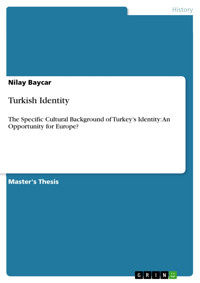
Master's Thesis from the year 2009 in the subject History of Europe - Newer History, European Unification, grade: 1,3, University of Hannover (Faculty of History, Philosophy and Social Sciences/ European Studies), language: English, abstract: Is Turkey a European country? To answer this question, we must first understand what is meant by ‘Europeanness’: Is it a sense of belonging to jewish-greek-roman antiquity, to Christianity, to the Renaissance and the Enlightement; which is the way the substantialists define Europeanness, or rather a commitment to the universal values (liberty, democracy, respect for human rights, fundamental freedoms and the rule of law) upon which the European Union was founded? The constructivists regard Europeanness as a commitment to European principles,defining the term in a syncretic way. So far, the identity of the European Union has prevalently been defined politically. In answering the question of whether Turkey belongs to the common European cultural heritage or not, it must first be pointed out that there would not have been a European history without Turkey since Turkey is the successor to the Byzantine and Ottoman empires that have shaped Europe. Moreover, it is important to note that the origin of Turkey itself lies within the cradle of European civilisation. As a contribution to the continuing debate on the place of Turkey within Europe the aim of this master’s thesis is to examine in detail the historical background and context of Turkey’s cultural identity. The paper is structured as follows: In Chapter 2 discussion will be presented on how ‘Europe’ and ‘Europeanness’ are popularly defined, also European identity and its relevance to the European culture will be discussed in the light of the constructivist approach, bearing in mind that the European Union is a unity in diversity. Having considered the main elements of European culture, the problem areas of European identity will be reviewed in detail. Subsequently, the dynamic dichotomizing concepts of ‘inclusion’ and ‘exclusion’ will be addressed, together with the negative impact of ‘multiple identities’, in order to explain the theoretical background behind Turkey’s characteristic ‘Europeannness’. In Chapter 3, the issue of the ‘Europeanness of Turkey’ will be examined and accession negotiations between Turkey and the EU will be discussed. Chapter 4 will clarify the specific character of Turkey describing it as being between the Orient and the Occident. Chapter 5 surveys political culture in Turkey, from the foundation of Turkish Republic in 1923 up to the present day. In Chapter 6 the intercultural dialogue between Turkey and Europe will be evaluated.
Das E-Book können Sie in Legimi-Apps oder einer beliebigen App lesen, die das folgende Format unterstützen:
Veröffentlichungsjahr: 2009
Ähnliche


















Page 1
Page 2
Acknowledgements
This master’s thesis is the result of my own study of over an 18 month period, but also reflects the contributions of some esteemed gentlemen. In this regard, I am grateful to my supervisors Mr. Dr. Peter Best and Mr. Coúkun Tözen for their academic support. I also want to record my thanks to our family friend Mr. Kevin Askew for correcting and improving my work linguistically. Finally, I would like to thank Mr. Thomas Donatus Breyer for his help with translation from German into English and for checking over the paper.
MA Nilay Baycar
Page 4
4.Turkey Between Orient and Occident……………………………………………….....63
5.Political Culture in Turkey from Atatürk to Erdo÷an………………………………...70
6.Intercultural Dialogue Between Turkey and Europe and the European Cultural Programmes which Turkey takes part in………………………………………………...79
7.Conclusion…………………………………………………………………………….......90
8.Appendix: ………………………………………………………………………………...97
Figures and Crosstabulations about Euro-Turks and Their Bridge Role Between Turkey and EU
9.Bibliography……………………………………………………………………………..102
Page 5
Is Turkey a European country? To answer this question, we must first understand what is meant by ‘Europeanness’: Is it a sense of belonging to jewish-greek-roman antiquity, to Christianity, to the Renaissance and the Enlightement; which is the way the substantialists define Europeanness,1or rather a commitment to the universal values (liberty, democracy, respect for human rights, fundamental freedoms and the rule of law) upon which the European Union was founded?2
The constructivists regard Europeanness as a commitment to European principles, defining the term in a syncretic way.3So far, the identity of the European Union has prevalently been defined politically. In answering the question of whether Turkey belongs to the common European cultural heritage or not, it must first be pointed out that there would not have been a European history without Turkey since Turkey is the successor to the Byzantine and Ottoman empires that have shaped Europe. Moreover, it is important to note that the origin of Turkey itself lies within the cradle of European civilisation. As a contribution to the continuing debate on the place of Turkey within Europe the aim of this master’s thesis is to examine in detail the historical background and context of Turkey’s cultural identity. The paper is structured as follows: In the first part of Chapter 2 discussion will be presented on how ‘Europe’ and ‘Europeanness’ are popularly defined. This will include reference to a variety of opinions on how to define Europeanness, and the role of European values will be analysed. In the second part, European identity and its relevance to the European culture will be discussed in the light of the constructivist approach, bearing in mind that the European Union is a unity in diversity. Having considered the main elements of European culture, the problem areas of European identity will be reviewed in detail. Subsequently, the dynamic dichotomizing concepts of ‘inclusion’ and ‘exclusion’ will be addressed, together with the negative impact
1ThiswayofEuropeannessisregardedas‘theholisticdefinitionofEuropeanness’.See: AyhanKaya&FerhatKentel,“EuroHTürkler.TürkiyeileAvrupaBirli4iArasındaKöprümü,Engelmi?”(EuroHTurks. ABridgebetweenTurkeyandtheEUorabarrier?),assupportedbyHeinrichBöllFoundation,%stanbulBilgi University(ed.),%stanbul,2005,p.107.
2The Union is founded on the principles of liberty, democracy, respect for human rights and fundamental freedoms,andtheruleoflaw,principleswhicharecommontotheMemberStates.See:EuropeanParliament. TreatyonEuropeanUnion(consolidatedversion),Article6(1),availableat:
http://www.europarl.europa.eu/hearings/20000222/libe/art6/default_en.htm(lastaccessedon26.01.2009).
3Kaya&Kentel,ibid.:pp.107H108.
Page 6
of ‘multiple identities’, in order to explain the theoretical background behind Turkey’s characteristic ‘Europeannness’.
In Chapter 3, the issue of the ‘Europeanness of Turkey’ will be examined. The question as to whether Turkey belongs geographically to Europe or not is addressed in the first part, whilst Turkey’s historical and cultural connections to Europe are discussed in the second part of the chapter.
The third part of Chapter 3 deals with the Europeanisation processs in Turkey, starting with the period of the Ottoman Empire; and specifically with the era of Sultan Selim III. Here the reform process transformed the administrative, diplomatic, economic, military and education functions, through the so-called Nizam-ı Jedid program. Subsequently, the reform process under the rule of Sultan Mahmut II will be discussed and following that, one of the most influential reform processes in the Ottoman history will be evaluated; namely the ‘Tanzimat reforms’. The Tanzimat period plays a critical role in Ottoman history, in the development of democracy and the secularisation of the state. It led to radical reform of the military, the central bureaucracy, and judiciary, and in administration, taxation, education and communication. This era of the Ottoman history is also of particular importance, as it marked the first steps towards the adoption of a european perspective amongst Turkish people, which could be regarded to some extent as a cultural revolution.
In the following part, the era of Jung Turks will be considered, comprising the most democratic period in Ottoman history and the period where Turkish nationalism developed through the intellectual thinkers of the time. The transition from the Ottoman Empire to the Turkish Republic occurred in this period; the Young Turk Revolution in 1908 being a turning point.
The Young Turks era is dealt with, along with the radical reforms under the rule of Atatürk, undertaken with the aim of modernising and secularising the young Turkish Republic to achieve the same level of contemporary civilisation apparent in Europe and the West. Thereafter, the ideology- and the doctrines of ‘Kemalism’ will be described, upon which the Turkish Republic was founded and on which it remains based on today. Having described the transformation process implemented by Atatürk, I will focus on the reforms after the Helsinki-phase, where Turkey was declared as a European candidate
Page 7
country by the Helsinki European Council of December 1999,4on the same basis and standards as the other European candidate countries.5Without any doubt, this was an important development in the history of Turkey-EU relations. It should be also noted that after Helsinki Turkey achieved various significant reforms, thus the whole europeanisation process gained speed: In the light of the Demirok-report of 2000,6which included the necessary reforms on Turkey’s way to the EU, the government carried out a reform process, realising numerous constitutional amendments and nine harmonisation packages. Subsequently, the revision of Article 301 of the Turkish Penal Code (TPC) on the denigration of Turkishness will be discussed. This is because of its particular relevance to Turkish identity, as an indicator of fundamental progress in the field of freedom of expression, which could be considered as a sine qua non requirement for EU membership.7In Chapter 3, accession negotiations between Turkey and the EU will also be discussed; in the light of the official documents of the European Commission. The current situation of the progress in the 33 chapters of the acquis’8will be mentioned withoung going into detail, in consideration of the sensitive state of the ongoing negotiations between the parties.
Chapter 4 will clarify the specific character of Turkey describing it as being between the Orient and the Occident. Thus, Eurocentricism and the antagonistic terms ‘Orient’ and ‘Occident’ will be discussed, as well as the close relations of Turkey with the Western world, whereby Turkey is regarded being a part of the West as the only country in the muslim world which has embraced a modernisation process under its own free will.
4EuropeanCommission,ReportoftheIndependentCommissiononTurkey,“TurkeyinEurope:Morethana promise?”,Brussels,September2004,p.14,availableat:
http://www.independentcommissiononturkey.org/pdfs/english.pdf(lastaccessedon25.02.2009).
5ibid.:p.14.
6See:http://www.amnesty.org/en/library/asset/EUR44/064/2000/en/domHEUR440642000en.pdf (lastaccessedon26.11.2008).
7CommissionStaffWorkingDocument.Turkey2006ProgressReport,COM/2006/0649final,SEC(2006)1390, Brussels,8.11.2006,pp.14H15,availableat:
http://ec.europa.eu/enlargement/pdf/key_documents/2006/nov/tr_sec_1390_en.pdf(lastaccessedon25.02.2009).
8See:EuropeanCommission.Enlargement,“HowdoesacountryjointheEU?”,availableat: http://ec.europa.eu/enlargement/enlargement_process/accession_process/how_does_a_country_join_the_e u/negotiations_croatia_turkey/index_en.htm#5(lastaccessedon25.02.2009). AccessionnegotiationswithTurkeyhasbeencarriedoutnotinall35chaptersoftheacquis,butinthefirst33 chapters.The34.and35.chapters,namely‘Institutions’and‘OtherIssues’areoutofthenegotiationprocess. See:SecretariatGeneralforEUAffairs,“AccessionNegotiations”,availableat: http://www.abgs.gov.tr/index.php?p=37&l=2(lastaccessedon25.02.2009).
Page 8
Following that, the fundamental differences between contemporary civilisations will be discussed briefly, in particular the contrast between Greek and Dutch cultures both being part of the European civilisation. Also the significant differences between Turkish and Arabian cultures will be discussed shortly, both regarded as a part of the muslim world. Later on, the great similarity between Turkish and Greek cultures will be discussed, bearing in mind that there are no definitive borders to European civilisation. Chapter 5 surveys political culture in Turkey, from the foundation of Turkish Republic in 19239up to the present day. However, ‘politics and political parties in Turkey’ is not the focus of this chapter. To clarify the political culture in Turkey, firstly, a general framework will be given about the phenomenon of ‘political culture’ in brief. Then the role of Islam in Turkey will be elucidated, as well as the nature of the secular state. Subsequently, Kemalism and the role of the military in Turkey will be explained, the paradigm shift in Kemalism after the transition to the multi-party system in 194610clarified, and Islamism in Turkey described, with the main focus on the era of Erbakan. Following that, the conservative democratic party AKP will be considered, this being the party implementing a reform process for the further democratisation and development of the state, as well as for Turkey’s membership to the EU, demonstrating that it should be regarded as an economically liberal party, and politically not islamist.
In Chapter 6 the intercultural dialogue between Turkey and Europe will be evaluated, with the objective of identifying methods of improving the negotiation process, currently in progress. After that, the role of religion in these discussions, particularly that of Islam and Christianity will be clarified, and also the particular need for an improved dialogue, in response to the September 11 terrorist attacks in 200111and various terrorist attacks in Europe. As a following issue, the transition role played by Euro-Turks on Turkey’s accession to the EU will be addressed. To fully explore the issue, the conclusions of the analysis of the social scientist Ayhan Kaya will also be considered. Subsequently, the importance of a real partnership, rather than the privileged partnership between Turkey and Europe, will be emphasised, as well as the necessity of strengthening intercultural dialogue between both
9GünterEndruweit,“TurkeyandtheEuropeanUnion:AQuestionofCulturalDifference?”,in:NezihiÇakar (ed.),Perceptions.AStrategicOverviewofTurkey,JournalofInternationalAffairs,VolumeIII.Number2,%stanbul,JuneHAugust1998,p.59.
10ErcanHayto4lu,“Türkiye’deDemokratikle^meSürecive1945’teÇokPartiliSiyasîHayataGeçi^inNedenleri (1908H1945)”(TheProcessofDemocracyandtheReasonsofTransitiontoMultiHPartySysteminTurkey),PAÜ. E4ilimFak.Derg.1997.Sayı:3,p.46,availableat:http://egitimdergi.pamukkale.edu.tr/makale/say%C4%B13/4H T%C3%9CRK%C4%B0YE.pdf(lastaccessedon25.01.2009).
11September11news.com(ed.),“TheArchivesofGlobalChangeinthe21stCentury”, http://www.september11news.com(lastaccessedon25.02.2009).
Page 9
participants. In the following part of the chapter, the ‘cultural-, social-, and humanitarian partnership’ between Turkey and the EU will be discussed, in the context of the ‘Barcelona Process’.12In addition to this, the ‘MEDA programme’ and the ‘Euro-Mediterrranean Social, Cultural and Human Partnership’ will be considered. Following this, other cultural programs of the EU, which Turkey takes part in, will be described including the ‘Culture Programme (2007-2013)’, ‘Lifelong Learning- and Youth in Action Programme’ and ‘Education and Training 2010 Work Programme’. In the final part of the chapter, accession negotiations between Turkey and the EU in the cultural field will be explained and Turkey’s advancement in this area will be evaluated, in the light of the progress reports of the European Commission giving the reader a better understanding of Turkish-EU cultural relations. In the end, Turkey’s work in the field of culture will be reviewed, on the basis of Turkey’s 2008 National Program.1.2. Literature Review and Methodology
The literature on the Europeanness of Turkey, which falls into the survey field of this paper, is quite comprehensive: Notable social scientists have attempted to analyse Turkey’s Europeannness: Whilst some like Hans Ulrich Wehler13and Heinrich August Winkler14are of the opinion that Turkey is not a European country, others argue that Turkey is part of Europe. Among those, the most popular analysts might be considered to be Günter Seufert,15Heinz Kramer16and Wolfgang Burgdorf.17Furthermore, Günter Endruweit18and Jan Cremer,19who have also been working in this subject area, see Turkey as european.
12EuropeanCommission.ExternalRelations,“TheEuroHMediterraneanPartnership”,availableat: http://ec.europa.eu/external_relations/euromed/index_en.htm(lastaccessedon25.02.2009)Seealso: OfficialSiteoftheEU,EuropaGlossary,“BarcelonaProcess”,availableat: http://europa.eu/scadplus/glossary/barcelona_process_en.htm(lastaccessedon25.02.2009).
13HansHUlrich Wehler, “Verblendetes Harakiri: Die TürkeiHBeitritt zerstört die EU”, in: Bundeszentrale für PolitischeBildung(Hrsg.),AusPolitikundZeitgeschichte,B33H34,Bonn,2004,pp.6H8. Seealso:HansUlrichWehler,“DietürkischeFrage.EuropasBürgermüssenentscheiden”,in:ClausLeggewie (Hrsg.),DieTürkeiundEuropa,editionSuhrkamp,FrankfurtamMain,2004,pp.57H69.
14HeinrichAugust Winkler, “Soll Europa künftig an den Irak grenzen?”, in: Claus Leggewie (Hrsg.), Die Türkei undEuropa,editionSuhrkamp,FrankfurtamMain,2004,pp.271H273.
15GünterSeufert,“KeineAngstvordenTürken!”in:ClausLeggewie,DieTürkeiundEuropa,editionSuhrkamp, FrankfurtamMain,2004,pp.70H75.
16HeinzKramer,“DieTürkei:EUHkompatibelodernicht?ZurDebatteumdieMitgliedschaftderTürkeiinder Europäischen Union”, in: Niedersächsische Landeszentrale für politische Bildung (Hrsg.), Informativ und Aktuell, Hannover, 2004, available at: http://www.nibis.de/nli1/rechtsx/nlpb/pdf/Europa/Tuerkei_09H04.pdf (lastaccessedon25.02.2009).
17Wolfgang Burgdorf, “Die europäische Antwort. Wir sind der Türkei verpflichtet”, in: Claus Leggewie, Die TürkeiundEuropa,editionSuhrkamp,FrankfurtamMain,2004,pp.80H84.
18Endruweit,1998,pp.54H72.
19Jan Cremer, “Die Türkei und die europäische Identität”, in: Bundeszentrale für Politische Bildung (Hrsg.), TürkeiundEU.Debatte2004,17.September2004,availableat:
Page 10
Concerning the Europeanisation of Turkey, the term ‘Europeanisation’ refers, as defined by Johan P. Olsen, to ‘the export of particular political and governmental forms of Europe into non-EU countries’;20in this case into Turkey. In this sense, Europeanisation looks at the relations of the European Union with Turkey.21When we consider the degree of Europeanisation in Turkey, we are speaking about a ‘transformation’ of the nation of the most fundamental kind.22In this regard, Heinz-Jürgen Axt, Antonio Milososki and Oliver Schwarz characterise ‘transformation’ as a development, through which the nation state -in this context Turkey- replaces its traditional policies with those of the EU and makes significant changes that differ markedly from its former structure.23The development of Europeanisation is described “as a process of diffusion”.24According to Radaelli’s definition, Europeanisation consists, besides diffusion process, also of processes of construction and institutionalisation of formal and informal rules, procedures and policy paradigms of Europe which transforms the structure of the nation state being integrated into the EU.25Furthermore, Ladrech sees Europeanisation as an “incremental process” of directing the domestic politics to the level that EU dynamics become both politically and economically parts of the national politics and the policy-making process.26The radical reforms of the nine harmonisation packages27on the way of the democratisation of Turkey could be seen as examples for those.
Regarding Turkey’s Europeanisation, accession conditionality28is of vital importance, being the process through which the EU makes Turkey’s membership to the union contingent on conditions,29categorised as the Copenhagen criteria, and declared annually in the Commission’s progress reports. Conditionality should in no way be regarded as “a
http://www.bpb.de/themen/C7YEJL,0,Die%20T%FCrkei%20und%20die%20europ%E4ische%20Identit%E4t.htm l(lastaccessedon25.02.2009).
20JohanP.Olsen,“TheManyFacesofEuropeanization”,ARENAWorkingPapers,WP01/02,2002,pp.2H3, availableat:http://www.arena.uio.no/publications/wp02_2.htm(lastaccessedon25.02.2009).
21ibid.JohanP.OlsenspeaksgenerallyfromtherelationsoftheEUwithnonEUHactors.Becauseofthesurvey fieldisaboutTurkeyandTurkeyisstillnotanEUmember,TurkeyHEUrelationshadbeenmentioned.
22HeinzHJürgenAxt&AntonioMilososki&OliverSchwarz,“EuropäisierungHeinweitesFeld.Literaturberichtund Forschungsfragen”,VSVerlag,PolitischeVierteljahresschrift,48.Jg.,Heft1,2007,p.140,availableat: http://www.springerlink.com/content/6p32939t8381572g/fulltext.pdf(lastaccessedon25.02.2009).
23ibid.:p.140.
24Olsen,ibid.:p.3.
25Axt&Milososki&Schwarz,ibid.:p.138.
26RobertLadrech,“EuropeanizationofDomesticPoliticsandInstitutions:TheCaseofFrance”,in:Journalof CommonMarketStudies1,1994,p.69.
27Theseharmonisationpackageswillbehandledinchapter3underthetitle‘ReformsaftertheHelsinkiPhase (1999H2009)’.
28Originally,itrefersto“Beitrittskonditionalität”.See:Axt&Milososki&Schwarz,ibid.:p.142.
29See:ibid.:p.142.
Page 11
mechanism of hierarchy” since it is quite possible for the canditate state itself to decline membership.30In this respect, we can speak from “Beitrittseuropäisierung”;31instead of a “Mitgliedseuropäisierung”;32because of the fact that Turkey is a non-EU country with whom accession negotiations have been progressing.
Central to the scope of this master’s thesis, the most recent academic work seems to be in the 2008 published book “Türkei und europäische Identität”33of Ellen Madeker. She sees European identity discursively constructed by clarifying the role of the concept ‘Identity’ on the debates about Turkey’s full-membership to the EU.34
Within the body of this master’s thesis, the author will be responding to the following questions: 1)What is Europeannness?
2)Which role does ‘Christianity’, ‘Renaissance’, ‘Reform’, ‘Enlightenment’ and the ‘Jewish-Greek-Roman Antiquity’ play in the formation of Europeanness? And how much is Turkey connected to this processes?
3)What is the common European cultural heritage and does Turkey belong to it?
4)In what respects is Turkey different from the rest of the muslim countries?
5)How strong are the relationships Turkey has with the rest of Europe?
6)Are there any definite borders to the spread of civilisations; in particular, that of European civilisation and culture?
7)Should the European Union enhance its multicultural and multireligious structure by accepting Turkey as a EU member or transform itself into a Christian club in the future?
30TanjaA.Börzel&SonjaGuttenbrunner&SimoneSeper,“ConceptualizingNewModesofGovernanceinEUH Enlargement”,Berlin,2004,availableat:
http://www.euHnewgov.org/database/DELIV/D12D01_Conceptualizing_NMG_in_EUHEnlargement.PDF (lastaccessedon25.02.2009).
31See:Axt&Milososki&Schwarz,2007,pp.142H143.AccordingtoGrabbe,thosecountrieswhichare europeanizedasnonEUmembers,“areonlyconsumers,notproducers,oftheoutcomesoftheEU’spolicy makingprocesses.”See:HeatherGrabbe,“EuropeanisationGoesEast:PowerandUncertaintyintheEU AccessionProcess”,in:KevinHeatherstone&ClaudioM.Radaelli(Hrsg.),ThePoliticsofEuropeanization, Oxford,2003,p.313.
32See:Axt&Milososki&Schwarz,ibid.:pp.143H144.
33EllenMadeker,“TürkeiundeuropäischeIdentität.EinewissenssoziologischeAnalysederDebatteumdenEUH Beitritt”,VSVerlag,Wiesbaden,2008.
34ibid.:p.14.
Page 12
As far as the methodology is concerned, interdisciplinary academic texts are the basis of ‘this work’; which could be regarded to be politically and historically reflexive. Besides the interdisciplinary texts, some data and graphics will be used to examine the role of Euro-Turks in the course of Turkey’s integration to the EU.
By discussing Europeanness of Turkey, we should start with ‘the definition of Europe’ and ‘Europeanness.’ In this regard, Vergara’s statements are noteworthy:
But… what exactly do we mean by ‘Europe’? Above all, it must be pointed out that defining Europe is a quite difficult and multi-faceted task. From a geographical point of view, Europe is not a clearly defined continent like Australia or Africa. WhilstEuropehas naturally, occurring borders to thenorth, westand south formed by the North Sea,Atlantic Oceanand theMediterranean,the situation in the east is more complex, as Europe and Asia are not separated by a natural geographic boundary.36Politically, ‘Europe’ comprises the 27 member countries of the European Union, but it may also be used to refer to both EU and non-EU countries which together comprise the 47 countries of the Council of Europe. People in Ireland, United Kingdom, Scandinavia, the North Atlantic and Mediterranean islands can also see themselves as occupying parts of ‘continental’ or ‘mainland’ Europe.
As far as ‘Europeanness’ is concerned, from a historical and cultural point of view, the “Greek Paideia, the Roman Humanitas, the Christian Ideal, the Renaissance, Rationalism, the Enlightenment and Secularism, Liberalism, Modernism” etc. are and have been the main
35Javier Vergara, “The History of Europe and its constituent Countries: considerations in favour of the new Europe”,JournalofSocialScienceEducation,Volume6,Number1,Madrid,June2007,p.15,availableat: http://www.jsse.org/2007H1/pdf/vergara_history.pdf(lastaccessedon25.02.2009).
36BeritRinke,“GehörtdieTürkeizuEuropa?”,UniversityofOldenburg.POLITISHWorkingpaperNo.5, Oldenburg,2006,p.9,availableat:http://www.politisHeurope.uniH oldenburg.de/download/WP5_Rinke_Turkey2006fin.pdf(lastaccessedon25.02.2009).
Page 13
supranational cultural developments born out of the old continent. These have spread extensively, shaping a great part of the so-called “universal culture”.37In this context, I want to mention the three main positions about Europeanness:
Historical substantialists38define the term generally in a holistic way stating that the main developments in European history are the determinative factors of what it is to be considered European.39In this sense, to be European, a country should have been participant in ‘Jewish-Greek-Roman Antiquity’, ‘the Renaissance’ and ‘Enlightenment’ processes and belong to ‘Christianity’.40‘Samuel Huntington, Hans Ulrich Wehler and Heinrich August Winkler’ support this view.41No doubt, the EU-27 countries are members of the Christian culture and they took part in the processes I have already mentioned. However, to argue that a country which is not a part of the Christian culture can not be a member of the European Union would be a fallacious statement. Also to claim that the Abrahamic religions42can not coexist would be scientifically not legitimate.
Secondly, constructivists define Europeanness in a syncretic way and argue that the criteria used by historical substantialists to define european identity were not strong enough and the arguments they put forward disprovable.43They claim that all the characteristics that the substantialists use to define the european identity had been and were historically constructed.44In addition, they think that the European identity and the criteria for the
37Vergara,2007,p.15.
38Gerhardscharacteriseshistoricalsubstantialistsasfollows:
“AlshistorischeSubstantialistenbezeichnenwirdiejenigenAutoren,dieinhaltlicheMerkmalederkulturellen Besonderheit Europas meist mit Bezug auf die Geschichte definieren und begründen und entlang dieser MerkmaleMitgliedsschaftskriterienfürdieEUdefinieren.”See:JürgenGerhards,“KulturelleUnterschiedein der Europäischen Union. Ein Vergleich zwischen Mitgliedsländern, Beitrittskandidaten und der Türkei”, 1. Auflage,VSVerlag,Wiesbaden,2005,p.27.
39ibid.:p.27.
40ibid.:p.27.
41ibid.:p.27.
42Inthestudyofcomparativereligion,anAbrahamicreligionisanyofthosereligionsderivingfromacommon ancientSemitictraditionandtracedbytheiradherentstoAbraham("Father/Leaderofmany"Hebrew¤ ¸ ¡ËArabicéñá),apatriarchwhoselifeisnarratedintheHebrewBible/OldTestament,andasaprophetinthe Qur'an.Thisformsalargegroupofrelated,largelymonotheisticreligions,generallyheldtoincludeJudaism, Christianity,Islam,andtheBahá'íFaith(baseduponIslam),andcomprisesabouthalfoftheworld'sreligious adherents.See:TheologicalDictionarywordoftheday,“Abrahamicreligion”,March04,2008,availableat: http://tdwotd.blogspot.com/2008/03/abrahamicHreligion.html(lastaccessedon16.02.2008).
43Gerhards,ibid.:p.28.
44ibid.:p.28.




