


8,39 €
Mehr erfahren.
- Herausgeber: Salt
- Kategorie: Abenteuer, Thriller, Horror
- Sprache: Englisch
Banned for over 30 years — Frank Walford's classic work of horror is available again. "Twisted Clay is a gruesome study of progressive insanity, but the study is obviously subordinate to a desire to excite and horrify." —H.M. Green She loved … and killed … both men and women. She was utterly beautiful and utterly mad. This is a tale of passionate horror … a breath-taking venture into abnormal psychology … a story which cannot be forgotten. "A competently told horror story." —Bruce Catton, Nea Service "A prose nightmare, tinged with Poe and Baudelaire substance." — N.Y. Mirror "This work will probably be regarded as one of the most notable books of the year. It merits numerous superlatives, such as most peculiar, most gruesome, most forceful." — Dayton, O., Daily News "Sensational study of a doomed, abnormal girl in her fight to maintain a warped personality against a world in her torturing journey along the misty and terrifying by-ways of progressive insanity." — Baltimore, Md., News "Remarkably persuasive and effective novel." — Cleveland, O., Press "The logical successor to the best products of the Tiffany Thayor school." — Durham, N.C., Herald-Sun
Das E-Book können Sie in Legimi-Apps oder einer beliebigen App lesen, die das folgende Format unterstützen:
Veröffentlichungsjahr: 2014
Ähnliche




















Banned for over 30 years — Frank Walford’s classic work of horror is available again.
“Twisted Clay is a gruesome study of progressive insanity, but the study is obviously subordinate to a desire to excite and horrify.” —H.M. Green
She loved … and killed … both men and women. She was utterly beautiful and utterly mad. This is a tale of passionate horror … a breath-taking venture into abnormal psychology … a story which cannot be forgotten.
“A competently told horror story.” —Bruce Catton, NEA SERVICE.
“A prose nightmare, tinged with Poe and Baudelaire substance.” — N.Y. MIRROR.
“This work will probably be regarded as one of the most notable books of the year. It merits numerous superlatives, such as most peculiar, most gruesome, most forceful.” — Dayton, O., DAILY NEWS
“Sensational study of a doomed, abnormal girl in her fight to maintain a warped personality against a world in her torturing journey along the misty and terrifying by-ways of progressive insanity.” — Baltimore, Md., NEWS.
“Remarkably persuasive and effective novel.” — Cleveland, O., PRESS.
“The logical successor to the best products of the Tiffany Thayor school.” — Durham, N.C., HERALD-SUN.
Twisted Clay
Born in 1882 in Balmain Sydney, Australia, Frank Walford was a buffalo hunter and crocodile shooter in his youth, later becoming a journalist and editor. He was a prolific writer whose short stories were dramatized on Australian radio. He died in 1969.
Published by Salt Publishing Ltd
12 Norwich Road, Cromer, Norfolk NR27 0AX
All rights reserved
Twisted Clay © The Estate of Frank Walford 2014
Re-twisting the Clay © Johnny Mains 2014
Frank Walford and the ‘Blue Mountaineers’ © Jim Smith 2014
The Reception of Twisted Clay © James Doig 2014
Twisted Clay first published in 1933
The right of Frank Walford to be identified as the author of this work has been asserted by his estate in accordance with Section 77 of the Copyright, Designs and Patents Act1988.
This book is in copyright. Subject to statutory exception and to provisions of relevant collective licensing agreements, no reproduction of any part may take place without the written permission of Salt Publishing.
Salt Publishing 2014
Created by Salt Publishing Ltd
This book is sold subject to the conditions that it shall not, by way of trade or otherwise, be lent, re-sold, hired out,or otherwise circulated without the publisher’s prior consent in any form of binding or cover other than that in which it is published and without a similar condition including this condition being imposed on the subsequent purchaser.
ISBN 978-1-84471-756-9 electronic
“Twisted Clayis a gruesome study of progressive insanity, but the study is obviously subordinate to a desire to excite and horrify.”
— H.M. GREEN
Contents
Re-twisting the Clay
Frank Walford and the ‘Blue Mountaineers’
The Reception of Twisted Clay
Acknowledgements
Re-twisting the Clay
JOHNNY MAINS
I’m going to keep this short and sweet.
My first introduction to the work of Frank Walford was in the mid 90s and the book in question was The Ghost and Albert and Other Stories, first published by T. Werner Laurie [1945]. I picked up a second-hand copy at a car boot for 50p. I didn’t know anything about the author, certainly didn’t know anything about his infamous novel and took it back to the place I was staying and read it over two or three days. I thought it was a cracking read; the stand-out for me was ‘The Coming of Flamea’ – a story about a fictional character coming to life.
I went to the library to see if there was anything else by Mr Walford, and was told that there would have to be an inter-library request put in, and did I have the required 50p to do such a task? I did not, went home, and promptly forgot about him.
A few years later I was hitchhiking in Ireland, and was picked up by a lovely couple and they invited me back to their house to camp on their lawn – the weather was pretty miserable, and the promise of some hot soup and a couple of cans of Guinness swayed me pretty easily. Their house was massive. I think he was a newspaper reporter, and they had one of the most impressive private libraries I had ever seen. I’ve yet to see better, and I think my library is rather magnificent. I was scanning through the books and a name popped out at me. Frank Walford. The book was called Twisted Clay, there was no dustjacket, and the boards were a dirty mustard colour. I didn’t think it was right to ask my hosts if I could take the book to the tent to read it, so made a note of the book down in my diary and had some lovely potato and leek soup.
Years passed. I could never find a copy of the book, and in the early days of Ebay I was more interested in collecting Dawn of the Dead memorabilia, which was very cheap to pick up back then. It wasn’t until May 7, 2009 at 12:36 pm on a website I occasionally post on called Vault of Evil, a member called James Doig posted:
An entertaining read in a similar vein is Frank Walford’s Twisted Clay, first published in 1933 and banned here in Australia for 30 years. It was reprinted by Horowitz a few times in the 1960s. It’s about a precocious 15 year old lesbian who murders her father when she learns he wants to take her to Europe to undergo experimental hormone treatment to help her. She suffers bouts of insanity during which she is compelled by the ghost of her father to dig him up and plug the hole in the back of his head (he complains his brains are falling out, you see). When she’s caught digging him up for the second time she’s committed to an asylum. When she escapes she takes to prostitution and acquires a taste for murdering her clients Jill-the Ripper style. After that it gets silly.
This was Twisted Clay? It sounded mental! I had to read it. I again tried to find a copy of the book, but any available copies were fetching hundreds. Today, there is a copy on Abe Books, selling for $2,000. I asked James Doig if he would help get me a copy of Twisted Clay scanned in to make my wish of owning the book a reality. James sent me the pdf file to read and I wasn’t let down in the slightest. It’s strange, The Ghost and Albert and Other Stories is completely different tonally and is such a minor work compared to this triumph.
I have also commissioned two essays by noted Walford scholars Jim Smith and James Doig. These give extra depth and a detailed background to this astounding book and its author. I wonder how Frank felt having the book banned for 30 years in his native country; on one hand, rather thrilling, it would have afforded him plenty of notoriety, but on the other, completely awful as his book wasn’t bringing in the money it should have.
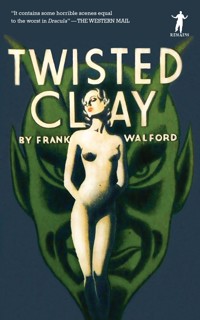
The artwork is from the Claude Kendall hardback, and has been tightened and freshened up by Richy Sampson. I toyed with the idea of commissioning new artwork for it, but I’m sure you’ll agree that this cover cannot be bettered!
As to the format of the book, I don’t want to be responsible in creating another hard to own book when there are several editions of this work which are beyond the price range of the casual reader. So, I’ve taken the plunge to launch the Remains classics line – so it should remain a constant price in both e-book and print on demand. And this book will forever be in print, so if you spill your cup of coffee on it, or loan it to a friend and it never returns – order another one in.
It’s been 52 years since Twisted Clay was last reprinted. I am honoured to have brought this very strange and criminally neglected classic back to life. To have the backing of Frank Walford’s family to publish this book as the very first title in the Remains list thrills me to the bone. Ladies and Gentlemen, get your shovels ready, we’ve got some digging to do . . .
Frank Walford and the ‘Blue Mountaineers’
JIM SMITH
Katoomba in the early 1930s would seem to have been an unlikely place to produce a remarkable output of creative writing. This small town, with a population of a little over 10,000, 100 km west of Sydney and 1000 m above sea level, was better known for being the centre of the Blue Mountains tourism industry. This was based on the opportunities to do vigorous walks in the mountain air and contemplate the awesome surrounding valleys from the cliff tops. Katoomba’s small literary ‘salon’ of that time included the following writers: Frank Walford (1882–1969), Eric Lowe (1889–1963), Eric’s wife Nina (1884–1971), Eric and Nina’s daughter Barbara (1913–2000), Osmar White (1909–1991), Eric Dark (1889–1987) and Eleanor Dark (1901–1985). Of these, only Eleanor Dark is today regarded as a significant literary figure. Hopefully, this republication of Walford’s first novel Twisted Clay will bring about recognition of his literary achievement.
All the writers who were later to call themselves the ‘Blue Mountaineers’ were bornoutside the Blue Mountains and came independently to Katoomba between 1919 and1923. Frank Walford was the first to arrive.
The Life of Frank Walford 1882–1924.
Frank Walford was born in Balmain in 1882.1After matriculating from Fort StreetBoys High School in 1898, he spent the next ten or so years in restless travels, alternating between office jobs and adventures in Northern Australia. His moreconventional employment included clerical work in banks, the customs department, ashipping office and the carrying business ‘Walford & Walford’ in Sydney. In tropicalAustralia, Walford claimed to have worked as a timber getter, mule packer,prospector, drover, “alligator” hunter, buffalo shooter, kangaroo hunter, orchidcollector, and pearler. During this period he owned his own boat, theSpindrift,whichhe sailed from Sydney, through the Barrier Reef, and as far as Broome. Walford’sunpublished manuscripts and his ‘autobiographical novel’A Fools Odysseyrefer tosome illegal activities such as “Chow running” (now referred to as people smuggling),drug smuggling and the maiming and killing of various people.2It is likely that someof these are fictional accounts. In the somewhat lawless frontier conditions ofNorthern Australia, Walford had to learn to defend himself and became a good boxer.He described himself as a “good shot with rifle, dead shot with revolver, excellenthand with knife”.3
By 1910 he settled down in the Parramatta district. He joined the Labor party,engaged in various political controversies, and was active in communityorganisations. In 1912 he married Madge Owen. Walford’s long career inprofessional journalism began in 1913 when he was a reporter and columnist for theCumberland Times.During his Parramatta years he ran a duck farm, became arespected amateur boxer and published his first bookletThe Jumbly History ofParramatta,a long satirical poem on local affairs.4He ran for the State seat twice asthe Labor candidate, being narrowly defeated in 1913 and 1916.5While supportingAustralian involvement in World War One, he was a prominent anti-conscriptionist.He started his own Parramatta based newspaperWalford’s Weeklywhich ran for fivemonths. After it closed, he moved to Katoomba and began working for theBlueMountain Echoin February 1919. Four months later he became editor of an insert intolocally distributed copies of Sir James Joynton Smith’s Sydney paper,Smith’sWeekly.6Walford and Smith began the Katoomba Chamber of Commerce in 1922.7During his years in Katoomba, Walford energetically explored the local bushland andset up a cave north of Medlow Bath as a base camp.8He wrote poetry from histeenage years and published many poems in a self-published anthology in 1919 and inthe local press.9
In 1920 Madge gave birth to twins, Owen (‘Bill’) and Hilda.10In 1921 the localSmith’s Weeklysupplement became theKatoomba Daily.On theDaily’spressWalford printedThe Eternal Ego,a philosophical work, which appears to have beenpartly inspired by the exultation and self-confidence he felt during his early years ofexploring the Blue Mountains. However the naïve neo-Nietzschean style andlanguage of the booklet make it embarrassing to read today. Walford campaignedduring his years at theKatoomba Dailyfor ways to boost local tourism. He putparticular emphasis on the need to open new ‘sights’, renovate and mark oldovergrown walking tracks and attract winter visitors to the area.11
The Writers Group Forms.
The Lowes came to Katoomba in 1921 from a grazing property in far western NewSouth Wales. They had both been writing short stories since 1912. Osmar White, whohad been born in New Zealand, arrived in Katoomba in the early 1920s after thebreakup of his parents’ marriage. Dr Eric Dark came with his wife Eleanor to take upa local medical practice in January 1923. The Lowes, Darks, Walfords and Whiteswere near neighbours. Walford met Dr Eric Dark when the latter joined the KatoombaChamber of Commerce in 1925. Dr Dark became close friends with Eric Lowe, whowrote in Dark’s surgery after hours. Eleanor Dark befriended the Lowes’ daughters. Osmar White first met Dr Dark as a patient when he was treated for an injured hand.These writers shared a common enthusiasm for bushwalking and rock climbing in thelocal area, discussing literature and politics and listening to music together. Duringthe period 1923–26 the published literary output of these ‘Blue Mountaineers’ wasconfined to short stories and poetry. Eleanor and Nina were working on themanuscripts of novels.
During the 1920s Walford wrote a vast number of words for theBlue MountainEcho, with his various campaigns for local advancement, weekly columns and general local reportage. These seem to have been happy years for him, during which he wrotemany exuberant articles about the joys of living in the Blue Mountains and lyricaldescriptions of its scenery. He established a close relationship with Eric Dark,working with him on campaigns to promote local tourism. Walford publishedPaths ofDew,another anthology of his poems in 1927 as well as a guide to local bushwalksoff the beaten track.12
Members of the Katoomba writers group had begun to disperse in November 1926,when the Lowes went to Adelaide. Osmar White travelled around the state working asa journalist and freelance writer. TheEchoceased publication at the end of 1928 andWalford moved to Parramatta where he started up theParramatta CityNews.After afew years this paper folded and Walford and Eric Lowe publishedEggs, a newspaper for poultry farmers financed by Dr Dark. In January 1930, the Walfords’ daughterValmai was born.
In mid-1930, with the return of Osmar White and Eric Lowe’s family to Katoomba, the ‘Blue Mountaineers’ began to reunite. Walford, while working at Parramatta,commuted back to Katoomba to continue his bushwalking trips and ran a local gravelquarry.13By August 1932 he was back in Katoomba full-time and operating withLowe another venture financed by Dr Dark, the Blue Mountaineers Guide Service.14
The early to mid-1930s saw the beginning of a remarkable period of creative writingand literary success by members of the ‘Blue Mountaineers’.In 1932 Eleanor Dark’s first publishednovelSlow Dawningappeared as did Dr Dark’s pioneering work on physiotherapy,Diathermy in General Practice.In 1933,Osmar White publishedhis first novel,Beyond Ceram, and Walford’sTwisted Claywas published inEngland and the following year in America.15In 1934 Eleanor Dark’sPrelude to Christopherappeared and Eric Lowe signed the contract for the novel, later partly serialized inThe Bulletinfrom 1936, that waspublished by Collins in London in 1938 asSalute to Freedom.
Eleanor Dark’s novels have received an enormous amount of literary analysis. However, no one has previously drawn attention to a remarkable similarity in theplots of three of the novels written in Katoomba in the early 1930s. Jean Deslines ofTwisted Clay,Myrna Stewart ofSalute to Freedomand Linda Hendon ofPrelude toChristopherare all highly sexualised, independent and unconventional women whoeventually succumb to insanity.Twisted ClayandPrelude to Christopherbothconclude with the suicides of their highly strung female protagonists.
After making contact with Bill Walford and his wife Dulcie in the early 1980s, I wasallowed to examine the papers of Frank Walford. Bill died soon after, but I continuedto visit Dulcie who told me much about Frank Walford’s life. One day she told methat Walford had said to her that Eleanor Dark had “stolen the idea” forPrelude toChristopherfrom him. Eleanor Dark’s body of work, both before and after thepublication ofPrelude to Christopher,demonstrates that she had more than enough literary imagination and psychological insight to conjure up her own plots. It is likelythat Walford gained as much inspiration from Dark as she did from him. What Walford’s remark illustrates is that the members of theBlue Mountaineerswriters’group were engaged in debates based on their reading of books on psychology and, inparticular, books dealing with psychopathology and sexuality.
Jean Deslines, inTwisted Clay,read similar works “to pry into the perplexingmysteries of my mentality.” Her reading list included “works by Havelock Ellis,Lombroso, Freud, Stekel, Jung, Brown, Bousfield and others.” These were the booksbeing read by the Katoomba authors and discussed during their bushwalks and evening soirées. Such titles were not readily available in the local subscriptionlibraries or bookshops. Dr Dark probably obtained them for the group. I found inFrank Walford’s papers copies of theMedical Journal of Australiafrom the 1930s, which carried regular articles on mental illness. Itis likely that Dr Dark subscribed to this and passed copies around the group. Thequestion of whether madness was hereditary, and the then current debates about‘nature versus nurture’ and eugenics are central preoccupations of bothTwisted ClayandPrelude to Christopherand to a lesser extent ofSalute to Freedom.The womenof these novels dread the encroaching loss of sanity, which they regard as possiblyinevitable because of their genetic inheritance. These questions were more thanphilosophical for Eleanor Dark, as her mother had suffered from a severe mentalillness.
Walford’s original title for his book,Twilight,perhaps left it more open tointerpretation as to whether the ‘darkening’ of the mind of Jean Deslines was a resultof her heredity or upbringing. His final title,Twisted Clay,16indicates that Walfordwanted to portray Jean’s psychopathic behaviour as an inevitable result of her geneticmake-up (‘nature’) and not her upbringing (‘nurture’). In contrast, modernpsychological studies have elucidated the influence of early dysfunctional upbringingin the formation of the traits of manipulative, cunning, ‘amoral’, cruel behaviour andlack of empathy that characterise sociopaths. It was perhaps an unfortunate distractionthat Walford made Jean a lesbian as well.
There have been many books, articles and theses that have highlighted the intellectualcompanionship and support received by Eleanor Dark through her correspondence with other women writers. In fact, she spent much more time rockclimbing,bushwalking and discussing literature with the predominantly male members of the‘Blue Mountaineers’ than she did in correspondence with other women writers.That Frank Walford and Eleanor Dark were thinking along similar lines in the 1930sis indicated by a short story that Dark had published inThe Bulletinin 1934.17Itrelates the solving of a homicide that had occurred on Katoomba golf course. Thevictim was murdered by the same method used by Jean Deslines on her father:“. . . killed by repeated blows on the head from some sharp instrument.” The murdererturns out to be the town’s mayor who, despite being white in appearance, has“. . . negro blood in him.” Dark describes him as having “. . . the indefinable taint of eviland uncleanness that so often goes with the mixing of bloods which should not bemixed.” The murderer’s rage against his victim is attributed to “racial instinct” and“atavistic bloodlust”. Dark was saying in her own way that he was made of ‘twistedclay’
It was no coincidence that two intense novels about disturbed and unconventionalwomen were written in Katoomba at the same time by friends who spend a lot of timewalking and talking together and reading the same books. Both novels also include somewhatclichéd elements typical of Gothic literature. Jean Deslines is born during a violent snowstorm and the mental chaos of Linda Hendon’s final descent into madness and suicide is mirrored by the lightning and thunder around her.
Eleanor Dark regardedPrelude to Christopheras her most important work. Criticstoday recognise its modernistic stylistic innovations.Twisted Clayis certainly the most original of Walford’s works. While it is much more conventional in style, itdeals convincingly with important psychological themes. It appears to be the firstauthentic portrayal in English literature of the inner life of an example of thepersonality type, now so recognisable in real-life horrors and in film, television andbooks, the sociopathic serial killer. Walford’s Jean Deslines is one of the first modernliterary ‘antiheroes’.
Walford’s later life.
Walford followed the success ofTwisted ClaywithThe Silver Girlin 1935. Hebecame a regular short story writer forThe Australian Journal, The Bulletinand manyother publications.18In 1939 Walford’s third novel,And the River Rolls On, waspublished in London. His popularity in England reached its peak in 1940, with 10,000copies ofThe Indiscretions of Iolebeing sold in five days.19From 1941, A.B.C. radiobecame an important outlet for many of Walford’s short stories which were read overthe air. The Walford and Dark families maintained a close friendship during the early1940s with the socialist-leaning Walford occupying executive positions in the localLabor Party branch, to which Dr Dark also belonged. After three decades ofcriticising local government aldermen in his newspapers, Walford finally ran forelection himself in December 1941.20
1942 saw the publication of Walford’s semi-autobiographical novel,A Fool’s Odyssey(Werner Laurie, 1942),based mainly on his early years of tropical travels, and the following year the adventure novel,The Barrier Rat, appeared.Both Dark and Walford joined the local Volunteer Defence Corps, but Walford moved out of the area to join the Guides and Reconnaissance Unit, under thecommand of the anti-communist crusader William Wentworth.21During his timewith Wentworth, and probably angered by Communist-led waterfront strikes that delayed shipment of supplies to Australian troops in New Guinea (where Walford’sson was serving), Walford abandoned his socialistic ideas and became an ardent anticommunist.
On his discharge from the Army, his standing in the local Australian Labor Party branch was still highenough for him to be invited to stand for election. However he found that, in hisabsence, Bruce Milliss, a secret member of the Communist Party, had stacked thelocal branch, leading to the resignation of many of the old local Labor Partystalwarts.22The December 1944 Katoomba Council election campaign was anextremely bitter one during which Walford denounced Dr Dark and the othermembers of the Labor Party ticket as communists.23The resulting split between themembers of the ‘Blue Mountaineers’ was not only personally traumatic but seriouslyaffected the writing of all the Katoomba based writers.
Dr Dark published only socialist tracts thereafter. Eleanor managed to complete theTimeless Landtrilogy, but then had an eleven year break from writing before her finalnovelLantana Lane.She published nothing in the last 25 years of her life. The Loweshad divorced in 1937 and Nina’s novels were never published. Eric Lowe publishedtwo more, fairly uninspiring, volumes in his family saga. The Lowe’s precociousdaughter Barbara had had her first short story published in 1929 and later became aprize-winning novelist.24Osmar White became a prolific author, continuing to produce a large output of short stories and journalism as well asmany books, mainly non-fiction.
Walford’s last overseas-published book was a collection of three short stories thatappeared in 1945,The Ghost of Albert and Other Stories(Werner Laurie, 1945). His novels failed to appeal to post war publishers. He continuedto receive rejections over several decades for such titles asThe Nietzschean, BelovedMinxandThe Immeasurable Moment.25About ten of his novels remain unpublished.In 1954 and 1955 six Walford titles were published by Frank Johnson as part of the‘Magpie Books’ series. These were cheaply produced stapled books with luridcovers. The majority were versions of previously published works by Walford. OnetitleChain of Violencehad to be destroyed as Gordon and Gotch refused to distributeit.26However, his short stories were still being widely published and regularly read onA.B.C. radio.
Walford continually pushed for publicity campaigns to counter the post-World War IIdecline in Blue Mountains tourism. He worked for many years to create what waslater known as Frank Walford Park. He was founder, patron or office holder of manylocal organisations including the Blue Mountains Historical Society, Blue MountainsConservation Society and the Pioneer Way Association. He occupied the Mayoral chair for the first time in December 1949, followed by terms in 1956/57 and 1962/63.His popularity and local influence in the local area was at its greatest level in the1950s.Walford lobbied his wartime commander and friend William Wentworth, then amember of Federal Parliament, to reverse the ban onTwisted Clay.In 1960 this waslifted and a Horwitz paperback version published. At this time, aged 78, Walford wasstill walking between 24 and 32 kilometres per week.27
Madge Walford died in 1963.28Frank’s friends felt that he lost much of his passionfor his usual pursuits after his wife’s death. He was defeated in the Blue MountainsCity Council election of December 1965 after 24 years continuous aldermanic service. Walford continued as patron of various local organisations and gave occasionallectures but did not again participate in any local controversies or produce any more fiction. Walford died on 30 May 1969 and was buried in Katoomba cemetery where some of the gruesome scenes inTwisted Claywere set.29
Endnotes
1 Birth 1882/4479. Parents Lion Henry Walford and Anna Maides.
2 F. Walford, A Fools Odyssey, T. Werner Laurie, London, 1942.
3Ibid., biographical “blurb”, p.5.
4 Walford 1942, op. cit., biographical ‘blurb’; E. Wilson ‘Alderman Was Once a Brilliant Boxer’, Mountain Gazette, 16 December 1964; “Double-Yew”, The Jumbly History of Parramatta, Frank Walford, Parramatta, 1915.
5 S. Tracey, ‘The Great War at Branch Level: The Minutes of the Parramatta Labour League 1916- 1918’, The Hummer, Vol.3(4) 2000, p.26.
6 Blue Mountain Echo, 20 June 1919.
Anon., ‘Advance Blue Mountains’, Blue Mountain Echo, 6 August 1920.
8 Anon., [F. Walford], ‘The Cave Dweller’, Blue Mountain Echo, 2 May 1919.
9 F. Walford, Starlight and Haze, The Mountaineer Printing and Publishing Co., Katoomba, 1919; Scrapbook of published poems 1912–1930s, Walford Family Archives.
10 Rotary Club of Katoomba, Old Leura and Katoomba, 1982, p.302.
11 J. Smith, The Blue Mountains Mystery Track, Three Sisters Productions, Winmalee, 1990, pp.18–26.
12 F. Walford, Paths of Dew, The Author, Katoomba 1927; F. Walford, New Walks and Sights, Wilsons Publishing Company, Sydney, N.D. [1927].
13 Old Leura and Katoomba, pp.302–303.
14 Anon., ‘Invitation Mystery Hike, Opening of Blue Mountain Guide Service’, Katoomba Daily, 9 August 1932.
15 No surviving copy of Beyond Ceram has yet been located. The UK first edition of Twisted Clay is copyrighted 1933, but according to the English Catalogue of Books, it was published in January 1934.
16 The title was inspired by the sixty third verse of Edward Fitzgerald’s translation of The Rubaiyat of Omar Khayyam (1859), which Walford prefaced his novel.
17 Eleanor Dark, ‘The Murder on the Ninth Green’, The Bulletin, 12 December 1934, pp. 29–30. This was the first short story that Dark published under her own name. She had previously used pseudonyms.
18 In a letter to Mary Campbell dated 2 September 1957, (private collection) Walford claimed to have had “over 600 short stories either published or broadcast”. The Walford Family Archives hold manuscripts or published versions of less than 200 short stories.
19 Frank Walford, ‘Notes for Station 3UZ’, Walford Family Archives. More than 20,000 copies were sold in total.
20 Anon, ‘Katoomba District Poll Result’, The Clarion, 9 December 1941.
21 F. Walford, In Khaki, unpublished manuscript [1940s], Walford Family Archives.
22 F. Walford, An Appeal by Frank Walford, [election brochure], The Author, Katoomba, November 1944.
23 Blue Mountains Advertiser, 17 November, 24 November, 1 December 1944.
24 Barbara Lowe, later McNamara, used the pen name Elizabeth O’Connor.
25 Manuscripts in Walford Family Archives.
26 Frank Johnson to Frank Walford, 17 June 1954, Walford Family Archives.
27 Anon., ‘After 34 Years Book’s Ban Lifted’, Blue Mountains Advertiser, 23 March 1961.
28 Anon., ‘Sudden Death of Mrs Madge Walford’, The Clarion, 4 August 1963.
29 Anon., ‘Death of Former Mountains Mayor’, Blue Mountains Advertiser, 5 June 1969.
The Reception of Twisted Clay
JAMES DOIG
On 6 June 1935 the Comptroller-General of the Department of Trade and Customs wrote to Sir Robert Garran, Chairman of the Commonwealth Book Censorship Board, asking him to consider whether Frank Walford’s novel Twisted Clay should be considered a prohibited import under the Customs Act. A few weeks later two members of the Censorship Board scribbled their judgements on a sheet of paper. 1 According to Garran, the book was “crude and repulsive. The so-called ‘psychology’ in it is cheap fake. I would ban.” J.P. Meurisse Haydon, Professor of French at the Canberra University College, wrote, “I can see no redeeming feature in this story of progressive insanity. It could, I am sure, prove very harmful to a highly impressionable nature. I would certainly ban.” Twisted Clay was placed on the prohibited list on 15 July 1935 and was not released until 19 September 1959.
The novel had been published in January 1934 by the London publisher, T. Werner Laurie and it is perhaps surprising that it took eighteen months for the Australian authorities to take action. Nicole Moore, in her study of literary censorship in Australia, The Censor’s Library, calls it a “high-octane mix of sex, crime, and morbid sensationalism,” qualities which were certain to bring the novel to the attention of the Book Censorship Board.2 Certainly the plot, the first person account of a lesbian serial killer, Jean Deslines, seems more akin to controversial exploitation films of the 1990s, such as Basic Instinct, than 1930s popular fiction. Perhaps the closest contemporary novel to it is Michael Arlen’s social satire, Hell! said the Duchess: A Bed-time Story, which was published around the same time (Heinemann, 1934).
Correspondence in Frank Walford’s personal archive indicate that the original title of Twisted Clay was Twilight, and that between December 1932 and February 1933 the novel was rejected by the London publishers, Hamish Hamilton, William Heinemann and Jonathon Cape.3 Later in the year, T. Werner Laurie accepted the novel and a contract was signed on 19 September 1933 with the book still provisionally titled Twilight.4
Prior to publication Walford ensured that Twisted Clay received positive press in local newspapers.5 In October 1933, the Cumberland Argus and Fruitgrowers Advocate published the following article under the headline, “Local Author’s Fine Effort,”
Mr Frank Walford, the well known Parramatta journalist, has had a novel accepted by a London firm of publishers. The title is Twisted Clay, and it is said to break entirely new ground. In a letter to Mr Walford, the publishers described the book as “an unpleasant but quite unusual story,” which was possessed of “exceptional strength.” They added that they were anxious to publish it without delay, and were enclosing a signed contract in anticipation of acceptance. In event of acceptance to the terms they asked him to cable in order to permit an immediate start on the work of publication.
A well-known Sydney journalist, who read the manuscript before its despatch to England, declared that, while he did not approve of “the remorseless dissection of a human soul,” nevertheless it was a story of a most unusual type” which displayed “great power.”
Briefly, the story concerns a girl who suffers alternating periods of mania and sanity. Her lucid intervals are devoted to evading the consequences of her actions while insane. Those who have read the MS are unanimous that Mr Walford has written a book that will excite attention.
Indeed, T. Werner Laurie does appear to have been excited by the book. According to the English Catalogue of Books, Twisted Clay was published in January 1934, and between January and March, Werner Laurie spruiked the book in its advertising in the major newspapers of the day: “The publishers feel that this novel will create a deep sensation. The MS was examined by four readers, each of whom foretold it a best seller.”6
In late January and early February newspapers in the United Kingdom were receiving review copies, and shortly afterwards reviews of the book began to appear, though Walford’s claim that a review in The Times of London called it “the best book ever written with a lunatic as a central character” cannot be substantiated.7 On 1 February 1934, the Yorkshire Herald described it as “remarkable and deeply interesting,” and stressed the serious intent of the author: “There is a great deal more in the book than actually appears in print, and on concluding the story one is led to consider the problems of the present day, with its perversion, sterilisation and mental defectives.” On 14 February, the reviewer for the Aberdeen Press and Journal called it “a remarkable account of progressive insanity,” while The Western Mail, under the heading, “Unsavoury,” focussed on the horror elements of the novel: “It contains some horrible scenes equal to the worst in Dracula,” declaring that Walford “is a master of the morbid.”
Review copies of the novel, including cuttings of published reviews, were sent to Australian newspapers in March and April, and reviews began to appear in late March, firstly in local newspapers, with positive reports appearing in the Katoomba Daily on 27 March and the Blue Mountains Times on 30 March, with the latter expressing the view, “possibly Twisted Clay is the most ambitious novel yet attempted in Australia.”
A glowing review appeared in Australia’s leading literary magazine, The Bulletin, on 4 April, which called Twisted Clay “a masterpiece in its ghastly line,” comparing it favourably with the realistic thrillers of Wilkie Collins, Zola, le Fanu and, more recently, Mrs Belloc Lowndes’ The Lodger. The same reviewer wrote a few months later in an article on “The Australian Novel,” that Twisted Clay was the best novel of horror he had read.
A review on 20 April for the national newspaper, The Sydney Morning Herald, was also positive: “Twisted Clay, by Frank Walford, is a remarkable and peculiarly horrible study of progressive insanity…This study in abnormal psychology has been most cleverly worked out, so that its qualities cannot be ignored; but most people will prefer to avoid it.” The Daily Telegraph reviewed it under the heading “A Modern Dracula,” and praised the quality of Walford’s writing, like The Bulletin reviewer comparing it to le Fanu, and stressing his serious intent, arguing Twisted Clay was more than just a thriller.
Unlike The Bulletin’s critic, other reviewers were less convinced by the book’s claim to realism. Nettie Palmer, in a piece for All About Books, a monthly literary review, felt that the book was an ingenious piece of “fantastic horror” but not in the least realistic, while the Sunday Sun dismissed it as neither convincing nor worthwhile, and The Western Mail of Perth described it as “too far-fetched.” The Woman’s Mirror, pre-empting the Book Censorship Board, declared it to be “a most unpleasant book which may interest psychologists, but will be nauseating to the average reader.” In April 1934 the Blue Mountains Times reported that the Library Committee was debating whether or not to purchase the book for the public library.
The controversial American publisher, Claude Kendall (whose murder in 1937 remains unsolved), published the novel in the United States in 1934 and began an advertising blitz that saw Twisted Clay reviewed in newspapers across the country.8 The reviews indicate that it created something of a sensation in the United States. The Lexington Leader reviewed it under the heading, “Frank Walford writes one of the most amazing books ever printed,” the Dayton Daily News opened by saying, “This work will probably be regarded as one of the most notable books of the year,” and the Sunday Herald Sun called it “the finest triumvirate of perversion, horror and murder written this spring.”
While most reviewers treated the book as a crime thriller and a study of abnormal psychology, others took a wider view. The Baltimore News and Post compared it favourably with The Well of Loneliness, and other critics mentioned the lesbian theme. This Week of Pittsburg, selecting Twisted Clay as the Book of the Week, called it “a modern Dracula,” and declared that “for excitement and horror, [it] transcends any of the works of Edgar Allan Poe;” similarly the New York Mirror compared it to “Poe and Baudelaire.” These reviews were quoted on the back panel of other Claude Kendall books to advertise Twisted Clay. No doubt, the popularity of pulp fiction in the United States at this time, with its ubiquitous combination of sex and crime, made Twisted Clay more receptive to the American market.
Certainly, the book appears to have sold well. According to a short article in The Bulletin following Twisted Clay’s banning, by February 1935 the book had gone into two editions in the United Kingdom and three in the United States.9 The online Australian literature database, AUSTLIT, says that Walford’s first three novels, including Twisted Clay, sold 20,000 copies overseas.
While contemporary critics noted the serious psychological concerns of the novel – the review in The Sydney Morning Herald is titled “Abnormal Psychology,” and reviewers tended to call it a “study” or “account” of “progressive insanity” – most realised that Walford’s intention was to write a sensational best seller. As H. M. Green wrote in A History of Australian Literature (Angus & Robertson, 1961), “Twisted Clay is a gruesome study of progressive insanity, but the study is obviously subordinate to a desire to excite and horrify.”10
Certainly, Walford gave the book serious credentials by having Jean Deslines read works by “Havelock Ellis, Lombroso, Freud, Stekel, Jung, Brown, Bousfield and others.” Havelock Ellis is a particular influence: “I read the night out, only desisting when the rosy shafts of dawn entered my bedroom window. Then I flung Ellis on the floor, and lay thinking. I had absorbed enough to know that I was a Lesbian.” The book is steeped in the psychology of “sexual inversion” of the day, which also influenced that much tamer tragedy of lesbian awakening, Radclyffe Hall’s The Well of Loneliness (1928).11
Walford also casts the book as a Gothic novel, and at least one reviewer saw it as stemming “directly from Matthew Gregory Lewis’s The Monk and Walpole’s The Castle of Otranto.”12 Jean Deslines birth takes place during a terrible storm, typical of Gothic fiction:
It was a bitter night when I first drew breath in this bitter world. A westerly gale lashed the Blue Mountains, and snow was driving under the eaves and verandas. The house trembled in the blast; once a resounding crash told that a pine tree had been torn up by the roots, to smash to earth in a ruin of flowers and shrubs. The electrical service was disorganised, and I was ushered into the world by the fitful gleam of candles which flickered and guttered even in the shelter of the bedroom. On the hearth glowed a fire of coke, before which I was washed and wrapped.




