


2,99 €
Mehr erfahren.
- Herausgeber: Maria Peitcheva
- Kategorie: Geisteswissenschaft
- Sprache: Englisch
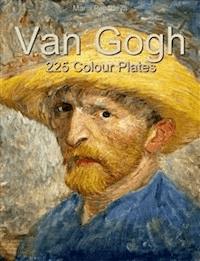
Vincent Willem van Gogh was a Dutch Post-Impressionist painter whose work had a far-reaching influence on 20th-century art. In just over a decade he produced over 2100 artworks, including around 860 oil paintings, the majority created in the last two years of his life. They include portraits, self-portraits, landscapes, still lifes, olive trees, cypresses, wheat fields and sunflowers, and are characterised by symbolic colourisation and dramatic, impulsive and highly expressive paintwork. He sold only one painting during his lifetime and was largely unnoticedby critics until his suicide, aged 37, which followed years of restless anxiety, poverty and mental illness.
Das E-Book können Sie in Legimi-Apps oder einer beliebigen App lesen, die das folgende Format unterstützen:
Veröffentlichungsjahr: 2016
Ähnliche
Van Gogh
225 Colour Plates
By Maria Peitcheva
––––––––
First Edition
*****
Van Gogh: 225 Colour Plates
*****
Copyright © 2016 Maria Peitcheva
Table of Contents
Title Page
Copyright Page
Foreword
Paintings
Foreword
––––––––
Vincent Willem van Gogh (30 March 1853 – 29 July 1890) was a Dutch Post-Impressionist painter whose work had a far-reaching influence on 20th-century art. In just over a decade he produced over 2100 artworks, including around 860 oil paintings, the majority created in the last two years of his life. They include portraits, self-portraits, landscapes, still lifes, olive trees, cypresses, wheat fields and sunflowers, and are characterised by symbolic colourisation and dramatic, impulsive and highly expressive paintwork. He sold only one painting during his lifetime and was largely unnoticed by critics until his suicide, aged 37, which followed years of restless anxiety, poverty and mental illness.
Born into an upper-middle-class family, Van Gogh drew as a child, was thoughtful and intellectual but evidenced signs of mental instability. He worked as an art dealer as a young man, but became depressed after he was transferred to London. He turned to religion, spending time as a preacher in southern Belgium, and later drifting in ill health and solitude. He was keenly aware of modernist trends in art, music and literature, and after moving back home with his parents, took up painting in 1881; supported financially by his younger brother Theo with whom he had a long correspondence of letters. His early works are mostly depictions of common and peasant labourers, and contain few signs of the vivid colourisation that distinguished his mature period. In 1886 he moved to Paris and discovered the French Impressionists. From then his paintings grew brighter in colour as he developed a style that became fully realised during his stay in Arles in 1888. There he lived in the so-called "Yellow house", and with Paul Gauguin developed a concept of colour that would symbolise inner emotion.
Van Gogh suffered from continued psychotic episodes and delusions. His friendship with Gauguin came to an end after a violent encounter during which he threatened the Frenchman with a razor, and in a rage, cut off most of his own right ear. He committed himself to a psychiatric hospital in Saint-Rémy, where his condition stabilised, leading to one of the more productive periods of his life. After he moved to Auberge Ravoux in the village of Auvers-sur-Oise under the care of the homeopathic doctor and artist, Dr. Gachet. While he was there, Theo wrote that he could no longer support him financially; a few weeks later, on 27 July 1890, Van Gogh walked into a wheat field and shot himself in the chest with a revolver. He died two days later.
Considered a madman and a failure in his lifetime, Van Gogh's emotionally charged paintings, spontaneous vivid colours, broad oil brushstrokes and early death have led to his current position in the public imagination as the quintessential misunderstood genius. His widespread critical, commercial and popular success began after his adoption by the early 20th-century German Expressionists and Fauves. His reputation grew steadily during the 20th century; today he is remembered as an important but tragic painter, whose troubled personality typifies the romantic ideal of the tortured artist. Art historians typically view him as an exceptionally talented, major influential artist whose mental instability inhibited and frustrated his artistic progression.
Paintings
Head of a peasant, 1884
Without the obsessive regime of self-instruction and direct observation from nature that typified his Nuenen period, it is doubtful we would know Vincent van Gogh today. A late starter, the almost 30-year-old van Gogh made up for lost artistic time in a fever of drawing and painting that culminated in his first masterpiece, 'The potato eaters', finished in 1885. Between December 1884 and the completion of this rustic nocturne, he produced forty bust-length portraits of peasant types: a series of Heads of the People as it were. Van Gogh's socialist sympathies are apparent in every one. Vigorously brushed and soberly coloured, they take substance from the darkness around them. Fiery highlights on flesh and fabric suggest lamplight. Indeed, 'The potato eaters' is lit by paraffin. The present brooding study in all likelihood shows Antonius van Rooij, paterfamilias of the group. Van Gogh yearned to share in the social simplicity and moral certainty of this man. That he could not do so, though painful to him, left open the way to art.




