


Erhalten Sie Zugang zu diesem und mehr als 300000 Büchern ab EUR 5,99 monatlich.
- Herausgeber: Nick Hern Books
- Kategorie: Poesie und Drama
- Serie: NHB Modern Plays
- Sprache: Englisch
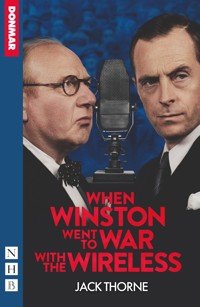
In May 1926, Britain grinds to a halt, as workers down tools for the General Strike. With the printing presses shut down, the only sources of news are the government's British Gazette, edited by Chancellor of the Exchequer Winston Churchill, and the independent, fledgling British Broadcasting Company, led by John Reith. The stage is set for a fierce battle over control of the news and who gets to define the truth. Jack Thorne's When Winston Went To War With The Wireless is a gripping play about the birth of a great British institution and its efforts to stay impartial. It premiered at the Donmar Warehouse, London, in June 2023, directed by Katy Rudd, with Stephen Campbell Moore as Reith, Adrian Scarborough as Churchill, and Haydn Gwynne as Stanley Baldwin. 'Jack Thorne never ceases to stimulate and entertain'Evening Standard
Sie lesen das E-Book in den Legimi-Apps auf:
Seitenzahl: 123
Veröffentlichungsjahr: 2023
Das E-Book (TTS) können Sie hören im Abo „Legimi Premium” in Legimi-Apps auf:
Ähnliche









Jack Thorne
WHEN WINSTON WENT TO WAR WITH THE WIRELESS
A True Story About Truth
NICK HERN BOOKS
London
Contents
Original Production Details
Acknowledgements
Dedication
Epigraph
Characters
When Winston Went To War With The Wireless
About the Author
Copyright and Performing Rights Information
When Winston Went To War With The Wireless was first performed on 13 June 2023 (previews from 2 June) at the Donmar Warehouse, London, with the following cast:
ISABEL SHIELDS
Kitty Archer
JOHN REITH
Stephen Campbell Moore
ARCHBISHOP OF CANTERBURY/J. C. C. DAVIDSON
Ravin J Ganatra
STANLEY BALDWIN
Haydn Gwynne
MURIEL REITH
Mariam Haque
ERNEST BEVIN
Kevin McMonagle
CHARLIE BOWSER/ENGINEER
Luke Newberry
MUSICIAN/SPEAKER OF THE HOUSE
Seb Philpott
ARTHUR PUGH/MUSICIAN
Elliott Rennie
CLEMMIE CHURCHILL/AMELIA JOHNSON
Laura Rogers
PETER ECKERSLEY
Shubham Saraf
WINSTON CHURCHILL
Adrian Scarborough
All other parts played by the company
Director
Katy Rudd
Designer
Laura Hopkins
Sound Designers
Ben and Max Ringham
Lighting Designer
Howard Hudson
Movement Director
Scott Graham
Composer
Gary Yershon
Video Designer and Animator
Andrzej Goulding
Casting Director
Anna Cooper CDG
Foley Consultant
Tom Espiner
Production Manager
Jim Leaver
Costume Supervisor
Lisa Aitken
Props Supervisor
Lizzie Frankl for Propworks
Associate Props Supervisor
Rachel Middlemore for Propworks
Associate Sound Designer
Ellie Isherwood
Wigs, Hair and Make-Up
Sharon Pearson
Supervisor Wigs, Hair and Make-Up Manager
Keisha Banya
Voice Coach
Charlie Hughes D’Aeth
Dialect Coach
Penny Dyer
Resident Assistant Director
Adam Karim
Assistant Set and Costume Designer
Jingyi
Assistant Sound Designer
Raffaela Pancucci
Sound Operator
Jake Hanks
Company Stage Manager
Robert Perkins
Deputy Stage Manager
Maria Gibbons
Assistant Stage Manager
Devon James-Bowen
Acknowledgements
Katy Rudd
Michael Longhurst
Laura Hopkins
Ben & Max Ringham
Craig Gilbert
Nick Morrison
Matthew Warchus
Andrew Marr
David Hendy
Georgina Born
Kate Varah
Robert Seatter
Jean Seaton
Rachel Taylor
Helena Clark
Hannah Spinks
Tom Hercock
Paul Sarony
Peter Sarony
The Estate of Alfred Noyes
The Estate of Asa Briggs
Cicely Hadman
Stuart Tubby
Mariella Johnson
J.T.
For Rachel Holroyd. With gratitude.
‘[The BBC was a] democracy of young pioneers, doomed like all the pioneering of youth to come up against the rigidity of age, discipline and experience.’
Cecil Lewis, ‘Broadcasting from Within’
Characters
JOHN REITH, thirty-seven, conflicted, confident, with a scar on his left cheek
WINSTON CHURCHILL, fifty-two, balding, barrel-chested, bellicose
ISABEL SHIELDS, late twenties, perfectly spoken, rather ornate
PETER ECKERSLEY, thirty-four, chief engineer. Pipe in his mouth, slouches about
STANLEY BALDWIN, fifty-eight, Prime Minister of the country, cleverer than he first appears
J. C. C. DAVIDSON, thirty-seven, deputy chief civil commissioner, deviously devoted
ERNEST BEVIN, forty-five, leader of the Transport and General Workers’ Union, wears the weight
ARTHUR PUGH, fifty-six, Chair of the TUC’s Special Industrial Committee, brow-beaten, overwrought
AMELIA JOHNSON, forties, newsreader, ramrod straight
CHARLIE BOWSER, early twenties, beautiful, inside and out, a ghost of a past
CLEMENTINE CHURCHILL, forty-one, witty, caring and frequently merciless
MURIEL REITH, thirties, full of a get-up-and-go that’s frequently thwarted
JIX, sixty, Home Secretary, quite a traditional home secretary
THE ARCHBISHOP OF CANTERBURY, seventy-eight, patrician, stooped
All other parts (and there are quite a few, see below) should be played by members of the company.
UNION MEN
HELGA, a singer
ENGINEER
H. G. WELLS
HELENA MILLAIS
BEATRICE LILLIE
A screaming MAN
ELLA FITZPATRICK
SANDY POWELL
A coughing WOMAN
COMMANDER KENWORTHY
DUKE OF CORNWALL
GERRY, a Foley artist
BILLY BENNETT
SPEAKER OF THE HOUSE
LLOYD GEORGE
MORGAN JONES
BRUCE, a spoons player
MARION CRAN
And FOLEY ARTISTS – I suggest some of the Foley in the script. I hope there’ll be room for a lot more in an actual production.
Note
News bulletins in the play have been adapted from BBC bulletins between 1 May and 13 May 1926.
This ebook was created before the end of rehearsals and so may differ slightly from the play as performed.
Prologue
There’s darkness. Pure darkness.
Then emerging from the darkness come UNION MEN, their faces dark, their headlamps filling the stage and their song filling the theatre.
UNION MEN.
When the union’s inspiration through the workers’ blood shall run,
There can be no power greater anywhere beneath the sun;
Yet what force on earth is weaker than the feeble strength of one,
But the union makes us strong.
Solidarity forever,
Solidarity forever,
Solidarity forever,
For the union makes us strong.
And they are gone.
ACT ONE
Scene One
HELGA is a singer, unaccustomed to radio, the ENGINEER is seemingly in control.
ENGINEER. Just give it your best, nice and slow is what I’d recommend.
HELGA. One can hardly slow down the music. The tempo is –
ENGINEER. Otherwise we get complaints, dear. People like to hear the words, you see…
HELGA. I don’t see how…
ENGINEER. The trouble being, of course, they lack the equipment. Only a very expensive receiver can do justice to transmission and only then when signals are very strong. Mostly all they hear is the equivalent to someone screaming in their privy.
HELGA. Probably better if I don’t think about screaming in the privy…
ENGINEER. Those are not my words, they’re the words of Peter Eckersley, my boss. Great man. So slow the tempo and avoid… well, final advice, avoid nipping about too much if you can help it.
HELGA. Nipping about?
ENGINEER. High, low and then high again, it distorts it. Which, if you’re in an over-large and poorly insulated privy, well…
HELGA. You want me to not sing the high notes?
ENGINEER. Oh, you need to sing them, dear, but make them a tad lower. If you can.
HELGA. Make the high notes lower?
ENGINEER. Yes. (Picking up a receiver.) Hello, control room, this is transmission studio number three, signal me when you’re ready for testing please.
HELGA. You do understand, I have to sing the notes as they are laid out at the tempo they’re laid out in.
A light comes on. He watches it closely.
ENGINEER. One, two, three, four, five, six, seven, eight, nine, ten. When Mary had a little scran, she often felt quite hungry, so everywhere she ever went she took an extra sandwich with her…
The light goes off.
Watch for the light to turn on again, when it does – sing.
JOHN REITH enters, on the storm.
HELGA. Who is this?
ENGINEER. Are you commandeering, sir?
PETER ECKERSLEY rushes in after him.
PETER. I’ve scrambled everyone to look for you.
REITH. Studio three felt the best.
ENGINEER. It’s happened?
REITH. It’s happened and we’re about to broadcast it.
PETER. I can’t believe they’ve done it.
HELGA. Done what?
REITH. The TUC’s finally fired the gun…
PETER. Or the Government have…
HELGA. Strike? A General Strike?
ENGINEER. They’re all going out?
PETER. Daily Mail printers refused to set an editorial condemning the TUC, Government called off negotiations, the TUC had no choice… Everyone – every union – is striking.
REITH (over PETER’s lines). Miss Shields! Isabel!
AMELIA JOHNSON enters from off in a cocktail dress.
AMELIA. I’m ready. I’m ready.
PETER. We’ll need five minutes.
REITH. Two minutes.
AMELIA. Oh. Where’s my –
REITH. I can handle this.
ISABEL SHIELDS enters after.
HELGA. I need to call my mother.
ISABEL. I’ve got a statement from them and a rather shorter one from Downing Street.
AMELIA. I just can’t find my jacket. Do I need a jacket?
ISABEL (to AMELIA). With shoulders like that? I’d have thought so.
REITH. This is my responsibility.
PETER. What does that mean?
REITH. I’ll take lead. I’ll do it.
AMELIA. But isn’t it my –
REITH. Peter – cue me in –
AMELIA. But don’t I do the news? I do the news.
HELGA. Can I leave? Can I get to a phone?
ENGINEER and PETER. No.
REITH. Hold out your hands.
AMELIA does, they’re shaking. REITH holds his out, they’re still.
I have this.
PETER (over the receiver). This is studio three, we will be taking over the airwaves as part of an emergency transmission –
REITH sits and begins to make notes.
ENGINEER. We’re scheduled anyway.
PETER. Then have studio two scheduled to go after we’re done.
ENGINEER. Yes, sir.
ISABEL gently places the statements in front of REITH.
ISABEL. This is everything we have, sir.
PETER. You know what you’re going to say?
REITH. No. Count me in.
He settles himself, he scans the pages, he looks up, PETER signals – they’re live.
This is London and all stations calling.
Negotiations between the Government and trade unions have broken down. The Trade Unions Congress have today declared a General Strike. The strike will commence at midnight tonight. According to an official memorandum of the Trades Union Congress the following trades are involved in the strike call: all transport, printing trades, iron and steel, electric and gas workers, and all those in building work. Sanitary services are to be continued however and there will be no interference with healthcare.
WINSTON CHURCHILL enters, humming, he pours himself a whisky – FOLEY ARTISTS pour water from one glass into another glass – he goes over to an ice bucket – they put two pebbles in the glass – he sits in his chair.
The Government have declared a state of national emergency exists and that as a precautionary measure they’ve moved detachments of troops and military vehicles into designated zones throughout the country for, and I quote, ‘the maintenance of law and order and the protection of life and property’.
May we appeal to all our listeners to make this strike as short and as painless as possible and to preserve goodwill so as to find a way out of this deadlock.
The BBC have received a message from the Prime Minister, it reads as follows: ‘Be steady. Remember that peace on earth comes from men of good will.’ I will repeat this. ‘Be steady. Remember that peace on earth comes from men of good will.’
Beat.
‘Be steady. Remember that peace on earth comes from men of good will.’
This is London. More when we have it.
He stands up. He signals to the ENGINEER who passes it to another studio.
There. There.
He breathes out.
Did I repeat the statement three times?
PETER. Yes, sir.
REITH. Was that a mistake?
PETER. No. They won’t be able to dock our coverage now, you know –
REITH. Did I really read it out three times?
PETER. You did.
REITH. Well. Good. Good. Get her ready for the air.
He indicates HELGA.
It’s done. They did it.
PETER. They did.
REITH rubs his face. He looks at HELGA.
REITH. Do you know ‘Abide with Me’?
HELGA. No.
REITH. Then sing what you can. This country will need all the distractions it can find at the moment.
Lights click out. Only CHURCHILL is left.
CHURCHILL (sings).
Then raise the scarlet standard high,
Beneath its shade we’ll live and die,
Though cowards flinch and traitors sneer,
We’ll keep the red flag flying here.
He raises a glass. The lights turn off completely.
Scene Two
ISABEL. A typical day at the BBC.
Well, it was very exciting.
Mostly exciting.
We’d have allsorts trooping in.
The London Radio Dance Band –
There’s a dash of Dance Band.
The Daventry Quartet –
There’s a dash of strings.
There were plays like – Light and Shade, a comedy by L. du Garde Peach.
FRANCIS. I would love to talk, darling, but sadly I’ve my foot trapped in a bucket.
A FOLEY ARTIST drops a bucket on the floor. There’s the sound of laughter.
ISABEL. And wonderful celebrities like Sir Oliver Lodge talking on worlds and atoms, Doctor C. W. Saleeby on health. Though the less said about H. G. Wells the better. The man squeaked. He squeaked.
H. G. WELLS (squeaky). Face the world. Learn its ways, watch it, be careful of too-hasty guesses at its meaning. In the end you will find clues to it all.
ISABEL. In the end you’ll find your voice is poorly suited to radio, Mr Squeaky Wells. Peter Eckersley, our wonderful chief engineer.
PETER wanders onto stage.
Even manufactured a special room, just for H. G. Wells, but did he squeak?
H. G. WELLS (squeak). Yes.
ISABEL. Of course he did.
And finally my favourite thing on the schedule – the comedians – everyone from the mysterious A. J. Alan to Joe Murgatroyd and his tiffs with his wife Blossom, to Miss Helena Millais with her Light Songs and Fragments from Life.
HELENA MILLAIS. Ullo, me ducks, ’ere I am again with me old string bag and nothing to sing bar ‘Ours Is a Nice ’Ouse Ours Is’.
ISABEL. There were only two rules:
PETER. ‘If you sneeze you will deafen millions.’
ISABEL. And –
PETER. ‘No gags on Scotsmen, Welshmen, clergymen, drink or medical matters.’
ISABEL. Open house on the Irish of course.
The news was never really central to our template. The BBC had been prevented from presenting the news until seven p.m. at night. Newspapers worried it would interfere with circulation if people could get the news for free.
But the General Strike meant everything changed. For newspapers could not be printed or distributed and that meant – well, that meant the wireless had power, you see? It was the only information source for many as to what was actually happening.
And so much was happening. Arguments raged in Parliament, and all across the country…
Yes. The General Strike changed everything – and the BBC – it turned out – was right in the centre of it –
Scene Three
CHURCHILL walks through the clock corridor in the Palace of Westminster. ERNEST BEVIN pursues him across the floor. ARTHUR PUGH just behind. FOLEY ARTISTS provide echoey steps.
BEVIN. Mr Churchill. Chancellor. Mr Churchill. Ernest Bevin and Arthur Pugh – here to talk to you and to the Prime Minister. Ready to resume negotiations. We’ve shown our hand, you’ve shown yours. Time to talk more, don’t you think?
CHURCHILL. Ernest, you say?
BEVIN. You know who I am, sir, and as General Secretary of the Transport and General Workers’ Union –
CHURCHILL. More than shown your hand, young Ernest, you’ve gone and taken your bloody clothes off.
BEVIN. It was purely your unwillingness to resume talks that left us –
CHURCHILL. I respect you enormously – Ernest, but the time for negotiation has passed. You weren’t able to control your people – the Daily Mail printers –
PUGH. The printers attacked without TUC support –
CHURCHILL. – would not publish and that rather forced us into our position, you see –
PUGH. The Daily Mail was calling us revolutionaries. Besmirching our patriotism.
CHURCHILL. The freedom of the press is the freedom to occasionally get things wrong.




