


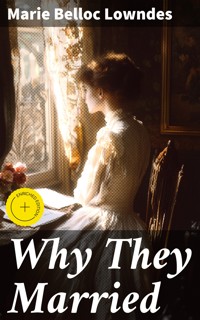
0,49 €
Niedrigster Preis in 30 Tagen: 1,99 €
Niedrigster Preis in 30 Tagen: 1,99 €
Mehr erfahren.
- Herausgeber: Booksell-Verlag
- Kategorie: Ratgeber
- Sprache: Englisch
In "Why They Married," Marie Belloc Lowndes intricately weaves a compelling narrative that explores the complexities of courtship and marriage through the lens of early 20th-century society. Utilizing a keen psychological insight and rich character development, Lowndes offers readers a tapestry of interwoven lives, each revealing the motives and desires that lead to the institution of marriage. Her prose, marked by both elegance and a touch of social critique, reflects an era grappling with shifting gender roles and societal expectations, making the novel a pertinent study of human relationships amidst modernity. Marie Belloc Lowndes, a prominent British author known for her keen observations of social dynamics, often drew inspiration from her own life experiences within the literary and social elite. A member of the prominent Belloc family, Lowndes was well-acquainted with the intricacies of personal relationships, often exploring themes of passion, betrayal, and societal pressure in her works. This background undoubtedly influenced her portrayal of marital dynamics and the psychological underpinnings that govern them in "Why They Married." Readers seeking a profound exploration of love, sacrifice, and the unspoken intricacies of marital union will find "Why They Married" to be a captivating read. Lowndes's ability to balance emotional depth with social commentary provides a rich experience that resonates with contemporary audiences, inviting reflection on the timeless questions surrounding love and commitment. In this enriched edition, we have carefully created added value for your reading experience: - A succinct Introduction situates the work's timeless appeal and themes. - The Synopsis outlines the central plot, highlighting key developments without spoiling critical twists. - A detailed Historical Context immerses you in the era's events and influences that shaped the writing. - A thorough Analysis dissects symbols, motifs, and character arcs to unearth underlying meanings. - Reflection questions prompt you to engage personally with the work's messages, connecting them to modern life. - Hand‐picked Memorable Quotes shine a spotlight on moments of literary brilliance. - Interactive footnotes clarify unusual references, historical allusions, and archaic phrases for an effortless, more informed read.
Das E-Book können Sie in Legimi-Apps oder einer beliebigen App lesen, die das folgende Format unterstützen:
Veröffentlichungsjahr: 2020
Ähnliche









Why They Married
Table of Contents
Introduction
This novel traces how affection, aspiration, insecurity, and the weight of custom entwine to determine not only whom people marry but why they accept the bargains, consolations, and sacrifices that marriage may demand, and how those motives cast long shadows across freedom, loyalty, and daily compromise.
Why They Married is a work of fiction by Marie Belloc Lowndes, a British novelist celebrated for her psychologically attentive narratives in the early twentieth century. Known for exploring moral tension within domestic and social settings, Lowndes brings to this book a keen eye for motive and consequence. First appearing in the early decades of the twentieth century, the novel belongs to the tradition of social and psychological realism, observing contemporary society with a measured, probing tone. Its world is recognizably that of its author’s time, where reputation, propriety, and economic calculation intersect with private feeling.
Without revealing its turns, the premise is clear: Lowndes examines the paths that lead individuals to the altar and the subtle aftermath of those choices. The narrative offers a close, observant voice that privileges interior reflection and carefully staged conversation, favoring unease and moral inquiry over spectacle. The mood is thoughtful and quietly tense, as everyday interactions reveal competing desires and obligations. Readers encounter a study of character rather than a puzzle to be solved, guided by an author attentive to how small decisions accumulate into life-shaping commitments.
A central question animates the book: when love, security, status, and duty do not align, which claims prevail, and at what cost? Lowndes explores the marketplace of emotion, where affection meets calculation and ideals confront practical necessity. The themes are enduring—romantic expectation versus social reality, the ethics of compromise, the role of money in intimate life, and the fragile balance between self-determination and communal judgment. The novel’s power lies in how it shows motives coexisting rather than cancelling each other, making choice less a single leap than a series of negotiated steps.
Stylistically, Why They Married favors psychological clarity over ornament. Lowndes situates meaning in gesture, dialogue, and the silences between them, allowing readers to infer as much as characters confess. The pace is deliberate, building pressure through ordinary scenes—a visit, a letter, a public encounter—until the stakes clarify themselves. Instead of melodrama, the tension arises from conflicting loyalties and the fear of misreading another heart. The result is an immersive portrait of social life, rendered with restraint, that invites readers to weigh motives alongside the characters.
For contemporary readers, the book’s relevance is direct. It illuminates how economic precarity, family expectations, and cultural narratives shape intimate decisions—concerns that persist, even if their outward forms change. The novel prompts reflection on consent and agency within social scripts, asking what is chosen freely and what is chosen because alternatives have been narrowed. It also questions how public performance—what others see and say—refracts private feeling. In its attention to motive and consequence, the story offers a mirror for modern debates about partnership, independence, and the meanings of success.
Situated within Marie Belloc Lowndes’s broader interest in moral psychology and social observation, Why They Married offers a discerning, humane account of why people enter marriage and how those reasons reverberate. It is not a manual but a conversation, inviting readers to listen for the unspoken terms that accompany vows. By tracing the interplay of desire and duty with patient intelligence, the novel gives enduring form to dilemmas that outlast fashions and eras. To read it is to consider one’s own answers to its title’s quiet, insistent question.
Synopsis
The novel opens in a closely observed social world where courtship is both personal and practical. A young woman of modest background is brought into a wider circle through family connections, and quickly learns that marriage is discussed as strategy as much as sentiment. Dinners, teas, and country visits introduce a range of acquaintances whose prospects are weighed in whispers. Suitors appear with different attractions and liabilities, and elders offer advice framed as experience. The narrative establishes a central question that will guide it forward: amid expectations, money, and reputation, what truly governs the choices that lead people to marry?
A first set of possibilities crystallizes around two contrasting offers of attachment. One comes from a steady, older figure whose security suggests reliable comfort; the other from a younger, charming man whose future depends upon uncertain ventures. Family pressure leans toward safety, while the heart listens to promise and excitement. Around this triangle, the book sketches parallel stories: a friend who confuses gratitude with love, another who seems determined to improve a fortune by alliance. Letters and conversations reveal how private motives are shaped by public talk, and how elusive the boundary becomes between prudence and fear, desire and self-delusion.




