


8,99 €
Mehr erfahren.
- Herausgeber: WS
- Sprache: Englisch
Even the best wordsmiths can trip over words that are commonly misused, mixed up or misspelled. This useful reference gets to the bottom of these language issues so that you can ensure you’ve got the word you’re looking for. With examples of how to sharpen up text and improve your writing, lists of useful social media abbreviations and a discussion of unusual plurals, this playful look at the often bizarre English language has got you covered, whether you’re writing a book, blog or an email.
Das E-Book können Sie in Legimi-Apps oder einer beliebigen App lesen, die das folgende Format unterstützen:
Seitenzahl: 221
Veröffentlichungsjahr: 2018
Ähnliche

















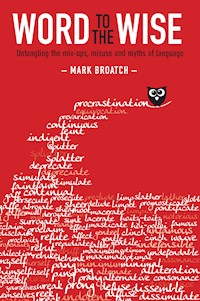
Word to the Wise
Untangling the mix-ups, misuse and myths of language
MARK BROATCH
For R and G
CONTENTS
How to use this book
How to write what you mean to say
A–Z of confused and misused words
Unusual plurals
Clichéd ‘streets’
Common social media abbreviations
Often misspelled
Bibliographical sources
Index
How to use this book
This is a book of confusables, words that are misused, misunderstood or questionably employed instead of other words. Word to the Wise groups words alongside others with which they are commonly or occasionally confused. Not all confusion occurs as a result of close sounds being muddled, however. Sometimes meanings are swapped or mistaken because words look alike, echo the consonants or vowels of other words or often appear in the same context. Take tortuous and torturous, froideur and hauteur, détente and entente cordiale, malicious and pernicious, cheesy and corny. All appear together here because of how they are used. If a word doesn't appear under its letter, consult the index at the end of the book.
Use is often disputed. Traditionalists say this is the rule and always will be. Free-rolling descriptivist types say you can't control how people use language and I'm not playing by your rules. Dictionaries will tell you that this is where that word came from, what it used to mean and how it's used now. Traditionalists say that's not what I learned and to change it is to risk complete communication breakdown.
The truth is in the middle. Most people use language as they use it, are aware that conventions exist and know — or think they know — one or two well, but are mostly hazy on the rest. Word to the Wise presents current usage and offers, when it's helpful, a view of whether any conventions stand up to logic and to how most people are speaking and writing.
Pronunciation aid is given in square brackets. For those who know nothing about phonetic notation, sounds are shown rather than the International Phonetic Alphabet — except for the mid-central vowel sound sometimes called the schwa, which is written as 'ǝ' and pronounced like the 'a' in 'about'. The book defaults to British usage, and where US usage, pronunciation or spelling is different — some Canadian differences may arise — this is noted. North Americans, Irish and Scots should also note that the suggestions given are non-rhotic — most mid and final 'r's' are not pronounced.
How to write what you mean to say
No single book can teach you how to write. Becoming a good writer — and in the age of social media we are all writers — is a process of learning and thinking, of writing, of rewriting and, perhaps most of all, of reading. You must read to improve your writing, and you must read the best writers to keep improving. There are no unbreachable rules of writing. But there are things to do and things not to do.
The first thing to do is have a plan. Why are you writing? What's your purpose, your goal? Every essay, blog post, official letter or report requires its own language, style and tone. As part of your plan, have a one-sentence summary of what the piece of writing is intended to achieve — what's sometimes in journalism called a nut graf — and always keep it in front of you, or at least in mind, while you are writing.
A second rule is to answer this question: who's your audience? How will you attract and keep their attention? Will it be the power of your argument, your ability to sway their emotions? To win their attention, they have to trust you. To do this, you must appeal to them using language that is familiar to them, use their frames of reference, the way they relate to the world. We do this all the time when we're speaking to people, to our boss, a child, a stranger or a friend. We automatically adjust our style between conversations, changing our modes of address, our vocabulary. This doesn't mean a writer fakes it, just that they find common ground. They don't patronise, don't make reading harder for their audience by using jargon, obscure words or poorly crafted sentences.
Think first
To write clearly you need to think clearly. Amazon boss Jeff Bezos, at time of writing the richest man in the world, has reportedly banned PowerPoint or bullet point presentations of ideas. In an email to his senior team, he wrote that those presenting ideas would be required to compose 'narrative' memos of four to six pages, using coherent sentences and clear arguments. They then would read the memo aloud and answer questions. This approach, he said, would force better thinking and understanding of what's important and how things are related. Slide presentations allow speakers to gloss over ideas and gaps in knowledge. Anyone who's listened to a poor presentation with the speaker clicking away at the screen knows the truth of this.
Presenting an idea well — getting readers to buy in — requires clear thinking, coherent ideas and precise expression. How to get there ?
START WITH A BANG
The cradle rocks above an abyss, and common sense tells us that our existence is but a brief crack of light between two eternities of darkness.VLADIMIR NABOKOV
Ihave more than once in my time woken up feeling like death. But nothing prepared me for the early morning in June when I came to consciousness feeling as if I were actually shackled to my own corpse.CHRISTOPHER HITCHENS
Every journalist who is not too stupid or too full of himself to notice what is going on knows that what he does is morally indefensible.JANET MALCOLM
Fiction has an entrepreneurial element, akin to the inventor's secret machine, elixir or formula.JAMES WOOD
Saccharine is our sweetest word for fear: the fear of too much sentiment, too much taste.LESLIE JAMISON
However you start, grab your reader. Grab them and don't let go. Even if there is no magic formula for writing well, there are tried and true approaches to finding the right ingredients. Limit the number of ideas in sentences, be active rather than passive, be positive, and avoid monotony by mixing up the length, shape and rhythm of sentences. Some can be tight, others looser, depending on your subject and intent.
Be precise and concise. This doesn't mean ideas and their expression are sketched so simply that you leave out important detail, but that you make every word, every sentence count. You can be economical without sacrificing accuracy.
Write with nouns and verbs. This doesn't mean no adjectives or adverbs, but they must help a sentence's precision and economy rather than make it flabbier. Prefer the short word to the long, the simple to the complex, the concrete to the abstract. Concrete language demands less of the reader than abstract. Sometimes you need abstract ideas to convey complex ideas, but usually it's best to use tangible concepts, graspable metaphors, real-world examples.
Don't be afraid to keep things simple. Sometimes people overcomplicate sentences because they are afraid of looking stupid. But don't be fearful of complex sentences. If they are clear, they can illuminate the toughest subjects.
Mix up the order of your sentences so that they have punch at their start and end. Rather than always using a simple subject-verb-object structure — 'The skipper made one last attempt to rescue the man from the rocks as the tide rose and the waves crashed higher' — switch the sentence around. 'As the tide rose and the waves crashed higher on the rocks, the skipper made one last attempt to rescue the stranded, exhausted man.' Don't be afraid to start sentences with conjunctions such as but, and, although or so, especially if the sentences are tightly linked. 'Proust must be cited for his notion of the "musical" structuring of memories (the task of narrating having been equated with the task of remembering). But, of course, there are predecessors.' (Susan Sontag).
Avoid clichés and stale metaphors. Limit the use of passive language; it can make your writing impersonal and drain it of life, because the passive shifts focus from the doer of the action to the action itself. The classic example of this is the CEO who says 'mistakes were made'. But using the passive might be appropriate if you are writing for a scientific or bureaucratic audience, or don't actually want to admit making a mistake.
Choose plain, direct words (give, tender, sudden, thief) over long Latinate words full of prefixes and suffixes. Nominalisations — nouns made from adjectives and verbs — are particularly disliked by traditionalists and admirers of good writing. Like passive language, they drain your writing of precision and power and can conceal who's doing what to whom. But they are used widely, and not just by academics, lawyers and bureaucrats, because of that reason. Keep in mind that English has been nouning and verbing for centuries. Perhaps because they are associated with the hype of business, a few attract particular scorn, including impact, leverage, action, task and grow (as of a company).
Even if many of the language conventions and preferences are based on little more than superstition, knowing them will give you confidence. Lack of confidence, or fear of looking a fool, has tripped up many a writer. They reach for the fanciest words, turn everything into a passive voice to sound authoritative, follow half-understood prohibitions from childhood lessons and end up sounding flat and pompous — and nothing like themselves. Learn the 'rules'. Your confidence will be redoubled if you know the conventions that most often light the touchpaper of traditionalists and can veer around them.
In writing you can always change the ending or delete a chapter that isn't working. Life is uncooperative, impartial, incontestable.ARIEL LEVY
REWRITE, REWRITE, REWRITE
Professional writers emphasise that the real writing is done in the rewriting. Nothing is finished in one draft. They go over each sentence and paragraph dozens of times, sometimes more.
Asked about how much rewriting he did, Hemingway famously replied, 'It depends. I rewrote the ending to Farewell to Arms, the last page of it, 39 times before I was satisfied.' What was the problem, asked the interviewer. Said Hemingway: 'Getting the words right.'
Other writers rewrite to 'relax' the prose because the first draft tends to be rather uptight. Even Lee Child, who does only one draft of his 100 million-selling Jack Reacher thrillers, admits to 'combing' through his writing of the day before, 'smoothing' out only a little before carrying on.
The phrase 'kill your darlings' has been attributed to William Faulkner, Stephen King, Allen Ginsberg, even Anton Chekov. Probably the first person to use it — though he may have been paraphrasing Samuel Johnson — was English critic Sir Arthur Quiller-Couch. He meant ridding your writing of extraneous ornament, not letting anything below-par get past. It is writing — clever phrases, lovely but pointless metaphors, repetition of the argument, pieces of filler writing that the eyes slip past without any adhesion — that doesn't advance the whole. Killing your darlings means being an editor rather than a writer.
THESAURUS OR NOT?
What makes us think writing is of the highest quality? Cognitive psychologist Steven Pinker says two of the features that 'distinguish sprightly prose from mush' are a varied vocabulary and the use of unusual words. But this can go horribly wrong. You can end up using the most arcane, least appropriate words, and end up not saying what you mean to say. Your writing will sound forced, and you might come across as try-hard. Remember that the thesaurus, as one English professor said, is 'a good reminder of words momentarily forgotten, but a bad guide to words previously unknown'. Use it to find the words on the tip of your tongue, not words you've never heard of. Words have core senses but also connotations and phonesthetics — how the sound of words influences meaning. As another wise person noted, use a thesaurus at the end of writing, not the beginning.
A line will take us hours maybe;Yet if it does not seem a moment's thought,Our stitching and unstitching has been naught.W.B. YEATS
The right tone
A piece of writing should feel natural, despite all the editing and rewriting work you've put in. It should sound in your voice, but your very best voice, your smartest and most eloquent. The tone of voice, or register, should be appropriate to your audience. Society has become more relaxed. The latest generation are adept at switching registers between a text, email, chat, blog post. But be careful when moving between mediums that you don't carry the casual language and style of social media into an essay, a report, a work-related email:
Yo bro, what's the haps with those reports, they were due yesterday, I can't even #wtf
A few common errors
Terrible, isn't it, that previous sentence. It uses a comma splice, which links two independent clauses with a comma where a full stop, semi-colon or a conjunction such as and or but might be more suitable. Even writers and editors who raise an eyebrow at stuffy language rules often dislike them.
Yet, as with many conventions, you can ignore the prohibition on the comma splice if you are good or famous enough. Samuel Beckett, Somerset Maugham and E.M. Forster were all users of the comma splice.
Even the sternest language guides say comma splices are okay when the clauses are short and balanced and the tone is conversational. 'Easy come, easy go', for example. Comma splices are common, and perfectly at home, on social media, which mimics patterns of speech far more than most writing. But in more formal contexts, comma splices might appear casual, careless or unprofessional. Avoid them particularly combined with conjunctions such as however. 'Productivity gains are inevitable given the level of investment, however many positions are likely to become surplus to requirements.'
DON'T DANGLE
Dangling participles in particular annoy many traditionalists, perhaps because, once you have attuned yourself to them, they seem so silly and illogical. Participles of verbs are often used in subordinate clauses that introduce sentences. They must refer to the main subject of the sentence.
'Finding the path, the wood quickly became impassibly thick.' This is wrong, because it is saying the wood found the path. It would need to be something like: 'Finding the path, the hiker entered the wood, which quickly became impassibly thick.'
But sentences can dangle in other ways, always with the introducing subordinate clauses left hanging.
Don't write: 'At age 60, her teachers still thought she had a decade of singing in her.' Or this: 'An epic venture, Jane Brown went to the lengths of including all of her extended family's portraits in a collage that delivered a one-two hit of warmth and poignancy.' That last one is a close copy of a real one, which went through a real subeditor.
Many of the words in this book are commonly confused. This is often because writers have only a vague idea of what they mean, or they think they mean something that they don't.
If you are not sure of the meaning, check it. If you are using words whose meaning has shifted or is disputed — nonplussed, disinterested, moot, shibboleth — make sure your intent is clear through context.
End well
Ihoped for my cousin to fail, and wished him luck.JOHN JEREMIAH SULLIVAN
The breeze is the merest puff, but you yourself sail headlong and breathless under the gale force of the spirit.ANNIE DILLARD
And I'm thinking about our prison cell — Ihope it's not too small — and beyond its heavy door, worn steps ascending: first sorrow, then justice, then meaning. The rest is chaos.IAN MCEWAN
If Harold Bloom continues to devote his life to the hopeful proposition that ordinary readers, as much as players and scholars, may become free artists of themselves, then good luck to him. He's only human.ANTHONY LANE
How you end a piece of writing is important too. It's the payoff, the thank you, for spending time with what has taken the writer far longer to compose than it took you to read. It should give the reader something to ponder, or leave them wanting more.
A-Z OF CONFUSED AND MISUSED WORDS
A
To abrogate [ab-roh-gate] is to end or abolish something, particularly in an official or formal manner, or to evade, particularly a responsibility. To arrogate [a-roh-gate] is to take or claim something, such as a right, without justification. To derogate [de-roh-gate] is to disparage or insult; (derogate from) to detract from; (derogate from) to deviate from expectations. A surrogate [suh-ro-gǝt] is a substitute, a deputy, or a woman who carries and gives birth to a child for another.
A theory or topic under discussion is abstruse if it's difficult to understand, from the Latin for 'put away' or 'hidden'. People are sometimes called obtuse if they are slow to understand or insensitive to others' feelings. Obtuse, which comes from the Latin for 'to beat against', also means blunt in a technical sense, so refers to an angle that's more than 90º but less than 180º. Because of the 'ob' prefix, it might be confused with obverse, which means 'turns toward'. The obverse is the opposite side of a fact or truth, or the logical counterpart of a proposition. It's also the side of a coin or medal that bears the principle design (the other side is the reverse); serving as an opposite or counterpart; facing the observer. Reverse generally means the opposite or contrary, or having the back of something showing to the observer.
As a verb it means to exchange the positions of, or to move or drive or cause to function in the opposite way. Perverse, which is often used as a mild insult, means contrary in nature, in deliberate opposition to what's expected, desired or reasonable.
Something that is abysmal is extremely bad (an abysmal film), or very great or severe (abysmal poverty), or — occasionally — might refer to resembling an abyss, i.e. a very deep chasm. Abyssal usually refers to an abyss or the bottom layers of the ocean. It can be used to mean immeasurable, unfathomable.
To accede to something is to agree (accede to a request), or to take office (acceded to the throne). To exceed is to go beyond something, such as a target, limit or budget. To succeed is to achieve or do well, or to take office after someone leaves the position.
To accept is to approve, generally agree upon or to receive. To except is to leave out, and also is a preposition for excluding or only. An excerpt is a short passage or segment taken from a longer work, such as a text, film or musical composition; to excerpt is to take such an extract.
A proposal might be deemed acceptable to a person or group, but sometimes a sentence will confuse it with amenable, such as: The plan to run trams from the city to the southern suburbs seemed amenable to the council and government. Amenable describes the party open to the proposal, not the idea. Write instead: The council was amenable to the plan or The plan appeared to be acceptable to the council.
Acrimony is bitterness or animosity, exhibited in speech or actions. Alimony is a support allowance paid by one former spouse to another following a divorce. Antimony is a metallic white chemical element. Hegemony [he-JE-muh-nee but also he-GE-muh-nee and he-je-MOH-nee] is the dominance of one group over others, usually by way of controlling norms and ideas, or the dominant position of a set of ideas that become fixed and 'commonsensical' and so prevent others being disseminated or considered. Parsimony is extreme reluctance to spend money, excessive economy. Sanctimony is feigned piety or righteousness, the show of being morally superior to others, affected saintliness. Simony (a less common term in modern times) is making profit out of selling religious pardons, favours or sacred things. (See condescending)
The names of organisations such as NASA (National Aeronautics and Space Administration), inventions such as sonar (sound navigation and ranging), chemicals such as GABA (gamma aminobutyric acid) and groups such as the Gestapo (Geheime Staatspolizei) are true acronyms — words formed using the initial letters of other words that can be pronounced as a word. All other words created out of initial letters are properly called initialisms (BBC, COPD, GDP). Although an older word, initialism is less known, and the use of acronym to refer to any word formed out of initials is unfortunately common. Some publication style guides stipulate that acronyms should be written as proper nouns, with only an initial capital — Nato, Anzac — apart from those already common nouns or with a few exceptions, such as AIDS, like other initialisms. Some more traditionalist publications still insist that initialisms such as G.D.P. be separated by full stops (periods in the US).
Short sayings that express helpful ideas come in many forms, and there's considerable crossover in how sayings are categorised. An adage is a saying, proverb or short statement that has come to be accepted as true over time ('No pain, no gain'). An aphorism is a pithy observation believed to contain a general truth ('Power tends to corrupt, and absolute power corrupts absolutely': Lord Acton). In logic or mathematics, an axiom is a formal statement that can be used as the basis of further reasoning; it can also be a self-evident or universally accepted principle ('Change is the only constant in life'). A dictum is likewise a short statement that expresses a general truth ('Pick your battles'). It is also an authoritative, often formal pronouncement or assertion. (An obiter dictum is a judge's expression of opinion on a point not essential to a legal decision.) A maxim is a concise, pithy statement that expresses a general truth or rule of conduct, or an aphorism ('All happy families are alike; each unhappy family is unhappy in its own way': Tolstoy). A motto is a short phrase intended to reflect the beliefs and intentions of a person, family or institution, especially as accompanying a coat of arms (Adidas's most recent motto is: 'Impossible is nothing'); in music, a motto is a recurring phrase. (See epigram)
To adduce is to show as evidence or proof (adduce additional evidence). To deduce is to infer or judge based on what one knows (nothing more could be deduced). (See imply)
It would seem unlikely that people might confuse a fancy word for saying goodbye with one that means a fuss or bustling confusion, but because both are uncommon in everyday English, the mix-up is not entirely surprising. Adieu [ad-yu], which comes from French meaning literally 'to God', is usually either said as an interjection meaning goodbye — 'Adieu!' — or as a parting statement: 'I bid you adieu'. Ado is a Middle English variation of 'at do' or 'to do', meaning fuss or trouble, as in 'a to-do about nothing'. It is probably most often used in modern times in the phrase 'Without further ado ...' in formal speeches, and hence the hypercorrection/pseudo -sophistication instinct probably kicks it into 'Without further adieu...'. And no, it's nothing to do with Hamlet: 'O, that this too too solid flesh would melt / Thaw and resolve itself into a dew!' (See myself, that and which, whom)
Adverse events or effects are unfavourable (adverse conditions contributed to a late start to the race).Averse usually applies to people and means opposed or strongly disinclined to something (I am not averse to changing my mind on this).
To give advice [-vise] is to offer one's opinion, counsel, recommendation; that is, to advise [-vize] them.
An aesthetic [ees-thet-ik] judgment is appreciative of, and concerned with the ideas of, art, beauty and good taste. An aesthetic is a set of principles underlying the work of a particular artist or art movement or, more informally, an individual's or group's sense of creative style or taste. An aesthete [ees-theet] is a person who affects a strong appreciation of beauty and art. An ascetic person is rigidly austere in her or his living habits, often for spiritual reasons, or a person who practises extreme selfdenial. (See austere)
An affable person is friendly, warm and approachable. If something is ineffable, however, it is incapable of being expressed in words (the ineffable wonder of space) or should not be uttered, such as the name of a deity in some religions.
The near-homonyms affect and effect confuse many. Affect as a verb means to make a difference to something — that is, to have an effect on it (it affected their work). It also means to pretend to have or feel something (to affect a friendship). The stress is on the second syllable: af-FECT. (Hence affectation, which is carefully devised behaviour that's designed to impress or be noticed, though pronounced AF-fectation.) In psychology, an affect is an experience or observable expression of emotion, and the stress is on the first syllable: AF-fect (he had a flat affect). An effect is a change that comes about as a result of some action, such a result, or the impression in someone's mind (a pleasant effect). The stress is on the second syllable: e-FFECT. To effect as a verb is to bring about (she effected the changes).
To aggregate [ag-rǝ-GATE] is to gather into a whole. The aggregate [AG-rǝ-gǝt] is the whole or total amount. To congregate is to gather, assemble. To segregate is to separate or isolate from others in a wider group.
To aid is to help, to offer assistance of someone or something, particularly of a tangible form; to give such assistance or support; or it constitutes money or supplies from a rich country to a poorer one (aid budget); or is something that assists or supports, particularly technology (teaching aid, hearing aid). An aide is an assistant to an important person, especially a head of government or military leader (presidential aide). Or it is someone who assists as they train (teacher's aide, nurse's aide).
The aisle of a church or supermarket is the passage between the seats or shelves. An isle is an island, especially in literary or romantic contexts.
Alimentary relates to digestion or food. That which is elementary is basic, fundamental or relates to early school in the US.
Alliteration is the occurrence of the same letter/s or sound/s at the beginning of a series of words (a fair few lively lads).Assonance is the occurrence of the same vowel sounds (the long wrong song) and is often extended to identical consonants with different vowels (milled, mulled, mould).Consonance means harmony; agreement; or is the repetition of consonants in series of words, particularly stressed final sounds




