


1,99 €
Mehr erfahren.
- Herausgeber: Bu Classics Books
- Kategorie: Abenteuer, Thriller, Horror
- Sprache: Englisch
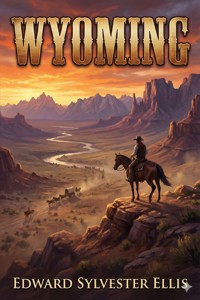
The vast, open plains of Wyoming set the stage for a dramatic saga of law and disorder. Settlers and soldiers clash in a land that refuses to be tamed easily, where destiny is written in blood and dust. Enter a world where the landscape itself is a character, beautiful yet unforgiving.
Das E-Book können Sie in Legimi-Apps oder einer beliebigen App lesen, die das folgende Format unterstützen:
Veröffentlichungsjahr: 2026
Ähnliche














CHAPTER I.
On the sultry third of July, 1778, Fred Godfrey, a sturdy youth of eighteen years, was riding at a breakneck speed down the Wyoming Valley, in the direction of the settlement, from which he saw columns of smoke rolling upward, and whence, during the few pauses of his steed, he heard the rattling discharge of firearms and the shouts of combatants.
"I wonder whether I am too late," he asked himself more than once, and he urged his splendid horse to a greater pace; "the road never seemed so long."
Ah, there was good cause for the anxiety of the lad, for in that lovely Wyoming Valley lived those who were dearer to him than all the world beside, and whatever fate overtook the settlers must be shared by him as well. He had ridden his horse hard, and his flanks glistened with wet and foam, but though every foot of the winding road was familiar to him, it appeared in his torturing impatience to be double its usual length.
Fred Godfrey had received the promise of his father, on the breaking out of the Revolution, that he might enlist in the patriot army so soon as he reached the age of seventeen. On the very day that he attained that age he donned the Continental uniform, made for him by loving hands, bade his friends good-bye, and hastened away to where Washington was longing for just such lusty youths as he who appeared to be several years younger than he really was.
Fred was a handsome, athletic youngster, and he sat his horse with the grace of a crusader. Although the day was warm, and his face glowed with perspiration, he wore his cocked hat, blue coat with its white facings, the belt around the waist and another which passed over one shoulder ere it joined the one around the middle of his body, knee-breeches, and strong stockings and shoes. His rifle was slung across his back, and a couple of loaded single-barreled pistols were thrust in his belt, where they could be drawn the instant needed.
During his year's service in the patriot army Fred had proven himself an excellent soldier, and the dash and nerve which he showed in more than one instance caught the eye of Washington himself, and won the youth a lieutenancy, at the time when he was the youngest member of his company.
The ardent patriot was full of ambition, and was sure, should no accident befall him, of gaining higher honors. When he tramped with several other recruits from Wyoming to the camp of the Continentals, hundreds of miles away, one of his greatest comforts was the belief that, no matter how the current of war drifted back and forth, there was no danger of its reaching Wyoming. That lovely and secluded valley was so far removed from the tread of the fierce hosts that they might feel secure.
But behold! News came to Washington that the Tories and Indians were about to march into the valley with torch and tomahawk, and he was begged to send re-enforcements without delay. The Father of his Country was then on his campaign through the Jerseys. The British army had withdrawn from Philadelphia, where it spent the winter, and Clinton with a part of the force was marching overland to New York, with the Continentals in pursuit.
The campaign was so important that the commander-in-chief could ill afford to spare a man. He knew that Wyoming was not entirely defenseless. Colonel Zebulon Butler of the Continental army was marshaling the old men and boys, and there was the strong defense known as Forty Fort, built by the original settlers from Connecticut, not to mention Wilkesbarre near at hand, so that it would seem the settlers ought to be able to protect themselves against any force likely to be brought against them.
However, Washington told several of his recruits from Wyoming of the appeal that had been made to him, and gave them permission to go to the help of their friends, though he added that he did not think it possible for them to reach the ground in time to be of service.
But a half dozen started on foot toward the threatened point. Within a day's tramp of their destination they fell somewhat apart, as each, in his familiarity of the country, believed that he knew a shorter and quicker way home than the others.
Fred Godfrey was almost in sight of his home, when he was both pleased and alarmed by coming upon an estray horse. He was saddled and bridled, and though contentedly cropping the grass at the roadside, the perspiration and jaded look showed that he had come from the battle-ground. It was startling to know that such was the fact, and supplemented as it was by the reports of guns, shouts, and the black volumes of smoke pouring upward, Fred was filled with an anguish of misgiving.
Without stopping to make inquiries or to guess who could have owned the estray steed, the young patriot slipped forward, caught the bridle before the animal had time to scent danger, and vaulting lightly into the saddle, turned the head of the horse toward Wyoming, and striking his heels against his ribs, quickly urged him to a dead run.
"I am needed there," said Fred, urging his spirited animal still more, and peering down the highway; "you're the best horse I ever rode, but I can't afford to spare you now."
Fred Godfrey not only was close to the stirring scenes that marked that memorable massacre, but he was among them sooner even than he anticipated.
CHAPTER II.
Just here we must turn aside for a minute or two, in order to understand the situation.
On the third of July, Colonel Zebulon Butler, of the Continental army, had marched forth at the head of his two hundred and odd boys, old men, and a few able-bodied soldiers to meet his cousin, the British Colonel Butler, with his horde of soldiers, Tories, and Iroquois Indians.
"We come out to fight, not only for liberty," said the patriot leader, as the battle was about to open, "but for our lives and that which is dearer than our lives—to preserve our homes from conflagration, and our wives and children from the tomahawk."
For a time all went well, and Colonel Zebulon Butler began to hope that the marauders would be driven off, but his force was unsteady, and some of them gave way when they saw their enemies as they swarmed out of the woods and assailed them.
The trembling mothers who were prayerfully listening to the sounds of battle on the plain above, heard the regular platoon firing which showed that all was going well; but, by and by, the increasing yells, the dropping shots, the blaze of musketry from the swamp on the left of the fighting settlers, where the Iroquois were rushing forth, the panic-stricken fugitives coming into sight here and there, white, panting and wild, told the dreadful truth. The patriots had been overwhelmed by the invaders, who were driving everything before them. But a single hope remained—flight.
Some might succeed in reaching the mountains on the other side the river, and possibly a few would be able to force their way through the dismal wilderness known as the "Shades of Death," and reach Stroudsburg and the sparse settlements on the upper Delaware, many miles away.
The moment the patriots began flying before the Tories and Indians, the panic spread to all.
It is a historical fact that in the flight the pursuers shot many of the patriot officers and soldiers in the thigh, so as to disable them from running, and left them on the ground to be finally disposed of afterwards, while the Iroquois hastened after the other fugitives.
Many of these were tomahawked in their flight; others fled down the river banks in the direction of Wilkesbarre, on the opposite side of the river; others made for the mountains back of the battle-ground; still others hastened to the protection of the Forty Fort, while a great many found a temporary refuge in the undergrowth of Monocacy Island, in the Susquehanna. Still others got across the river and plunged into the mountainous wilderness and began their toilsome tramp through the section I have named, and which is still known as the "Shades of Death."
It was at this hour that Fred Godfrey galloped directly into the massacre in his desperate resolve to do all he could to save his friends.
He had turned off from the main highway, and was making toward a point whence came the sounds of sharp firing, and such shouts as to show that some unusual conflict was going on. He caught glimpses of figures moving among the trees, but he paid no heed to them, and pressed steadily forward over a half-broken path until he was stopped in the most startling manner that can be imagined—that is, by a rifle-shot.
Some one fired from the front, and undoubtedly would have struck the youthful rider, had not his horse at the very instant snuffed the danger and flung up his head. The action saved the life of the rider at the expense of the steed, who received the cruel bullet and lunged forward and fell to the ground with such suddenness that but for the dexterity of Fred Godfrey he would have been crushed.
As it was, the youth saved himself by a hair's breadth, leaping clear of the saddle and brute just in the nick of time.
The thin wreath of smoke was curling upward from the undergrowth, and the horse was in the act of falling, when a Seneca Indian, in his war paint and agleam with ferocity, bounded from the cover, and with his smoking gun in his hand and the other grasping the handle of his tomahawk, dashed towards the patriot, whom he evidently believed was badly wounded.
"S'render! s'render!" he shrieked, coming down upon him as if fired from a cannon.
"I'm not in that business just now," snapped out Fred Godfrey, leveling and firing his pistol, with the muzzle almost in the face of the fierce warrior.
The aim could not have been more accurate. The subsequent incidents of the Wyoming massacre were of no interest to that Seneca warrior, for the sharp crack of the little weapon was scarcely more sudden than was the ending of his career.
CHAPTER III.
Fred Godfrey did not stop to reload his pistol. He had another ready for use, and he unshipped his rifle in a twinkling, and hurried for the point where he hoped to gain some tidings of his loved ones. Everything was in a swirl, and of his own knowledge he could not tell the proper course to take.
He ran through the wood toward the point for which he was making at the moment the Seneca Indian shot his horse, but, short as was the distance, all sounds of conflict were over by the time he reached his destination.
Among the parties dashing hither and thither, in the blind effort to escape the Tories and Indians, who seemed to be everywhere, Fred recognized several friends and neighbors. Indeed, since Wyoming was his native place, it may be said that nearly all the fugitives were known to him.
"Why ain't you with your folks?" suddenly asked a middle-aged farmer, who stopped for a moment in his panting flight to exchange a few words and to gain breath.
"Can you tell me where they are?" asked Fred in turn.
"They're well on their way across the Susquehanna by this time, if they haven't reached the other shore."
"How do you know that?" asked Fred, his heart bounding with hope at the news which he was afraid could not be true.
"I saw them go down to the river bank before the fighting begun: Gravity told me that just as soon as he saw how things were going he meant to run to where they were waiting and take them over in his scow."
"How do you know that he has done so?"
"I don't know it of a certainty, but I saw Gravity making for the river bank a while ago, and I've no doubt he did what he set out to do."
This news was not quite so good as Fred supposed from the first remark of his friend, but it was encouraging. Before he could ask anything more, the other made a break and was gone.
"Oh, if they only did get across the river," muttered Fred, making haste thither; "it is their only hope."
And now it is time that you were told something about those in whom the young patriot felt such painful interest.
They were Maggie Brainerd, whose father, a leading settler from Connecticut, had gone out with the company to fight the invaders of Wyoming; Eva, her eight-year-old sister, and Aunt Peggy Carey, the sister of the dead parent, and who had been the best of mothers to the children for the last three years. Maggie and Eva were the half-sisters of Fred Godfrey, between whom existed the sweetest affection.
Maggie was a year younger than Fred, and Aunt Peggy was a peppery lady in middle life, who detested Tories as much as she did the father of all evil himself. When Mr. Brainerd bade each an affectionate good-bye and hurried away with the others to take part in the disastrous fight, they huddled close to the river bank, hoping he would soon return to them with the news that the invaders had been routed and driven away.
Side by side with the patriotic father marched the servant of the family—Gravity Gimp, an enormous African, powerful, good-natured, and so devoted to every member of his household that he gladly risked his life for them.
Gravity went into the battle with his gun on his shoulder and with the resolve to do his part like a man. He loaded and fired many times, but at the first sign of panic he broke and made for the river side, determined to save the women folks there, or die in the attempt. He lost sight of his master, whom he left loading and firing with the coolness of a veteran. It did not occur to Gravity that he might do good service by giving some attention to the head of the family, who had not half the strength and endurance of himself.
Aunt Peggy, Maggie, and Eva waited on the river bank, with throbbing hearts, the issue of the battle. When it became certain that the patriots had suffered a check, they hoped that it was only for a brief time, and that they would speedily regain the lost ground.
While they waited, the smoke from blazing Fort Wintermoot was wafted down the valley, and became perceptible to the taste as well as to the sight. The fugitives were seen to be taking to the river, fields, and woods, and the painted Iroquois were rushing hither and thither, gathering in their fearful harvest of death.
"Aunt," said Maggie, taking the hand of Eva, "it won't do to wait another minute."
"But what will become of your father and Gravity?"
"They are in the hands of God," was the reverential reply of the courageous girl, who had asked herself the same question.
When her loved parent had kissed her good-bye he made her promise that on the very moment she became assured of the defeat of the patriots she would lose no time in getting as far away as possible. She would have felt justified in breaking that pledge could she have believed there was any hope of helping her father, but she knew there was none.
Eva was in sore distress, for now that she understood, in her vague way, the whole peril, her heart went out to the absent ones.
"Where's papa and Gravity?" she asked, holding back, with the tears running down her cheeks.
"They are doing their best to keep the bad Indians away," replied Maggie, restraining by a great effort her own feelings.
"I don't want to go till papa comes," pleaded the broken-hearted little one.
"But he wants us to go; he told me so, Eva."
"Did he? Then I'll go with you, but I feel dreadful bad."
And she ran forward, now that she knew she was doing what her father wished her to do.
CHAPTER IV.
The scene at this moment was terrifying.
The river was swarming with fleeing soldiers, old men, women, and children, struggling to reach the other side and get away from the merciless hordes assailing them.
Where so many were taking to the river, it would seem that there was little hope for the three, who were moving along the bank toward some point that would take them out of the rush.
For a time they attracted no special notice, but it was impossible that this should continue.
"Oh, the scand'lous villains!" muttered Aunt Peggy, applying her favorite epithet to the Tories; "how I would like to wring their necks! I've no doubt that Jake Golcher is among them. The idea of his coming to our house to court you—"
"There, there," interrupted Maggie, "this is no time to speak of such things; Jacob Golcher is among them, for I saw him a few minutes ago, and we may need his friendship."
"I'd like to see me—"
"There's Gravity!" broke in Eva, clapping her hands. The other two, turning their heads, saw that she spoke the truth.
The bulky negro servant of the family came limping toward them with his smoking musket in hand. He was bare-headed, like Maggie and Eva, and his garments were badly torn. He was panting from his severe exertion, and the perspiration streamed down his dusty face.
"Where's father?" was the first question Maggie asked, as he drew near.
"Can't tell," was the reply; "when I last seed him, he was fightin' like all creation, and graderlly workin' off toward the woods."
"Then there is hope for him!" exclaimed Maggie, looking yearningly at the servant, as if asking for another word of encouragement.
"Hope for him? Course dere am, and so dere am for you if you hurry out ob dis place."
"But where can we go, Gravity? I promised father to try to get away, but how can we do so?"
"I'll soon show you," replied the African, rapidly recovering his wind, and moving along the bank in the direction of the present site of Kingston.
Gravity knew there was no chance for his friends until they reached the other side of the river, but it would not do to enter the stream near where they then stood.
A portion of the Susquehanna was so deep that it would be necessary for all to swim, and, strange as it may seem, the only one of the party who could do so was Maggie Brainerd herself. Though Gravity had lived for years along the river, he could not swim a stroke.
It was a wonder that the little party had not already attracted the notice of the horde swarming along the shores. They must do so very soon and Gravity hurried his gait.
"I'm looking for dat scow ob mine," he explained; "if any ob you happen to cotch sight ob it—"
Eva Brainerd gave utterance to such a shriek that every one stopped and looked toward her.
Without speaking, she pointed up the bank where a hideously painted Iroquois was in the act of drawing back his gleaming tomahawk and hurling it at Gravity Gimp, who until that moment was unconscious of his peril.
The negro held his loaded gun in hand, but the time was too brief for him to turn it to account. In fact, at the very moment he looked at the redskin, the latter let fly.
With remarkable quickness, Gravity, knowing that the Indian was aiming at his head, dropped his shoulders just as the weapon whizzed past, and striking the ground, went bounding end over end for a dozen yards.
The Iroquois was amazed by his own failure. He stared for a single moment, and then, seeing that the dusky fellow was unhurt, he brought his gun to his shoulder, with the intention of destroying the only protector the women and children had, so as to leave them defenseless.
But in the way of raising his gun to his shoulder, taking aim and firing, Gravity Gimp was five seconds in advance of the noble red man: enough said.
"De fust duty arter shootin' off a gun am to load her up agin," remarked Gravity, as he began pouring a charge from his powder horn into the palm of his hand, preparatory to letting it run down the barrel of his weapon.
"Don't wait," pleaded Maggie, greatly agitated by what had just taken place, and by the shouts, cries, and reports of guns about them; "if we tarry we are lost."
"I reckon I'm too well 'quainted wid dese parts to got lost," said the servant, who was really making all the haste he could in the way of reloading his gun. In a moment he had poured the powder into the pan of his weapon.
"Now we'll trabbel," he said, hurrying again along the river shore. He took enormous strides, his gait being that peculiar hurried walk which is really faster than an ordinary trot.
It compelled the others to run, Maggie still clasping the hand of Eva, while Aunt Peggy forgot her dignity in the terrors of the time and held her pace with them.
The truth was that though Gravity was the owner of a scow which he had partly hidden at the time he saw the possibility of its need, he was afraid it had been taken by others of the fugitives that had stumbled upon it.
Less than a hundred yards remained to be passed, and, as that was fast put behind them, even the phlegmatic Gravity began to show some nervousness.
"I thinks we're gwine to make it," he said, recognizing several well-known landmarks; "and, if we does, and gits to de oder shore and has 'bout two hundred and fifty miles start ob de Tories and Injins, why dat will be sort ob cheerin' like."
All this time the sable guide, although walking fast, limped as if he were hurt.
"What makes you lame?" asked Eva.
"I was hit by a cannon-ball on de knee," was the astonishing answer: "it slewed my leg round a little, but I'll soon be all right again."
At this moment, when the hearts of all were beating high with hope, a rustling was heard among the undergrowth on their right, and the little company paused and looked up, expecting to see a dozen or more painted Iroquois in their war paint.
The click, click of the African's rifle, as he drew back the flint, showed that he was ready to do everything to defend those who cowered behind him like scared sheep.
To the surprise of each, however, a single man came hurriedly forth. All identified him as Jake Golcher, an old resident of Wyoming, but one of the bitterest of Tories, whose hatred of his former neighbors and friends seemed as intense as that of Queen Esther, or Katharine Montour, one of the leaders of the invaders.
He was as much surprised as the fugitives themselves, and he stared at them with open mouth, slouch hat thrown on the back of his head, and the stock of his gun resting at his feet. He was the first to recover his speech, and, with an expletive, he demanded:
"Where did you come from?"
"Am you abdressing your remarks to me or to de ladies?" asked Gravity of the man whom he detested, and of whom, even then, he had not the slightest fear.
"I'm speaking to all of you," said Golcher, glancing furtively at the vinegar face of Aunt Peggy, and bestowing a beaming smile on Maggie Brainerd.
Much as the latter despised the Tory, she had too much sense to show it at this time. Walking toward him, she clasped her hands, and with an emotion that was certainly genuine, she said:
"Oh, Mr. Golcher, won't you help us?"
"What are you axin' him dat for?" broke in Gravity; "we don't want no help from him."
Aunt Peggy was evidently of the same mind, for though she said nothing, she gave a sniff and toss of her head that were more expressive than words.
The sallow face of the Tory flushed, as he looked down in the sweet countenance of Maggie Brainerd, made tenfold more winsome by the glow of the cheeks and the sparkle of the eyes, arising from the excitement of her situation.
Bear in mind that the party had gone so far along the bank of the river that they were somewhat removed from the swarm of fleeing fugitives, and therefore no immediate danger threatened; but the call for flight was as loud as ever, and a few minutes' delay was liable to bring down a score of Indians and Tories.
To none was this fact more evident than to Maggie Brainerd. In truth, she believed that Golcher was at the head of a company within call, and she sought to win his good-will before it was too late.
Gravity stood with his gun at his side, the hammer raised, and ready to fire the instant it became necessary. One foot was thrown forward, and his whole demeanor was that of enmity and defiance.
I may as well say that the servant was trying hard to persuade himself that it was not his duty to raise his piece and shoot the renegade without any further warning.
It would have been shocking, and yet there would have been some palliation for it.
In a short time the African's debate with himself ended in what may be called a compromise.
"I'll keep my eye on him while dis foolish conversation goes on, and de minute he winks at Miss Maggie, or says anyting dat she don't like, I'll pull trigger."
CHAPTER V.
"Do you want me to befriend you?" asked the renegade, bending his head down close to the scared countenance of Maggie Brainerd, smiling and trying to speak in so low a voice that no one else could catch his words.
"Of course I do; don't you see what danger we are in? Oh, Mr. Golcher—"
"Don't Mister me," he interrupted, with a reproving grin; "call me Jake."
"Oh, Jake, have you seen anything of father?"
"Where would I see him?"
"Why, he went out with the rest to fight the Indians and Tories, and you were with them."
"Oh, yes; I did see him," said Golcher, as though the incident was so slight that he had forgotten it for the time: "he fought well."
"Was he—was he—Oh, Jake, tell me?—was he hurt?"
"I don't think he got so much as a scratch; he was with three or four others, and they were getting in the best kind of work; but you know it was no use for any one; I saw that they would be shot down where they stood, so I ran up and told your father to follow me; you know that nobody dare touch him when I took charge. I led him and his friends back toward the mountains and stayed by them till all danger was over, and then I bade them good-bye: if they have taken the least care and done as I told them to do, they are a great deal safer than you are at this very minute."
Maggie Brainerd's heart sank within her. She knew that the story that Jake Golcher had just told her was without an iota of truth. He had lied so clumsily that he had not deceived her at all.
The very question which he had asked about her parent was proof that he had not seen him, and therefore could know nothing of him.
The young lady was shocked, but she was helpless. Her duty was to do her utmost for the safety of those who were now with her, and she was sure that Golcher could give great help, if he chose to do so.
"Jake," said she, speaking with all the earnestness of her nature, "this is a dreadful day for Wyoming; I can hardly realize what has taken place; I do not believe that any one on this side of the river is safe."
"Of course he isn't—that is, none of the rebels is; our folks are all right."
"Can you save us?"
"I don't know what's to hinder—that is, if I take the notion, but I don't feel like doing much for that spitfire of an aunt, that insulted me the last time that I called at your house."
"You musn't mind her peculiarities; she is a good woman, and then, you know, she is my friend."
"Well, that makes a good deal of difference—that's a fact," remarked Golcher, with such a grotesque attempt to look arch and loving, that the watchful African, instead of firing upon him as he had meant to do, smiled.
"I'm afeard he don't feel berry well; he'll feel a good deal worse if Aunt Peggy or me gets hold of him."
"And then," added Golcher, glancing at Gravity, "you heard the impudence of that servant."
"Because he is a servant you ought to excuse him; I should feel very sorry to have him suffer harm."
"I don't mind taking particular care of you and your little sister there, but I would prefer to leave Aunt Peggy, as you call her, and the darkey to shift for themselves."
"Then I do not want you to do anything for Eva and me," said Maggie, resolutely, feeling that she was throwing away invaluable time by holding converse with this man; "God has been better to us than we deserve, and we shall leave all with him."
She turned to move off, much to the relief of Aunt Peggy, who had hard work to hide her impatience, when Golcher saw that he had gone too far. Catching her arm, he said:
"Don't be so fast; where will you go, if you don't go with me?"
"Gravity is our guide."
"I haven't told you I wouldn't take care of you, have I?"
"But if you are unwilling to include all of us, I do not want your friendship."
"Then for the sake of you I will save you all, though nobody beside me would do so; but, Maggie, I'll expect a little better treatment from you when I come to your house again."
At this point Golcher saw that the patience of the young lady was exhausted. Her companions were ready to chide her for halting to speak to him, though the words that passed took but a few minutes. He reached out his hand to lay it on her arm, but she drew back.
"Maggie," said he, warningly; "when I came down the river bank, I left six Seneca warriors among the trees back there; they are tired waiting for me; their guns are loaded, and I have only to raise my hand over my head to have 'em fire every one of 'em; if they do it, they will all be pointed this way."
Maggie Brainerd was sure the Tory spoke the truth.
"You will not do that, Jake, I am sure."
"Not if you act right; follow me."
Maggie reached out her hand as an invitation for Eva to come to her; but Aunt Peggy grasped one of the little palms in her own, for she had overheard the invitation. When Maggie looked around, her aunt compressed her thin lips and shook her head in a most decided fashion.
"No, ma'am; Eva stays here: if you want to go off with that scamp you can do so, but the rest of us don't."
"But, aunt, what shall we do? There's no escape for us unless we put ourselves in his care; Jake has promised to see that no harm befalls us from the Indians."
"Ugh!" exclaimed the aunt, with a shudder of disgust: "I'd rather trust myself with the worst Indians that are now in the valley than with him."
"Them's my sentiments," broke in Gravity; "we don't want to fool away any more time with him."
"Then you'll take the consequences," said the Tory, trembling with anger. "I offered to protect you and you refused to have me; I'll still take care of Maggie and Eva, but as for you others, you shall see—"
CHAPTER VI.
The last few sentences that passed between Maggie Brainerd and Golcher, the Tory, were heard, not only by Aunt Maggie, but by the African servant.
This was due to the fact that the renegade in his excitement forgot his caution, besides which the servant took occasion to approach quite close to the two.
A very brief space of time was occupied in the conversation, but brief as it was, Gravity was resolved that it should end. He did not believe the declaration of Golcher that he had a party of half-a-dozen Senecas within call, though it was possible that he spoke the truth; but beyond a doubt the savages were so numerous that a summons from the Tory would bring a number to the spot.
When, therefore, Jake adjusted his lips for a signal, Gravity bounded forward and caught him by the throat.
"Don't be in a hurry to let out a yawp; if dere's any hollerin' to be done, I'll take charge of it."
Golcher was as helpless as a child in the vise-like grip of those iron fingers. He not only was unable to speak, but he found it hard work to breathe.
Dropping his gun, he threw up both hands in a frantic effort to loosen the clutch of those fingers.
"Why, Gravity," said the horrified Maggie; "I'm afraid you will strangle him."
"And I'm afraid I won't," replied the African, putting on a little more pressure.
Gravity, however, had no intention of proceeding to extremities, though he might have found justification in so doing. He regulated the pressure of his powerful right hand so that his victim, by putting forth his best efforts, was able to get enough breath to save himself.
"Young man," said Gravity, still holding him fast, "I don't think dis am a healthy place for you; de best ting you can do am to leave a little sooner dan possible."
"Let—me—let—me—go!" gurgled Golcher, still vainly trying to free himself.
"I don't find dat I've got much use for you, so I'll let you off, but de next time I lays hand onto you, you won't got off so easy, and bein' as you am goin', I'll give you a boost."
To the delight of Aunt Peggy and the horror of Maggie Brainerd, Gravity Gimp now wheeled the Tory around as though he were the smallest child, and actually delivered a kick that lifted him clear of the ground.
Not only once, but a second and third time was the indignity repeated. Then, with a fierce effort, Golcher wrenched himself free from the terrible fingers on the back of his neck, and, plunging among the trees, vanished.
"Dat ar might come handy," said Gravity, picking up the loaded musket which the panic-stricken Tory had left behind him and handing it to Aunt Peggy, who asked, with a shudder:
"Do you s'pose I would touch it?"
"Let me have it," said Maggie; "I consider it fortunate that we have two guns with us."
It was a good thing, indeed, for Maggie Brainerd, like many of the brave maidens of a hundred years ago, was an expert in handling the awkward weapons of our Revolutionary sires. With this at her command, the chances were she would be heard from before the rising of the morrow's sun.
But, if Jake Golcher was a mild enemy before, it was certain he was now an unrelenting one. He would neglect no effort to avenge himself upon all for the indignity he had received.
The African understood this, and he lost no time in getting away from the spot with the utmost speed.
It was now about five o'clock in the afternoon, but it was the eve of the Fourth of July, and the days were among the longest in the year. It would not be dark for three hours, and who could tell what might take place in that brief period?
Extremely good fortune had attended our friends thus far, but it was not reasonable to expect it to continue without break.




