



0,49 €
Niedrigster Preis in 30 Tagen: 1,99 €
Niedrigster Preis in 30 Tagen: 1,99 €
Mehr erfahren.
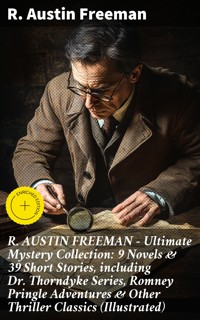
In "A Silent Witness," R. Austin Freeman masterfully weaves a compelling narrative that explores the intricate realm of forensic detection. This novel is distinguished by its meticulous attention to detail and its unique blending of scientific inquiry with classic detective storytelling. Freeman's protagonist, Dr. John Thorndyke, a pioneer in forensic science, is called upon to solve a baffling murder case where the evidence is both elusive and suggestive, presenting readers with a rich tapestry of clues that demand keen observation and analytical reasoning. Set against the backdrop of early 20th-century London, the novel not only reflects the period's fascination with science and technology but also interrogates the moral ambiguities surrounding justice and truth. R. Austin Freeman was a physician with a profound interest in the capabilities of forensic science, often drawing upon his medical background to craft his narratives. His innovation in the detective genre, specifically with the introduction of scientifically rooted crime-solving techniques, marks an important evolution in literature. Freeman's own experiences and the scientific advancements of his time fueled his desire to create a detective character whose methods illustrated the potential of rational thought in an era grappling with both crime and chaos. "A Silent Witness" is an essential read for enthusiasts of mystery literature and those interested in the intersections of science and storytelling. Freeman's intricate plotting and vivid characterizations will captivate readers, while Thorndyke's methods will inspire the analytical minds among us. This novel not only entertains but also invites readers to consider the implications of evidence and its power in uncovering hidden truths. In this enriched edition, we have carefully created added value for your reading experience: - A succinct Introduction situates the work's timeless appeal and themes. - The Synopsis outlines the central plot, highlighting key developments without spoiling critical twists. - A detailed Historical Context immerses you in the era's events and influences that shaped the writing. - A thorough Analysis dissects symbols, motifs, and character arcs to unearth underlying meanings. - Reflection questions prompt you to engage personally with the work's messages, connecting them to modern life. - Hand‐picked Memorable Quotes shine a spotlight on moments of literary brilliance. - Interactive footnotes clarify unusual references, historical allusions, and archaic phrases for an effortless, more informed read.
Das E-Book können Sie in Legimi-Apps oder einer beliebigen App lesen, die das folgende Format unterstützen:
Veröffentlichungsjahr: 2022
Ähnliche


A Silent Witness
Table of Contents
Introduction
Objects speak where people equivocate, and the drama of A Silent Witness lies in learning to read the quiet, durable testimony of things against the noise of human assumption. R. Austin Freeman builds his mystery around the notion that matter—bones, dust, stains, interval, and mechanism—retains a memory more reliable than eyewitnesses. The result is an inquiry whose tension springs less from chase or confession than from the gradual illumination of what the world already knows. That illumination becomes a moral undertaking: distinguishing conjecture from demonstration, and private suspicion from proof that can stand in the open air of law and reason.
A Silent Witness is a novel of detective fiction by the British writer R. Austin Freeman, featuring his medicolegal investigator Dr. Thorndyke. Set in early twentieth-century London and its professional milieu, it embodies the scientifically minded branch of the classic mystery, in which laboratory method and legal procedure guide the search for truth. Appearing during the formative years of modern crime fiction, the book reflects an era when forensic science was consolidating its techniques and courtroom standards. Freeman’s standing as an early master of the scientific detective lends the novel historical interest as well as narrative authority.
The premise unfolds from an apparently ordinary incident observed by a young medical man, whose curiosity is sharpened by small irregularities that refuse to resolve into coincidence. Consultation with Dr. Thorndyke turns that unease into disciplined inquiry, as scattered details—medical, material, and circumstantial—begin to suggest a pattern with serious legal implications. The investigation moves from clinical observation to controlled experiment, and from private surmise to evidence robust enough for public scrutiny. Without disclosing the turns of the plot, it is safe to say that danger, secrecy, and reputation come to depend on how faithfully physical traces can be interpreted.
Readers encounter the story through a sober, reflective first-person voice that values clarity over bravado, inviting them to weigh each datum as it appears. Freeman’s style is measured and exact, punctuated by demonstrations that are both instructive and dramatic without resorting to sensationalism. Scenes in the laboratory and in formal settings typical of legal practice anchor the action, while the city’s streets and rooms provide an everyday canvas against which small anomalies glow. The tone remains courteous, rational, and quietly suspenseful, with the pleasure of reading tied to the progressive assembling of a case the audience can verify step by step.
At its core, the book explores the authority of evidence and the limits of memory, asking how we know what we think we know. It probes the ethics of expertise: when a specialist speaks for the mute facts, what duties of restraint and candor arise? Freeman also considers professional identity—how a physician’s habits of observation translate into the courtroom’s demand for proof—and the way urban life both obscures and records human action. The title’s promise is kept: the “witness” is neither informant nor confession, but the persistent, indifferent record kept by bodies, tools, timings, and traces.
For contemporary readers, A Silent Witness matters because it models intellectual virtues that remain urgent: patience with data, humility before uncertainty, and rigor in separating inference from demonstration. In an age saturated with information, the novel’s insistence on chain-of-custody thinking and transparent methods feels bracing rather than antique. Its portrait of expert testimony anticipates modern debates about forensic reliability, bias, and the responsibilities of specialists who translate technical findings for lay audiences. The book invites a productive skepticism toward narrative neatness while honoring the possibility that truth, properly handled, can be publicly shared.
Approached today, the novel offers both historical texture and fresh relevance: a bridge between the gentlemanly puzzle and the procedural mindset that now dominates crime storytelling. It rewards attentive reading, presenting fair clues without fanfare and trusting the reader’s capacity to compare possibilities as the facts accumulate. Without unveiling its later surprises, one can say that its satisfactions are earned in the laboratory of careful thought. To follow Thorndyke here is to practice looking harder and arguing better—a discipline as useful outside fiction as within it, and a reason the book retains its quiet authority.
Synopsis
R. Austin Freeman’s A Silent Witness (1914) presents Dr. John Evelyn Thorndyke, a medico-legal expert whose quiet precision drives a case in which physical traces speak more reliably than memory or motive. The narrative, told by a young medical observer drawn into Thorndyke’s orbit, begins with events that look routine yet leave unsettling residues: a sudden death under plausible circumstances and ancillary oddities that do not cohere. Freeman’s method foregrounds the sober rhythms of professional practice—clinic, mortuary, and laboratory—while introducing the central question: when testimony conflicts, can minute, inanimate remnants provide the most faithful account of what truly happened?
The opening movement places the narrator at close quarters with a death that the authorities can readily classify, and with ancillary facts that resist tidy explanation. Official conclusions trend toward accident or misadventure; the narrator’s medical eye detects small discrepancies that feel out of proportion to the verdict. He consults Thorndyke, who insists on seeing places and objects rather than accepting summaries. Where lay witnesses supply impressions, Thorndyke attends to surfaces, textures, and sequences of action, reassessing the incident not as an isolated event but as a node in a chain whose missing links may be recoverable.
Investigation proceeds by scrupulous accumulation. Thorndyke gathers specimens, photographs, and measurements; he examines biological and material particles whose presence, condition, or arrangement silently constrains the story the scene can tell. He repeats procedures under controlled conditions, attends to medical records, and checks statements against demonstrable possibility. The narrator observes how Thorndyke withholds premature conclusions, preferring provisional models tested by fresh observation. As the inquiry widens, the doctor’s approach reveals how modest details—overlooked by routine practice—can translate into decisive indices of time, movement, and contact, gradually delimiting which narratives remain compatible with the facts.
Pressure intensifies when suspicion narrows and a living person’s fate becomes entangled with the emerging pattern. Legal stakes rise, and public confidence hardens around a seemingly straightforward construction of events. Thorndyke, maintaining a rigorously neutral stance, visits key locations, reconstructs sequences, and correlates distances and intervals that an alibi or assumption might misstate. A distinctive material correspondence begins to link disparate places and moments, suggesting continuity where witnesses perceive separation. Throughout, Freeman contrasts conversational plausibility with evidential necessity, letting the reader watch Thorndyke’s patience transform anecdote into analysis without disclosing the destination prematurely.
Complications follow. Fresh incidents and attempts—intentional or inadvertent—to disturb the record introduce noise into the evidential field. Administrative momentum threatens to fix a narrative before the inquiry has matured, while sympathetic figures risk being misunderstood. Thorndyke persists in distinguishing what is merely consistent from what is demonstrable, testing whether motive stories actually fit the measurable traces. The narrator chronicles careful experiments and modest revelations that cumulatively displace confident assumptions. Step by step, a network of small, mutually reinforcing facts emerges, pointing toward a coherent reconstruction that neither melodrama nor coincidence can dislodge.
Freeman stages the climax in a formal arena where evidence must withstand scrutiny, setting Thorndyke’s method against adversarial inference. The doctor presents his findings as a sequence of transparent demonstrations rather than rhetoric, explaining the medical mechanics of injury and timing, and the origin and journey of telltale particles. Apparent simplicities unravel as physical facts contradict convenient readings, and the chain of events is reassembled in a manner that reconciles anomalies the earlier account left unresolved. While the outcome clarifies responsibility, the emphasis remains on process: how disciplined observation converts silence into testimony without resorting to speculation.
A Silent Witness endures as a model of the scientific detective novel, balancing narrative restraint with intellectual rigor. Freeman’s focus on laboratory practice, field verification, and ethical testimony showcases an early, influential articulation of forensic reasoning in popular fiction. The novel illustrates how patient attention to small material signs can recover truth from ambiguity, and how expert interpretation guards justice against haste. Beyond its immediate plot, it resonates as an argument for method over conjecture, offering readers a measured suspense grounded in procedures that have shaped later crime writing and continue to define credible investigative storytelling.
Historical Context
A Silent Witness (1914) by R. Austin Freeman belongs to his Dr. John Thorndyke series, situated in early twentieth century London among medical schools, law courts, and professional chambers. The milieu is late Edwardian and early Georgian Britain under George V, with the Inns of Court, the Old Bailey, and London teaching hospitals as institutional backdrop. Freeman, a trained physician, centers medico legal practice: laboratory work, autopsies, and expert testimony. The novel’s streets, chambers, and river crossings reflect a metropolis linked by omnibuses, railways, and the expanding Underground. Within this setting, scientific routine and legal procedure frame inquiry rather than romantic intuition.
Around the time of composition, forensic science was consolidating in Britain. Scotland Yard created a Fingerprint Bureau in 1901, drawing on the Henry classification developed in British India; notable early convictions followed in 1902 and 1905. Blood science advanced rapidly: Karl Landsteiner identified blood groups in 1900, and Paul Uhlenhuth’s precipitin test in 1901 distinguished human from animal blood. Microscopy, casts, and comparative measurements entered evidentiary practice. Freeman incorporates these methods with unusual exactitude, stressing controlled experiments, careful preservation of traces, and incremental inference, thereby aligning his fiction with contemporary medico legal standards rather than with sensational shortcuts.
London teaching hospitals such as Guy’s, St Bartholomew’s, St Thomas’, and University College Hospital trained doctors through ward rounds, anatomy, and pathology laboratories, heirs to reforms after the Anatomy Act of 1832 and to antiseptic and aseptic practices established since the nineteenth century. Autopsy techniques and bacteriology had become routine components of medical learning. The coroner system, with inquests and medical witnesses, connected hospitals to the courts. Figures like Bernard Spilsbury were emerging as famous pathologists in the 1910s. Freeman’s physician detective, functioning as an expert witness, reflects a professional world where clinical observation and laboratory verification were increasingly authoritative.
British criminal procedure in this period moved from magistrates’ hearings to jury trials at the Central Criminal Court, the Old Bailey, with coroner’s inquests often preceding charges. The Criminal Appeal Act 1907 established a Court of Criminal Appeal, reflecting concern for procedural safeguards. Expert testimony—medical, chemical, and photographic—was admitted but rigorously tested by cross examination. The Inns of Court organized barristers’ practice, while solicitors prepared cases and police gathered preliminary evidence. Freeman portrays this ecosystem with care: the expert’s role is precise and limited, evidentiary standards matter, and courtroom dynamics shape how scientific findings are translated into legal proof.
Technologies available to London professionals by 1900 to 1914 broadened investigative possibilities. Wilhelm Röntgen’s X rays, discovered in 1895, were used in British hospitals within a year, enabling non invasive examinations. Photographic documentation, including photomicrography, aided in recording minute traces. Electric lighting and improved optics supported night work in laboratories. The telephone, telegraph, and a dense postal network—with multiple daily deliveries in central London—accelerated communication. Railways and the Underground facilitated rapid movement across the metropolis and to nearby towns, allowing alibis and timelines to be checked against timetables. Freeman’s narrative logic relies on these infrastructures to constrain and verify competing accounts.
The Metropolitan Police’s Criminal Investigation Department, professionalized since the late nineteenth century, collaborated with outside experts when cases required specialized analysis. Britain’s popular press reported sensational trials in detail, shaping public expectations about scientific proof. The Crippen case in 1910, the Seddon poisoning trial in 1912, and the Brides in the Bath murders in 1915 illustrated the evidentiary clout and controversy of pathology, toxicology, and circumstantial reconstruction. Such cases familiarized readers with experts, exhibits, and diagrams in court. Freeman writes within this media climate, emphasizing reproducible demonstrations and measured conclusions, counterbalancing sensationalism with method while acknowledging how publicity can frame perceptions of guilt and certainty.
Freeman, born in 1862 and medically qualified before colonial service on the Gold Coast from 1887 to 1891, brought clinical discipline to detective fiction. Dr. Thorndyke, introduced in The Red Thumb Mark in 1907, exemplifies the scientific detective, a strand paralleling but distinct from Conan Doyle’s Holmes. Freeman also pioneered the inverted detective story in The Singing Bone in 1912, foregrounding proof rather than surprise. A Silent Witness continues this emphasis on experiment, controlled observation, and expert reasoning. The series’ Inner Temple chambers and hospital ties root the stories in real professional geographies, reflecting esteem for specialized knowledge and a rising culture of credentialed expertise.
Published in 1914, on the cusp of the First World War, the novel captures a late Edwardian confidence in institutions—hospitals, laboratories, courts—and in the capacity of methodical science to resolve ambiguity. It implicitly critiques overreliance on intuition, rumor, or uncorroborated testimony, advocating physical evidence, documented procedures, and cautious inference. At the same time, its attention to due process and expert limits reflects contemporary debates about fairness after the new right of criminal appeal. In this way, A Silent Witness embodies its era’s faith in rational order while acknowledging the need for disciplined scrutiny within the machinery of justice.
A Silent Witness
I — THE BEGINNING OF THE MYSTERY
THE history upon which I am now embarking abounds in incidents so amazing that, as I look back on them, a something approaching to scepticism contends with my vivid recollections and makes me feel almost apologetic in laying them before the reader. Some of them indeed are so out of character with the workaday life in which they happened that they will appear almost incredible; but none is more fraught with mystery than the experience that befell me on a certain September night in the last year of my studentship and ushered in the rest of the astounding sequence.
It was past eleven o'clock when I let myself out of my lodgings at Gospel Oak; a dark night, cloudy and warm and rather inclined to rain. But, despite the rather unfavourable aspect of the weather, I turned my steps away from the town, and walking briskly up the Highgate Road, presently turned into Millfield Lane. This was my favourite walk and the pretty winding lane, meandering so pleasantly from Lower Highgate to the heights of Hampstead, was familiar to me under all its aspects.
On sweet summer mornings when the cuckoos called from the depths of Ken Wood, when the path was spangled with golden sunlight, and saucy squirrels played hide and seek in the shadows under the elms (though the place was within earshot of Westminster and within sight of the dome of St. Paul's); on winter days when the Heath wore its mantle of white and the ring of gliding steel came up from the skaters on the pond below; on August evenings, when I would come suddenly on sequestered lovers (to our mutual embarrassment) and hurry by with ill-feigned unconsciousness. I knew all its phases and loved them all. Even its name was delightful, carrying the mind back to those more rustic days when the wits foregathered at the Old Flask Tavern[1] and John Constable tramped through this very lane with his colour-box slung over his shoulder.
It was very dark after I had passed the lamp at the entrance to the lane[1q]. Very silent and solitary too. Not a soul was stirring at this hour, for the last of the lovers had long since gone home and the place was little frequented even in the daytime. The elms brooded over the road, shrouding it in shadows of palpable black, and their leaves whispered secretly in the soft night breeze. But the darkness, the quiet and the solitude were restful after the long hours of study and the glare of the printed page, and I strolled on past the ghostly pond and the little thatched cottage, now wrapped in silence and darkness, with a certain wistful regret that I must soon look my last on them. For I had now passed all my examinations but the final "Fellowship," and must soon be starting my professional career in earnest.
Presently a light rain began to fall. Foreseeing that I should have to curtail my walk, I stepped forward more briskly, and, passing between the posts, entered the narrowest and most secluded part of the lane. But now the rain suddenly increased, and a squall of wind drove it athwart the path. I drew up in the shelter of one of the tall oak fences by which the lane is here inclosed, and waited for the shower to pass. And as I stood with my back to the fence, pensively filling my pipe, I became for the first time sensible of the utter solitude of the place.
I looked about me and listened. The lane was darker here than elsewhere; a mere trench between the high fences. I could dimly see the posts at the entrance and a group of large elms over-shadowing them. In the other direction, where the lane doubled sharply upon itself, was absolute, inky blackness, save where a faint glimmer from the wet ground showed the corner of the fence and a projecting stump or tree-root jutting out from the corner and looking curiously like a human foot with the toes pointed upward.
The rain fell steadily with a soft, continuous murmur; the leaves of the elm-trees whispered together and answered the falling rain. The Scotch pines above my head stirred in the breeze with a sound like the surge of the distant sea. The voices of Nature, hushed and solemn, oblivious of man like the voices of the wilderness; and over all and through all, a profound, enveloping silence.
I drew up closer to the fence and shivered slightly, for the night was growing chill. It seemed a little lighter now in the narrow, trench-like lane; not that the sky was less murky but because the ground was now flooded with water. The posts stood out less vaguely against the background of wet road, and the odd-looking stump by the corner was almost distinct. And again it struck me as looking curiously like a foot—a booted foot with the toe pointing upwards.
The chime of a church clock sounded across the Heath, a human voice, this, penetrating the desolate silence. Then, after an interval, the solemn boom of Big Ben came up faintly from the sleeping city.
Midnight! and time for me to go home. It was of no use to wait for the rain to cease. This was no passing shower, but a steady drizzle that might last till morning. I re-lit my pipe, turned up my collar, and prepared to plunge into the rain. And as I stepped out, the queer-looking stump caught my eye once more. It was singularly like a foot; and it was odd, too, that I had never noticed it before in my many rambles through the lane.
A sudden, childish curiosity impelled me to see what it really was before I went, and the next moment I was striding sharply up the sodden path. Of course, I expected the illusion to vanish as I approached. But it did not. The resemblance increased as I drew nearer, and I hurried forward with something more than curiosity.
It was a foot! I realized it with a shock while I was some paces away; and, as I reached the corner, I came upon the body of a man lying in the sharp turn of the path; and the limp, sprawling posture, with one leg doubled under, told its tale at a glance.
I laid my finger on his wrist. It was clammy and cold, and not a vestige of a pulse could I detect. I struck a wax match and held it to his face. The eyes were wide-open and filmy, staring straight up into the reeking sky. The dilated pupils were insensitive to the glare of the match, the eyeballs insensitive to the touch of my finger.
Beyond all doubt the man was dead.
But how had he died? Had he simply fallen dead from some natural cause, or had he been murdered? There was no obvious injury, and no sign of blood. All that the momentary glimmer of the match showed was that his clothes were shiny with the wet; a condition that might easily, in the weak light, mask a considerable amount of bleeding.
When the match went out, I stood for some moments looking down on the prostrate figure as it lay with the rain beating down on the upturned face, professional interest contending with natural awe of the tragic presence. The former prompted me to ascertain without delay the cause of death; and, indeed, I was about to make a more thorough search for some injury or wound when something whispered to me that it is not well to be alone at midnight in a solitary place with a dead man—perchance a murdered man. Had there been any sign of life, my duty would have been clear. As it was, I must act for the best with a due regard to my own safety. And, reaching this conclusion, I turned away, with a last glance at the motionless figure and set forth homeward at a rapid pace.
As I turned out of Millfield Lane into Highgate Rise I perceived a policeman on the opposite side of the road standing under a tree, where the light from a lamp fell on his shining tarpaulin cape. I crossed the road, and, as he civilly touched his helmet, I said: "I am afraid there is something wrong up the lane, Constable; I have just seen the body of a man lying on the pathway."
The constable woke up very completely. "Do you mean a dead man, sir?" he asked.
"Yes, he is undoubtedly dead," I replied.
"Whereabouts did you see the body?" enquired the constable.
"In the narrow part of the lane, just by the stables of Mansfield House."
"That's some distance from here," said the constable. "You had better come with me and report at the station. You're sure the man was dead, sir?"
"Yes, I have no doubt about it. I am a medical man," I added, with some pride (I had been a medical man about three months, and the sensation was still a novel one).
"Oh, are you, sir?" said the officer, with a glance at my half-fledged countenance; "then, I suppose you examined the body?"
"Sufficiently to make sure that the man was dead, but I did not stay to ascertain the cause of death."
"No, sir; quite so. We can find that out later."
As we talked, the constable swung along down the hill, without hurry, but at a pace that gave me very ample exercise, and I caught his eye from time to time, travelling over my person with obvious professional interest. When we had nearly reached the bottom of the hill, there appeared suddenly on the wet road ahead, a couple of figures in waterproof capes. "Ha!" said the constable, "this is fortunate. Here is the inspector and the sergeant. That will save us the walk to the station."
He accosted the officers as they approached and briefly related what I had told him. "You are sure the man was dead, sir?" said the inspector, scrutinizing me narrowly; "but, there, we needn't stay here to discuss that. You run down, Sergeant, and get a stretcher and bring it along as quickly as you can. I must trouble you, sir, to come with me and show me where the body is. Lend the gentleman your cape, sergeant; you can get another at the station."
I accepted the stout cape thankfully, for the rain still fell with steady persistency, and set forth with the inspector to retrace my steps. And as we splashed along through the deep gloom of the lane, the officer plied me with judicious questions. "How long did you think the man had been dead?" he asked.
"Not long, I should think. The body was still quite limp."
"You didn't see any marks of violence?"
"No. There were no obvious injuries."
"Which way were you going when you came on the body?"
"The way we are going now, and, of course, I came straight back."
"Did you meet or see anyone in the lane?"
"Not a soul," I answered.
He considered my answers for some time, and then came the question that I had been expecting. "How came you to be in the lane at this time of night?"
"I was taking a walk," I replied, "as I do nearly every night. I usually finish my evening's reading about eleven, and then I have some supper and take a walk before going to bed, and I take my walk most commonly in Millfield Lane. Some of your men must remember having met me."
This explanation seemed to satisfy him for he pursued the subject no farther, and we trudged on for awhile in silence. At length, as we passed through the posts into the narrow part of the lane, the inspector asked: "We're nearly there, aren't we?"
"Yes," I replied: "the body is lying in the bend just ahead."
I peered into the darkness in search of the foot that had first attracted my notice, but was not yet able to distinguish it. Nor, to my surprise, could I make it out as we approached more nearly; and when we reached the corner, I stopped short in utter amazement.
The body had vanished! "What's the matter?" asked the inspector. "I thought this was the place you meant."
"So it is," I answered. "This is the place where the body was lying; here, across the path, with one foot projecting round the corner. Someone must have carried it away."
The inspector looked at me sharply for a moment. "Well, it isn't here now," said he, "and if it has been taken away, it must have been taken along towards Hampstead Lane. We'd better go and see." Without waiting for a reply, he started off along the lane at a smart double and I followed.
We pursued the windings of the lane until we emerged into the road by the lodge gates, without discovering any traces of the missing corpse or meeting any person, and then we turned back and retraced our steps; and as we, once more, approached the crook in the lane where I had seen the body, we heard a quick, measured tramp. "Here comes the sergeant with the stretcher," observed the inspector; "and he might have saved himself the trouble." Once more the officer glanced at me sharply, and this time with unmistakable suspicion. "There's no body here, Robson," he said, as the sergeant came up, accompanied by two constables carrying a stretcher. "It seems to have disappeared."
"Disappeared!" exclaimed the sergeant, bestowing on me a look of extreme disfavour; "that's a rum go, sir. How could it have disappeared?"
"Ah! that's the question!" said the inspector. "And another question is, was it ever here? Are you prepared to make a sworn statement on the subject, sir?"
"Certainly I am," I replied.
"Then," said the inspector, "we will take it that there was a body here. Put down that stretcher. There is a gap in the fence farther along. We will get through there and search the meadow."
The bearers stood the stretcher up against a tree and we all proceeded up the lane to the place where the observant inspector had noticed the opening in the fence. The gravel, though sodden with the wet, took but the faintest impressions of the feet that trod it, and, though the sergeant and the two constables threw the combined light of their lanterns on the ground, we were only able to make out very faintly the occasional traces of our own footsteps.
We scrutinized the break in the fence and the earth around with the utmost minuteness, but could detect no sign of anyone having passed through. The short turf of the meadow, on which I had seen sheep grazing in the daytime, was not calculated to yield traces of anyone passing over it, and no traces of any kind were discoverable. When we had searched the meadow thoroughly and without result, we came back into the lane and followed its devious course to the "kissing-gate" at the Hampstead Lane entrance. And still there was no sign of anything unusual. True, there were obscure foot-prints in the soft gravel by the turnstile, but they told us nothing; we could not even be sure that they had not been made by ourselves on our previous visit. In short, the net result of our investigations was that the body had vanished and left no trace. "It's a very extraordinary affair," said the inspector, in a tone of deep discontent, as we walked back. "The body of a full-grown man isn't the sort of thing you can put in your pocket and stroll off with without being noticed, even at midnight. Are you perfectly sure the man was really dead and not in a faint?"
"I feel no doubt whatever that he was dead," I replied.
"With all respect to you, sir," said the sergeant, "I think you must be mistaken. I think the man must have been in a dead faint, and after you came away, the rain must have revived him so that he was able to get up and walk away."
"I don't think so," said I, though with less conviction; for, after all, it was not absolutely impossible that I should have been mistaken, since I had discovered no mortal injury, and the sergeant's suggestion was an eminently reasonable one.
"What sized man was he?" the inspector asked.
"That I couldn't say," I answered. "It is not easy to judge the height of a man when he is lying down and the light was excessively dim. But I should say he was not a tall man and rather slight in build."
"Could you give us any description of him?"
"He was an elderly man, about sixty, I should think, and he appeared to be a clergyman or a priest, for he wore a Roman collar[2] with a narrow, dark stripe up the front. He was clean shaven, and, I think, wore a clerical suit of black. A tall hat was lying on the ground close by and a walking-stick which looked like a malacca, but I couldn't see it very well as he had fallen on it and most of it was hidden."
"And you saw all this by the light of one wax match," said the inspector. "You made pretty good use of your eyes, sir."
"A man isn't much use in my profession if he doesn't," I replied, rather stiffly.
"No, that's true," the inspector agreed. "Well, I must ask you to give us the full particulars at the station, and we shall see if anything fresh turns up. I'm sorry to keep you hanging about in the wet, but it can't be helped."
"Of course it can't," said I, and we trudged on in silence until we reached the station, which looked quite cheerful and homelike despite the grim blue lamp above the doorway. "Well, Doctor," said the inspector, when he had read over my statement and I had affixed my signature, "if anything turns up, you'll hear from us. But I doubt if we shall hear anything more of this. Dead or alive, the man seems to have vanished completely. Perhaps the sergeant's right after all, and your dead man is at this moment comfortably tucked up in bed. Good-night, Doctor, and thank you for all the trouble you have taken."
By the time that I reached my lodgings I was tired out and miserably cold; so cold that I was fain to brew myself a jorum of hot grog in my shaving pot. As a natural result, I fell fast asleep as soon as I got to bed and slept on until the autumn sunshine poured in through the slats of the Venetian blind.
II — THE FINDING OF THE RELIQUARY
I AWOKE on the following morning to a dim consciousness of something unusual, and, as my wits returned with the rapidity that is natural to the young and healthy, the surprising events of the previous night reconstituted themselves and once more set a-going the train of speculation. Vividly I saw with my mind's eye the motionless figure lying limp and inert with the pitiless rain beating down on it; the fixed pupils, the insensitive eyeballs, the pulseless wrist and the sprawling posture. And again I saw the streaming path, void of its dreadful burden, the suspicious inspector, the incredulous sergeant; and the unanswerable questions formulated themselves anew.
Had I, after all, mistaken a living man for a dead body? It was in the highest degree improbable, and yet it was not impossible. Or had the body been spirited away without leaving a trace? That also was highly improbable and yet, not absolutely impossible. The two contending improbabilities cancelled one another. Each was as unlikely as the other.
I turned the problem over again and again as I shaved and took my bath. I pondered upon it over a late and leisurely breakfast. But no conclusion emerged from these reflections. The man, living or dead, had been lying motionless in the lane all the time that I was sheltering, and probably for some time before. In the interval of my absence he had vanished. These were actual facts despite the open incredulity of the police. How he had come there, what had occasioned his death or insensibility, how he had disappeared and whither he had gone; were questions to which no answer seemed possible.
The fatigues of the previous night had left me somewhat indolent. There was no occasion for me to go to the hospital to-day. It was vacation time; the school was closed; the teaching staff were mostly away, and there was little doing in the wards. I decided to take a holiday and spend a quiet day rambling about the Heath, and, having formed this resolution, I filled my pipe, slipped a sketch-book into my pocket, and set forth.
Automatically my feet turned towards Millfield Lane. It was, as I have said, my usual walk, and on this morning, with last night's recollections fresh in my mind, it was natural that I should take my way thither.
Very different was the aspect of the lane this morning from that which I had last looked upon. The gloom and desolation of the night had given place to the golden sunshine of a lovely autumn day. The elms, clothed already in the sober livery of the waning year, sighed with pensive reminiscence of the summer that was gone; the ponds repeated the warm blue of the sky; and the lane itself was a vista of flickering sunlight and cool, reposeful shadow.
The narrow continuation beyond the posts was wrapped as always, in a sombre shade, save where a gleam of yellow light streamed through a chink between the boards of the fence. I made my way straight to the spot where the body had lain and stooped over it, examining each pebble with the closest scrutiny. But not a trace remained. The hard, gravelly soil retained no impress either of the body or even of our footsteps; and as for the stain of blood, if there had ever been any, it would have been immediately removed by the falling rain, for the ground here had a quite appreciable slope and must have been covered last night by a considerable flowing stream.
I went on to the break in the fence—it was on the right-hand side of the path—and was at once discouraged by the aspect of the ground; for even our rough tramplings had left hardly a trace behind. After an aimless walk across the meadow, now occupied by a flock of sheep, I returned to the lane and walked slowly back past the place where I had sheltered from the rain. And then it was that I discovered the first hint of any clue to the mystery. I had retraced my steps some little distance past the spot where I had seen the body, when my eye was attracted by a darkish streak on the upper part of the high fence. It was quite faint and not at all noticeable on the weather-stained oak, but it chanced to catch my eye and I stopped to examine it. The fence which bore it was the opposite one to that in which the break occurred, and, since I had sheltered under it, the side of it which looked towards the lane must have been the lee side and thus less exposed to the rain.
I looked at the stain attentively. It extended from the top of the fence-which was about seven feet high—half-way to the ground, fading away gradually in all directions. The colour was a dull brown, and the appearance very much that of blood which had run down a wet surface. The board which bore the stain was traversed by a vertical crack near one edge, so that I was able to break off a small piece without much difficulty; and on examining that portion of the detached piece which had formed the side of the crack, I found it covered with a brownish-red, shiny substance, which I felt little doubt was dried blood, here protected by the crack and so less altered by contact with water.
Naturally, my next proceeding was to scrutinize very carefully the ground immediately beneath the stain. At the foot of the fence, a few tussocks of grass and clumps of undergrown weeds struggled for life in the deep shade. The latter certainly had, on close examination, the appearance of having been trodden on, though it was not very evident. But while I was considering an undoubted bruise on the stalk of a little dead-nettle, my eye caught the glint of some bright object among the leaves. I picked it out eagerly and held it up to look at it; and a very curious object it was; evidently an article of jewellery of some kind, but quite unlike anything I had ever seen before. It appeared to be a little elongated, gold case, with eight sides and terminating at either end in a blunt octagonal pyramid with a tiny ring at its apex, so that it seemed to have been part of a necklace. Of the eight flat sides, six were ornamented with sunk quatre-foils, four on each side; the other two sides were plain except that each had a row of letters engraved on it-A.M.D.G[3] on one side, and S.V.D.P on the other. There was no hall-mark and, as far as I could see, no means of opening the little case. It seemed to have been suspended by a thin silk cord, a portion of which remained attached to one ring and showed a frayed end where it had broken or chafed through.
I wrapped the little object and the detached fragment of the fence in my handkerchief (for I had broken off the latter with the idea of testing it chemically for blood-pigment), and then resumed my investigations. The appearances suggested that the body had been lifted over the fence, and the question arose, What was on the other side? I listened attentively for a few seconds, and then, hearing no sound of footsteps, I grasped the top of the fence, gave a good spring and hoisting myself up, sat astride and looked about me. The fence skirted the margin of a small lake much overgrown with weeds, amidst which I could see a couple of waterhens making off in alarm at my appearance, and beyond the lake rose the dark mass of Ken Wood. The ground between the fence and the lake was covered with high, reedy grass, which, immediately below my perch, bore very distinct impressions of feet, and an equally distinct set of tracks led away towards the wood—or from the wood to the fence; it was impossible to say which. But in any case, as there were no other tracks, it was certain that the person who made them had climbed over the fence. I dropped down on the grass and, having examined the ground attentively without discovering anything fresh, set off to follow the tracks.
For some distance they continued through high grass in which the impressions were very distinct: then they entered the wood, and here also, in the soft humus, lightly sprinkled with fallen leaves, the footprints were deep and easy to follow. But presently they struck a path, and, as they did not reappear on the farther side, it was evident that the unknown person had proceeded along it. The path was an old one, well made of hard gravel, and, where it passed through the deeper shade of the wood, was covered with velvety moss and grey-green lichen; on which I made out with some difficulty, the imprints of feet. But these were no longer distinct; they did not form a connected track; nor was it possible to distinguish them from the footprints of other persons who might have passed along the path. Even these I soon lost where I had halted irresolutely under a noble beech that rose from a fantastic coil of roots, and was considering how, if at all, I should next proceed, when, there appeared round a curve of the path a man in cord breeches and gaiters, evidently a keeper. He touched his hat civilly and ventured to enquire my business. "I am afraid I have no business here at all," I replied, for I did not think it expedient to tell him what had brought me into the wood. "I suppose I am trespassing."
"Well, sir, it is private property," he rejoined, "and being so near London we have to be rather particular. Perhaps you would like me to show you the way out on to the Heath."
I accepted his offer with many thanks for his courteous method of ejecting a trespasser, and we walked together through the beautiful woodland until the path terminated at a rustic turnstile. "That will be your way, sir," he said, as he let me out, indicating a track that led down to the Vale of Health.
I thanked him once more and then asked: "Is that a private house or does it belong to your estate?" I pointed to a small house or large cottage that stood within a fenced enclosure not far from the edge of the wood.
"That, sir," he replied, "was formerly a keeper's lodge. It is now let for a short term to an artist gentleman who is making some pictures of the Heath, but I expect it will be pulled down before long, as there is some talk of the County Council taking over that piece of land to add to the public grounds. Good-morning, sir," and the keeper, with a parting salute, turned back into the wood.
As I took my way homeward by the Highgate Ponds I meditated on the relation of my new discoveries to the mystery of the preceding night. It was a strange affair, and sinister withal.
That the tracks led from the lane to the wood and not from the wood to the lane, I felt firmly convinced; and equally so that the body of the unknown priest or clergyman had undoubtedly been spirited away. But whither had it been carried? Presumably to some sequestered spot in the wood. And what better hiding-place could be found? There, buried in the soft leaf-mould, it might lie undisturbed for centuries, covered only the deeper as each succeeding autumn shed its russet burden on the unknown grave.
And what, I wondered, was the connection between this mysterious tragedy and the queer little object that I had picked up? Perhaps there was none. Its presence at that particular spot might be nothing but a coincidence. I took it from my handkerchief and examined it afresh. It was a very curious object. As to its use or meaning, I could only form vague surmises. Perhaps it was some kind of locket, enclosing a wisp of hair; the hair perhaps of some dead child or wife or husband or even lover. It was impossible to say. Of course, this question could be settled by taking it to pieces, but I was loth to injure the pretty little bauble; besides it was not mine. In fact, I felt that I ought to notify publicly that I had found it, though the circumstances did not make this very advisable. But if it had any connection with the tragedy, what was the nature of that connection? Had it dropped from the dead man or from the murderer—as I assumed the other man to be? Either was equally possible, though the two possibilities had very different values.
Then the question arose as to what course I should pursue. Clearly it would be my duty to inform the police of the mark on the fence and the tracks through the grass. But should I hand over the mysterious trinket to them? It seemed the correct thing to do, and yet there might after all be no connection between it and the crime. In the end I left the matter to be decided by the attitude of the police themselves.
I called at the station on my way home and furnished the inspector with an account of my new discoveries; of which he made a careful note, assuring me that the affair should be looked into. But his manner expressed frank disbelief, and was even a trifle hostile; and his emphatic request that I would abstain from mentioning the matter to anyone left me in no doubt that he regarded both my communications as wild delusions if not as a deliberate hoax. Consequently, though I frequently reproached myself afterwards with the omission, I said nothing about the trinket, and when I left the station I carried it in my pocket.
No communication on the subject of this mysterious affair ever reached me from the police. That they did actually make some perfunctory investigations, I learned later, as will appear in this narrative. But they gave no publicity to the affair and they sought no further information from me. For my own part, I could, naturally, never forget so strange an experience; but time and the multitudinous interests of my opening life tended to push it farther into the background of memory, and there it might have remained for ever had not subsequent events drawn it once more from its obscurity.
III — "WHO IS SYLVIA?"
THE winter session had commenced at the hospital, but at Hampstead the month of October had set in with something like a return to summer. It is true that the trees had lost something of their leafy opulence, and that here and there, amidst the sober green, patches of russet and gold had made their appearance, as if Nature's colour-orchestra were tuning up for the final symphony. But, meanwhile, the sun shone brightly and with a genial heat, and if, day by day, he fell farther from the zenith, there was nothing to show it but the lengthening noonday shadows, the warmer blue of the sky and the more rosy tint of the clouds that sailed across it.
Other and more capable pens than mine have set forth the charm of autumn and the beauties of Hampstead—queen of suburbs of the world's metropolis; therefore will I refrain, and only note, as relevant to the subject, the fact that on many a day, when the work of the hospital was in full swing, I might have been seen playing truant very agreeably on the inexhaustible Heath or in the lanes and fields adjacent thereto. In truth, I was taking the final stage of my curriculum rather lazily, having worked hard enough in the earlier years, and being still too young by several months to be admitted to the fellowship of the College of Surgeons; promising myself that when the weather broke I would settle down in earnest to the winter's work.
I have mentioned that Millfield Lane was one of my favourite haunts; indeed, from my lodgings, it was the most direct route to the Heath, and I passed along it almost daily; and never, now, without my thoughts turning back to that rainy night when I had found the dead—or unconscious—man lying across the narrow footway. One morning, as I passed the spot, it occurred to me to make a drawing of the place in my sketch-book, that I might have some memorial of that strange adventure. The pictorial possibilities of the lane just here were not great, but by taking my stand at the turn, on the very spot where I had seen the body lying, I was able to arrange a simple composition which was satisfactory enough.
I am no artist. A neat and intelligible drawing is the utmost that I can produce. But even this modest degree of achievement may be very useful, as I had discovered many a time in the wards or laboratories—indeed, I have often been surprised that the instructors of our youth attach such small value to the power of graphic expression; and it came in usefully now, though in a way that was unforeseen and not fully appreciated at the moment. I had dealt adequately with the fence, the posts, the tree-trunks and other well-defined forms and was beginning a less successful attack on the foliage, when I heard a light, quick step approaching from Hampstead Lane. Intuition—if there is such a thing—fitted the foot-step with a personality, and, for once in a way, was right; as the newcomer reached the sharp bend of the path, I saw a girl of about my own age, simply and serviceably dressed and carrying a pochade box[4] and a small camp-stool. She was not an entire stranger to me. I had met her often in the lane and on the Heath—so often in fact that we had developed that profound unconsciousness of one another's existence that almost amounts to recognition—and had wondered vaguely who she was and what sort of work she did on the panels in that mysterious box.
As I drew back to make way for her, she brushed past, with a single, quick, inquisitive glance at my sketchbook, and went on her way, looking very much alive and full of business. I watched her as she tripped down the lane and passed between the posts out into the sunlight beyond, to vanish behind the trunks of the elms; then I returned to my sketch and my struggles to express foliage with a touch somewhat less suggestive of a birch-broom.
When I had finished my drawing, I sauntered on rather aimlessly, speculating for the hundredth time on the meaning of those discoveries of mine in this very lane. Was it possible that the man whom I had seen was not dead, but merely insensible? I could not believe it. The whole set of circumstances—the aspect of the body, the blood-stain on the fence, the tracks through the high grass and the mysterious gold trinket—were opposed to any such belief. Yet, on the other hand, one would think that a man could not disappear unnoticed. This was no tramp or nameless vagrant. He was a clergyman or a priest, a man who would be known to a great number of persons and whose disappearance must surely be observed at once and be the occasion of very stringent enquiries. But no enquiries had apparently been made. I had seen no notice in the papers of any missing cleric, and clearly the police had heard nothing or they would have looked me up. The whole affair was enveloped in the profoundest mystery. Dead or alive, the man had vanished utterly; and whether he was dead or alive, the mystery was equally beyond solution.
These reflections brought me, almost unconsciously, to another of my favourite walks; the pretty footpath from the Heath to Temple Fortune. I had crossed the stile and stepped off the path to survey the pleasant scene, when my eye was attracted by a number of streaks of alien colour on the leaves of a burdock. Stooping down, I perceived that they were smears of oil-paint, and inferred that someone had cleaned a palette on the herbage; an inference that was confirmed a moment later by what looked like the handle of a brush projecting from a clump of nettles. When I drew it out, however, it proved to be not a brush, but a very curious knife with a blade shaped like a diminutive and attenuated trowel; evidently a painting-knife and also evidently home-made, at least in part, for the tang had been thrust into a short, stout brush-handle and secured with a whipping of waxed thread. I dropped it into my outside breast pocket and went on my way, wondering if by chance it might have been dropped by my fair acquaintance; and the thought was still in my mind when its object hove in sight. Turning a bend in the path, I came on her quite suddenly, perched on her little camp-stool in the shadow of the hedge, with the open sketching-book on her knees, working away with an industry and concentration that seemed to rebuke my own idleness. Indeed, she was so much engrossed with her occupation that she did not notice me until I stepped off the path and approached with the knife in my hand. "I wonder," said I, holding it out and raising my cap, "if this happens to be your property. I picked it up just now among the nettles near the barn."
She took the knife from me and looked at it inquisitively. "No," she replied, "it isn't mine, but I think I know whose it is. I suspect it belongs to an artist who has been doing a good deal of work about the Heath. You may have seen him."
"I have seen several artists working about here during the summer. What was this one like?"
"Well," she answered with a smile, "he was like an artist. Very much like. Quite the orthodox get up. Wide brimmed hat, rather long hair and a ragged beard. And he wore sketching-spectacles—half-moon-shaped things, you know—and kid gloves—which were not quite so orthodox."
"Very inconvenient, I should think."
"Not so very. I work in gloves myself in the cold weather or if the midges are very troublesome. You soon get used to the feel of them; and the man I am speaking of wouldn't find them in the way at all because he works almost entirely with painting-knives. That is what made me think that this knife was probably his. He had several, I know, and very skilfully he used them, too."
"You have seen his work, then?"
"Well," she admitted, "I'm afraid I descended once or twice to play the 'snooper'. You see, his method of handling interested me."
"May I ask what a 'snooper' is?" I enquired.
"Don't you know? It's a student's slang name for the kind of person who makes some transparent pretext for coming off the path and passing behind you to get a look at your picture by false pretences."
For an instant there flashed into my mind the suspicion that she was administering a quiet "backhander", and I rejoined hastily: "I hope you are not including me in the genus 'snooper'."




