


6,99 €
Mehr erfahren.
- Herausgeber: No Exit Press
- Kategorie: Krimi
- Sprache: Englisch
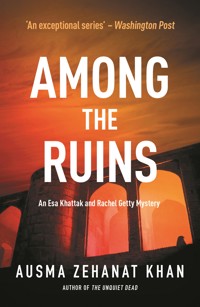
Esa Khattak wanted Justice. Now he just needs to stay alive. The murder of renowned political filmmaker, Zahra Sobhani, brings Esa Khattak's cultural holiday in Iran to a sudden halt. Dissidents are being silenced and Khattak's mere presence in Iran is a risk. Yet when asked to unofficially investigate the activist's death, he cannot resist. Soon, he finds himself embroiled in Iran's tumultuous politics and under surveillance by the government. When the trail leads back to Zahra's family in Canada, Khattak calls upon his partner, Detective Rachel Getty, for help. As Khattak gets caught up in the fate of Iran's political prisoners, Rachel sees through to the heart of the matter: Zahra's murder may not have been quite what it seemed. Steeped in suspense, Among the Ruins is a powerful, provocative mystery exploring the interplay of politics and religion, and the intensely personal ripple effects of one woman's murder.
Das E-Book können Sie in Legimi-Apps oder einer beliebigen App lesen, die das folgende Format unterstützen:
Veröffentlichungsjahr: 2018
Ähnliche









AMONG THE RUINS
Khan’s provocative third mystery featuring Esa Khattak: a powerful novel exploring the interplay between politics and religion, and the intensely personal ripple effects of one woman’s murder.
On leave from Canada’s Community Policing department, Esa Khattak is traveling in Iran, reconnecting with his cultural heritage and seeking peace in the country’s beautiful mosques and gardens. But Khattak’s supposed break from work is cut short when he’s approached by a Canadian government agent in Iran, asking him to look into the death of renowned Canadian-Iranian filmmaker Zahra Sobhani. Zahra was murdered at Iran’s notorious Evin prison, where she’d been seeking the release of a well-known political prisoner. Khattak quickly finds himself embroiled in Iran’s tumultuous politics and under surveillance by the regime, but when the trail leads back to Zahra’s family in Canada, Khattak calls on his partner, Detective Rachel Getty, for help.
Rachel uncovers a conspiracy linked to the Shah of Iran and the decades-old murders of a group of Iran’s most famous dissidents. Historic letters, a connection to the Royal Ontario Museum, and a smuggling operation on the Caspian Sea are just some of the threads Rachel and Khattak begin unraveling, while the list of suspects stretches from Tehran to Toronto. But as Khattak gets caught up in the fate of Iran’s political prisoners, Rachel sees through to the heart of the matter: Zahra’s murder may not have been a political crime at all.
ABOUT THE AUTHOR
© Athif Khan
Ausma Zehanat Khanholds a PhD in International Human Rights Law with a specialisation in military intervention and war crimes in the Balkans. She has practised immigration law and taught human rights law at Northwestern University and York University. Formerly, she served as Editor in Chief ofMuslim Girlmagazine, the first magazine to reflect the lives of young Muslim women. Her debut novel,The Unquiet Dead, won the Barry Award, the Arthur Ellis Award and the Romantic Times Reviewers Choice Award for Best First Novel. She is a long-time community activist and writer. Born in Britain, Ausma lived in Canada for many years before recently becoming an American citizen. She lives in Colorado with her husband.
ausmazehanatkhan.com | @noexitpress | @AusmaZehanat
PRAISE FORTHE LANGUAGE OF SECRETS
‘Thought-provoking, intelligent plot’ –Daily Mail
‘A superb follow-up to the first novel in the series, perfectly balancing lyrical prose with intense thriller pacing for a brilliantly-handled, must-read novel’ –Leanna,The Crime Review
‘Khan delivers an action-packed police procedural complemented by strong characters with believable motives’ –Associated Press
‘Exceptionally fine… A heartfelt novel for lovers of crime fiction and anyone interested in the complexities of living as a Muslim in the West today’ –Library Journal(starred review)
‘The Language of Secretsis as much an examination of the complicated social, political and religious aspects of the war against terrorism as it is a crime procedural’ –Carol Memmott,Washington Post
PRAISE FORTHE UNQUIET DEAD
‘The Unquiet Deadis a powerful and haunting story’ –Laura Wilson,The Guardian
‘Stunning, both for its beautiful writing and for the visceral brutality and terror of its subject matter,The Unquiet Deadreads more like fine literature than standard crime novel. This book is an experience, not just a novel, and deserves a close reading’ –The Crime Review
‘There’s much to admire in this well-plotted Canadian debut’ –Karen Robinson,Sunday Times Crime Club
‘Compelling and challenging, this is a beautifully written and powerful story of inhumanity and justice’ –Leigh Russell, bestselling author of the DI Geraldine Steel series
‘A powerful and absorbing debut novel’ –Peter Murphy, author of the Ben Schroeder series and former counsel at the ICTY
‘Compelling and hauntingly powerful… Anyone looking for an intensely memorable mystery should put this book at the top of their list’ –Library Journal
For the green birds of June.
Don’t give up, don’t give in – you are many.
For Nader, who hopes one day to return.
For my Iranian family, who share the dignity and beauty
of their culture with ceaseless generosity.
And for Sane, whose father asked us to remember.
May you and the others find justice and peace.
A Time Line of Modern Iran
1905–1911
After a promising beginning, Iran’s Constitutional Revolution is thwarted by Russian and British intrigue. With some democratic concessions, the Qajar Dynasty emerges as Iran’s preeminent power. The ideals of this democratic moment remain a reference point for democracy advocates in Iran throughout the twentieth century.
1925
Reza Khan, a military officer in Persia’s Cossack Brigade, names himself Shah of Persia after staging a coup against the Qajar Dynasty. His authoritarian rule is characterized by an ambitious campaign to modernize the country, similar to the secularizing and modernizing polices of Mustafa Kemal Ataturk in Turkey.
1935
Persia is officially renamed Iran. By the mid-1930s, political dissent against the Shah’s authoritarian policies begins to emerge.
1941
Reza Shah declares Iran a neutral power during the Second World War, but his refusal to break ties with Germany leads to his ousting by Allied forces. Russia and Britain jointly occupy Iran. Reza Shah’s son, Mohammad Reza Shah Pahlavi, succeeds to the throne. Parliament is allowed to function and civil society is revitalized. With the backing of the Great Powers, a brief period of political opening begins.
1951
Prime Minister Mohammad Mossadegh is democratically elected. Mossadegh attempts to nationalize the British-owned oil industry. He is removed from power by the Shah, but regains office through an outpouring of popular support. Mohammad Reza Shah exits Iran. Iran’s confrontation with Britain leads to an economic blockade.
1953
A CIA coup topples the Mossadegh government. Mohammad Reza Shah returns to Iran. A new pro-Western, modernizing authoritarian regime emerges. Iran’s second democratic opening of the twentieth century comes to an end.
1957
American and Israeli intelligence officers work with Mohammad Reza Shah to set up SAVAK, an Iranian intelligence organization later blamed for the torture and execution of thousands of political prisoners.
1963
The Shah implements ‘The White Revolution,’ an aggressive campaign of social and economic Westernization that is met with intense popular opposition. Popular religious nationalist Ayatollah Khomeini is arrested and sent into exile, in one of many crackdowns on the Shah of Iran’s opponents. By the late 1960s, the Shah relies regularly on SAVAK to quell political dissent.
1976
In one of a series of reforms that alienates a largely religious populace, the Shah replaces the Islamic calendar with an ‘imperial’ calendar, dated from the founding of the Persian Empire. The Shah’s close alliance with the West is buttressed by growing corruption, and together with widespread political repression undermines the legitimacy of his rule.
1978
Mass demonstrations and strikes erupt in response to the Shah’s rule. Martial law is imposed.
1979
January 16The Shah flees Iran amid intensifying unrest.
February 1Ayatollah Khomeini returns from his exile in France. He emerges as the leader of the revolution.
April 1After a national referendum, Iran declares itself an ‘Islamic Republic.’
November 4Students storm the U.S. Embassy in Tehran, taking fifty-two Americans hostage. They demand that the Shah return from the United States to face trial in Iran. Khomeini applauds their actions. A crisis is ignited between the United States and Iran.
1980
AprilThe United States and Iran sever diplomatic ties over the hostage crisis. The U.S. Embassy becomes a training ground for the Revolutionary Guards Corps.
JulyMohammad Reza Shah dies in exile in Egypt.
SeptemberIraq invades Iran. The eight-year war that follows claims more than a million lives on both sides.
1981
American hostages are released after 444 days of captivity. Supporters of Khomeini win the post-revolutionary power struggle, and take full control of the country.
1985
The United States covertly seeks to sell arms to Iran in exchange for the release of hostages held by Iran-backed militants in Lebanon, prompting the Iran-Contra scandal.
1988
Iran accepts United Nations Security Council Resolution 598, leading to a cease-fire in the Iran-Iraq War.
1989
FebruaryBritish author Salman Rushdie’s bookThe Satanic Versescauses uproar among fundamentalist Muslims, and Ayatollah Khomeini places a fatwa (religious edict) on the writer, calling his book ‘blasphemous against Islam.’ A three-million-dollar bounty is placed on Rushdie’s head.
JuneKhomeini dies. An elected body of senior clerics known as the Assembly of Experts chooses the outgoing president of the Islamic Republic, Ali Khamenei, to succeed Khomeini as Iran’s Supreme Leader.
AugustAli Akbar Hashemi-Rafsanjani, the speaker of the National Assembly, becomes president of Iran.
1993
Rafsanjani wins re-election.
1995
The United States imposes oil and trade sanctions on Iran, accusing Iran of sponsoring terrorism, committing human rights abuses, and seeking to sabotage the Arab-Israeli peace process.
1997
Political reformer, Mohammad Khatami, is elected to Iran’s presidency in a landslide victory. Khatami promises social and economic reforms.
2000
Pro-reform candidates and allies of President Khatami win 189 of the 290 seats in parliament, setting the stage for reformers to control the legislature for the first time since the Islamic Revolution of 1979.
2001
President Khatami wins re-election. Conservatives begin a crackdown on the Reform Movement through their control of the courts and the Revolutionary Guards Corps.
2002
In his January State of the Union speech, American President George W. Bush refers to Iran as part of an ‘axis of evil,’ accusing Iran of pursuing weapons of mass destruction. The speech is met with anger in Iran.
2003
Iran admits to plutonium production, but the International Atomic Energy Agency finds no evidence of the development of nuclear weapons. Iran agrees to rigorous U.N. inspections of nuclear facilities.
2004
Conservatives reclaim control of Iran’s parliament after controversial elections are boycotted by reformists. The new Iranian government declares its intention of restarting a nuclear program.
2005
Hardline mayor of Tehran, Mahmoud Ahmadinejad, campaigns as a champion of the poor and pledges to return to the values of the 1979 Revolution. He defeats one of Iran’s elder statesmen in the presidential election.
2007
The United States announces new economic sanctions targeted at Iran’s military and its disputed nuclear program.
2009
Iranian President Mahmoud Ahmadinejad is declared the landslide victor in presidential elections, sparking protests by supporters of reformist candidate Mir Hossein Mousavi, who was widely expected to win. The Green Movement is launched and protests rock Iran for the next six months. Severe repression and mass arrests crush the movement.
2010
Iran’s relationship with the international community deteriorates further over its nuclear program. Additional international sanctions are imposed.
2011
Fearing the spread of the Arab Spring, the Iranian regime places Green Movement leaders Mir Hossein Mousavi, Zahra Rahnavard, and Mehdi Karroubi under house arrest. The regime welcomes popular revolt in Bahrain, Egypt, and Tunisia but opposes it in Syria, where it backs Assad’s rule.
2013
Hassan Rouhani is elected on a reformist platform that promises to end Iran’s hostile relationship with the West. Nuclear negotiations between Iran and the P5+1 begin. Civil society restrictions are slightly eased.
2015
A nuclear agreement is reached. Sanctions against Iran are gradually lifted, but Iranian hardliners crack down on civil society. Iran’s Supreme Leader rejects diplomatic relations with the United States. Leaders of the Green Movement remain under house arrest.
Who killed these youngsters in their own country?
I wish they would answer.
Parvin Fahimi, mother of Sohrab Arabi
Killed June 15, 2009, age 19
1
Esfahan nesf-e jahan.
Esfahan is half the world. Wouldn’t you agree, Inspector Khattak? You’ve been in my city for weeks now, abandoning the urgency of Tehran for Esfahan’s twilight peace. Exploring its attractions, ambling along its boulevards, pausing to read in the gardens of Chahar Bagh. How many times have I seen you under the plane trees, a book in your hands, occasionally lifting your head into the wind? I thought you were reading in your own language, perhaps making a study of a tour book that would tell you about the secret passages behind the Grand Mosque, or the Shaking Minarets of Junban. But when I drew closer, I saw you had set yourself a more delicate task, taking your time to uncover the mysteries of the great Persian poets. But not Rumi for you, no. He’s too often misquoted by too many would-be Sufis. And if we’re honest with each other, as I hope we will always be, English translations are so utterly without grace, so empty of any meaning. I knew a man of your reputation could not be content with translations of Rumi, so I thought, perhaps Sadi or Hafiz? It is Hafiz who extends the invitation, after all:I lay my wings as a bridge.
Yes, Inspector Khattak, think of these letters as a bridge. Between my world and yours, between my thoughts and yours, between my suffering and your unattainable freedom. If you had a taste for irony, you would conclude we are bound up together, chained.
But you aren’t reading Hafiz either. You’ve brought your own book, you travel your own closed circuit. You carry the words of our exiles, a dangerous book to carry on your person – but so many books are dangerous inIran, so many paragraphs treason, these letters I write to you folly. Hide them for they will condemn us.
Don’t be frightened, Inspector Khattak. I can’t be anything but glad that you’ve come – come to take up my burden –
You will soon have a story to tell.
2
The small town of Varzaneh was a two-hour bus ride from the imperial capital of Esfahan. The bus wound through sand dunes along a rugged road, the early morning light describing the dunes in dust-pink whorls. Esa had been told to visit Varzaneh by Nasih, the proprietor of his guesthouse in Esfahan.
‘I see you in the teahouses or gardens all day,’ Nasih said. ‘You need a change of scene. There are places to visit nearby, but if you want to see something a little different, take the bus to Varzaneh, and visit the Salt Lake. You’ll like the pigeon towers, and you must walk along the Old Bridge. The people are friendly, though only a few may understand your Persian.’
Esa smiled.
‘Is my Farsi as unintelligible as that?’
‘You have an accent,’ Nasih said. ‘I can’t place it, but I like it. Go.’ And then surprising Khattak with his knowledge of the English proverb, ‘A change is as good as a rest.’
So Khattak had found himself on the first bus out of Esfahan, bumping along the eastern road to a town that seemed as if the desert had swallowed it up and spit it back out again, the dun-colored dwellings absorbed into the surrounding terrain. He had dutifully listened to the guide’s explanation of Varzaneh’s attractions: its history of Zoroastrianism, its faithful adherence to the middle Persian language, the craftsmanship of women skilled in weaving the traditional tablecloth of thesofreh.
‘You must go down to the river, you will see them laying thesofrehout.’
Khattak had visited the six-hundred-year-old Jame Masjid first, standing beneath the minaret the guide had boasted of, its sandcolored brick rising to a height of sixty-five feet, over the old town and dunes. At its summit, the diamond-patterned brickwork was interrupted by a pair of loudspeakers, out of place in this desert setting. Some distance from the spire, the blue dome made a modest statement, patterns of desert and sky echoed in the old mosque’s architecture and in the inlaid tilework of the blue mihrab.
Khattak paused to read the inscription surrounding the mihrab. Shah Rukh, the son of Tamerlane the conqueror, had captured Esfahan in 1417, inscribing his plea for heirs on the mihrab’s bluekashanitiles. When Esa finished reading, he noticed a screen of tiny, symmetrical crosses reflecting a pattern on the floor, the crosses picked out against a wash of light.
As he turned, two women in white chadors stepped over the pattern, the crosses mottling the fabric of their shawls. It was an arresting image – the blue mihrab, the sandy walls, the rose-gold crosses on a field of white. It took him a moment to realize the women had turned from the screen to face him, the dials of their faces framed by their shawls.
The woman on the left stared back at him, her dark eyes huge in a clear, young face. She was indescribably lovely with high arched brows and softly flushed cheeks, but he was struck most by an impression of sorrow.
She’s damaged, he thought. And just as quickly,I haven’t come here to solve anyone’s problems but my own.
He didn’t know what prompted the thought. The woman didn’t speak to him, didn’t ask for anything, but neither did she look away, as if the space between them was weighted with intangible desires. She was looking at him, he couldn’t be sure she was seeing him.
He transferred his gaze to her companion. She might have been in her twenties, though it was difficult to tell with the enveloping chador that left her face half-hidden. She smiled at him, her glance bold and inquisitive, her eyes and lips tilted up at the corners, a cast to her features that hinted at an impish nature. There was a beauty mark beside her left eyebrow, and underneath this a tiny sickle-shaped scar.
The call to the mid-day prayer sounded. He remembered his manners and glanced away, murmuring a greeting. The women murmured back, one reaching for the other’s hand. They disappeared down a narrow arcade, their figures diminishing under a succession of arches, elegant in their simplicity. He wasn’t thinking of the arches, or the light or the splendid mihrab.
He was left with the impression of dolorous eyes.
Later, in thechaikhanehteahouse across from the mosque, Esa drank tea from a gold-rimmed glass, a sugar cube between his teeth. He liked strong, milky chai, but he’d learned to adapt in the weeks he’d spent in Iran. He could hear the muted sound of the river rushing past, a gently throbbing loneliness. He felt the welling sweetness of the air against his face, and wanted nothing more than to relax into its embrace. But he knew why he’d followed Nasih’s advice and come to Varzaneh. He was seeking a distraction from the letter.
You will soon have a story to tell.
It read to him like a threat. He’d had a sense of being watched, the letter confirmed it. Someone was following him through the streets of Esfahan, someone who’d come close enough to read the title of the book he carried in his pocket. He’d felt the shadow of a watcher ever since he’d arrived in Esfahan three weeks ago. He’d assumed it was an official minder, sent to act as his detail by a member of the Iranian government, even though he’d applied for a tourist visa with his Pakistani passport, instead of his Canadian one. He’d claimed an interest in making a pilgrimage to various sites of worship, and paid for a tour visiting the cities of Mashhad, Qom, and Shiraz. Esfahan, the city of poets, philosophers, pilgrims, and kings, had been last on his list. He’d thought to reflect on his experiences in the city’s peaceful gardens, but the arrival of the letter had changed that.
Nasih had brought him a book on the Alborz Mountains, written in Farsi, the Persian language. Esa’s name was printed in a small, neat hand on the cover leaf. Pleased and surprised, he’d thanked Nasih for the gift.
‘No, no,’ Nasih said. ‘I found it on the doorstep when I went to the market. I don’t know who left it for you.’
Puzzled, Esa paged through the book in the privacy of the courtyard, stationed at his chair beneath the quince tree. When he’d opened the book, soft yellow rose petals had fallen out, along with the folded letter. Holding the letter to his face, he smelled the perfume of the roses. He wondered at first if the book with the rose petals was a gesture in some secret rite of courtship.
But when he read the letter, he knew it for a threat.
Whether from agents of the regime, or from a provocateur, the letter was intended to disrupt the peace he’d found in Esfahan’s early spring.
We are bound together, chained.
He didn’t want to be.
He hoped the letter was a prank of some kind, meant to scare him, or perhaps to startle him out of his lethargy. Though lethargy was an unusual change of pace.
The Drayton inquiry had come to a close after a protracted hearing, vindicating his choices about that desperate night on the Bluffs. The public outcry against the government had been so strong that in the end, the Minister of Justice had paraded Khattak before the cameras as a solution to his problems.
‘Yes, we didn’t act on information we had about Drayton, but look what Khattak did to set things right.’
Tom Paley’s missing file on Drayton had turned up as mysteriously as it had disappeared.
In its aftermath, he’d received a cryptic note from his former partner, Laine Stoicheva.
You’re welcome, Esa.
As soon as he’d gotten his visa, he’d left for Iran with a brief stop along the way.
He was still on administrative leave, awaiting a decision on the fate of his stewardship of Community Policing. He hadn’t seen Rachel in weeks, though he called and emailed her as often as he could. But every time they talked, they couldn’t bring themselves to discuss the outcome of the case that had resulted in his being placed on administrative leave.
He’d killed a man.
And though he’d sensed Rachel’s willingness to listen, he hadn’t wanted to revisit that night at Algonquin Park. Enough that it haunted his dreams, he didn’t need to bring the nightmare out into daylight to examine it. He wasn’t ready, though the weeks he’d spent in Esfahan, not thinking of that night in the woods, had helped.
Until the letter had arrived to disturb his sense of calm.
Because either the letter was a threat or it was a demand.
And he wasn’t prepared for either.
He crumpled the letter up, ready to drop it in a dustbin.
Sober second thought gave him pause.
These letters I write are folly. Hide them for they will condemn us.
There was a loose brick in the wall behind the quince tree.
He thought of burning the letter so it would leave no trace, but with a policeman’s instinct, he folded it into a fragment of itself, and placed it behind the brick with care.
Then he realized something else.
These letters I write are folly.
This was only the first.
As he sipped his tea, taking a slow pleasure in it, women in white chadors swept through the mosque’s courtyard and dispersed down to the Old Bridge, a sea of fluttering doves on the breeze. The image charmed him, the white veils unique to Varzaneh, a sight Nasih had urged him not to miss.
These poems now rise in great white flocks.
The letter had turned his thoughts to Hafiz.
He followed the progress of the women along the seven arches of the Old Bridge, the river below surging with browns and blues. At the first arch, two slender young women broke away from the flock. One of them waved to him, it was the woman with mischievous eyes. She blew him a kiss with full, pouting lips.
Mildly scandalized, Khattak looked around. No one had noticed the kiss. The young woman looped her arm through her friend’s, bringing her friend to Khattak’s notice.
It was the woman with sad, dark eyes.
Don’t, Khattak thought.Don’t come any closer.
He raised his tea glass and nodded his head, returning his attention to the mosque. His heart was beating unaccountably fast. He pretended to study the crumbling minaret of the mosque. If he looked toward the river, he knew the woman’s eyes would still be on him. He thought of rising quickly, paying his bill and returning to the station to catch an earlier bus. But he didn’t know why the thought of two young women should frighten him.
Again he had the sense of being watched, that prickling of his nerves. But apart from the mosque-goers who were headed to the river, no one else was in view.
His eyes scanned the mosque. He had exited from the door on the left, and walked along the alley at the rear to view the dome’s exterior profile. The chipped-away bands of ceramic glowed turquoise in the sun. Now huffing around the corner from the exit came a heavyset woman with a bright pink scarf that seemed destined to escape the collar of her smock.
It was a painter’s smock with several strategically placed pockets. She fished through the pockets, muttering to herself, discarding matchbooks, a cell phone, cigarettes. A prolonged search produced a piece of paper. She studied it, grimacing.
The hair bunched thickly on her forehead was a sandy blond touched with gray.
She looked up and met Khattak’s eyes, holding out the piece of paper. After a moment, she lifted her hand in a wave, her shoulders slumping in a gesture of relief.
Despite her haphazard attire, there was an air of officialdom about her.
She’d been searching for Khattak, and she’d found him.
His sojourn in Paradise was over.
3
The Sonata
No one says anything in the car. I know they’re Basiji, and I know we’re not headed to Evin. I turn my head to look out the window, one of the Basiji catches me. He cuffs my head with his fist. The violence is a shock, even after Evin. ‘Keep your head down,’ he says. ‘Where are you taking me?’ I ask. I’m ready for the blow this time, my arms up to protect my face. These men are frightening, but they aren’t much older than me. ‘Please,’ I say. ‘My family will want to know where I am.’ The Sonata turns south, away from the mountains. The driver grunts something over his shoulder. ‘Shahr Ray,’ he says. My stomach drops at the name. Sweat breaks out on my body, I lose control of my hands. My heart feels like a stone in my chest, I swallow, and I can’t speak.
I’m going to Kahrizak.
4
They walked along the Old Bridge together, enough of a distance between them as they walked to deny an association if they needed to. The woman hadn’t presented a business card or any other form of identification, and Khattak didn’t ask for one. He slowed his pace to accommodate her limp. She was overweight and favored her left knee as she walked. The piece of paper she’d held up to examine was a photograph of Khattak clipped from a Canadian newspaper.
‘My name is Helen Swan, but call me Touka, everyone does.’
She spoke in a distracted manner with the hand gestures to match, but her gray eyes were sharp and direct. They widened with appreciation as they ranged over Khattak’s face.
‘I’ve been touring Iran for a few weeks – mostly up north, at the sea. I love this country, I come back every year.’
He didn’t ask how she managed to obtain the visa. He suspected he didn’t want to know.
He was following the progress of the young women who’d crossed the bridge ahead of them. The ground below was covered with thesofrehthe weavers had left out to dry, geometric patterns that cut across the river’s banks in colorful, even patches.
‘Mostly, I buy souvenirs for resale – carpets, ceramics, even turquoise. But every now and again, I run errands on behalf of our government.’
Khattak didn’t know what to make of this. There was no formal relationship between the governments of Canada and Iran. Canada had closed its embassy in Iran in 2012, expelling Iranian diplomats from its own territory at the same time. There wasn’t even a pretense at consular relations between the countries. Aware of this, Khattak cut to the heart of the matter.
‘The Iranians must have a file on you, then.’
‘Perhaps.’ She made a harried gesture with her hands. ‘What does it matter? I’m in a position to do favors for certain people and to withhold favors from others, which makes me useful. Especially now there’s been an election in Canada. With the new government, who knows how things might change?’
Khattak suspected Touka Swan knew quite well if relations between Canada and Iran were about to change with the election of a new prime minister.
‘Ms. Swan –’
‘Touka,’ she interrupted. ‘You’re here on holiday, I understand that. And you were clever about getting your tourist visa, so you’ve managed to keep yourself out of the spotlight.’
It was Khattak’s turn to interrupt.
‘I’m on leave,’ he said. ‘I’ve no interest in whatever you’ve come to speak to me about.’
‘But you know Zahra Sobhani.’
Touka Swan came to a halt above one of the arches. She studied thesofrehspread out on the banks.
‘Maybe I should get into buying and sellingsofreh,’ she mused.
‘Ms. Swan –’
‘Inspector Khattak,’ she said firmly. ‘You are not at liberty to refuse your duty. It would be nothing for me to drop a word in the ears of the wrong people, and bring your visit to this country to an end. I don’t like making threats, but I expect you to hear me out.’
Khattak leaned against the railing. The women he was idly tracking had reached the far end of the bridge. They were talking to a serious young man with an air of grievance who was in the business of renting out tour bikes. Esa thought they would ride to the other side of the Zayanderud River and disappear from his view. Instead, they wheeled the bikes in his direction. The sad-eyed woman had exchanged her chador for a manteau and head scarf. As she rode past him, its tail whipped over her shoulders, the white cloth bordered by a band of swallows. It was whimsical and pretty, at odds with his impression of the woman’s magnetic eyes.
‘I know Zahra Sobhani by reputation only,’ he said at last. ‘We’ve never met.’
Sobhani was a well-known Canadian filmmaker. Her documentary on Iran’s 2009 election had swept the awards season, winning accolades for its originality, a story told without commentary or subtitles, the music written by Zahra’s son, the musician Max Najafi, acclaimed in his own right.
The documentary was calledA Requiem for Hope.Khattak had seen it at the Toronto International Film Festival, and had attended the discussion with mother and son that followed. Zahra Sobhani had struck him as a fiercely capable woman, bold and unafraid, burning with unresolved questions. Her son had spoken about his music. When pressed to comment on the politics of the film, Max Najafi had said simply, ‘Iranisthe music, that’s all I have to say.’
Khattak had been impressed by the somber mood of a young man gifted with exceptional talent, a man without the need for words. The next time he’d viewed the film, he’d understood a little better. The film was personal to Max, the music intimate, reflective – sorrowful.
It had penetrated Esa’s defenses, making him think of that dark night in the woods.
And other things he wished to forget.
A gun in his hand. The sound of a body thudding against the ice.
He felt its echo in Esfahan, so far away from home.
He looked at Touka Swan and knew she had come to tell him Zahra Sobhani was dead.
‘What happened?’ he asked quietly.
Not far from Varzaneh, seasonal birds invaded the Gavkhuni wetland. Though climate degradation had eroded their numbers, a few straggling pelicans dotted the banks of the river, their beaks bullet gray against turbulent flashes of green.
‘She insisted on returning to Iran. She was welcomed at the airport like a conquering hero –’
‘Like a daughter of Iran,’ Khattak interposed. It was a phrase he loved.
Touka Swan shot him a swift glance. She went on as if he hadn’t spoken.
‘She must have thought that made her safe. Or that no one in the government would take notice of her. You remember her documentary about the election?’
Khattak nodded.
The stolen election of June 2009 and its slogan,Where Is My Vote, had dominated international headlines for a time, the death of a young protester named Neda Agha Soltan captured on a cell phone to harrowing effect and sent around the world.
Elections were stringently conducted within Iran: candidates were required to receive the Guardian Council’s approval before they were granted permission to campaign. When widely supported reformist candidates had met these requirements, their subsequent, categorical loss was viewed by the public as electoral fraud.
Neda Agha Soltan and millions of others had poured into the streets to protest what they called the embezzlement of their votes: the regime had responded with violent repression, the mass arrest of protesters, and in some cases, its forces had meted out death.
‘Then you remember how the film ended,’ Touka continued.
‘Yes. There was a selection of photographs. An “In Memoriam” section for the students killed during the protests that followed the vote.’
‘It was also a memorial for the living. Zahra came back on behalf of the living.’
‘I find it strange that the government allowed her to return.’
‘She raised an international outcry, painting the Iranian regime in the worst possible light, when they were trying to sanitize their image. They must have weighed the risks of letting her return.’
A flock of starlings rose up from under the bridge. Khattak watched their wings beat against the sky before they spun away into the desert emptiness. To Khattak, the sky seemed cumbrous.
‘Wouldn’t she have realized it was still a risk?’
‘That’s why she didn’t allow her son to come. She intended to use her platform to demand the release of all of Evin’s political prisoners. She was planning to make a follow-up documentary.’
Khattak didn’t want to hear the rest. He had tremendous respect for Zahra Sobhani’s determination. Evin prison was notorious for its abuse of human rights, its state-sanctioned cruelties a well-known lexicon of torture.
The smallest act of personal defiance could gain an ordinary citizen months of discretionary detention without recourse to due process of the law. The interrogators, the wardens, the prosecutors, the judiciary, the Ministry of Intelligence and Security – these were arms of a long-churning machinery of repression.
‘I’m surprised the regime allowed her anywhere near Evin. Photography is forbidden at the prison, she must have known that.’
‘She didn’t ask anyone’s permission. She dodged her official minders. A few pictures leaked from her camera would have raised the profile of the prisoners held there. But I admit, I’m surprised she risked it. She normally proceeded through the appropriate channels.’
Khattak was beginning to understand why Touka Swan had sought him out.
‘If she was willing to take such a risk, she must have gone to see someone who mattered to her. Personally.’
‘Haven’t you been reading the news?’
Khattak waved away a man who approached him with the offer to rent a jeep to drive over the dunes. They exchanged pleasantries, the tour guide delighted to meet a visitor who was fluent in his language.
Touka Swan looked at him with interest.
‘You speak Farsi.’
‘My father taught me.’ She already knew this, he thought. He moved away from Touka, careful to look in the opposite direction. The tour guide’s friends were gathering behind them. ‘I don’t think we should be seen together. I don’t know who you represent, and I don’t want to find out. Whatever you’ve come to tell me about Zahra, you could be next. Or I could.’
Touka gave an inelegant snort.
‘Your profile isn’t high enough to worry the Ministry of Intelligence. All you’ve done is read a slightly subversive book.’
Khattak’s hand went to his breast pocket.
‘It’s foolish of you to carry it around with you.’
‘It was you?’ he asked. ‘You’ve been following me? Was it you who sent me the letter?’
He had a difficult time reconciling the dreamlike phrasing of the letter with the matter-of-fact woman beside him.
Touka scratched her head.
‘I’ve been keeping an eye out for you at the request of our government, but I don’t know what you’re referring to. The first rule of traveling in Iran is not to put anything in writing. I’ve come to you because our government is trying to – balance – its interests in Iran.’
‘I have no idea what you mean.’
She sighed deeply, reaching into her pocket for her cigarettes. Without asking Khattak if he minded, she lit a cigarette and expelled the smoke over the river. She coughed for several moments before speaking again.
‘One week ago, Zahra Sobhani was arrested for taking photographs at Evin prison. Two days ago, her body was delivered to her family’s doorstep in Tehran.’
The hollowness that had cut away at Khattak since that night in the woods now opened into a chasm. He felt himself clawing at the edges of it, a wetness behind his eyes.
‘They murdered her?’ he asked.
‘She was tortured, raped, and beaten to death.’
Touka stubbed out her cigarette, her knee buckling at the action. She gripped the deck of the bridge with her hands. They were powerful hands, the skin chafed and raw, the knuckles dark red. They looked like the hands of a fisherwoman.
His mind racing, Khattak said something he hated himself for saying. It laid his selfishness bare.
‘How does this concern me? She made a dangerous choice, she’s paid for it, there’s nothing I can do.’
‘We need a name,’ Touka said. ‘We need to know who’s responsible.’
Khattak shook his head. He couldn’t understand why.
‘It could be any one of the interrogators at the prison,’ he said. ‘A prison I have the sense to avoid.’
The noise of the crowd was growing behind them. Khattak felt a prickling at the back of his neck. He knew he should walk away without hearing anything else, take the next bus back to Esfahan, then to Tehran, pack up his things and leave. He knew nothing good waited for him in the streets of the capital or at the outskirts of Evin prison.
‘We think Barsam Radan is directly implicated. All we need is proof.’
Khattak knew the name, as did anyone who followed news of Iran. Radan was a senior official at the Ministry of Intelligence and Security. He frequently attended Evin to take part in the interrogation of political prisoners, a catch-all phrase for students, labor organizers, artists, intellectuals, and journalists. He’d reigned over the most ruthless period of repression in the history of the prison, with a special fire reserved for those who’d protested the stolen election.
The name Barsam meant ‘Great Fire.’ Prisoners in Evin’s infamous Ward 209 whispered to each other of his coming –the Great Fire is here to burn us down.
The tour guide approached Khattak again. This time Khattak made a lengthy request. The guide listened, his head cocked to one side. When Khattak finished, the guide waved to his friends. They departed as a group for thechaikhaneh.
When they were out of earshot, Khattak asked, ‘Why? What could that possibly gain you? The Iranian government rarely admits culpability in these cases. At most, they’ll hold a low-ranking interrogator to account. You won’t be able to get Radan. You know he’s much too powerful.’
He didn’t want to ask why the Canadian government would want such proof or what they intended to do with it. He could sense the shadowy presence of an intelligence agent behind Touka Swan’s façade.
Touka’s smile was tight.
‘That’s why we need him. Radan is an operator, he runs a network of spies and informants. He has a finger in every pie. If he’s implicated and we can prove it, that’s a significant blow to the entire apparatus. And it would protect dual citizens like Zahra.’ Sensing Khattak’s skepticism, she continued. ‘That’s not our primary focus. Our government has a problem on its hands. We’re on the brink of resuming diplomatic relations. The prime minister is planning to reopen our embassy in Tehran. And Canadian businesses have been waiting for the chance to invest. There’s a lot at stake here – politically, financially. But we won’t be able to do any of these things if we don’t demand accountability from Tehran. And not a low-level interrogator, as you suggested. Zahra’s son has managed to capture the attention of the press. He would never accept that as a solution.’
Khattak cut her off.
‘Would you, if it was someone you loved?’
‘There are other ways of seeking justice, Inspector Khattak. Didn’t you decide that in the Drayton case? I believe that’s what you said at the inquiry.’
Khattak looked at her quickly. How long had he been on Touka Swan’s radar? And just how thorough was her dossier on him?
‘Even if everything you say is true, how could I get you proof of Radan’s involvement? What kind of inquiries could I make? I have no authority here, and I certainly have no jurisdiction.’
At his words, Touka Swan relaxed a little. She must have sensed he was giving in.
‘Don’t worry about jurisdictional issues, you won’t be saying or doing anything in an official capacity. You speak Farsi, you’ll blend in, and you know how to be careful. We’ve heard a rumor there’s a video.’
Khattak was appalled. ‘Of the interrogation? Or the murder?’
He didn’t know which would be worse.
But Touka was shaking her head, ash-gray hair drifting into her eyes.
‘I don’t know. If I can locate it, I’ll want you to take a look at it. Someone will contact you if I can get my hands on it. If you have sources you can work in Canada, do so. Have your partner visit Max Najafi. It would help to track Zahra’s movements before she left for Iran.’
Khattak felt a quick lift of his spirits. He wouldn’t be alone. He knew he could ask anything of his partner, Rachel Getty, and she would be there to help.
With a small sigh of defeat, Khattak said, ‘I won’t go to Evin. I won’t put my family through what might happen to me there.’
‘You won’t need to,’ Touka said, assured now of her victory. ‘Zahra has a stepdaughter from her husband’s second marriage. Roxana Najafi is the prisoner she went to Evin to free. Roxana’s family is under house arrest in Esfahan. Start there and tell me what you find.’
When Khattak seemed to hesitate, she added, ‘I know your résumé better than you think. You’re on leave because of what happened in Algonquin. You’ve also had your share of difficulties with the press. If you deliver Radan, I can make that go away.’ She waited a beat. ‘And if you don’t, you might find your difficulties worsen.’
Khattak raised his head. He looked straight at Touka, holding her with his gaze.
‘If I did, that wouldn’t be the reason. If you’ve been keeping tabs on me, you should know that about me by now.’
The blush that rose to Touka’s face made her a little less formidable.
As she walked away without a word, her left leg dragging on the road, Khattak placed his hand over the spot where she had rested hers on the bridge, covering the card she’d left behind. A phone number was typed on its surface in black ink. And under this she had written in a minuscule hand,Yes, you are being followed.
The guide returned with his friends and a supply of bottled water, carrying several steaming paper bags.Lavashbread and kebabs, accompanied by small containers of a yogurt mixture calledmast-e khayar, along with grilled tomatoes and onions, a snack for an afternoon picnic.
He’d asked Fardis, the guide, to drive him to see the Salt Lake, a salt flat that spread out from the southwestern part of the wetlands, a striking contrast between hot blue sky and boundless earth. Fardis chatted on about this and the wonders of the Black Mountain, a magma formation that signaled the beginning of the wetlands. Much was being done to promote tourism in the region, to offset the drying up of the marsh and the extinction of wetland species. Fardis’s friends showed Esa photographs from their trips to visit the lake.
When they reached the lake, Esa witnessed its wonders for himself. A vast white plain, a heartbreaking sky, the salt gathered like shabby mounds of snow.
As he drank from the bottled water Fardis had poured into a glass, Khattak thought again,These poems rise in great white flocks.
The women in chadors, the flurries of salt foam, the rose-gold crosses on a dusty floor – what a stark and beautiful country this was.
Fardis quoted Hafiz with gentle pride.
Even after all this time the sun never says to the earth, you owe me.
A love like that lights the whole sky.
He wondered if the words expressed Zahra’s feeling for her country. Was it the reason she’d risked her safety to return to Iran, to fight for Roxana Najafi? Had she loved Roxana like a daughter of her own? So much so she couldn’t bear the thought of her broken and misused body? Had she risked a worse fate for herself in order to spare Roxana?
He shook his head at the stupidity of the regime, at its mindless and needless savagery. Left to herself, Zahra Sobhani would have raised her voice in support of Iran’s political prisoners. Obstructed by the petty tyrannies of the state, she would have returned to her home in Canada to be with her only child.
The murder and defilement of Zahra Sobhani would become an international incident, a diplomatic nightmare with long-lasting consequences. The voices of protest that had gone underground, the attention of the world’s media that had moved on to other tragedies would now return. The spotlight was back. The regime had created the very thing it wished to suppress.
And now Esa thought of the poet Rumi.
The wound is the place where the light enters you.
Staring out at the salt flat, he raised his glass to Zahra’s memory.
5
Everything I do violates a law.
I sing, I draw, I speak, I write – everything I do violates a law.
But what kind of law cleaves us like a sword?
What kind of law pounds us like a stone?
What kind of law hangs us from a crane?
They’ve killed our mother – the mother of all the children of Iran, her death a stone, a ripple in the pond, a crack in the wall, a crack in the regime – the place where the fortress is breached, a treasure among the ruins.
I slip through the crack to find you, borne along on a sea of light.
I have so many stories to tell you, but I find I have so little time.
Before the guards come, there is something you must do.
You must find out what Zahra wanted with the letters.
6
Khattak placed the second letter behind the brick in the courtyard. Nasih had brought it to him inside a tea cozy in a box addressed to Khattak. And he wondered whether Nasih was beginning to suspect there was more to these gifts than readily appeared. Why would Khattak, a stranger to Iran, be receiving gifts from someone he didn’t know? It would make anyone curious.
Though the second letter was a more dangerous possession than the first, Esa couldn’t bring himself to destroy it. The letter read as if it had been written by a prisoner at Evin, possibly Zahra’s stepdaughter – if any of what Touka Swan had told him was true, something he’d ask Rachel to verify.
As painful as the circumstances of Zahra’s death were, he found himself relieved to be shaking off the sense of lethargy that had immobilized him during his stay in Iran. There were two possibilities to consider. The first was that Touka Swan was not who she claimed to be and he was being set up for reasons unknown. The second possibility mirrored the first: the letters were sent not from any political prisoner or jailed activist, but rather by an agent of the Ministry of Intelligence, as a means of entrapment. And Nasih could be that agent, though Khattak found it hard to suspect him of anything more than an interest in Khattak’s well-being.
But the fact remained: Khattak was a high-ranking police officer, a status he’d kept to himself when he’d applied for his pilgrimage visa, so he could see the potential for trouble, perhaps even detention – he could be used as a bargaining chip. But he cautioned himself as well. He was an insignificant player in the larger scheme of things, he’d attended the pilgrimage sites faithfully and with vivid interest – and a Canadian officer of any stripe was not of the same value to the regime as an American.
It was possible Touka Swan was an emissary of the Canadian government. But that didn’t answer the question of the letters. He couldn’t envision a scenario where a prisoner inside Evin would have the freedom to write these letters, and arrange to have them sent to his lodgings. The letters indicated knowledge of his movements. By what means could a prisoner inside Tehran’s notorious prison have gained such knowledge?
The letters were a blind of some kind.
And what had the letter writer meant by telling him Zahra had been seeking the letters?
Were there more to come?
And if there were, how could Zahra have known about them?
It was circular logic that made little sense.
He realized if Rachel was able to confirm the basic facts of Zahra Sobhani’s death, the most sensible course to pursue would be to return to Tehran to speak with Zahra’s mother, and to arrange a viewing of the body, both of which were dangerous propositions. Perhaps that was why Touka had suggested he seek out Roxana’s family in Esfahan first.
He looked up at the sound of ice cubes clinking inside a glass. The spring weather was temperate, the trees coming into blossom, a wide variety that included willows, hackberries, walnut trees, and elms. And the Chahar Bagh gardens were famous for theirchinarplane trees.
Nasih was approaching him, a cold glass of juice on the tray before him. It was an inspired concoction of watermelon and lemonade, made with Shirazi lemons. He invited Nasih to join him beneath the quince tree, wanting to assess how the proprietor of the guesthouse might be connected to the letters.
‘Agha Nasih,’ he began, making use of the respectful form of address, ‘I don’t know who is bringing me these gifts. Did you happen to see anyone this time?’
Nasih nodded. His sunburned face was set in welcoming folds. His manner had become less formal in the weeks Khattak had spent in Esfahan, and he answered Khattak with warmth. And without, as far as Khattak could discern, a trace of deception. But that could be a cover, if Nasih was an agent of the Ministry of Intelligence, instead of just the host of his guesthouse.
‘It was a young man who left it at the desk. His name was Ali. He said a man paid him to bring you the box, he wasn’t told the man’s name.’
A request for a description met with little success. Ali was possibly in his twenties or early thirties, dark-eyed, dark-haired, smooth in manner.
And Ali as a name in Iran was as common as Jacob or Matthew in Canada.
Esa thanked Nasih, finished his drink, and decided to walk over to the gardens of Chahar Bagh to make his call to Rachel in private. The time difference wasn’t extreme, unless he needed to call her in the evenings, but he did wonder if it was possible that his phone calls were being monitored. The disturbing sensation of being watched had vanished. He didn’t recognize anyone in the park as someone he’d spotted before, or observe anyone lingering close enough under the trees to overhear his call.
Rachel’s voice was bright with welcome and tinged with surprise.
‘Sir, how are you? Have you been enjoying the break?’
They spent several minutes catching up – enough time to learn that his friend, the prosecutor Sehr Ghilzai, was doing well at her new job and seemed happy, a thought that gladdened him. He found himself thinking of Sehr more often these days, a fact that caught him by surprise. He asked after Nate and Audrey Clare, and about Rachel’s brother, Zachary. Neither of them mentioned Esa’s sister Rukshanda. Ruksh had asked her brother to leave the family home as soon as their mother had returned from Pakistan, and Esa hadn’t spoken to her since. It was a situation he needed to rectify, but he found himself needing time to reflect before he could begin to earn back his sister’s trust.
‘Can I do anything for you, sir? Send you anything?’
Esa’s response was careful. ‘I’d like to be kept up to date on the news if you don’t mind. There must be many developments I would find interesting, especially as I’m in Esfahan. Nate could probably give you a sense of what I’d like to hear.’ And before Rachel could ask for specifics, he hurried on, ‘Don’t use your personal account, be creative. And be aware that I may also call you from other numbers at odd times, depending on where I’m traveling.’
There was a long pause on the line. He could almost hear Rachel thinking, just as he could hear her munching something over the phone.
‘I can do that, sir. But you should come home. Now, without delay.’
So Rachel had heard about Zahra Sobhani’s murder. And she was as sharp as ever at putting the pieces together. She was warning him about the severity of the Canadian government’s reaction to Zahra’s death. A change in the wind had seemed possible with the lifting of sanctions against Iran and the election of a new prime minister in Canada; now relations between both governments would harden. Unless he was able to satisfy Touka Swan’s demands, demands that were beginning to seem more urgent.
‘There are a few remaining sights I’d like to see, visits I still have to make – but I don’t expect to be here much longer.’
AMONG THE RUINS
ABOUT THE AUTHOR
PRAISE FOR THE LANGUAGE OF SECRETS
A Time Line of Modern Iran
1
2
3
4
5
6
7
8
9
10
11
12
13
14
15
16
17
18
19
20
21
22
23
24
25
26
27
28
29
30
31
32
33
34
35
36
37
38
39
40
41
42
43
44
45
46
47
48
49
50
51
52
53
54
55
56
57
58
59
60
Author’s Note
Recommended Reading
Acknowledgments
Copyright




