


Erhalten Sie Zugang zu diesem und mehr als 300000 Büchern ab EUR 5,99 monatlich.
- Herausgeber: Bitter Lemon Press
- Kategorie: Abenteuer, Thriller, Horror
- Sprache: Englisch
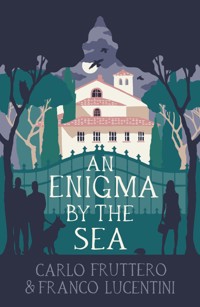
On the wintry Tuscan coast, the wealthy elite retreat to their lavish holiday homes. But the season turns sinister when a couple vanishes from a locked villa, and the body of a dubious count washes ashore, bludgeoned to death. With echoes of Agatha Christie and the erudite suspense of Umberto Eco, a sly meditation on class, illusion, and desire, this literary mystery is both sharply observant and darkly entertaining.
Sie lesen das E-Book in den Legimi-Apps auf:
Seitenzahl: 591
Veröffentlichungsjahr: 2026
Das E-Book (TTS) können Sie hören im Abo „Legimi Premium” in Legimi-Apps auf:
Ähnliche

















1
2
3
AN ENIGMABY THE SEA
Carlo Fruttero and Franco Lucentini
Translated by Gregory Dowling
4
5
CONTENTS
I
A Certain Air of Secrecy
1
A certain air of secrecy hangs over it, which is in part due to the very nature of the place, and in part to its acquired, artificial characteristics.
The rotating stands that the stationery shops, the tobacconists’ and the bijouterie stalls put out in summer, for example, only ever have one postcard, the same for years now, showing the pine forest. And since the photographer, in order to give an overall view, resorted to a long aerial shot, all that can be seen is a broad, unbroken band of green alongside the sea. ‘Pineta della Gualdana’, it reads on the back, with German, English and French translations.
It looks like a stretch of Tyrrhenian coastline that has somehow remained unspoilt, and thus merits being sent to friends and relatives in far-off lands. But beneath that seamless stratum of interweaving tresses things are very different.
For instance, a Danish tourist, on his way down from Pisa or Volterra, may feel sudden relief on seeing the asphalt darken beneath the coolness of the great green sun-screens, and after a mile or so, he may be attracted by a recess, an unostentatious opening amid the trunks on his right. There are no signs or notices, and the prospect of breaking his journey by entering it and maybe finding his way to the beach for a 8quick dip in the Mediterranean will strike him as irresistible. He will brake brusquely, turn into the beckoning alley, chug his camper up a slope for a few dozen yards: but beyond the slight mound – actually a dune – are two red and white bars that block the way, and an unostentatious stone building, of one storey, where guards in khaki uniforms control the access to the pine forest.
One of them, Vannucci, perhaps (a tough, gnarled man in his sixties), will wave one hand in an oscillatory gesture, with the index finger raised prohibitively, and the Scandinavian will thus understand that he is to back off again, with his skin-peeled, disappointed family. Laboriously manoeuvring the camper around the triangular flower bed which acts as a bollard, he may see the entrance barrier admit Ciacci (the electrician) in his grey van or the exit barrier rise to emit Grechi (the plumber) in his blue van; he may have time to note, for example, Signor Zeme’s white Volvo emerging ponderously from an internal path, or the distant shape of Signor Mongelli cycling forwards to get his newspaper (Vannuccini will come out and hand it to him, a guard with no resemblance whatsoever to Vannucci: tall, large, fair-haired, young).*
But in essence, the only thing that is clear at the guards’ lodge is that the pine forest is private property. Even the wire netting that encloses it on three sides (the fourth opening on to the long beach) is difficult to spot, since it is set back and is now hidden by sprawling masses of pittosporums, arbutus, junipers, sorghums and laurels.
9The thick scrub, partly arranged in intentional hedges and partly flourishing in spontaneous clusters, almost wholly conceals the hundred and fifty ‘villas’ that the fencing discreetly protects from outsiders.
Barely visible and rarely seen, the pine forest is perceived by those who do know of its existence in a variety of ways, as numerous as its birds, insects, shrubs, as the shades of its colours according to the hour and the season. For the various branches of the public administration (the land-registry office, the Tuscan regional authorities, the town council, the inland revenue, etc.), it is simply a residential estate. But take Signor Monforti now (a Milanese ex-businessman who dabbles, or rather dabbled, in the hobby of local history): he is particularly interested in its past vicissitudes, starting with the Medicean statutes where it is first mentioned (1585), and he is still seeking, albeit wearily, listlessly, for some documentary evidence of the raids (this was, for Dante, the meaning of the word gualdana) from which its name is supposed to derive.
For the local emergency services, it is a potential hazard, where a fire can break out at any moment in summer. For Ciacci, Grechi and the handymen and shopkeepers of the nearby village, it is a considerable source of income. For Vannucci, Vannuccini and the other eight guards, it is a secure and undemanding job, except for the period from June to September, when the inhabitants of the hundred and fifty (153, to be precise) residential units are all – or almost all – bustlingly present, with children, guests, foreign domestic staff, cars and surfboards.
There is a moderate flow of visitors at Christmas and Easter, but for the rest of the year the sun sets on a dark and deserted wood. The 153 villas, all lying low and flat in the thick scrub, are mostly empty, overrun by desperate spiders, rats, millipedes, 10lizards and even grass-snakes, whose fragile mummies will be found months later in a shower or a corner of the basement.
There are some exceptions: for example Signor Lotti, an ex-jeweller from Florence, who lives here on his own the whole year round, does not like to speak to anyone and wanders the avenues at night on a bicycle, preceded and followed by his four Irish setters, which he commands with a whistle inaudible to the human ear. There is Hans Ludwig Kruysen, the great harpsichordist and organist, who still gives an occasional concert but now spends most of the year with his devoted lady companion in the Gualdana. And by contrast there is the beautiful Signora Neri, abandoned here with her two children by her husband who now lives in Toronto with Signor Mongelli’s ex-wife. And there is also old Signora Borst, from Zurich, with her old friend Eladia, from Lugano.
For these and a few other permanent residents, the pine forest is not an ephemeral, sunlit place where they spend their summer holidays, but a refuge, a hiding place secluded from the world, though well furnished with all worldly conveniences. And it was the Gualdana’s certain air of secrecy that drew them here, for various reasons – the various wounds and hopes of life; and now they themselves help to accentuate that secrecy, with their scattered dots of light peeping from the black backdrop of the winter undergrowth.
This evening for example – it is dusk on a December day – the wind that began to stir at sunset continues to send a plaintive wail down the chimneys, a kind of repeated summons heard indistinctly at odd times and in odd places, and which finally becomes distinguishable as the syllables: ‘… o-liiin!’ or perhaps ‘… a-riiin!’ A foreign name, it would seem, and probably female.
11There are some who pay no attention and continue to read in their wicker armchairs, to arrange Tarot cards on a table, to battle with a stain on a sofa-cover. Others peer out of their doors, opening new yellow rectangles in the now definitive darkness of the pine forest.
‘… a-riiin!’ invokes the voice, faint but closer, carried away by the wind. ‘… o-liiin!’
Perhaps a cat, or a pedigree dog that has not returned home.
‘It’ll be some idiotic babysitter who’s lost a child,’ says Signor Monforti, the owner of lot no. 39 and the villa built thereon.
He speaks wearily and indifferently, continuing to watch, if indeed he was watching it, an old episode of the PerryMason series that a local station broadcasts at this hour.
His two guests – his sister Sandra and his brother-in-law Ettore, who have come to spend their Christmas holidays here – are agitated by this hypothesis.
‘No, really? Then you’d better phone, let’s call the guards, let’s go and see.’
Perry Mason is phoning too: 75,000 dollars are missing from a safe.
‘It’s not worth it,’ says Monforti. ‘There’ll be hundreds of people getting in the way, they’ll have called the Carabinieri by now.’
The Carabinieri have already arrived in fact, and they are trying to make a militarily manageable picture out of the impossible tangle of shifting shadows that the pine forest presents to their torches in this north wind. The two longer sides of this irregular trapezium of about 2 miles by 700 yards border respectively on Highway 249 and the sea. An internal network of asphalted path runs lengthwise in the shape of a rough and shaky trident, whose prongs are crossed by five winding minor roads. Another non-asphalted coastal path tortuously follows 12the dunes along the shore between two low protective hedges of straggling sorghum. In the hedge on the beach side small openings provide access to the residents’ shelters and beach huts, all made of cane, instead of the more common but aesthetically unpleasing cabins and umbrellas.
At around five p.m., in the vicinity of one of these openings, Signora Barbara Graham, of English nationality, had spotted an empty cigarette packet (Philip Morris, the low-tar kind) that had been thrown into the bushes despite the various notices and receptacles which, at regular intervals, remind visitors to keep the forest and the beach clean.
As her son Colin, who was accompanying her on her walk, had sat down for the purpose of filling his bucket with sand, Signora Graham took it upon herself to collect the litter and then made her way to the nearest receptacle to deposit it. When she returned, she found the bucket still where she had left it, but of her son, a child of some twenty months, there was no trace.
2
The Carabinieri’s small car is parked at the exact spot where the disappearance was first noted and it completely and unnaturally obstructs the path along the dunes. Everything combines to make it look smaller, despite its blazing headlamps and its blue light whirling doggedly away on the roof. Swept clean by the icy gusts of the north wind, the sky bears down with all its brilliant stars on the innumerable pines of the approximately 2 miles by 700 yards of the Gualdana. Marshal Butti knows, from information furnished by his colleagues of the GuardiaForestale, that the pines are not in fact innumerable at all; but the statistics none the less speak of 18,300 trunks, varying in 13age from ten to a hundred and fifty years, without counting aleppo pines, ilexes, cork trees, mimosas, laurels and other trees of average girth, which have grown spontaneously or been planted by the residents. And beneath them, the dense, bristling, humpbacked expanse of scrub.
How can they begin to look for, let alone find, a twenty-month-old child here? The mother, fortunately, is not in a state of shock; she is not crying or screaming. (But – reflects the Marshal – had she been an anxious Mediterranean mother, she would never have let a child of that age out of her sight for even an instant!) She is a tall, washed-out blonde, who answers every question concisely, in good Italian.
How long was the child left alone? No more than a minute, two at the most. What did the lady do then? She started to call him, running up and down a stretch of the coastal path; she went to see if he was on the beach; she went back to the road; she called him again and looked for him; finally she ran home to alert her husband.
The husband is distraught. All his shouting into the wind has left him voiceless, but he cannot desist from uttering his tender invocation which he now repeats softly among the bushes: ‘Colin … Colin … Colin …’
His idea is that the boy has not gone far, but is huddled up somewhere, trembling with cold and terrified by the night. He rules out another idea implicitly put forward by the Marshal, who has asked whether the Signora saw anyone in the area before the disappearance. A kidnapping? But they’ve hardly been to the place before! They only got here this morning! What band of kidnappers could have had the time or means to organise the crime?
And in fact the Grahams – who bought villa no. 97 last March from a dentist in Turin, whose wife found the place deadly 14dull – know and are known by hardly anyone in the Gualdana. The only people they had informed of their impending arrival were Dalmiero (the only taxi driver in the village, who picked them up from Pisa airport at midday) and Vannuccini and his wife Ivella, who turned the heating on and cleaned the house for them yesterday.
‘Colin …’ the father starts calling again, in a persuasive, playful tone, as if he were looking for the boy among the armchairs in the living room, rather than among the hostile, thorny bushes, ‘Colin … Colin …’
Shadowy figures come towards the parked Fiat Uno in straggling clusters, with torches in their hands and collars turned up against the ever-sharper cold.
‘He could have got into a hut,’ says one male figure. ‘We ought to check them all, systematically.’
The adverb sounds like a reproach to the Marshal, who is doing nothing systematic at all because he has another, even more important adverb in his mind: rapidly. Out of consideration for the parents nobody says aloud what is quite clear to everyone.
‘Tomorrow they’ll find him frozen to death,’ mumbles Monforti in a low voice.
‘Come on, don’t say such things,’ protests his sister Sandra, shivering.
‘It’ll drop below zero tonight, if it hasn’t already,’ insists her brother lugubriously.
The fact is that Colin (described by Vannuccini as ‘robust’) is wearing shorts and a denim jacket, because the weather had been deceptively mild before the north wind started up. He must therefore be found as soon as possible. But the Marshal knows from experience in Sardinia that to comb this sort of ground properly and within a reasonable space of 15time, not even thirty men would suffice, whereas he has just three.
The system-lover, whom Monforti recognises as Signor Zeme with a large cap pulled down over his eyes, offers a new suggestion: ‘What we need are dogs, let’s ask Signor Lotti if his dogs …’
Another cloaked form speaks up curtly from the darkness. It is Signor Lotti.
‘Mine are hunting dogs. You’d need properly trained ones here.’
The Marshal, who has already discussed the matter with headquarters at Grosseto over the radio, says with equal curtness: ‘I’ve asked, but there aren’t any at Grosseto, there are just the GuardiadiFinanzaones, for drugs. They’re sending over the police dogs from Florence, they’ll be here in a couple of hours.’
Monforti shrugs and murmurs darkly to his brother-in-law: ‘Oh sure, police dogs! What could they possibly sniff out, in this wind?’
They all look at their watches. It is 6.50 p.m. And although there is now this concrete hope of having the dogs, the idea of standing there doing nothing (and without knowing what to say to Colin’s parents) seems unbearable to everyone. Signor Zeme therefore returns to his proposal of searching the huts from one end of the beach to the other.
‘We could form two teams,’ he says. ‘One towards Poggiomozzo and the other towards the Capriola.’
These are two small rocky promontories, to the north and south, which geographically enclose this stretch of coast. But complications and points of detail arise at once.
‘But there’s the Old Ditch,’ Signor Mongelli points out. ‘So one team ought to set out from the border of the campsite 16and move this way, while the other one moves in the opposite direction, towards Rome, while a third …’
‘Rome?’ asks Signora Graham, clutching at the only name she recognises amidst these as yet mysterious toponyms.
‘Southwards,’ says Signor Zeme. ‘That way.’
His arm waves upwards to remote stars and then drops as if forced by the wind. Even angrier gusts scatter new objections and counter-proposals, distort the explanations being given to those who continue to turn up out of the darkness. There is now a sizeable crowd around the Carabinieri’s car, and an animated buzz of voices.
‘Colin …’ Signor Graham starts up again, sweeping his torchlight over junipers and rosemaries, while the Sergeant and the two Corporals do the same, but over a wider range and with less inadequate lamps.
As for the Marshal, he stands in silence by the half-open car door, from which there emerges the intimate crackle of the radio. He does not like this inactivity, but neither does he like taking hasty initiatives, ‘just for the sake of it’, and a search, even if restricted to the huts and the beach, would not be a simple job.
It is quite true that one of the various difficulties to be considered is the Old Ditch, a canal with brickwork banks, five metres wide, which the hydraulic engineers of Grand Duke Leopold II of Tuscany built in the last century as a drainage system against floods. This canal, crossed by a bridge known – aptly enough – as ‘the Grand Duke’s’, cuts the Gualdana diagonally from north-east to south-west and flows into the sea between two breakwater barriers formed of large boulders and concrete blocks.
An efficient and rapid search, therefore, would require four teams: two moving from the mouth of the canal in opposite directions; and two coming towards them from the opposite 17borders, after an exploration of the two adjacent stretches of free beach. Beyond the borders, in fact, the child might have roamed northwards as far as Poggiomozzo (where in summer there is a noisy and much-detested campsite), and southwards as far as the Capriola …
Too much overlapping, too many reference points, for amateur searchers who continue to fill the darkness with suggestions that are not only confused but also muffled by mouth-protecting woollen scarves. But even if the shadowy figure with the loudest and most resolute voice (Signor Zeme) were to succeed in taking charge of the situation and were to impose a satisfactory plan of action, he would find himself up against a further series of impediments that Marshal Butti refrains from pointing out to him.
Along the two miles of ‘private’ beach, there are in theory fifty-one huts to search. In fact, seven of them were unroofed and half-destroyed by the violent gale at the end of October, while four others, closer to the sea, were swept away by the breakers. There are thus forty huts where the child could be sheltering. Each hut is circular in form and divided into three sections; each section is numbered and corresponds to one of the 153 lots on which the 153 ‘villas’ stand (apart from exceptions, contraventions, prerogatives and misappropriations which are not, however, relevant to the search). The door of each section consists of a cane wing that usually closes with a simple iron hook; but at least a third of the residents have an excessive sense of property and prefer to adopt a padlock, a rusty and precarious contraption to which is entrusted the task of conserving battered deckchairs, buckets and deflated mattresses throughout the winter.
Little Colin, if he has indeed sought refuge or shelter in a hut, is most likely to have chosen one of the sections with a 18door that had either been left open or had got torn off by the gale; but it is equally possible that, finding the sections closed and being unable, on account of his size, to reach the hooks or padlocks, he simply slipped underthe door, between the frayed canes and the sand.
Consequently the search cannot be restricted to the sections with doors that are either open or can be opened by lifting the hook, but must also include the interiors of the padlocked ones. What will the volunteers’ response be, when faced with this obstacle? Will they decide simply to sidestep it, thus rendering the result of the operation entirely haphazard? Or will they take it upon themselves to force the locks, to cut the chains?
The boot of the Uno contains, among other tools, some efficient wire-clippers, but the Marshal has no desire at all to hand them over to the searchers. A bathing hut by the sea is undoubtedly a different matter from a house, but breaking and entering is bound to contravene some regulation, law, or article of the Penal Code. It is true that chains and padlocks can subsequently be replaced. But at whose expense? The Grahams’? The estate’s? Someone might even try to involve the Carabinieri; the residents include several lawyers (some of them highly influential) and foreigners (some of them very important), two highly susceptible categories, much given to quibbles and complaints.
Thus Marshal Butti does not intervene in the discussion and waits in silence for his dogs under the innumerable stars. He overhears, and in his heart commends, the remark of a well-muffled shadowy shape who makes as if to leave the group.
‘I’m off, we’re doing no good here. We’re just getting in the way.’
Monforti’s murmured announcement was intended for his sister Sandra, but the hooded sheepskin coat standing by 19his side, though almost identical, does not contain the sister in question.
‘Ah, you’re here too,’ says the woman within it.
It is the beautiful Signora Neri, who has hurried here with her thirteen-year-old son to assist in the search.
‘I should have stayed in and watched PerryMason,’ Monforti confides to her in a cynical whisper.
‘No, come on, we can help surely. Look, come with me, we’ll make a team, the two of us.’
She takes him by the arm, guides him through the opening in the sorghum hedge and goes down through the dunes to the nearest hut. She is carrying a torch, which she plays diligently over each of the three sections (nos 82, 83, 84), restoring momentary life to a flabby yellow ball, two folding chairs that rust has rendered unfolding, a gap-toothed rake, a broken mirror.
‘Colin … Colin …’ she starts to call in a low voice.
Her companion gives a snort of impatience. ‘What’s the point of calling? God only knows what’s happened to him, poor thing.’
‘Gabriele, don’t!’
A sudden gust of wind drives her hood back on to her shoulders and her gently glowing face appears set against the coruscating myriads of the sky.
‘You’re a marvel of creation,’ sighs Monforti. ‘That’s the worst of my troubles.’
‘Oh come now!’
She precedes him towards the neatly aligned (and numbered) cane shelters that lie at the end of the dunes and the border of the property. And in fact a board nailed to a post between two wild azalea bushes reads ‘Private Property’. At that point the beach proper begins, sloping smoothly and uniformly downwards for about fifty yards.
20‘I reckon he’s drowned. Dragged away by the undertow.’
‘Listen, Gabriele …’ begins Signora Neri.
But a violent gust attacks her almost purposefully, tearing the exasperation from her voice, so that she starts again in a patient, reasoning manner: ‘Wait, just look at the sea: with this wind from inland, it’s not even stirring.’
And in fact the sea appears above suspicion; it is perfectly calm, the voice of the surge is patient and reasonable as it withdraws and returns, deposits and reabsorbs its threadlike margin of foam. But that innocent air, of one that would never dream of snatching and engulfing a twenty-month-old English child, does not convince Monforti.
‘A freak wave,’ he insinuates.
‘Freak wave, my foot! We’re not in Australia!’
‘You never know.’
‘Gabriele, you may enjoy this …’
‘Enjoy it?’ he suddenly shouts, throwing his arms wide under the starry universe. ‘I’m not enjoying myself, OK? I’m not enjoying myself!’
‘OK, you’re not enjoying yourself, sorry,’ she says with resignation.
Monforti trips over an empty petrol can, one of the many bits of jetsam that the sea has abandoned on the beach during autumn, and kicks it across the sand.
‘This beach gets dirtier by the day.’
‘They’ll be cleaning it up tomorrow, or before Christmas anyway; Vannucci told me so this morning.’
‘Oh yes,’ Monforti says, with obscure sarcasm, ‘Vannucci!’
They move a few more yards in the direction of Capriola, Rome, the South in general, and are about to walk around a huge tree trunk lying slantwise across the beach when the trunk suddenly gives voice.
21‘Good evening,’ one of its gnarled bumps says amiably, rising to its feet.
It takes them a second or two to realise that it is Signorina Eladia, Signora Borst’s friend from the Ticino.
‘It’s no use looking in the forest,’ says Eladia, nodding towards the faint blue flashes of the Uno and the little dots of light flickering in the black weft of the undergrowth. ‘Colin must be here, near the sea.’
‘Have you seen him on the beach?’ asks Signora Neri.
‘No, it was this morning, in the cards: I saw water, a lot of water …’ explains the Signorina, with a wide gesture towards the Tyrrhenian Sea. ‘And two figures, a large and a smaller one, who came through the shadows.’
‘But that’s us!’ Monforti laughs improperly, receiving a sharp dig in the ribs from Signora Neri.
An unnecessary dig, since Eladia maintains a humbly, sweetly unswerving faith in her Tarot cards, remaining deaf to all scepticism, superior to all irony.
‘No, I don’t think so,’ she says seriously. ‘These two came from the other direction, and there was also a very negative sign, one of great danger. And in fact …’
All the possible combinations of the pack mirror for her the infinite combinations of life; indeed, over the years, the roles have been reversed: real life is played out there, among symbolic Kings of Wands and Knights of Coins, while the world holds no interest for her, other than as a dull confirmation, an inevitable adjustment to the pre-announced truths of the Tarot cards.
‘Let’s hope for the best,’ says Signora Neri, looking at the star-crowded sky, as if portentous signs could be expected from there too. ‘Do you know these Grahams? Have they got any other children?’
22‘I only met them once, two months ago, when they came to see about the furniture,’ says Eladia. ‘But I think they’ve just got the one boy.’
She squats back down on the trunk – or rather, minuscule as she is in her black fur coat, she is reabsorbed by it, becoming a confused whorl between two thick, upward-stretching branches.
Signora Neri pulls her hood around her head and holds it tight with one gloved hand. ‘It would be terrible,’ she says, ‘poor woman.’
‘Poor silly woman,’ says Monforti. ‘Have you ever heard of anyone losing a child like that? For a packet of cigarettes – an empty one, what’s more.’
‘It could happen to anyone,’ says Signora Neri.
‘Has it happened to you?’
Signora Neri has a son of thirteen and a daughter of twelve.
‘What’s that got to do with it? Anyway it was a very civilised gesture.’
‘All too easy,’ replies Monforti, ‘to bask in the illusion that this is a civilised place.’
‘Well …’ says Signora Neri.
But then she falls silent and listens.
The wind persists with its decidedly uncivil gusts, shaking and flexing the trees closest to the beach, which have been reduced by years of barbaric weather to stiff, monstrous, inimical shapes. The pine forest offers a hostilely low profile, like a threatening brow, and above it the sky is an abyss. From its great lair, the sea laps with the meekness of a beast poised to pounce.
Surrounded by these immemorial forces of the Tyrrhenian coast, Natalia Neri is seized with an acute sense of precariousness; she suddenly finds herself doubting the solid reality of the 153 villas, of the fencing, of the road network, of the ten guards, of the regulated estate in which she ordinarily believes. 23Where are my children? she wonders in sudden alarm. Andrea has joined the others in looking for the child. Giudi is at home with a cold, watching an old episode of PerryMason(75,000 dollars were missing from a safe).
‘I remember when there used to be boars,’ says the obscure whorl on the trunk. ‘They would come down the Old Ditch to get away from the hunters, and eat the pine kernels.’
Signora Borst’s villa (lot no.126, in the front row nearest the sea) was one of the first to be built, which is why it is now one of those most in need of restoration.
‘One night Signor Lopez, our neighbour, heard some strange noises in front of his house and went out to see. He came down all the way to the beach, more or less where we are now. There was no moon, just like now, and he saw what he thought was a huge dog growling. He wasn’t afraid of dogs, he always made friends with them at once, so he went towards it, started talking to it, and suddenly it charged him, knocking him right over. It was a boar, wounded and raging. When we heard the yells we came running down and found Lopez disembowelled on the sand. There was nothing we could do for him, poor chap.’
‘My God,’ says Signora Neri in horror, ‘did you know that, Gabriele?’
‘Sure,’ says Monforti. ‘And there are other stories, if you’re interested.’
‘About boars?’
‘No, after the fiftieth or sixtieth villa the boars stopped coming. They’re extremely shy beasts and there were too many building sites here, too many cars, too much noise. But there was the fire seven … no, eight years ago – anyway before you arrived.’
‘I foretold the fire,’ recalls Eladia, not at all boastfully. ‘The cards spoke quite clearly. And we were all ready, we’d put our 24money and documents in a bag the day before, and we had our bicycles ready.’
‘Mamma mia,’ says Signora Neri, ‘this place is a …’
‘Sssh,’ says Eladia. She has risen from the trunk again and is gazing into the distance, southwards, where the vague pallor of the sand dies into the dark.
‘Here you are, they’re coming,’ she announces without emotion.
‘Who?’
‘I don’t know. Let’s signal to them.’
Nervous and also hampered by her gloves, Signora Neri has trouble in turning on her nickel-plated torch, which she finally waves over her head, even though she can still make out nothing on the beach. The north wind has not only accentuated the teeming bustle of the firmament, but has falsified distances even along this modest stretch of the earth’s crust, intensifying and thus bringing closer the lights scattered along the promontory of the Capriola (there are a few houses up there too). But from that vivid cluster a little dot now detaches itself, becomes more distinct. It is actually much lower, as well as much closer. And it is moving, it has already left the free beach and is some way along the ‘private’ one, it is within shouting distance, one can run towards it yelling and stumbling on the sand, it is a shadow, a human figure, a large figure with a smaller figure on its shoulders, it is the guard Vannucci who has found little Colin.
3
Understandably, after poor Signor Lopez’s disembowelling by the boar, his widow wanted nothing more to do with the Gualdana; the villa thus passed on to a textile industrialist from 25Prato, and two years ago, when he went bankrupt, it was bought by Signor Zeme. And it is he now who invites everyone along, to lot no.122, first row by the sea, since, as he points out, it is within a stone’s throw.
Almost everyone thinks this an excellent idea, both because whisky, vodka, etc. seem highly desirable after this long exposure to the freezing wind, and because the occasion is a festive one, the adventure has ended happily, and some kind of celebration seems called for. Colin’s parents (the child sits in his mother’s arms, looking full of beans and highly pleased with his enterprise) seem in no hurry to go back home; the Carabinieri themselves who, in the meantime, have used their car horns to summon all the scattered searchers and have sent a radio message to the van with the dogs (which had already reached Monteriggioni), do not reject the offer. Vannucci, the hero of the evening, naturally asks for nothing better than to recount the various phases of his search and happy discovery all over again. And Monforti’s reluctance is finally overcome by the joined forces of his sister Sandra and his brother-in-law Ettore, with the rather less enthusiastic participation of beautiful Signora Neri.
The Uno is left sitting there with the Sergeant inside, irradiating its blue toy-like flashes, and everybody else follows the coast path for a few yards, turns into a narrow path on the right and thus reaches a wide, paved terrace.
Like almost every other villa in the Gualdana, this too is constructed essentially of a few brickwork joints that serve to hold together spectacular glass walls, on the principle that the inhabitants must feel themselves immersed in the vegetation wherever they are in the building. A principle that is much appreciated (as Marshal Butti well knows) by the summer thieves, who slip into the pine forest from the beach and never 26fail to find some spectacular window left carelessly open, thus greatly facilitating the removal of video cameras, money, silverware, sometimes jewellery.
The sliding shutters and the curtains of this particular wall are open and give a full view of the Zeme living room, a wide rectangle of blue ceramics and white plaster, which has been furnished either entirely at random or with deliberate, arrogant eclecticism.
It looks like a furniture-shop showroom, thinks Signora Neri, who has never been there before, picking her way through the confusion of carved wood, crystalware, wickerwork, plastic and steel, with upholstery ranging from silk to leather and synthetic fibres.
Vannuccini’s impression is equally negative, but for practical rather than aesthetic reasons: a few days ago he helped his wife Ivella to shift this mass of clutter to make way for the vacuum cleaner and now it strikes him that the operation will have to be repeated when the Zemes come back for the Easter and summer holidays.
Marshal Butti thinks nothing of this abundance, which he automatically attributes to the opulence of a place like the Gualdana, and his attention is drawn instead to a person half-hidden in a corner. This is a small, thin woman, who is seated on the very edge of a semicircular leather bench and looks as if she has been set down there, her puny body having no capacity or will to take up a more comfortable position. She is poised in a provisional, hunched attitude, her hands between her knees, and is staring at a television which stands enthroned on a rustic chest. And from the images flickering over the screen, Monforti deduces that she too must have been following the episode of the PerryMasonseries (both yesterday and the day before, the local station broadcast Japanese cartoons after Perry27Mason). But there would be no point in asking her who stole the 75,000 dollars from the safe, because poor Signora Zeme has for some time suffered from a serious form of depression and everything that happens around her reaches her as if from immense distances, like an echo rolling hollowly down dark gorges and then dispersing across lugubrious deserts.
Monforti realises that those landscapes have not changed since he last saw her in September, and that the treatment they talked about then has borne no fruit. He sees her raise eyes of cement as the living room is suddenly invaded by searchers and rescuers, and he moves towards her in comradely fashion, giving her time to face up to the general cheerfulness, to rustle up a ragged smile, a simulacrum of involvement.
The boy has been found? What boy? Ah, an English boy.
The grey, slender figure now rises to her feet, her eyes slide with glassy indifference over little Colin, resting, blond, beautiful, calm and happy in his mother’s arms.
‘Listen to Vannucci, he’ll tell you all about it!’ her husband exhorts her, while he opens a black enamelled bar-cabinet and brings out bottles and glasses. ‘He found him.’
Vannucci, an old hunter and thus accustomed to repetition, starts off again at once.
Immediately after calling the Carabinieri, he explains, while it was still light, he followed his instinct and went down to the beach and looked for footprints.
‘If there were any, I would see them,’ he states with an astute smile, meaning that on the beach, in this season without the bustle of bathers, a small child’s footprints could not escape his eyes.
Having found them, he started following them round quirky semicircles and down sudden diagonals, along the water’s edge, between the dunes at the verge of the forest, in a circle 28around some bizarre piece of wreckage, spaced out by a little run, pulled tight by a moment of uncertainty, but always moving southwards, towards the boundary of the Gualdana.
‘But then it got too dark, I couldn’t see them,’ the hunter recalls, and in his demonstrative fervour he bends down to the carpet of Indonesian raffia with yellow and turquoise patterns.
He straightens up again, with a knowing look. ‘But I’d brought my torch!’
And so, step by step, he followed the tracks almost as far as the Capriola, and finally discovered the child behind the upturned keel of a resin boat. He wasn’t crying, he wasn’t frightened, he just looked as if he were resting after a rather tiring walk.
‘I can’t speak English,’ reveals Vannucci, ‘and he doesn’t speak Italian. But he let me pick him up without any fuss, he isn’t afraid of anything or anyone.’
Signor Graham smiles proudly between sips of whisky. The boy, still in the arms of his mother, who has chosen vodka, looks around imperturbably.
‘I couldn’t believe that he had got so far,’ repeats Vannucci in admiration. ‘He walked almost two miles in under an hour.’
He knocks back his vermouth and Signor Zeme refills his glass, then offers the bottle to the Carabinieri, who refuse, make their farewells and leave. And now the other guests, who had all remained on their feet apart from Signora Graham, move towards the spectacular wall by which they had entered.
‘Don’t go yet, sit down a moment,’ says Signor Zeme, gesturing towards a multicoloured group of armchairs and divans in rattan.
‘No, thank you, I really must go, I’m expecting a phone call,’ they all reply, more or less. Now that the spot of excitement is over, nobody would know what to say to him.
29Monforti hesitates for a moment. Should he stay and talk to Signora Zeme about their respective depressions, discuss the latest developments in analytic therapies and psychotropic drugs? ‘Apparently in certain Swiss clinics they’re experimenting with a …’ No, too depressing.
‘I don’t understand why they keep on coming here,’ he says into Signora Neri’s ear as they leave. ‘It seems she’s got a mother or a sister in the Alto Adige: why doesn’t her husband take her there? Or to Cortina, or on a cruise to Egypt, anywhere. This pine forest is a disaster for a depressive.’
‘What about you then?’
‘But I come because you’re here!’
‘O Lord.’
As they emerge, the wind swoops down on them as if to punish them for forgetting it, and they turn towards the theatrically illuminated panel where the last scene of the drama has just come to a conclusion. Behind the spectacular picture window they see Signor Zeme replacing the bottles and Signora Zeme depositing herself back in front of the television, where the Japanese puppets continue their stylised combat. Then, amid the keen shafts of wind that abbreviate the farewell rites and cut short the handshakes, they all walk off with bowed heads to their own numbered residences; and the disappearance and rediscovery of the English child remain entrusted to the capricious memory, the unwritten annals, the future mythology of the Gualdana.
* The meticulous (or absent-minded) reader who likes to keep a constant check on ‘who’s who’ will find an annotated list of all the main people and animals in the novel in an Appendix at the end of the book.
II
This Morning on the Wide Pavement
1
This morning on the wide pavement in front of the guards’ lodge there stands an earthenware pot with an ilex tree waiting to be transformed into a Christmas tree.
The owner of the nursery, Mazzeschi, had offered to provide a fir, as more in keeping with Nordic traditions, observing that the foreign residents would find any other sort of tree out of place, a makeshift solution. But this cowardly conformism ran up against the prevailing rigour of the Gualdana, where the slightest variation from the native flora is considered a betrayal and an example of vulgarity. There are still those who wince at the sight of the cypresses planted fifteen years ago by the late Signori Perroux in front of their villa, and a good few have snubbed a Member of Parliament from Rome, the Hon. Bonanno, who has separated his property from his neighbour’s by planting a thuja hedge.
The ilex, including its pot, is three metres high, and Vannucci, Crociani the gardener and Grechi the plumber are all offering suitable suggestions to Vannuccini, as he stands at the top of the ladder, draping the foliage with festoons of coloured lights.
It is a little after eleven. Signora Borst and her friend Eladia arrive on their bicycles and stop for a moment to gaze 31approvingly at the tree and its decorations, leave a book at the lodge for Signora Neri and proceed on their way to the village to do some shopping. There is a slight sirocco breeze in the air and it is not cold, but the sky is almost completely overcast.
‘Higher up, higher up!’
‘It’s slipping here, put a peg on it!’
Signor Mongelli arrives on his bicycle now, to ask if anyone has seen the electrician. He is told that Ciacci is indeed at the Gualdana, maybe at the Kruysens’, and he sets off again into the forest, pedalling energetically.
‘You can’t see them on this side!’
‘No, not like that, it’s leaning over!’
Both barriers are raised and Signor Zeme drives out in his white Volvo, slowing down just a fraction and giving a nod of greeting. His wife is sitting beside him, and she is not only less stiff than usual but is actually waving her hands as she talks.
Is she better?
From the top of the ladder Vannuccini confirms this possibility: when his wife, Ivella, called yesterday to do the cleaning, she found her almost normal, compared with the previous occasion, when she hardly said a word, not even hello, didn’t do her hair, didn’t even want to go out. But now she’s thinking of going to see her family in Alto Adige after the holidays, instead of returning to Rome with her husband.
Vannucci finds it natural that she should be feeling better: after all, it was incredible that a woman who was still young, and had everything she could ever need to lead a happy life, should have let herself go in that way, without finding the strength to react.
Natural, my arse! Strength to react indeed! Crociani the gardener thinks this is just a load of balls, and shows that the person talking knows nothing about this illness. A cousin of 32Crociani’s, a hard-working woman who got up every day at six, spent years and years like that, sitting in the kitchen staring at her hands, unable to sew on a button, to boil an egg.
Grechi, the plumber, cites the case of Nannini, the petrol-pump attendant, who had to pass his Shell pump on to his nephew, on account of a form of depression which wouldn’t go away even after sixty injections and two long stays in a nursing home. And Magnolfi, the builder, has a daughter who’s been through it, and Sguanci, the barber’s father, is depressed too, it’s months since anyone’s seen him at the Il Molo bar, and he doesn’t even do the football pools any more. And here in the forest, apart from Signora Zeme and Signor Monforti, there are bound to be plenty of other cases. No getting away from it, young and old, rich and poor, it’s an illness that can strike anyone, quite at random, and then it may go away all of a sudden or drag on indefinitely, just as it chooses.
This broad medical history doesn’t convince Vannucci. Con-artists putting it on, loafers who just don’t want to pull their fingers out, that’s what all these depressed cases are in his opinion. Or at best, wimps without any strength or willpower.
Him and his strength again. But can’t the prat see that losing your willpower is what the illness is all about? And if your will goes, so does the power to have any will, that’s the logic of it. And besides – cackles Crociani, turning to the others – who should know better than Vannucci? Isn’t the poor bugger in exactly the same situation when it comes to cunt? As everyone knows, he doesn’t want to screw any more, and he doesn’t even want to want to screw. So is he having injections for it, taking pills or suppositories? No. He’s a wimp who isn’t even bothered about being one, that’s how the illness works!
Vannucci denies this loudly, and he is busily inviting those present to send round their wives and sisters, even their 33mothers and mothers-in-law, when the Grahams turn up on foot from the forest. The father is holding his son’s hand. The mother is pregnant. It is a year since Colin was lost and found again.
2
A year and a day, to be precise. And when Vannucci makes a caressing gesture, with a wrinkled smile of complicity, the child stares at him without any sign of recognition, and then immediately turns to look at a magpie flapping noisily away. He has forgotten all about his adventure on the beach.
‘After a year,’ says Monforti’s brother-in-law, ‘he’s bound to have forgotten all about it, one of the blessings of infancy.’
He is at the wheel of his own car, next to his wife Sandra. From the back seat Monforti does not let this incautious remark pass without comment. ‘That remains to be seen,’ he objects, lugubriously rather than polemically. ‘Who’s to say that the trauma won’t come out thirty years later?’
This business of infantile traumas transferred to the unconscious or even simply forgotten, and none the less responsible for serious depressions in later life, is something he has picked up from Signora Zeme, who has recently begun a course of analytic therapy and who phoned him on her arrival yesterday to bring him up to date on her progress.
It’s not – she told him – that she has discovered her own trauma yet, but the mere fact of having started to look for it has done her a power of good: it’s stirring her, stimulating her, making her more active …
Too much so, perhaps. Monforti is perfectly aware that states of euphoria can be a prelude to terrible relapses. But the poor woman’s idea of going away for a while to Alto Adige, 34where her family will be able to help her in her search, seems no worse than any other. He himself should ask Sandra, who is four years older than he is, if she can recall some special and possibly traumatic event that befell him as a child and which no one has ever told him about. Precisely because they didn’t want to disturb him, maybe.
‘Sandra,’ he says, ‘you don’t …’
‘Just a moment,’ Sandra interrupts him, as she is writing a shopping list for the village.
Or could it be – he wonders – that his trouble stems from the very fact that nothing special has ever happened to him? That his life, up to the dark tunnel of depression, had rolled along far too smoothly? Along easy tracks? A happy childhood – he thinks, reviewing things – and an untroubled adolescence; a hit with the girls and successful at his studies; then an active and fruitful role, with Sandra and her husband, managing the firm inherited from his father. And suddenly …
‘Sorry, what were you saying?’ asks his sister, folding up the list. ‘Don’t I …’
‘You haven’t put your belt on, as usual.’
‘Oh no, you’re right … Anyway we’re almost there.’
‘The Carabinieri are almost always waiting behind the Shell garage.’
‘Really?’ she asks, with a tone of shrill vivacity, selected at the last moment instead of a sigh.
She pulls the belt around her shoulder for appearance’s sake, and keeps it pulled until they have passed the bend and the lay-by with the Shell station, where in fact no Carabinieri are lurking.
And there is the village.
‘It’s still a beautiful village!’ Sandra says with her usual rapture, not having seen it since September.
35‘It was a beautiful village until six or seven years ago,’ concedes her brother from the back seat. ‘Now it’s just totally squalid.’
At the wheel, Ettore, the respective husband and brother-in-law, expresses no opinion and makes a show of being entirely wrapped up in his driving, although the traffic is much lighter than it is in summer or even at Easter. But from the smile that hovers on his lips, as the car reaches the first houses and continues towards the centre, one would say that he is comparing the two villages: the one Sandra sees and the one Gabriele sees.
sandra – Several rows of modern anonymous houses, refined, however, by espaliers of jasmine, trumpet flowers, bougainvillaea, with several delightful villas in liberty style along the seafront and then …
gabriele – A miserable suburb of ugly houses which started springing up illegally thirty years ago and which has mushroomed over the last ten, with a few tasteless little detached houses along the seafront and then …
sandra – … and then the natural grace of humble eighteenth-and nineteenth-century architecture, which created a harmonious web of streets and alleyways, piazze and piazzette,all animated by the colourful display of fruit, jewellery, ornaments, fish, not to mention the designer dresses.
gabriele – … and then the usual ex-village of ex-fishermen, remade and repainted, spoilt everywhere by nickel-plating, aluminium frames, plate-glass windows and plastic curtains, and of course packed to the brim with stinking pizzerias, rôtisseries, trattorias, fish shops, not forgetting the discothèque, Il Patio.
sandra – The whole place lying at the foot of a hill, on whose steep slopes, as in a Christmas crib, nestles the 36ancient medieval village, encircled by its almost intact walls and dominated by the *Collegiata: a venerable church …
gabriele – The whole place lying at the foot of a hill, on whose back-breaking slopes, like a wasps’ nest, squats the so-called medieval village, encircled by tumble-down walls and dominated by the ‘Collegiata’: a fancy name for a …
sandra – … a venerable Romanesque church of the XIII century containing a SanodiPietroand a large Resurrectionattributed to Beccafumi, and dominated in turn by the **Rocca, a lofty fortress with battlements where I could live the rest of my days if the Torrianis would only rent me a wing.
gabriele – … a fancy name for a tiny little black-and-white striped church fronted by two lions (or whatever they are), covered in mould and corroded the way we’re all going to be one day, and dominated in turn by the ‘Rocca’, an absurdly large and banal castle in grey stone which would drive me to suicide if I had to live there like those lunatics, the Marchesi Torriani.
As for the rest, there is little to compare. There is of course the small port with its lighthouse, half-a-dozen fishing smacks and an infinite number of pleasure boats of all sizes and shapes; there is a Piazza Grande with four plane trees around a fountain, the town hall and another modest Renaissance church where Mass is said once a year; there is the so-called ‘meadow of the honey-bees’, a vast ‘archaeological’ site (with remains of Roman walls and a few remnants of a tower against Saracen raids) used as a public car park.
From there a short road climbs into the real heart of the village, a little square in the shape of an hourglass named after Fidia Burlamacchi, a local benefactor, but which everyone calls Piazza Garibaldi, on account of the bronze bust set 37into the wall of a house where the Hero is said to have spent a night.
Here, if one excepts the derisive opinion of a few eccentrics, are to be found the best baker, the best butcher, the best greengrocer and the best pastry-maker in the village, as well as the only stationery shop, and here the inhabitants of the Gualdana come for their provisions, and also to meet one another and chat.
And indeed Monforti spots almost at once beautiful Signora Neri talking to Signor Zeme by the newspaper stand, while Signora Zeme stares distractedly upwards, towards the overhanging Rocca, with a thin cigarette in her hand.
Exclamations, greetings and pronouncements on the weather ensue. A shame about the sirocco, there wasn’t a trace of a cloud three days ago. And the radio says it’s going to get worse, storms are on their way from the Atlantic. Let’s hope they’re wrong, they often are. On the other hand we could do with some rain: the forest is bone dry.
But the conversation might well grind to a halt at this point, if the poster by the news stand did not offer a further talking point.
At km 52 along the ‘Maremmana’:
deathtrap bend
claims another victim
3
This same poster is the source of worried conjectures on the part of Marshal Aurelio Butti, standing at the window of his office on the first floor. The station is almost opposite the news stand and the Marshal can see the dark block capitals distinctly, 38but as a custodian of law and order, whose task is to prevent rather than repress, his eye reads other, more deadly words:
gardener massacres
wife and lover
then shoots himself
or alternatively:
young skipper
kills lover’s husband
36 stab wounds
It has not happened yet but it could happen, given the reports he has received from various sources this morning. The Marshal naturally knows all about the affair that has been going on for months now between the wife of Orfeo Baldacci, the gardener at the Gualdana, and young Dino Fioravanti, who makes a sort of living by hiring his boat out to tourists during the summer months and teaching primary-school children to swim in the winter. A long, lanky fellow, about thirty years old, an odd sort with anarchist leanings, but of the green, ecological kind, and anyway with no previous convictions.
His blond beard has won the heart, or tickled the fancy, of the aforementioned Signora Baldacci, a non-native resident from San Quirico d’Orcia, forty-two years old, restive, dissatisfied with her husband and her own social position, given to exotic clothing, sometimes bordering on the indecent. Having inherited a small property in Val d’Orcia she promptly sold it to a German choreographer, and with the proceeds opened a boutique selling so-called Florentine leghorn hats imported from Indonesia and took up the study of English and the flute.
39As the gardener did not react in any way to these quirks, the Marshal believed him to have resigned himself for the sake of peace and quiet to his cuckold’s role. But clearly he was mistaken. Last night, near the Il Molo bar, the two men were involved in an altercation which degenerated into violence, via spitting, shoving, punching, kicking and crude karate-chops.
Fortunately, as neither of them was armed, the brawl concluded with simple grazes and multiple bruising on both sides. And since neither of them has been admitted to hospital or lodged a complaint, there is no reason for Marshal Butti to take any official steps in the matter. Officially, indeed, he knows nothing about it. However, he has heard a report of threats, both of a symbolic kind (‘I’ll tear your head off!’, ‘I’ll rip your bollocks out!’), and unfortunately of a more realistic and disturbing kind (‘I’ll shoot the pair of you, you and that bitch!’, ‘I’ll strangle you, I’ll slit your guts open, I’ll throw you to the fish!’).
Furthermore, the husband is a hunter and possesses two shotguns (a Benelli and a Remington), under regular licence. The lover, as a sailor, fisherman and diver, presumably has access to a variety of weapons that could be adopted for cutting or perforating purposes, such as knives, rockets and harpoons, without forgetting his familiarity with ropes and knots. What steps should be taken at this point?
Hardly a month goes by without Headquarters sending some new circular illustrating and insisting on the concept of prevention. But how to effect prevention, in these circumstances?
Butti distractedly swings his regulation pistol which hangs at his side in its black holster. He is a man of courage when the occasion demands it, and has been involved in several gun battles with both organised and disorganised criminals, at 40times emerging victorious, always with honour. But in this case, unfortunately, there aren’t even the grounds for an ordinary summons to the station. He could perhaps fall back on the ‘private and informal interview’. But with whom? Just Fioravanti, or with Baldacci as well, or maybe all three, momentarily calling the wife away from her study of the flute?
The idea leaves the Marshal with an unpleasant churning sensation in the pit of his stomach, it gives him a sudden sense of the emptiness and pointlessness of life. And the sight of Signora Zeme (whose condition last year he can recall perfectly, but who now, as she walks along with her husband and Signor Monforti towards the cake shop looks more or less normal) strikes him almost as a warning.
If the truth be told – the Marshal reflects – what is required is a representative of spiritual rather than temporal power; his Carabiniere uniform is less suited to the occasion than Father Everardo’s cowl, which he saw fluttering into the square a little while ago aboard a motor scooter; its wearer has now stopped to greet the Gualdana visitors by the news stand.
Another great mouther of the word prevention, the Capuchin priest would rather (and who could disagree?) that pistols and machine guns were never brought into action. He defines handcuffs as a ‘symbol of defeat’, and if he had his way he would transform the Force into a corps of social workers, psychiatrists and confessors, organising games and educational amusements. Prevention, my dear Marshal, prevention …
But the Marshal has already left the window and is now descending the grey stone steps, with his pistol jostling at his side. There is not a moment to lose, if he wants a preventive consultation with this priest who is forever bobbing around, preventing here, preventing there. 41




