



0,49 €
Mehr erfahren.
- Herausgeber: Librorium Editions
- Kategorie: Krimi
- Sprache: Englisch
Bellamy slid off the high stool, walked unsteadily to the window and stood swaying on his heels looking down at the snow, on Conduit Street. The bar-tender mixed himself a whisky and soda and began to polish the chromium counter. Bellamy turned, and leaned against the window, looking at the bar-tender.
He was tall, slim and dark. He looked immaculate although his quiet grey suit was old. There were circles under his eyes. He looked very tired, slightly depraved. His big brown eyes were dull.
He said in a low, rather hoarse and attractive voice: “Why doesn’t anybody come in here? Has Mr. March been in, Sydney?”
He began to walk towards the bar.
Das E-Book können Sie in Legimi-Apps oder einer beliebigen App lesen, die das folgende Format unterstützen:
Veröffentlichungsjahr: 2026
Ähnliche


















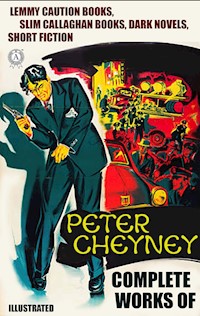

ANOTHER LITTLE
DRINK
by
PETER CHEYNEY
© 2026 Librorium Editions
ISBN : 9782387411327
CHAPTER ONE Monday WHISKY MAKES YOU FRISKY
CHAPTER TWO Monday THE TRAP FOR BELLAMY
CHAPTER THREE Monday WHISKY FOR A LADY
CHAPTER FOUR Monday NOTHING LIKE AN ALIBI
CHAPTER FIVE Monday EXIT CAROLA—ENTER IRIS
CHAPTER SIX Monday CLOSE-UP OF A LIAR!
CHAPTER SEVEN Tuesday NOTHING LIKE THE TRUTH
CHAPTER EIGHT Tuesday PAY-OFF FOR IRIS
CHAPTER NINE Tuesday CHEMIN-DE-FER-DE-LUXE
CHAPTER TEN Wednesday TEA FOR TWO
CHAPTER ELEVEN Wednesday TACTFUL INTERVIEW
CHAPTER TWELVE Wednesday THIRD DEGREE MADE EASY
CHAPTER THIRTEEN Wednesday A NIGHT OUT
CHAPTER FOURTEEN Thursday AND THE BLACK COMES UP
CHAPTER FIFTEEN Thursday ANOTHER LITTLE DRINK
CHAPTER ONEMonday WHISKY MAKES YOU FRISKY
I
Bellamy slid off the high stool, walked unsteadily to the window and stood swaying on his heels looking down at the snow, on Conduit Street. The bar-tender mixed himself a whisky and soda and began to polish the chromium counter. Bellamy turned, and leaned against the window, looking at the bar-tender.
He was tall, slim and dark. He looked immaculate although his quiet grey suit was old. There were circles under his eyes. He looked very tired, slightly depraved. His big brown eyes were dull.
He said in a low, rather hoarse and attractive voice: “Why doesn’t anybody come in here? Has Mr. March been in, Sydney?”
He began to walk towards the bar.
Sydney said: “No, I ’aven’t seen ’im for days. Believe it or not I s’pose ’e’s short of money like everyone else in this bloody war. ’E was a good spender when ’e ’ad it.”
Bellamy climbed on to the high stool. He picked up his glass and finished the whisky and soda. He looked at Sydney. Sydney mixed another one. Bellamy began to sing off key:
“Here’s to the good old whisky,
Get it down, get it down . . . . . . .”
The bar-tender said: “No, Mr. Bellamy, let’s ’ave the other one.”
Bellamy leaned over the bar towards Sydney. Sydney put his head close against Bellamy’s. They began to harmonise. They sang:
“If the sergeant steals your rum—never mind.
If the sergeant steals your rum—never mind.
He’s entitled to a tot
But he’ll take the bloody lot
For he’s just an awful sot.
Never M-i-n-d . . . . . . . !”
They finished on a high-pitched note. It sounded awful. Bellamy picked up his glass and drained it. The bar-tender said:
“Mr. Bellamy, believe it or not, you owe five pounds four shillings.”
Bellamy looked at him dully. He murmured:
“Oh, my God! Five pounds four shillings. It must be a lie.”
He considered for a moment. Then he said:
“Sydney, I feel sick. How much whisky do you have to have to feel sick, Sydney?”
The bar-tender thought for a moment. Then he said:
“Believe it or not I’ve never ’ad enough whisky to feel sick.”
Bellamy got up. He walked to the chair where his overcoat lay and began to struggle into it.
He said: “I hoped Mr. March would come in. Where the hell is that one?” He fumbled in his coat pockets. “Have you got a shilling, Sydney?”
The bar-tender put his hand in his pocket. He produced a shilling and laid it on the bar top. Bellamy picked it up, walked to the fruit machine which stood up against the wall beside the bar, put in the shilling and pulled the handle down. When the machine stopped working the three golden lemons were in a line. There was a click, and a gold coloured plaque came out into Bellamy’s hand. He grinned feebly. He took the plaque over to the bar and put it down.
“That’s the first time I’ve ever got any money out of one of those machines,” he said. “Five pounds. That leaves four shillings on the bill I owe you. Well run that.”
“What you say, Mr. Bellamy,” said Sydney. “Congratulations on that win. Believe it or not I think you ought to ’ave one on the ’ouse.”
Bellamy nodded. He wished Sydney would stop saying “Believe it or not.” The bar-tender poured out another double Haig. Bellamy stood teetering on his heels. Then he began to put on his gloves. He picked up his hat, put it on. Said:
“Goo’-bye, Sydney,” and walked out of the room.
The bar-tender heard him going unsteadily down the stairs. He grinned. He picked up the whisky and soda that Bellamy had left and put it under the bar.
Outside it was dark and cold. Bellamy, his hands in his overcoat pockets, his feet crunching in the snow, walked down Conduit Street, turned into Bond Street, then off towards Albemarle Street. He began to feel sick.
Half-way down Albemarle Street he looked into a doorway. A dim blue sign twinkled: “The Malayan Club. First Floor. Open.” Bellamy turned into the doorway and began to walk up the stairs. When he came to the turning in the stairs he leaned against the balustrade for a moment and then sat down. He closed his eyes for a moment and leaned back against the wall. The cold air on top of the whisky he had been drinking most of the afternoon was making his head spin.
To his left on the small landing at the turn of the stairway was a cloakroom door. To his right, looking up the stairs, Bellamy could see that the double doors of the Malayan Club were slightly open. Through the aperture he could see a table already laid for dinner. He got to his feet and began to walk up the stairs. He pushed open the door.
The Malayan Club was an “L” shaped room with the bar round the corner from where Bellamy stood. He walked up to the bar. He grinned drunkenly at the blonde barmaid:
“Hullo, honey,” he said. “And how is my little Blondie?”
The girl smiled.
“I’m swell,” she said.
She shot a quick glance at the only other occupant of the room—a woman.
Bellamy leaned up against the bar. He looked at Blondie. He looked from her carefully marcelled hair down to her neat shoes. He murmured:
“Did anyone ever tell you that you’ve got something, honey? Well, you have. You have sex appeal plus. You are practically a unique woman. One of these days when the weather gets a little better I’m going to make love to you. I’m going to tell you that your eyes are like amethysts and that the curve of your hips is just nobody’s business. I’ll probably write you a poem too. That’s the sort of fellow I am.”
She said: “Mr. Bellamy, really! Anyhow, you talk to all the girls like that.”
“You lie in your teeth,” said Bellamy. “You are the only woman I ever really loved. One day when I’ve got time, you might remind me to tell you what I really think about you.”
She smiled.
“That ought to be good,” she said.
He leaned over the bar and whispered something in her ear.
“Mr. Bellamy!” Her eyes twinkled. “You’ve got your nerve!”
“That,” said Bellamy, “is about all I have got. Blondie, what ought I to drink?”
She smiled at him. She was thinking that there was something rather nice about Nick Bellamy, that he was a mug to drink so much. She was wondering why he never did any work.
“The hair of the dog that bit you is what they say,” she smiled.
He grinned. The grin showed his even white teeth below the small black moustache. He said:
“All right. A double Haig.”
She hesitated. Then:
“Are you going to pay for it, Mr. Bellamy?”
He looked at her vaguely.
“What’s the idea?” he asked.
She looked a little uncomfortable.
“Your bill here is over seven pounds, Mr. Bellamy,” she said. “The Guv’nor says nothing doing until that’s paid.”
He said nothing. He fumbled in his waistcoat pocket and produced a cigarette case. He opened it and took out a cigarette. The woman who had been sitting by the fire in the other corner of the room came over to the bar.
She was of middle height with a round and attractive figure. She was fair; her face was pleasant and the features well-cut. Her eyes were very blue.
She was well-dressed in a tailored suit which seemed cut to accentuate the curves of her figure. Her silk stockings were beige and very sheer, and her small feet were encased in patent leather pumps with four-inch heels. Stuck in the front of her black crêpe de chine turban was a small diamond question-mark.
She came up to the bar and stood beside Bellamy. She said in a quiet well-bred voice:
“Don’t let them get you down, Nicky. And have that drink on me.”
She ordered two double whiskies and sodas. Bellamy smiled at her.
“Whoever you are, you’re a sweet,” he said. “I think that’s very very kind of you. Having regard to the amount of money that I’ve spent in this bar you’d think they’d’ve stretched my credit to one more drink.” He made a little bow. “My name’s Bellamy,” he said. “How d’you do?”
She laughed.
“I’m very well,” she said. “But why pretend you don’t know me? We’ve met before.” She flashed him a smile. “I’m not in the habit of buying strange men drinks, Nicky,” she said.
“Well, what d’you know about that?” said Bellamy. “And how could I forget somebody like you? I wonder where we met and if it was me—if it was me!”
“I’ve seen you half a dozen times,” she said. “At Ferdie Mott’s place usually. I was there with Harcourt March that night you won £120 on one hand at poker, and I’ve seen you do a little losing too. But I can understand you not remembering me. Most of the time you were too cock-eyed to remember anything.”
He said: “I know. Isn’t it awful? Every morning when I wake up I make up my mind I’m going to give up drinking because it interferes with work. But as the day goes on I come to the conclusion that it is work that interferes with drinking.” He said to her with great gravity: “I like drinking.”
He drained his glass.
“So I see,” she said. “What about another?”
Bellamy said: “I think you’re very kind.”
She ordered two more whiskies.
“Just in case you’d like to remember me the next time you see me,” she said. “I’m Iris Berington—Mrs. Iris Berington.”
He nodded.
“Of course,” he said. “Now I’m beginning to remember. I saw you around one day in some club with Harcourt. So he must be a friend of yours. He’s an old friend of mine. So now I’m an old friend of yours. I’m very fond of Harcourt, but I like you better.”
“Harcourt’s good fun,” she said. “He has one trouble. The same as yours. He drinks a little too much.”
Bellamy said: “Impossible! You can’t drink too much.”
She laughed.
“You’re incorrigible. But I suppose you’ve heard that from a lot of people?”
He said airily: “I’ve heard that from, a lot of women. I like being that way.”
He looked at her seriously.
“Iris,” he went on, “I think you’re marvellous. One of these fine days when I’ve got time I must tell you what I really think about you.”
She smiled at him: “A few minutes ago you were saying exactly the same thing to the barmaid.”
“I know,” said Bellamy. “Didn’t anybody ever tell you that history invariably repeats itself?”
She said:
“And you consider yourself history?”
“History’s practically my second name,” said Bellamy. “Anyway, honey, if you’ll be Cleopatra I’ll have a stab at being a successful Marc Antony.”
He walked over to the chair where he had left his hat.
“I must be getting along,” he said. “There was some place I had to go to—somebody I was looking for. If I could only remember where it was or who it was. Good-bye, Iris, I’ll be seeing you, and the next drink’ll be on me.”
She put her hand over his.
“I’m often around here,” she said, “usually about eleven o’clock at night. I’ll always be very glad to see you, Nicky.”
“That’s very nice of you,” said Bellamy. “You know,” he said dramatically, “it’s my fatal beauty that does it.”
She smiled.
“I bet it is,” she said. “Well, so long!”
She went back to her seat by the fire. Bellamy walked to the door. With his hand on the door-knob he turned and said:
“I say, if you see Harcourt by any chance, tell him I’d like to see him sometime.”
She said: “Yes, of course I will. Where is it you want to see him?”
“Oh, just around,” said Bellamy vaguely. “You see, he and I use all the same clubs and bars around here. As we both possess the swellest thirsts it’s practically impossible for us to miss each other for very long. ’Bye, darling.”
He went out.
II
Vanning looked at his watch as the car swung round by Norfolk Street and stopped in front of the office. It was just after six. He told the chauffeur to wait.
He walked quickly across to the entrance of the building. He was thinking that it was damned cold and wondering whether Freda would want to go to Carola’s party. He stubbed his toe on the sandbags piled against the side of the outside door.
Vanning was big, burly and compact. His shoulders were wide and he moved with the quickness and certainty of a man who is consciously fit. His face, ruddy, round and inclined to run to a jowl which made his thick neck seem thicker, was also determined, intelligent and sensitive.
He went up the stairs three at a time. On the first floor he stopped to light a cigarette. Then he walked along the corridor and pushed open one half of the big double doors whose frosted glass proclaimed the offices to be those of the Vanning International Trading Corporation Limited—an imaginary organisation which concealed the activities of the “C” Bureau.
He walked through the big outer office where a solitary clerk remained at his desk, through the middle office where a dozen men and two women were hard at work, along the short passage into his own room.
He shut the door behind him and stood looking at his secretary. She was standing in front of the big mahogany glass-topped desk lit by one powerful desk lamp. Her face was drawn. Vanning looked at her for a moment and then switched his glance to the desk.
Lying on the desk top were five newspapers folded into column and double-column widths. Three of them were German, one Turkish, one Roumanian.
Vanning crossed to the desk in three quick paces. He stood looking down at the newspapers, reading the German ones. His eye, taking in the hand of his secretary that rested on the desk top, noted vaguely that her fingers were trembling.
She moved a little as he dropped into the chair and began to read the translation of the Turkish newspaper. After a moment he stopped reading. He said:
“Christ. . . !”
He stubbed out his cigarette and lit another. His face was grim.
She said: “Sir Eustace has been through. They know about it. He wants you to see him as soon as possible. I told him you’d be back at six o’clock.”
He nodded.
“Does anyone here know, Mary?”
She shook her head.
“Nobody. Of course not. I did the Turkish translation myself.”
Vanning got up. He walked over to the window, pulled aside the heavy curtain and stood peering into the black-out. She stood watching him, looking at his broad back and heavy shoulders. When he turned she evaded his eyes.
He said: “This is the third time. You didn’t know that, did you? It’s the third time. God . . . it’s fearful . . . it’s bloody! And what the hell am I to do about it. . . ?”
She said: “Sir Eustace said you weren’t to take it too much to heart; that he could imagine how you would feel about it. He said he wanted you to know that. He said. . . .”
Vanning said: “Shut up, Mary. I don’t want his sympathy. All I want is to get my hands on this damned traitor.”
He walked over to the door. As he opened it he growled at her over his shoulder.
“Get through to Sir Eustace. Tell him I’m on my way.”
He slammed the door.
The secretary went over to her desk on the other side of the big room. She fumbled about in the drawers for her aspirin bottle. She could not find it.
She was crying when she picked up the telephone.
Vanning stopped his car at the Whitehall end of Birdcage Walk. He got out and walked for fifty yards in the direction of Wellington Barracks. Then he pushed open the iron gateway of an old-fashioned house that backed on to the Walk, crossed the small garden and rang the door-bell.
The door opened immediately. An elderly butler, obviously waiting for Vanning, said:
“Please come this way, Sir. Sir Eustace is already here.”
Vanning took off his coat, followed the butler down the long passage and into the warm, well-lighted study at the end. The servant announced him and disappeared.
Vanning walked over to the desk at which the Under-Secretary was working. He said abruptly:
“This is pretty damned awful, Sir. I suppose you knew about it as soon as we did?”
The Under-Secretary nodded.
“We get the German and Turkish papers very quickly,” he said. “I suppose we get them at the same time as you do.”
He got up, came round the desk and shook hands with Vanning. His thin, experienced face was unperturbed and smiling.
He indicated the armchair by the side of the fire. Then he went back to the desk and returned with a box of cigars. He took two cigars out of the box, pierced them, gave one to Vanning and produced a match from a gold case. Then he sat down in the other chair facing Vanning.
“I expect you are feeling rather bad about this thing, Vanning,” he said. “You feel that it’s all very mysterious and that someone in your bureau must be implicated. Well. . . . I don’t want you to worry too much and I can tell you that the Minister joins me in that wish. Your bureau has done too much good work for you to be unduly perturbed about this incident. More especially as. . . .”
Vanning interrupted. He stuck his big head forward. His eyes were hard.
“Thank you, Sir Eustace,” he said. “It’s nice of you to say that, and it’s nice of the Minister to indicate that I’ve done some good work in this War. I’m not such a fool as not to realise that quite a lot of that good work has been nullified by these incidents. I realise that I’ve had a free hand with the ‘C’ Bureau, that the staff is my staff, the responsibility mine, and that if leakages occur I’m going to be held responsible in the end.”
He shrugged his shoulders helplessly.
The Under-Secretary smiled slowly. He examined the glowing end of his cigar.
“I wonder if it would help you if I gave you an indication of what the Minister thinks about you, Vanning,” he said quietly. “Perhaps it might help if I told you that he thinks so much of what you’ve done—apart from the ‘incidents’ as you call them—that you can regard your inclusion in the next Honours List as a certainty.”
His smile deepened.
“Smoke your cigar quietly,” he said. “And relax. You’re too valuable to tear your mind to pieces by worrying over this thing. Incidentally,” he went on, “you will not feel so bad when I tell you that neither the Minister nor I am very surprised at the fact that the Goebbels organisation got their hands on your propaganda before you had a chance to issue it. I might almost say that we expected it.”
His smile deepened as Vanning’s eyebrows went up in surprise.
“You see,” the Under-Secretary continued, “there are two angles on this business. The obvious angle, and the one that is not quite so obvious. Let me deal with your own attitude first of all.”
He broke his cigar ash carefully into the ash-tray on the arm of his chair.
“Six months before War was declared, you registered the Vanning International Trading Corporation Ltd.—apparently an international Import business, but in fact cover for the activities of the ‘C’ Bureau—our most important organisation for the dissemination of pro-Allied propaganda in enemy and neutral countries. You selected your own staff. But in remembering this please also remember that every member of your staff was first of all checked thoroughly by the Special Branch at Scotland Yard before he, or she, was appointed. Therefor the Special Branch must share responsibility for those appointments.”
Vanning nodded.
“That’s true enough,” he said. “But. . . .”
“At the end of September—I think it was”—the Under-Secretary went on, “the first incident occurred. The propaganda which you had arranged should go to the Central European neutrals appeared in the Balkan newspapers some three days before the copy had even left your organisation. It was not in the form in which you proposed to issue it. The copy had been twisted, falsified and generally edited so as to defeat its own ends and to nullify the effect of the real copy—even if we had been fools enough to issue it after the original publication.
“There is no doubt, of course,” said the Under-Secretary smoothly, “that the Goebbels organisation had somehow received copies of the propaganda and, after doing their worst with it, had issued it to the Balkan people.”
“You will remember,” the quiet voice went on, “that the Minister and you and I had a conference. It was arranged that you should go through your staff list with a fine-tooth comb, and that on the pretext of economy you should dispense with the services of anyone on whom the slightest, the most vague, suspicion might rest. As a result of that combing-out process you dispensed with the services of three people. I’m afraid that I only remember the name of one of them. . . .”
He looked enquiringly at the other.
Vanning said: “The three people who went were Harcourt March, Ferdinand Mott and Nicholas Bellamy.”
The Under-Secretary nodded.
“Exactly,” he said. “I only remembered the name of Bellamy. I remembered that name for reasons which I will produce.”
“We imagined,” he went on, “that with these people gone, the rest of your people were absolutely above suspicion. Yet there was another leakage in November and now, in January, there is this last and most important leakage.”
He drew on his cigar slowly.
“For which somebody who is on my staff now must be responsible,” said Vanning.
The Under-Secretary said: “Perhaps partly responsible. But the point I have to make is an important one. After you had dispensed with the services of March, Mott and Bellamy, the Minister suggested that it might be a good thing if some sort of observation were kept on these three people. You will remember that it was arranged that you should appear to be rather upset at having to part with them and that you should make it your business to keep in touch socially.”
“I’ve done that,” said Vanning. “I’ve had them to dinner now and again, and my wife has had them to her cocktail parties. The process has been quite useless, of course.”
“But,” said the Under-Secretary, “perhaps more importantly you will remember that we had also arranged that the Special Branch should keep a fatherly eye on the three of them just in case.”
“And I didn’t agree with that,” said Vanning brusquely. “I made it quite clear at the time, Sir, that I had absolutely nothing against any of the three. Nothing tangible, I mean.”
“I remember,” said the Under-Secretary. “You thought it a little unfair on them. They were the three people on whom some possibly unfounded and very vague suspicion had fallen and so they had to be sacrificed.”
Vanning said: “Even ‘unfounded and vague suspicion’ did not apply to Bellamy, Sir Eustace. I was glad of the opportunity to get rid of him but only because he was drinking like a fish, appallingly lazy and very slack in his work. He could work when he wanted to but he seldom wanted. That’s why I got rid of him.”
The Under-Secretary said very softly: “I remember you bringing that up at the time. No suspicion—no matter how vague—fell on Bellamy. He was just a case of laziness and too much drink-taking.” He began to smile again. “That is the interesting part of this business,” he said.
Vanning’s eyebrows went up again.
“You mean. . . ?”
“I mean this,” said the other. “The Special Branch, for reasons best known to themselves, have come to the conclusion that they have a very good lead in connection with this business. They are, in fact, fairly certain that, given a little more rope, the individual they want will proceed to hang himself. They propose to give him that additional rope, which is the matter for our discussion.”
“So it is someone on the staff,” said Vanning. “Someone who is still in the organisation?”
“Plus someone who is outside it,” said the Under-Secretary.
He laid his half-smoked cigar in the ash-tray.
“The Special Branch believe,” he said, “that some quite lesser member of your staff—not anyone who is handling really important work, but someone with access to documents that would enable him (or her) to anticipate the lines of your propaganda issues from time to time—is in touch with somebody outside your staff, someone sufficiently experienced in your methods to enable him to work up the raw material supplied by his confederate and get it over to the Goebbels organisation before you have issued your own copy.”
He got up and stood with his back to the fire, his hands clasped behind him.
Vanning nodded.
“What do they propose to do?” he asked.
The Under-Secretary smiled.
“They have a scheme,” he said. “A scheme which they think will supply the evidence they want, which will put the further information they must have—information as to methods and technique—into their hands. This is the scheme:
“Harbell of the Special Branch, who is in charge of this business, wants you to support him by very carefully following out these instructions.”
“He wants you to contact the man Bellamy—the one you got rid of for laziness and liquor. He wants you to tell Bellamy the full story of the leakages and to tell him about this last one. Your attitude will be that you are fearfully worried about this business, and that you are, on your own responsibility, asking Bellamy to investigate the leakages. You will tell him that his past experience in your organisation will be invaluable to him in this connection, and you will tell him that you will be prepared to supply him plentifully with money. In fact you will be appointing him an unofficial investigator who will report to you personally from time to time.”
Vanning got up. His face was flushed. His eyes angry.
“Harbell must be stark, staring, raving mad, Sir Eustace,” he said. “It would be lunacy to put such an investigation into Bellamy’s hands, the man’s a sot. He’s drunk every day by lunch time. He’s seldom, if ever, sober. His brain is mildewed with whisky. He’s lazy, incompetent and he talks all the time. Within ten minutes of getting such an appointment he’d be telling the world about it in some West End bar or club. The idea of employing Bellamy is fatuous—and impossible.”
The Under-Secretary nodded.
“That was exactly my own reaction,” he said. “I’m afraid that I put it even more strongly than you did just now. But the idea isn’t at all bad. Anyway Harbell wants it done and he’s in charge of the Special Branch section dealing with the leakage. He has an excellent reason for wanting Bellamy employed.”
“Which is?” queried Vanning.
The Under-Secretary looked at Vanning with a benign smile. He said:
“Vanning, Bellamy is the man they want. Harbell is practically certain that Bellamy, working with someone in your office, is responsible for the leakages. He was personally responsible for the first one. Then, after he was discharged by you he made a contact with someone on your staff—probably some silly woman; they tell me he has a way with women—and that ‘someone’ who is relatively unimportant in your organisation has been supplying Bellamy with his raw material. He has done the rest.”
“Harbell doesn’t think that Bellamy is such a fool. Harbell thinks he’s pretty clever—almost brilliant. Although the Special Branch are practically certain of their man they still need some further information. They think that they will get it this way. They think that if Bellamy is employed to investigate this matter and report to you, he must give himself away. They believe that the reports he makes to you must, of necessity, be framed so that they lead away from himself, because he himself is the criminal, and he, naturally, knows that fact. Also the fact that he receives this appointment from you will give him an added confidence in his ability to pull the wool over all our eyes. D’you see?”
Vanning said: “I see. My God . . . Bellamy . . . Nicky Bellamy. Who’d have thought it?”
The Under-Secretary said: “Quite. It’s always the person one doesn’t suspect, isn’t it?”
Vanning shrugged his shoulders.
“Well. . . . The Special Branch know their job, I suppose,” he said.
The Under-Secretary nodded.
“Believe me,” he said, “they know their job very well. I take it that you will contact our friend Bellamy and appoint him as your investigator.” He smiled again. “You will give him the necessary rope to hang himself with.”
Vanning nodded.
“Very good. Sir Eustace,” he said. “It shall be done. I will contact him to-night if possible.”
The Under-Secretary said: “That will be excellent. I’ll let Harbell know that you are doing that. And, by the way, Vanning, don’t stint our friend for money. I should like to think that his rope was a silken one.”
He held out his hand.
Vanning went into his office at seven o’clock. He said to his secretary:
“Get through to Nicholas Bellamy—the one who used to work here. Telephone his flat. Find out where he is. Let me know.”
As the secretary was going out of the room she said:
“Mrs. Vanning has been through. She wanted to know if you were going to Miss Everard’s party to-night.”
Vanning shook his head.
“I shall be working here,” he said. “When you’ve found Mr. Bellamy put him through to me here.”
She was almost at the door when he called her. She stopped, turned round.
“Is Mr. Bellamy friendly with anyone on the staff here?” he asked casually.
She considered for a moment.
“I believe he meets two or three people in the copy department,” she said eventually.
“I see,” said Vanning. He smiled at her. “When did you see him last?” he asked.
She blushed.
“I had dinner with him about a week ago, Mr. Vanning,” she said.
She closed the door softly behind her.
One of the telephones on Vanning’s desk jangled—the private wire to his flat. He picked up the receiver. It was Freda.
“Shall you be coming home for dinner, Philip?” she asked. “And what about Carola’s party. . . ?”
He interrupted.
“Listen, Freda,” he said. “It’s happened again . . . it’s happened again.”
His voice was grim.
There was a little pause. Then she said tremulously:
“They haven’t stolen some more. . . .”
“They’ve got the stuff we were working on,” he said. “They’ve got it in print already in Germany, Turkey and Roumania, so beautifully twisted that it’s going to do irreparable harm. What do you think about that?”
She gave a little gasp.
“Oh, Philip,” she said. “How terrible. . . .”
“But you haven’t heard anything yet, Freda,” he went on. “There’s a joke to this—a damned awful joke. Listen. I’ve just come back from Sir Eustace. The Special Branch suspect somebody. Someone outside the office who’s rewriting our original notes supplied by someone working inside. And who do you think it is? It’s Bellamy . . . Nicky Bellamy . . . that rotten traitorous sot!”
She said: “Good God, Philip. What are they going to do?”
“They’ve got a scheme,” said Vanning. “I didn’t like it at first but the more I think about it the better it seems. I’ll tell you about it when I get back. But I shan’t be home to dinner and I shan’t be able to go to Carola’s party. I’m working late. I’ve got to redraft all our stuff as a result of this.”
“Poor Philip,” she murmured softly. Then she said: “Don’t worry, it will work out all right. It will be all right. I’ll get Harcourt to take me to Carola’s. He telephoned through. He’s coming here for a cocktail.”
“All right,” said Vanning. “But don’t let him or anyone else even get an inkling about Bellamy. Be careful. Even watch the inflection of your voice when you mention his name. This has got to be kept on the ice until we can get him set. Good-bye, honey.”
He hung up the receiver. Outside, in the outer office, he could hear his secretary ringing one bar after the other—trying to find Bellamy.
CHAPTER TWOMonday THE TRAP FOR BELLAMY
I
It was a quarter to eight when Vanning went into the Buttery at the Berkeley Restaurant. He walked straight to an unoccupied table and sat down. On the other side of the room Bellamy, in a big overcoat with an astrakhan collar, was deep in conversation with a good-looking woman.
Vanning watched them. Bellamy was telling a story. He leaned across the table illustrating the points in the story with facile fingers. The woman, who was wearing a smart green hat, leaned back in her chair obviously amused. When Bellamy came to the end of the story they both laughed. Then he got up, leaned over the table and said a few words to her, picked up his hat and came over to Vanning’s table.
He said: “ ’Lo, Philip. I say, do something for me. I have just been having drinks with that woman over there. Get the waiter to put them on your bill, will you?”
Vanning said: “Is it as bad as that?”
“It is,” said Bellamy. “It’s worse than that.” He went on cheerfully: “I had a bit of rotten luck this afternoon. I won a jackpot in a fruit machine of £5, and dam’ it I owed ’em five pounds four shillings at the bar, so of course I had to pay the bill. Pretty tough, don’t you think, Philip?”
Vanning said: “Well, you don’t look broke. That fur coat cost some money.”
Bellamy grinned. The thought flashed through Vanning’s head that if Bellamy were to take a pull at himself, he’d be quite a good-looking fellow.
Bellamy said: “I wouldn’t know about that. It’s not mine.”
Vanning looked up.
“Your friend’s going,” he said.
The woman with whom Bellamy had been drinking had got up. Vanning could see that she was about forty years of age, well turned-out, good-looking. She smiled good-bye at Bellamy, who waved back to her.
Vanning said pleasantly: “Now who would that be?”
Bellamy grinned.
“Dam’ nice woman,” he said. “I don’t know who she is. I never met her before.”
Vanning said: “My God, this is the Berkeley. Do you mean to say you just sat down and got into conversation with that woman and bought her a drink?”
Bellamy’s eyes opened.
“Why not?” he said. “I happened to sit at her table. She had a sense of humour anyway. She liked the story I told her.”
“I hope it was a decent one,” Vanning said.
Bellamy raised his eyebrows.
“Absolutely,” he said. “My stories are always decent. Clever—and not too risqué. Double Haig please! And to what do I owe the pleasure of this appointment?”
Vanning called the waiter, ordered the drinks.
He said: “Nicky, I want you to go easy on the liquor. I’ve got a job for you.”
“My God!” said Bellamy. “So it’s happened at last. I’ve got a job. How awful!”
“You don’t mean to say that you don’t want a job?” said Vanning.
Bellamy smiled sweetly.
“Ever since you chucked me out of that office of yours, Philip,” he said, “I’ve done my best to avoid one, but it looks as if you’ve caught up with me.” He leaned towards Vanning—“So you just can’t get on without me. That great secret organisation—the ‘C’ Bureau—just can’t get along without little Nicky.”
Vanning said: “You keep your head shut about the ‘C’ Bureau. Just remember that that organisation is the Vanning International Trading Corporation Limited.”
“Oh, that’s all right,” said Bellamy. “After all I’m only talking to you.”
“I know, Nicky,” said Vanning. “But you talk too much. If you’re going to do this job you’ve got to stop talking and you’ve got to stop drinking.”
Bellamy said: “It doesn’t sound much of a job. Tell me about it, Philip.”
He fumbled for a cigarette. Vanning, looking at him, found himself thinking of his conversation with the Under-Secretary, and of his remark: “Harbell doesn’t think that Bellamy is such a fool. Harbell thinks he’s pretty clever—almost brilliant.” Vanning thought that either Harbell was mad or Bellamy was a very good actor. Was it so ridiculous that Bellamy should have the mind, the planning ability and the guts to get away with stealing and selling national secrets to an enemy?
The waiter put the drinks on the table. Bellamy had by this time found his cigarette case. He opened it. There was only one cigarette inside. He held the case towards Vanning, who shook his head and produced his own case.
“Have one of mine, Nicky,” he said. “Listen and don’t interrupt. You’re luckier than you think. You’ve got a chance of making good.”
Bellamy nodded.
“I’m listening,” he said. “I’m all ears.”
Vanning dropped his voice.
“First of all,” he said, “I want you to carry your mind back to the end of last September. You remember I had to ask you and March and Mott to go, because we were reducing staff? I was fearfully sorry to do it because although you were a bit erratic in your work, the stuff you did do was quite brilliant. Another thing was, you had a better idea of what we were trying to do, a better idea of how the organisation actually worked than the other two. I was more sorry to lose you than either Harcourt or Ferdie Mott. So you can imagine how glad I am that I am able to tell you that you can work for me again. But not in exactly the same way.”
“Go on, Philip,” said Bellamy. “I’m pulsating with interest.”
“To cut a long story short,” said Vanning, “a rather serious position has arisen in regard to the ‘C’ Bureau. For the last month I’ve been working on some special propaganda intended for the Roumanian and Turkish newspapers and for one or two of the Balkan editions. It was good stuff. Well, somehow Goebbels got hold of it. First of all he got hold of our copy, turned it inside out, and has published his version in the papers in Germany, Roumania and Turkey. He’s kicked the ground from under our feet. This is the third leakage. The first one was in September last; the second one was in November.”
Bellamy pursed up his lips.
“That’s not so good, Philip,” he said. “A nigger in the wood-pile, hey? Spies at work?”
“Something like that,” said Vanning.
He finished his drink.




