


0,49 €
Niedrigster Preis in 30 Tagen: 1,99 €
Niedrigster Preis in 30 Tagen: 1,99 €
Mehr erfahren.
- Herausgeber: Booksell-Verlag
- Kategorie: Gesellschafts- und Liebesromane
- Sprache: Englisch
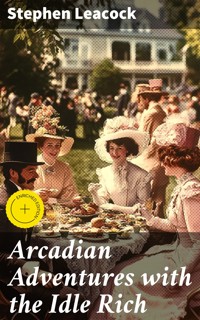
In "Arcadian Adventures with the Idle Rich," Stephen Leacock presents a satirical exploration of the lives and follies of the upper class in early 20th-century Canada. Through a series of humorous sketches and narrative vignettes, Leacock employs a witty literary style characterized by light-hearted irony and playful language. The book reflects the burgeoning societal changes of the time, as well as the transition from Victorian ideals to more modern sensibilities, offering keen insights into class distinctions and the absurdities of wealth through a comedic lens. Leacock, a prominent Canadian humorist and educator, drew inspiration from his own experiences and observations of the wealthy elite. His background in economics and social commentary provided him with the tools to engage critically yet humorously with the themes of privilege and leisure. As one of the first Canadian writers to gain international fame, Leacock's works are integral to understanding the evolution of Canadian literature and humor. Highly recommended for readers seeking both entertainment and social critique, "Arcadian Adventures with the Idle Rich" invites you to revel in Leacock's sharp wit and keen eye for the absurdity in human nature. It serves as a delightful reflection on wealth and society that remains relevant and enjoyable to readers today. In this enriched edition, we have carefully created added value for your reading experience: - A succinct Introduction situates the work's timeless appeal and themes. - The Synopsis outlines the central plot, highlighting key developments without spoiling critical twists. - A detailed Historical Context immerses you in the era's events and influences that shaped the writing. - A thorough Analysis dissects symbols, motifs, and character arcs to unearth underlying meanings. - Reflection questions prompt you to engage personally with the work's messages, connecting them to modern life. - Hand‐picked Memorable Quotes shine a spotlight on moments of literary brilliance. - Interactive footnotes clarify unusual references, historical allusions, and archaic phrases for an effortless, more informed read.
Das E-Book können Sie in Legimi-Apps oder einer beliebigen App lesen, die das folgende Format unterstützen:
Veröffentlichungsjahr: 2021
Ähnliche











Arcadian Adventures with the Idle Rich
Table of Contents
Introduction
Where comfort masquerades as virtue and ceremony as substance, Arcadian Adventures with the Idle Rich exposes how a moneyed class converts leisure into a creed, influence into entertainment, and institutions into ornate stages on which the anxieties of status, faith, and power perform their polished, comic, and often revealing routines; it suggests that a city’s grandest avenues are less homes than theaters, their audiences eager for reassurance, their actors convinced that applause confirms wisdom, and their scripts written by habit as much as by conviction, so that amusement becomes a method of rule and laughter a mirror that refuses to flatter.
Stephen Leacock’s Arcadian Adventures with the Idle Rich is a work of social satire first published in 1914, situated in the early twentieth-century urban milieu. Set in a fictional North American metropolis, it turns its gaze upon the fashionable world clustered around a prestigious avenue and the institutions that orbit it. The book belongs to the comic tradition, but its humor is pointed, using a polished surface to reflect the deeper absurdities of privilege. Readers encounter an environment of clubs, churches, offices, and drawing rooms, a cityscape assembled not to celebrate wealth so much as to examine the habits and pretensions it sustains.
The premise is deliberately episodic: an ensemble of financiers, socialites, professionals, and gatekeepers crosses an elegant stage where nothing seems more serious than appearances. Rather than following a single hero’s arc, the narrative presents interlinked situations in which power performs itself with an air of perfect normality. The voice is urbane and deadpan, trusting irony to do the work of argument, while the mood oscillates between playful exaggeration and cool observation. Readers can expect a sequence of sharp set pieces, each revealing how decorum and convenience collaborate, and how a well-dressed city can mistake its own rituals for principles.
Key themes include the psychology of status, the spectacle of philanthropy, and the way institutions bend to the expectations of their wealthiest patrons. The book probes how faith can drift toward fashion, how education can bow to influence, and how public virtue can be staged as private reassurance. It treats money less as a pile of coins than as a cultural weather system, shaping what people believe is possible or proper. The satire remains humane, but it is unsparing in tracing the slide from confidence to complacency, from civic aspiration to ceremonial display, and from conviction to convenience.
Leacock’s method is to balance genial comedy with exacting scrutiny. He relies on understatement, skewed logic, and careful escalation, letting small social gestures swell into full-blown absurdities. Characters are drawn as recognizable types rather than psychological case studies, not to flatten them but to illuminate recurring patterns of behavior. The structure’s mosaic quality allows each episode to refract the others, so that jokes resonate across chapters and motifs accumulate force. The prose favors clarity over ornament, giving the humor room to breathe, while the timing of turns and reveals proves that satire can be both graceful in movement and firm in intention.
For contemporary readers, the book’s questions feel timely: what happens when influence is treated as wisdom, when benevolence doubles as branding, or when governance becomes a matter of public relations? Its city of sumptuous façades anticipates ongoing conversations about inequality, institutional credibility, and the relationship between culture and capital. The comedy invites laughter, but it also encourages skepticism toward performances that pass for consensus. By showing how people justify what benefits them most, it provides a lens through which to consider modern forms of prestige and persuasion, without prescribing answers—only offering a clear view of how the game is played.
Approached as a standalone work of urban satire, Arcadian Adventures with the Idle Rich offers an experience that is brisk, witty, and quietly cumulative in its critique. It rewards readers who enjoy keen observation, linguistic poise, and humor that entertains while it elucidates. Without demanding specialized knowledge, it opens a window onto an era and a mindset, demonstrating how the machinery of privilege can hum so smoothly that its sound becomes a city’s background music. The result is a book that invites both pleasure and reflection, a guided tour of elegance that encourages one to ask what, exactly, elegance is for.
Synopsis
Arcadian Adventures with the Idle Rich presents a sequence of interlinked sketches set in a prosperous North American city. The narrative focuses on the daily routines, social customs, and institutional power of the wealthy class, observing how influence circulates among homes, clubs, churches, and offices. Characters recur across episodes, revealing a network in which status and convenience shape decisions. The book proceeds by situating readers in familiar public spaces of the elite and then showing how minor incidents escalate into notable events. Its overall aim is descriptive rather than plot-driven, assembling a composite picture of an urban milieu devoted to display, management, and ceremony.
The opening episodes assemble a dinner table of financiers, patrons, and aspirants, using a lavish meal to introduce etiquette and priorities. Hosts and guests negotiate precedence, hint at deals, and validate one another’s importance through taste, conversation, and seating. Staff move invisibly to preserve effortlessness, while menus and wine lists perform as credentials. A single absent person can unsettle arrangements, and an unexpected visitor tests the boundaries of exclusivity. This carefully staged social ritual establishes the tone for the volume: interactions are polite but strategic, and personal relations often serve as conduits for business, reputation, and the maintenance of a shared social order.
Attention turns to an exclusive men’s club, where silence, armchairs, and committees regulate belonging. Admission is tightly controlled, with a single objection able to undo a candidate’s chances. Inside, innocuous reading rooms double as informal offices, and minor rules, such as coat standards or speaking in hallways, signal major divisions. Elections, resignations, and obscure subcommittee decisions subtly redirect influence across the city. Through this setting, the narrative shows how status is conferred and defended by routine procedure, how consensus hardens around habit, and how the slow machinery of club governance shields the private deliberations that precede public announcements.
Finance enters in the figure of a market specialist who organizes flotations, consolidations, and strategic rumors. The sketches observe prospectuses, underwriting syndicates, and timed dispatches that guide investment sentiment. Public enthusiasm follows cues crafted in offices and relayed through newspapers and luncheon tables. Meanwhile, risk distribution ensures that exposure is diluted among distant subscribers, while principals retain options to withdraw gracefully. Regulators and lawyers appear, fulfilling formal requirements and providing reassurance. The narrative avoids scandal, emphasizing process: how a venture is framed as inevitable, how confidence is cultivated, and how a successful launch advances reputations, unlocking the next, larger opportunity.
A fashionable church provides another arena where influence is negotiated. The rector calibrates sermons to the expectations of a distinguished congregation, arranging music, committees, and fundraising to harmonize civic and spiritual calendars. Seating maps, memorial windows, and parish subscriptions mark subtler hierarchies than titles alone convey. Disputes over choir direction or ritual detail are resolved in drawing rooms as much as vestries, ensuring that consensus aligns with donors’ wishes. The church thus functions as a social hub that confers moral sanction on prevailing arrangements, while its public programs—charity drives, festivals, and lectures—allow participants to enact benevolence without disturbing established routines.
Society’s appetite for novelty appears in episodes about imported philosophies and fashionable cults. A prominent hostess sponsors visiting teachers, assembles select audiences, and organizes demonstrations that blend entertainment with edification. Exotic vocabulary, incense, and ritual objects decorate otherwise familiar salons, and participation confirms a capacity to appreciate the latest cultural currency. Subscriptions and memberships proliferate, promising inner knowledge and improvement through curated courses. The narrative highlights process rather than belief: how movements are adopted, translated into tasteful events, and eventually retired as new fascinations arrive, leaving behind a residue of programs, photographs, and a modest expansion of social connections.
Philanthropy and education feature through endowments, building campaigns, and the placement of trustees. A university expands its faculties and facilities as benefactors specify memorial names, design preferences, and program goals. Committees weigh curricula against funding opportunities, and administrators balance scholarly aims with the continuity of donations. Public ceremonies inaugurate laboratories, libraries, and museums, each linking civic advancement to private generosity. Faculty adapt to revised priorities, while students encounter new rules and resources. The account emphasizes governance: who sits on boards, who appoints chairs, and how benchmarks are defined to demonstrate success, all without overt conflict, but with lasting institutional consequences.
Municipal life enters through a contest for clean government, pitting reformers against an entrenched organization. Speeches, meetings, and banquets array supporters, while newspapers shape narratives around efficiency, fairness, and growth. Franchise agreements, utility rates, and civil-service appointments serve as practical tests of principle. Ballots and legal challenges proceed in orderly stages, with attention to counting, certification, and endorsements. Whatever the outcome, the process displays how business methods inflect public administration, and how appeals to integrity depend on alliances formed in clubs, churches, and offices. The city appears as an integrated system where public and private interests continually negotiate boundaries.
The concluding movement returns to drawing rooms and corridors, where routines reassert themselves and yesterday’s events become anecdotes. The sketches end without melodrama, underlining the durability of rituals that organize prestige, comfort, and control. Across dinners, clubs, markets, churches, salons, campuses, and campaigns, the book assembles a consistent picture of how influence is produced and maintained. Its central message is descriptive: wealth, culture, and authority circulate through institutions that normalize arrangement and exchange. By following incidents in sequence and refraining from final verdicts, the narrative presents an urban panorama whose stability depends on ceremony, mutual recognition, and carefully managed appearances.
Historical Context
Stephen Leacock situates Arcadian Adventures with the Idle Rich in a bustling North American metropolis of the early twentieth century, a composite of Montreal, Toronto, and New York around 1900–1914. The novel’s “Plutoria Avenue” evokes Montreal’s St. James Street financial district and the social exclusivity of Toronto’s Annex and Rosedale, set amid electric streetcars, skyscraper banks, and gilded churches. The timeframe precedes the First World War but follows the consolidation of corporate capitalism and urban growth of the 1890s–1910s. Leacock, a McGill University economist in Montreal from 1903, writes with insider knowledge of boardrooms, university trustees, denominational rivalries, and the rituals of high society that defined the period’s urban elite.
The rise of trusts and corporate finance between 1890 and 1914 forms the novel’s central historical backdrop. In the United States, J. P. Morgan engineered massive consolidations such as U.S. Steel (1901) and the Northern Securities Company (1901), the latter dissolved by the Supreme Court in 1904 under the Sherman Antitrust Act (1890). Canada pursued its own antitrust path through the Combines Investigation Act (1889; revised 1910). Montreal’s St. James Street housed the Bank of Montreal (1817) and, after 1907, the Royal Bank of Canada’s head office, symbolizing concentrated financial power. Leacock’s “Bank of Plutoria” and the “wizard” financiers mirror this culture of pools, syndicates, and paper empires that dominated prewar urban life.
The Panic of 1907 crystallized anxieties about unregulated finance. A failed stock corner in October 1907, linked to F. Augustus Heinze, triggered a run on the Knickerbocker Trust (New York, 22 October), call money rates spiked to 100 percent, and J. P. Morgan famously corralled bankers in his Madison Avenue library to stage rescues. Without a central bank, ad hoc syndicates stabilized markets. Canada, with nationwide branch banking and periodic revisions of the Bank Act, avoided runs of comparable scale, though credit tightened and mergers accelerated. Leacock’s scenes of feverish speculation, whispered rescue dinners, and the brittle confidence of plutocrats transpose the crisis psychology of 1907 into satire.
Investigations and reforms followed the panic. The Pujo Committee (U.S. House of Representatives, 1912–1913) exposed a Wall Street “Money Trust,” detailing interlocking directorates across banks and railroads. Congress responded with the Federal Reserve Act (1913), creating a central bank to manage liquidity and provide a lender of last resort. Canada’s Parliament revised the Bank Act in 1913, reinforcing the chartered, branch-banking model centered in Montreal and Toronto. These measures curtailed, but did not end, the power of private syndicates. Leacock’s portrayal of directors who straddle banks, railways, insurance firms, and charities dramatizes the pre-reform entanglements the Pujo hearings quantified and the ambivalent effectiveness of subsequent regulatory architecture.
Urban machine politics and municipal reform movements shaped the civic environment that Leacock lampoons. In the United States, Tammany Hall under bosses Richard Croker (1886–1902) and Charles F. Murphy (1902–1924) exemplified patronage-driven governance, prompting the National Municipal League (founded 1894) to advocate civil service, nonpartisan ballots, and expert administration. The city-manager system appeared in Staunton, Virginia (1908) and spread after Dayton, Ohio’s 1913 charter. Toronto instituted a Board of Control in 1904 to streamline administration. Leacock’s committees, boards, and “public-spirited” banquets echo these reforms’ rhetoric while exposing how club ties and donors’ interests continued to steer contracts, appointments, and civic prestige projects.
Religious life and the Social Gospel framed elite activism. Walter Rauschenbusch’s Christianity and the Social Crisis (1907) and Washington Gladden’s municipal reform leadership articulated a theology of social responsibility; in Canada, figures like Salem Bland and, later, J. S. Woodsworth connected Protestantism to labor and welfare. The Young Men’s Christian Association, founded in London in 1844 and institutionalized in North America by the 1860s, pioneered intensive capital campaigns by 1906–1913 to build gymnasiums and dormitories. Leacock’s rival parishes and grand Y.M.C.A. drives reflect denominational competition for affluent congregants, pew rents, and naming rights, skewering the nexus of faith, fundraising technique, and social display that marked prewar urban Protestantism.
Philanthropy’s expansion under the “Gospel of Wealth” furnished the era’s cultural architecture. Andrew Carnegie’s 1889 essay rationalized elite giving; he endowed over 2,500 libraries worldwide, including roughly 125 in Canada, while creating the Carnegie Corporation (1911). The Rockefeller Foundation received its charter in 1913. In Montreal, donors such as the Redpath family funded McGill’s Redpath Museum (1882) and other facilities; Leacock, on McGill’s faculty from 1903, witnessed endowment politics and trustee governance under Principal Sir William Peterson (1895–1919). The novel’s university scenes—chasing gifts, shaping curricula to please patrons, and awarding honorary degrees—mirror this philanthropic economy in which cultural capital and social control accompanied conspicuous generosity.
As social and political critique, the book exposes the structural power of a plutocracy that fuses finance, church, philanthropy, and civic office. It indicts interlocking directorates, the capture of public institutions by donors and boards, and a justice and moral order calibrated to class. By parodying rescue dinners, fashionable piety, and transactional charity, Leacock highlights how reforms after 1907 and the rhetoric of uplift left underlying inequalities intact. The work thus scrutinizes a prewar urban order—Canadian and American—where regulation moderated excesses without dislodging elite dominance, and where public virtue often cloaked private interest, shaping policy, culture, and cityscapes alike.




