


9,99 €
Mehr erfahren.
- Herausgeber: Parkstone International
- Kategorie: Geisteswissenschaft
- Sprache: Englisch
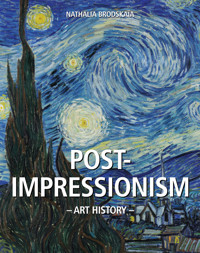
While Impressionism marked the first steps toward modern painting by revolutionising an artistic medium stifled by academic conventions, Post-Impressionism, even more revolutionary, completely liberated colour and opened it to new, unknown horizons. Anchored in his epoch, relying on the new chromatic studies of Michel Eugène Chevreul, Georges Seurat transcribed the chemist's theory of colours into tiny points that created an entire image. With his heavy strokes, Van Gogh illustrated the midday sun, while Cézanne renounced perspective. Rich in its variety and in the singularity of its artists, Post-Impressionism was a passage taken by all the well-known figures of 20th-century painting - it is here presented, for the great pleasure of the reader, by Nathalia Brodskaïa.
Das E-Book können Sie in Legimi-Apps oder einer beliebigen App lesen, die das folgende Format unterstützen:
Seitenzahl: 60
Veröffentlichungsjahr: 2024
Ähnliche
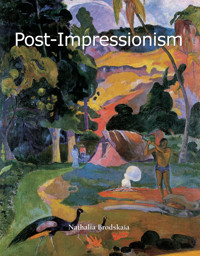

Nathalia Brodskaïa
POST-IMPRESSIONISM
© 2024, Confidential Concepts, Worldwide, USA
© 2024, Parkstone Press USA, New York
© Image-Barwww.image-bar.com
All rights reserved. No part of this may be reproduced or adapted without the permission of the copyright holder, throughout the world.
Unless otherwise specified, copyright on the works reproduced lies with the respective photographers. Despite intensive research, it has not always been possible to establish copyright ownership. Where this is the case, we would appreciate notification.
ISBN: 979-8-89405-013-3
Contents
Introduction
Post-Impressionism And Its Contributions
Major Artists
Paul Cézanne (1839-1906)
Vincent Van Gogh (1853-1890)
Paul Gauguin (1848-1903)
Henri De Toulouse-Lautrec (1864-1901)
List Of Illustrations
Claude Monet, Bouquet of Sunflowers, 1881. Oil on canvas, 101 x 81.3 cm. The Metropolitan Museum of Art, New York.
INTRODUCTION
The term ‘Post-Impressionism’ has only one meaning: ‘after Impressionism’. Post-Impressionism is not an art movement, nor an art style; it is a brief period at the end of the nineteenth century. Impressionism being a phenomenon unique to French painting, the idea of Post-Impressionism is also closely linked to French art. Generally, the beginning of the Post-Impressionist era dates from 1886, from the moment of the eighth and final joint Impressionist Art exhibition. The era ends after 1900, running only into the first decade of the twentieth century. Although ‘Post-Impressionism’ and its chronological limits are well-defined, it seems that several Post-Impressionist works exist outside this period. Despite this period’s extreme brevity, it is often described as an ‘era’ of Post-Impressionism. In fact, this twenty-year period saw the emergence of such striking artistic phenomena, such varying styles of pictorial art and such remarkable creative personalities, that these years at the turn of the century can without a doubt be characterized as an ‘era’.
The period of Post-Impressionism began at a time of unbelievable changes in the world. Technology was generating true wonders. The development of science, which formerly had general titles – physics, chemistry, biology, medicine – took many different, narrower channels. At the same time this encouraged very different areas of science to combine their efforts, giving birth to discoveries that had been unthinkable just two to three decades earlier. Knowledge of new territories could not go unnoticed in the development of art.
The year 1886 marked the beginning of fundamental changes in the appearance of Paris. A competition was organized for the construction of a monument to commemorate the centenary of the French Revolution (1789) which coincided with the World’s Fair. It was the project of the engineer Gustave Eiffel to build a tower which was accepted.
Amongst the Post-Impressionist artists of the period, some immediately welcomed the new architectural aesthetic. For Paul Gauguin the World’s Fair was the discovery of the exotic world of the East, with its Hindu temples and its Javanese dances. But the functional purity of the pavilion construction also impressed him. Gauguin liked the heavy and simple decoration of the tower, and its purely industrial material. The Post-Impressionist era was to dramatically change tastes and artistic passions.
The year 1900 brought Paris new architectural landmarks: palaces appeared on the banks of the Seine. The principle of these constructions is that of a metallic structure surrounded by a façade of stone. These structures allowed roofs to be built over the huge spaces of the Grand Palais and to place spectacular halls for different kinds of temporary exhibitions inside. Many famous sculptors and painters of the end of the nineteenth century took part in the decoration of the palace, so that it became the monument to the new style, born in the era of Post-Impressionism.
Paul Gauguin, Winter Day, 1886. Oil on canvas, 71.8 x 55.9 cm. Aaron M. and Clara Weitzenhoffer Bequest, Fred Jones Jr. Museum of Art, University of Oklahoma, Oklahoma City.
Paul Cézanne, Still Life with Dish, Glass and Apples, 1879-1880. Oil on canvas, 46 x 55 cm. Private collection, Paris.
Paul Signac, Boat in the St Tropez Harbour – Tartanes pavoisées, St Tropez, 1893. Oil on canvas, 56 x 46.5 cm. Von der Heydt-Museum, Wuppertal.
Henri-Edmond Cross, Hair, c. 1892. Oil on canvas, 61 x 46 cm. Musée d’Orsay, Paris.
POST-IMPRESSIONISM AND ITS CONTRIBUTIONS
The era of Post-Impressionism was the time of lone painters; only a very small number of them got together, and then only rarely. They didn’t share the same opinion about art, nature or painting style. The only thing the painters had in common was the impression that Impressionism left on them: none of them could have worked in this manner, working as if Impressionism had not existed. All these artists faced the same sad fate – not one of them had a hope of ever entering the Salon and showing his work to the public. Impressionists had shown them a possible way: they created their own exhibitions, excluding from it those who were not with them. They were all very different: some did not have the necessary level of professionalism according to the jury’s rules; some shocked the public by being too bold in their style, too negligent or using colors which were too intense.
A new exhibition opened in 1884 in Paris: Le Salon des artistes indépendants. The new Salon was a solution for everyone, because there was no jury and nobody was selecting works for the exhibition. Each painter could show whatever he wanted. The only condition was the number of works being shown, that number changed year after year.
Although it was often hard to discover a great talent among hundreds of pieces shown there, it was that Salon that gave the opportunity to such uneducated artists as Henri Rousseau to discover the art scene. School education ceased to be an essential quality for painters; Vincent van Gogh and Paul Gauguin were also persistent, self-taught painters. Paul Cézanne – ‘the Impressionist’ –, who was not satisfied with Impressionists’ style, also chose his own special path; Henri de Toulouse-Lautrec, even though he had received classical education, decided to choose a disapproved path. The work of all these painters was conceived in the era of Post-Impressionism and their lives, surprisingly, ended with the end of the century: Van Gogh died in 1890, Seurat – in 1891, Lautrec – in 1901, Gauguin – in 1903, Cézanne – in 1906 the Douanier Rousseau – in 1910.
Henri Rousseau, known as the Douanier Rousseau, War or The Ride of Discord, 1889. Oil on canvas, 114 x 195 cm. Musée d’Orsay, Paris.
Paul Sérusier, The Talisman (L’Aven in the Bois d’Amour), 1888. Oil on canvas, 27 x 21.5 cm. Musée d’Orsay, Paris.




