


Erhalten Sie Zugang zu diesem und mehr als 300000 Büchern ab EUR 5,99 monatlich.
- Herausgeber: Ryland Peters & Small
- Kategorie: Lebensstil
- Sprache: Englisch
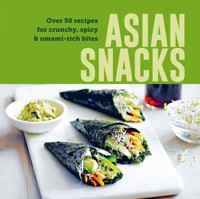
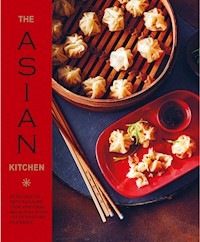
Immerse yourself in the DELICIOUS world of PAN-ASIAN SNACKS with this fantastic collection of over 50 recipes, from SAMOSAS TO SUSHI and DUMPLINGS TO DOSA. Travel around the FAR EAST from the comfort of your own home and DISCOVER the vast array of popular small bites that are on offer. Pick from Chinese spring rolls, Indonesian satay skewers, Japanese teriyaki bites, Korean sticky chicken, Vietnamese summer rolls, Indian chaat and a whole host more. Food from Eastern corners of the world is often thought of as some of the most exciting and enticing on the planet. Whether umami-rich with Japanese miso or soy sauce, spiked with gently building layers of aromatic Indian spices, or replete with fragrant Thai herbs, chilli and garlic, each mouthful packs a big flavour punch. The savoury bites that usually serve as a precursor to an Asian meal are no exception flavour-wise, and quite often everyone will scramble to take the last one on the plate! Snacks from street-food markets around Asia have also become increasingly popular. Here you'll find a great collection of over 50 recipes that will satisfy any Asian-food aficionado's cravings.
Sie lesen das E-Book in den Legimi-Apps auf:
Seitenzahl: 97
Veröffentlichungsjahr: 2025
Das E-Book (TTS) können Sie hören im Abo „Legimi Premium” in Legimi-Apps auf:
Ähnliche













ASIAN SNACKS
ASIAN SNACKS
Over 50 recipes for crunchy, spicy & umami-rich bites
Designer Paul Stradling
Editor Abi Waters
Production Manager Gordana Simakovic
Creative Director Leslie Harrington
Editorial Director Julia Charles
Indexer Vanessa Bird
Published in 2025 by Ryland Peters & Small
20–21 Jockey’s Fields
London WC1R 4BW
and
1452 Davis Bugg Road,
Warrenton, NC 27589
www.rylandpeters.com
email: [email protected]
Text © Ghillie Başan, Jordan Bourke, James Campbell, Ross Dobson, Matt Follas, Dunja Gulin, Tori Haschka, Carol Hilker, Vicky Jones, Jackie Kearney, Jenny Linford, Loretta Liu, Uyen Luu, Nitisha Patel, Louise Pickford, Annie Rigg, Fiona Smith and Ryland Peters & Small 2025. Design and photography © Ryland Peters & Small 2025. (See page 128 for full credits.)
ISBN: 978-1-78879-722-1
EISBN: 978-1-78879-738-2
10 9 8 7 6 5 4 3 2 1
The authors’ moral rights have been asserted. All rights reserved. No part of this publication may be reproduced, stored in a retrieval system or transmitted in any form or by any means, electronic, mechanical, photocopying or otherwise, without the prior permission of the publisher.
A CIP record for this book is available from the British Library.
US Library of Congress Cataloging-in-Publication data has been applied for.
The authorised representative in the EEA is Authorised Rep Compliance Ltd., Ground Floor, 71 Lower Baggot Street, Dublin, D02 P593, Ireland www.arccompliance.com
Printed and bound in China.
NOTES
• Both British (Metric) and American (Imperial ounces plus US cups) are included in these recipes for your convenience; however, it is important to work with one set of measurements only and not alternate between the two within a recipe.
• All spoon measurements are level unless otherwise specified.
• All eggs are medium (UK) or large (US), unless specified as large, in which case US extra-large should be used. Uncooked or partially cooked eggs should not be served to the very old, frail, young children, pregnant women or those with compromised immune systems.
• Ovens should be preheated to the specified temperatures. We recommend using an oven thermometer. If using a fan-assisted oven, adjust temperatures according to the manufacturer’s instructions.
• When a recipe calls for the grated zest of citrus fruit, buy unwaxed fruit and wash well before using. If you can only find treated fruit, scrub well in warm soapy water before using.
CONTENTS
INTRODUCTION
DOUGH RECIPES FOR BAO & DUMPLINGS
VINEGARED RICE
DIPPING SAUCES
SUSHI & SASHIMI
BUNS & DUMPLINGS
ROLLS & PANCAKES
FRITTERS & FRIED SNACKS
SKEWERS & WINGS
SWEET THINGS
INDEX
CREDITS
INTRODUCTION
Immerse yourself in the delicious world of Asian snacks with this fantastic collection of over 50 recipes, from samosas to sushi and dumplings to dosa.
Food from Eastern corners of the world is often thought of as some of the most exciting and enticing on the planet. Whether umami-rich with Japanese miso or soy sauce, spiked with gently building layers of aromatic Indian spices, or replete with fragrant Thai herbs, chilli and garlic, each mouthful packs a big flavour punch.
The savoury bites that usually serve as a precursor to an Asian meal are no exception flavour-wise. Snacks from street-food markets around Asia have also become increasingly popular in recent times, fuelling our appetite for these irresistible snacks.
This book enables you to travel around the Far East from the comfort of your own home and discover the vast array of popular small bites that are on offer. Pick from Chinese spring rolls, Indonesian satay skewers, Japanese yakitori chicken, Korean bulgogi wraps, Vietnamese summer rolls, Indian dhal fritters and a whole host more to choose from.
These wide-ranging recipes will satisfy any craving.Whether it’s a crispy fried fritter or pancake, a succulent and rich skewer or chicken wing, fresh and simple sushi, or unctuous bao buns filled with spiced meat or vegetable mixtures. Why not choose several recipes from around Asia to create an enticing pan-Asian feast to share with family and friends.
It’s not just savoury snacks that make an appearance. Sweet snacks from around Asia also feature and pair perfectly with the other savoury dishes if you are looking for a sweet hit to enjoy after your selection of Asian snacks..
Dive in and enjoy a great collection of delicious recipes that will satisfy any Asian-food aficionado's cravings.
DOUGH RECIPES FOR BAO & DUMPLINGS
EGG DOUGH
150 g/1 cup plus 2 tbsp Asian white wheat flour
40 ml/3 tbsp water
1 egg
MAKES 16 DUMPLING SKINS
Place the flour in a mixing bowl and add the water and egg. Mix together, then turn the dough out onto a lightly floured surface. Using lightly floured hands, knead for 20– 25 minutes. The dough will be sticky at first but will become smooth and silky. Separate in half and roll into two equal cylinders, each about 2.5 cm/ 1 inch in diameter. Cover with a damp kitchen cloth and set aside to rest at room temperature for 30 minutes.
Use a sharp knife to slice the dough cylinders into 16 equal pieces. On a lightly floured surface, roll out each piece with a rolling pin until it has a neat round shape and a diameter of around 7.5 cm/ 3 inches.
FLUFFY BREAD DOUGH
230 g/1¾ cups plain/all-purpose flour
3 teaspoons baking powder
2 tablespoons caster/superfine sugar
80 ml/1/3 cup milk
3 tablespoons groundnut/ peanut oil
salt
MAKES 24 DUMPLING SKINS
Put the flour in a large bowl and mix in the baking powder, sugar and ½ teaspoon salt.
Stir in the milk, oil and 70 ml/ ¼ cup plus 2 teaspoons water to form a dough.
Turn the dough onto a floured board and knead for 5 minutes until it becomes elastic.
Cover with clingfilm/plastic wrap and let it rest at room temperature for 1 hour.
BREAD DOUGH
2 tsp fast-action dried yeast
450 g/3½ cups Asian white wheat flour
100 g/¾ cup plus 1 tbsp icing/ confectioners’ sugar, sifted
15 g/2 tbsp dried milk powder
¼ tsp fine salt
2 tsp baking powder
180 ml/¾ cup water, add more if needed
50 ml/scant ¼ cup vegetable oil, plus extra for oiling
MAKES 16 BAO BUNS
Place the yeast in a large mixing bowl, then add the flour, sugar, milk powder, salt and baking powder. Make sure the yeast is separated from the salt by the layer of flour. Add the water and oil and bring together with a dough scraper. When no dry flour remains, remove the dough from the bowl and place on a lightly floured surface. Knead firmly for 5–10 minutes until smooth and elastic.
VINEGARED RICE
Sushi should never be put in the fridge (it will go hard). The vinegar in this rice will help preserve it for a few days if kept, wrapped, in a cool place.
400 ml/1¾ cups Japanese rice*
1 piece of dried kelp (kombu), 5 cm/2 inches square, for flavouring (optional)
3 tbsp Japanese rice vinegar
2½ tbsp sugar
2 tsp sea salt
MAKES 1 LITRE/4 CUPS
*Please note, the rice in this recipe is measured by volume, not weight.
Put the rice in a large bowl and wash it thoroughly, changing the water several times, until the water is clear. Drain and leave in the strainer for 1 hour. If short of time, soak the rice in clear cold water for 10–15 minutes, then drain.
Transfer to a deep, heavy-based saucepan, add 460 ml/2 cups water and a piece of dried kelp (kombu), if using. Cover and bring to the boil over a high heat for about 5 minutes. Discard the kelp. Lower the heat and simmer, covered, for about 10 minutes, or until all the water has been absorbed. Do not lift the lid. Remove from the heat and leave, still covered, for about 10–15 minutes.
Mix the rice vinegar, sugar and salt in a small jug/pitcher and stir until dissolved.
Transfer the cooked rice to a large, shallow dish or handai (Japanese wooden sumeshi tub). Sprinkle generously with the vinegar dressing. Using a wooden spatula, fold the vinegar dressing into the rice. Do not stir. While folding, cool the rice quickly using a fan. Let the rice cool to body temperature before using to make sushi.
Lightly oil the mixing bowl. Shape the dough into two cylinders and place back in the oiled bowl, cover with oiled cling film/plastic wrap and leave in a warm place to rise for 40–60 minutes or until doubled in size.
Remove the risen dough from the bowl, punch it down and knead it again briefly, but very carefully rather than firmly this time. Roll the dough out into a big rectangle and portion it out into 16 equal balls. Cover the dough balls with oiled cling film and leave to rest again for 30 minutes in a warm place.
Roll out each dough ball so that it has a diameter of around 7.5 cm/3 inches; try to make the centre slightly thicker than the edges so that it can hold the filling. Cover each dough circle with a damp kitchen cloth as you finish to stop it from drying out.
DIPPING SAUCES
CHINESE DIPPING SAUCE
A perfect sauce for steamed or fried wontons and all kinds of noodle dishes.
50 ml/scant ¼ cup light soy sauce
2 tsp Chinese black vinegar
1 tsp caster/granulated sugar
1 tsp fresh ginger, peeled and grated
1 tsp sesame oil
¼ tsp chilli/chile oil
sterilized glass jar with airtight lid
MAKES 75 ML/⅓ CUP
Whisk all the ingredients together in a bowl, or, if you have a clean glass jar with a lid, put all the ingredients into the jar, screw on the lid and shake well.
Serve immediately or store in a glass jar with an airtight lid in the fridge. The sauce will keep for up to 5 days.
JAPANESE DIPPING SAUCE
Traditionally served in hot summer months with chilled noodles.
200 ml/¾ cup dashi broth (see Note below)
3 tbsp Japanese soy sauce
3 tbsp mirin
½ tsp caster/granulated sugar
sterilized glass jar with airtight lid
MAKES 300 ML/1¼ CUPS
Whisk all the ingredients together in a bowl, or, in a clean glass jar with a lid and shake well.
Serve immediately or store in a glass jar with an airtight lid in the fridge. You can store the sauce in the fridge for up to 3 days.
Note: To make 1 litre/quart of dashi broth, pour 1.25 litres/1¼ quarts water into a pan, add 1 tablespoon chopped dried kombu and set aside for 30 minutes. Bring to the boil, removing any scum that appears on the surface, reduce the heat and simmer for 10 minutes. Remove the pan from the heat, stir in 1 tablespoon bonito flakes and let cool. Strain and use immediately or chill until required. The broth will keep stored in an airtight container for 3 days in the fridge or can be frozen for up to 1 month.
KOREAN DIPPING SAUCES
Korea is famed for its love of the condiment or side dish. Choganjang is the simplest of dipping sauces, perfect with all noodle dishes. Ssamjang is a spicy fermented chilli/chile bean paste, often served with Korean BBQ, but also delicious stirred into Korean soups. [Pictured on page 6]
CHOGANJANG
a pinch of sesame seeds
2 tbsp dark soy sauce
1 tbsp brown rice vinegar
MAKES 45 ML/3 TBSP
Dry-fry the sesame seeds in a small frying pan/ skillet set over a medium heat until evenly toasted. Pour the soy sauce and vinegar into a small bowl and sprinkle with sesame seeds.
Use as required or store the soy and vinegar mixture without the sesame seeds in a sterilized glass bottle until ready to serve.
SSAMJANG
1 tsp sesame seeds
60 ml/¼ cup doenjang (Korean soy bean paste)
2 tsp gochujang (Korean chilli/chile paste)
1 spring onion/scallion, thinly sliced
1 small garlic clove, crushed/minced
1 Asian shallot, finely chopped
2 tsp rice wine
2 tsp sesame oil
1 tsp runny honey
MAKES 150 ML/⅔ CUP




