


2,99 €
Mehr erfahren.
- Herausgeber: 22 Lions Bookstore
- Kategorie: Fachliteratur
- Sprache: Englisch
Many of our problems in life arise from difficulty in deciding or for the fear of making the wrong decision. Despite this, the experience of making mistakes and the constant fear of making mistakes do not allow improving our ability to make good decisions.
The right decision, made with confidence, always starts from solid inner knowledge and is based on wisdom. A person may never have control over the future reality, and yet be able to make decisions that increase the potential for success.
The great leaders of human history, as well as successful entrepreneurs, have always been able to make the right decisions more often than most because they recognize elements in reality that other people cannot see.
In this book, you will discover what these elements are, and learn how to think effectively to maximize your results in all situations.
Das E-Book können Sie in Legimi-Apps oder einer beliebigen App lesen, die das folgende Format unterstützen:
Veröffentlichungsjahr: 2021
Ähnliche

















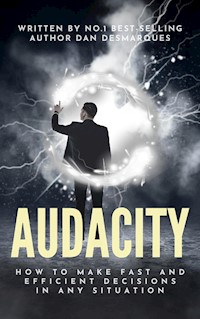
Audacity: How to Make Fast and Efficient Decisions in Any Situation
Dan Desmarques
Published by 22 Lions, 2021.
Table of Contents
Title Page
Copyright Page
About the Author
About the Publisher
Introduction
Chapter 1 - How Problems Prevent Happiness
Chapter 2 - The Illusion in Appearances
Chapter 3 - The Consciousness of the Spirit World
Chapter 4 - The Meaning of Our Identity
Chapter 5 - The Practical Benefits of Awareness
Chapter 6 - The Rationalization of Ignorance
Chapter 7 - The State of Mental Death
Chapter 8 - The Fear of Being Different
Chapter 9 - The Mental Prison of the Majority
Chapter 10 - The Influence of Guilt
Chapter 11 - The Value of Our Friendships
Chapter 12 - The Awareness of Freedom
Chapter 13 - The Importance of Change
Chapter 14 - The Triangulation of the Elements of Success
Chapter 15 - The Inner Transformation and the Perception of Reality
Chapter 16 - The Importance of Help in the Karmic Context
Chapter 17 - The Importance of the Problem in Spiritual Evolution
Chapter 18 - How We Enter the Spiritual Paradise
Chapter 19 - The Importance of Suffering for Learning
Chapter 20 - How to Accept Happiness in the Worst Situations
Chapter 21 - The Illusion of Social Reputation
Chapter 22 - Why Death Is So Feared
Chapter 23 - Why Compliance Doesn't Bother Most People
Chapter 24 - The Diseases of the Spirit
Chapter 25 - The Influence of Spirituality on Unemployment
Chapter 26 - The Causes of Inner Transformation
Chapter 27 - The Association Between Pleasure and the Mind
Chapter 28 - The Change Represented by Reincarnations
Chapter 29 - The Constraints of the Social System
Chapter 30 - The Unexpected Opportunities to Learn
Chapter 31 - The Awakening of Consciousness
Copyright Page
Audacity: How to Make Fast and Efficient Decisions in Any Situation
By Dan Desmarques
Copyright © Dan Desmarques, 2021 (1st Ed.) All Rights Reserved.
About the Author
Facebook: facebook/dandesmarques
Twitter: @dandesmarques
Instagram: @dandesmarques
Blog: dandesmarques.tumblr.com
About the Publisher
This book was published by 22 Lions
More information at www.22Lions.com
Introduction
Many of our problems in life arise from difficulty in deciding or for the fear of making the wrong decision. Despite this, the experience of making mistakes and the constant fear of making mistakes do not allow improving our ability to make good decisions.
The right decision, made with confidence, always starts from solid inner knowledge and is based on wisdom. A person may never have control over the future reality, and yet be able to make decisions that increase the potential for success.
The great leaders of human history, as well as successful entrepreneurs, have always been able to make the right decisions more often than most because they recognize elements in reality that other people cannot see.
In this book, you will discover what these elements are, and learn how to think effectively to maximize your results in all situations.
Chapter 1 - How Problems Prevent Happiness
Throughout our existence, we are faced with problems that need to be resolved, dilemmas that leave us reflecting on the best attitude to take in a given situation.
In the end, it is the result of our choices that allows us to become aware of the meaning of each one of them.
We can never go back, and if we could, we wouldn't go so far in the wrong way. But also, without these mistakes, we could not have learned.
We always run after the truth without ever reaching it, because the truth we seek also transforms us. And in the face of these transformations, we lose many of the people we love and respect, because these people are immersed in another plane of reality, with other challenges, largely different from ours.
The faster we learn and transform, the faster is the process I just described. But that doesn't mean our results are more visible.
Internal transformations can rarely be seen from the outside. Only we know the meaning of our sorrows, our depressions, and our fears. Others cannot understand the same emotions in the same way, because their soul has gone through a different process, among other lifetimes, in other places.
We come across many souls in the course of our lifetimes, and we all seek the same, the same happiness, peace and spiritual fulfillment, but we all seek it differently throughout our lives and between lives. If this were not so, if the truth were already in us, all dilemmas would be mere illusions.
In a way, this is true, if we look at problems as illusions of different levels:
• On the first level—we are faced with the force of inequality and misfortune;
• On the second level — we are faced with the polarity of decision and opportunity;
• On the third level—we face our own responsibility in shaping our problems.
• It is on the third level that people realize how they created their problems.
At this last level, the person no longer says, “She betrayed me” but rather says “I picked the wrong person”; and no longer says, “I was unemployed because I was fired”, but rather “I chose my profession and the wrong path in life”; and no longer says, "I am unhappy", but rather says "I must take responsibility for my own happiness."
Most people are between the first and second stages, either because they still choose to be slaves to money, the need to belong to a system that places them at a certain social level, or because they feel dependent on emotional structures to survive.
The vast majority of people live terrified by the fear of loneliness, and this is what keeps them from venturing through new paths in life.




