


5,49 €
Mehr erfahren.
- Herausgeber: The Mystery Press
- Kategorie: Krimi
- Sprache: Englisch
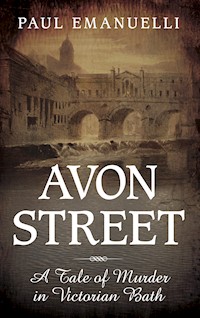
One night, one rash act, one crime changed James Daunton's life for ever. Robbed of everything he once had, and trapped in a merciless vendetta, James must now take on Nathaniel Caine and his gang to survive. Alone, he cannot hope to win, but to find allies he needs to learn to trust in a world of betrayal. Each of those who promise help has their own secrets, hidden in silences, half-truths and lies. And asked if it is fate, destiny, or simply chance that brings them together, each of them would have a different answer. Avon Street is an historical adventure story that takes the reader on a journey behind the Georgian façades of the city to expose the darker side of Victorian Bath. It is a book about the potential that lies, often unlocked or unrecognised, in all of us.
Das E-Book können Sie in Legimi-Apps oder einer beliebigen App lesen, die das folgende Format unterstützen:
Veröffentlichungsjahr: 2012
Ähnliche

















Contents
Title
Prologue
Chapter 1
Chapter 2
Chapter 3
Chapter 4
Chapter 5
Chapter 6
Chapter 7
Chapter 8
Chapter 9
Chapter 10
Chapter 11
Chapter 12
Chapter 13
Chapter 14
Chapter 15
Chapter 16
Chapter 17
Chapter 18
Chapter 19
Chapter 20
Chapter 21
Chapter 22
Chapter 23
Chapter 24
Chapter 25
Chapter 26
Chapter 27
Chapter 28
Chapter 29
Chapter 30
Chapter 31
Chapter 32
Chapter 33
Chapter 34
Chapter 35
Chapter 36
Chapter 37
Chapter 38
Chapter 39
Chapter 40
Chapter 41
Epilogue
What Really Happened in Bath in 1850?
Copyright
‘It was a much safer place for a gentleman in his predicament – he might there be important at comparatively little cost.’
Jane Austen, Persuasion
(referring to Bath)
Prologue
Thomas Hunt left his home in the early hours of that February morning in 1850 and made his way through the maze of Avon Street alleyways. Nestled in his arms was his three-year-old daughter, still drowsy from the beer that he had fed her earlier. As he walked, he rocked her gently and sang a lullaby; the same song over and over again.
Memory led him without thought through gaps and passageways half-hidden in the dark rookery of huddled buildings. He strode, unthinking, through the filth-filled gutters that ran beside rank after rank of windowless hovels. His senses were oblivious to the stench; his bare feet numb to the cold, his mind conscious only of the small, warm body in his arms, and the words of the song that bound them together. Still he walked on, stopping for nothing, his eyes registering nothing, until he reached the muddy banks of the River Avon. Only then did he pause for a moment to kiss his daughter’s forehead, before wading out into the river.
When the ice-cold waters began lapping at her body, she struggled against the imprisoning cradle of his arms. He held her tightly then and whispered softly until she was submerged. Her body arched and fought against him. Still he held her under the water, resisting her struggle for life, until he could feel no more movement.
Only when her body was still and limp did the reality of what he had done explode in his mind. He had wanted to protect her from his life, from the struggle to survive in Avon Street, from the inevitable loss of hope and faith. Now he understood that he had robbed her of her chance to be.
Holding her tight, he willed her back to life, willed the warmth of his body to pass to her. He held her tighter still, kissing her forehead time and again, holding her cold hand in his, and trying to call out for help and forgiveness. No prayer-words came. Instead he screamed, like an animal in the night, and buried deep within the formless sound he cursed the name of ‘Nathaniel Caine’, the only man he hated more than himself. Then, in the sudden peace of the silence that followed, he surrendered his life to the water.
Thomas Hunt was found later that morning, fifty yards downstream. The river carried his daughter’s body almost twenty miles away from him and through five battering weirs.
Map of central Bath circa 1850 by Cotterill. (Bath and North East Somerset Records Department)
Chapter 1
Eyes were watching him. James Daunton could sense them, probing and picking at his spine, like a surgeon’s scalpel. He turned and looked back down the deserted road that ran alongside the River Avon, but all he could see were the dark shapes of people moving to and fro across North Parade Bridge; faceless ghosts in the night, too far away to pose any threat. He turned back again, scrutinising every window and shadowy recess in the nearby Institute Building, but still he could see no one. Pulling his coat tighter, he walked on.
James dismissed his sense of foreboding as best he could, put it down to tiredness. The moon was full and low and bright; much brighter than the gaslights that glowed at intervals along the road. Its shifting white light was playing shadow-tricks with his mind, he told himself; conjuring ghosts where none existed. On instinct he reached inside his coat, checking that his money was safe. The back of his hand brushed against the letter. Searching for a distraction, he took the pages from his pocket. He already knew the letter’s contents by heart. Just holding it between his fingers was enough to send its sentences spilling again through his mind. It would be so easy to let it go, he thought; let the wind take it from his hand and carry it away, but that would solve nothing. He struggled to decide who had betrayed whom, and yet was left wondering if it even mattered?
Shivering, he returned it to his pocket and quickened his pace, anxious now for the company of friends. He turned before reaching the row of ugly factories and warehouses that blocked his view of Pulteney Bridge beyond and crossed through the shadow of the Abbey church. As the sounds of people drew louder, so his mind became easier. He smiled to himself, surveying the bustle of ramshackle, makeshift shops that hugged the Abbey’s side. Each stall looked as if a good shove would bring it tumbling down, and yet they survived.
In front of the shops, the air was rich with the scent of potatoes baking on smoking braziers. James struggled through the usual throng of beggars and street-sellers, with their trays of combs and pins, nutmeg graters and cutlery. He tried to avoid their eyes and outstretched hands. Then he noticed the girl, hidden at first in the crowd; a pale girl of seven or eight years. There was nothing unusual in her appearance. She wore a sacking dress and was playing on one of the penny whistles from the tray that hung around her neck. He saw that she wore no shoes, but then many of the children of the poor went shoeless. Everyone said it was to appeal to the sympathy of those they begged from, but he knew in his heart that it was more often from necessity. She shivered as she played, and yet she seemed oblivious to the cold, oblivious to the people around her; perhaps that was what made her seem so vulnerable. He found himself reaching into his pocket, shuffling coins. ‘This is for you,’ he said, pushing his way past the others and giving the girl a shilling.
She smiled at him, her eyes shining bright. ‘Are you buying them all?’
‘No,’ James replied. ‘You must keep them. You can sell them tomorrow. The money is a gift, a payment for your beautiful playing.’
She grinned and took a whistle from the tray, polishing it on her dress. ‘This one sings sweet as any bird,’ she said, holding it out towards him with a broad smile.
He accepted it and returned her smile. ‘Run home now, and get out of this cold night air.’ As he turned to walk away, he reached inside his pocket, grasping another coin, but when he turned back she had already disappeared from sight, lost in the crowd.
When he reached the Abbey churchyard it was busy and flooded with light from the tall windows of the Pump Rooms. He could see the people inside, taking their seats for the concert. The musicians were tuning their instruments, the discordant notes doing battle as they filled the air. Slowing occasionally, he acknowledged various acquaintances in the square with a nod of the head. He even exchanged greetings with one or two, but did not break his stride until he saw the person he was looking for.
Frank Harcourt was standing beneath the honey stone colonnades which formed an entrance to the churchyard from Union Street. A tall man of about thirty with a wiry, angular body, he stood head and shoulders above most of those around him. His face was striking, in both its strength and warmth; the always ready smile, displaying perfect white teeth, offsetting the harder aspects of his features. He was of course impeccably dressed, as usual, everything tailored to his own precise requirements, everything perfectly matched.
‘You’re late, James,’ Frank said. ‘It seems to have become your custom of late.’
James held out his hand. Frank was never late of course, though he never seemed to hurry anywhere; always composed and at his ease, always so sure of what he wanted from life. James envied him that certainty of purpose and resolute optimism. ‘My apologies Frank, I needed to walk for a while and clear my mind.’
Frank laughed. ‘Don’t look so concerned. I arrived only a few moments ago myself.’ He reached out and shook James’ offered hand. ‘And what do you have there, hidden in your coat?’
James brought out the whistle with a smile and placed the tips of his fingers, with elaborate precision, on its finger holes. He pursed his lips several times, in preparation, his face overly serious, as though he was readying himself for a solo concert performance. ‘I would like to play, for your enjoyment, a lesser known piece by Mr Mozart.’ He put the mouth-piece to his lips and produced a short cacophony of random, tuneless notes to the obvious displeasure of several passers-by.
Frank laughed. ‘Mr Mozart would never recognise his composition.’ He turned, smiling, and made to leave. ‘You are a gentleman of many talents, James, but playing the tin whistle is not one of them.’
‘We are not due to meet your friends for hours yet,’ James said, putting the instrument in his pocket. ‘Why did you wish to meet so early? Where are we going?’
‘If I told you our destination you would probably provide a hundred reasons not to go there. Trust me and I will show you where some excitement can be had in this tedious city.’
‘I take it we are going to Avon Street?’
Frank laughed. ‘You know me too well James. Avon Street has so much to offer, provided one knows where to seek it out.’ He paused, his expression questioning for a moment. ‘Correct me if I’m wrong, but I thought that you had enjoyed our recent forays to the place?’
‘They were entertaining, yet not without a certain amount of guilt.’
Frank smiled. ‘Ah yes, guilt – a much wasted use of a man’s time in my opinion. Something best kept for old age, when one has little else to do. Besides we’re only going as far as Westgate Buildings. You can barely smell Avon Street from there.’
With Frank leading the way they soon reached a busy Kingsmead Square. Two constables stood beneath the bare trees at its centre, chatting and nodding occasionally to passers-by. The tops of their tall stovepipe hats and the silver buttons on their long tunic coats glistened in the light of the nearby street lamp. James noticed that they kept their gaze resolutely diverted from the open doors of the nearby warehouse, in Westgate Buildings; the doorway to which the crowd was so obviously drawn.
❖❖❖
James shielded his eyes in the light from the doorway of the massive warehouse and, like all the others, handed over a shilling to one of the burly men guarding the entrance. The smell that greeted him as he entered the building was as pungent as a dose of smelling-salts. The sweat of the crowd mingled with the reek of stale beer, and did battle with an overpowering stench of sewage.
James hesitated for a moment, and held his hand up by reflex to his nose. At the side of the door, crowds jostled to get near to a table loaded with barrels, though the place could hardly have had a liquor licence. He considered buying a drink, but thought better of it and followed Frank, who was already making a path for them through the mass of bodies.
In his desperation to keep up, James pushed by a man standing, drinking in the crowd. The push caught the man off balance, sending him stumbling forward. When he turned, the effects of his shove were all too apparent; the man’s waistcoat and trousers were stained with dark patches of spilt beer. James tried to smile, stumbling over words of apology, but half suspecting that it was pointless before the words were spoken. He watched as the man passed his now largely empty mug to one of his friends. The man was grinning, but it was a cold grin. He reached out suddenly and James felt the man’s fingers around his throat, pushing him backwards into the crowd. It took him by surprise. He could smell the beer on the man’s hand as he tried to pull his hand away, but his hold was too strong and the more he struggled the tighter became the grip. ‘I apologised,’ James said, struggling for breath.
‘Did you now?’ The man laughed and drew back his other fist to strike, just as Frank stepped out of the crowd to the man’s side.
‘Enough of this!’ Frank said. ‘My friend meant you no harm. It was a simple accident.’
‘Wait your turn,’ the man replied, half-looking in Frank’s direction, his cold hand retaining its grip on James’ throat. ‘I’ll sort you out later.’ Then he looked towards his friends. ‘Or do you want him, lads?’ They moved forward in response.
Frank moved to James’ side. Using the diversion, James brought his arm up with force and broke the man’s hold on his neck and stepped back. He knew now that there was no escape.
‘We want none of this,’ Frank said. ‘Reconsider!’
The man took a step forward, laughing. Then his expression changed. James followed the frightened stare of his eyes and saw the man who had pushed his way through the crowd, behind Frank. He was a bewhiskered giant of a man with an ugly scar running across the width of his cheek. Everyone around them seemed suddenly quiet in his presence.
His opponent took a step backwards, pushing his friends to one side, a strained smile on his now ashen face. ‘Just a misunderstanding,’ he said, looking at the man with the scar. ‘I meant no offence Mr Caine.’ His words trailed off as he lowered his gaze and then turned, trying to smile in Frank’s direction. ‘I was just larking about. I wouldn’t have hurt him.’
Frank stared back at the man. ‘You should apologise to my friend.’
‘I’m sorry,’ the man said, turning to James.
James nodded and then turned away, looking around him for the scar-faced man, but his vast frame was already some distance away and he was fast disappearing into the crowd. Frank threw an arm around James’ shoulder. ‘Follow me, James,’ he said, ushering him through the crowd. ‘There’s money to be won.’
‘Did you know that man?’ James asked.
‘No more than you did. Let’s be grateful that he saw reason before something came of it. They might have beaten us senseless, or had us ejected before we had a chance to lay a bet.’
‘No, you misunderstand,’ James said, ‘I was referring to the large man standing behind you, the man with the scar. The one he called Caine.’
Frank brushed the sleeve of his coat with the back of his hand. ‘Perhaps he was one of the organisers, or one of the thugs they employ to keep the peace. Now let’s find a bookmaker and relieve him of some money.’ He tidied his collar and walked on.
Robbed of the promised fight, the crowd surged forward and James felt himself propelled ever closer to the rough wooden amphitheatre in the centre of the warehouse. All around him men were standing on benches and tables, all looking in the direction of the arena. James could now see into the circular wooden pit. It must have been twelve feet in diameter, he estimated. Within seconds he found himself pushed up against the stout, rough wooden fence, felt it digging into the bottom of his ribcage.
At the far side of the arena was a small mound of hard-packed red earth where twenty or so rats were gathered, scrabbling at the wooden walls. The rest of the circular floor was littered with the bodies of dead rats. The stench was appalling. Above the pit, lanterns were suspended, lighting every inch of the bloodied ground below, and every crevice in the fence surrounding it.
He watched as a young boy with a broom walked up to the arena, through a wide gap between the benches at the far side of the room, and unbolted a gate in the fence. Entering, he took the stave, hooked to a cord around his trousers, and began, with incredible accuracy and dexterity, to dispatch any rats that showed signs of wounds. Then, taking up his broom, he swept the torn bodies into a pile, before picking them up in bunches, by their tails, and flinging them into the corner of the room, counting the corpses out loud as he threw them. On the corner walls, behind the growing heap of bodies, James could make out rows of collars and several stuffed heads of dogs, with staring glass eyes and torn fur.
When the arena was clear the Master of Ceremonies, a squat man with a pockmarked face and a booming voice, stepped to the gate. ‘Let’s have some quiet now,’ he roared, ‘and all of you who has dogs, keep they quiet too.’ Men scrabbled to get a view, fighting to get to the tiered platforms at the sides of the room; standing on tables and benches in the centre. ‘The next dog is the third of the six we have before you tonight,’ the fat man continued. ‘You’ve all seen him before. His name is Captain. His owner is Caleb Brown and he hails from Wiltshire. The bookmakers will be pleased to take bets on first and second for the night, and on the individual kill for each dog. Please place your bets, gentlemen. The rules be the same for every match, fifty rats in the arena, and as many rats as he can kill stone dead, not wounded, in fifteen minutes, is what the dog scores. The winner tonight will take away a silver collar and three gold sovereigns. Now, let’s have the rats and only the girt big uns mind.’ The crowd cheered.
James grabbed hold of the nearest bookmaker. ‘How did the first two dogs fare?’ he asked.
‘They was just to make up numbers; novice dogs getting their first blooding,’ the man said. ‘The first had twelve and the second twenty-three.’
‘What odds will you give me on Captain to take the night?’
‘Captain’s the favourite. You won’t get better than evens anywhere in the house.’
James held out four notes to the man. ‘Twenty pounds on Captain to win then.’
‘I can’t take that,’ the bookmaker said. He muttered under his breath, ‘Bloody gentry … All the same … throwing their sodding money about.’
‘Damn me!’ Frank interjected loudly, staring intently at the man, before bursting into mocking laughter. ‘Has the world gone mad? You must forgive us, my man. We thought your livelihood depended on the taking of bets. We hadn’t realised that you were selective in your choice of customers. Is there perhaps something wrong with our money?’
James smiled, but the bookmaker’s words had taken him by surprise, made him think. He could see now, all too well, that the stake was excessive. He needed a win and a sizeable win, but he knew nothing of the sport, nothing of the dog’s form, and he had wagered far more than he could afford.
‘There’s no need for that,’ the bookmaker said. ‘It’s just as I can’t carry a bet that big on the favourite. I haven’t got time to lay it off.’
James looked at Frank. ‘The bet was too large. We have the night ahead of us and the card game in a few days time.’ He turned to the bookmaker, ‘Five pounds then. Will you take the bet?’
‘I’ll take it,’ the bookmaker said, as he passed the marker to James. ‘And you?’ he asked, looking in Frank’s direction. ‘The clever one – do you want Captain?’
‘No, I’ll have five pounds on the sixth dog; if you’ll give me odds of three to one or better. I believe he goes under the name of King George.’
The bookmaker snatched the note from Frank’s hand. ‘I’ll give you three to one, but I can’t do better.’
James smiled at Frank and then turned his attention back to the arena, trying to forget his impetuousness. The Master of Ceremonies had left the ring and the young lad had taken his place again. This time he had no broom, but was carrying two wire cages in his scarred hands. They were filled with new rats, enough to replace each of the corpses he had thrown from the arena. The stench from the cages left no doubt as to their origin.
His duties done, the boy bowed, acknowledging the roars of approval from the crowd. One or two threw coins into the ring, which the boy quickly seized on, brushing the rats aside, wincing, but feigning indifference at the occasional bite.
James watched as the rats ran towards the raised mound at the side of the fence, heaping body upon body as they fought to escape, until the mound of earth was covered by a living, moving heap of rats, scrabbling over each other to climb the barrier. The boy walked nonchalantly to the gate and tossed the cages over the fence. Captain’s owner passed the small brown and white terrier to the boy by the scruff of the neck and clambered over the fence into the arena. Then the boy handed the dog back to him and vaulted the fence. The man moved to the centre of the arena holding Captain and as the Master of Ceremonies called out that the time had begun, he released the dog. The rowdy gathering let out a huge roar and money began to change hands quickly.
The crowd chorused, as though with one voice, ‘Blow ‘em! Blow ‘em!’ and James watched as those leaning on the fence, above the mound of rats, stretched over and blew furiously. It seemed to unnerve the rats, causing them to scatter from their defensive mass, making them easier prey for the dog. Bodies flew from the pack as the dog tore into them. Each rat shrieked its own death, as the dog’s jaws snapped and shook.
Then one of the rats bit into the terrier’s nose and clung on, blood soaking its coat and the ground around. A second took hold of the dog’s upper lip. Captain yelped with pain and tried to toss the rats free, but they clung on, and the bleeding increased as the wounds grew deeper. James willed the dog to free himself.
By the time he was free, the dog had lost precious seconds. Urged on by his owner, Captain again tore into the rats, seemingly oblivious to the pain. When the whistle blew, the dog’s owner seized him by the leather collar around his neck. Thirty-nine dead rats were counted in the arena.
A good result, despite the set-back, James thought, but the sport was not to his liking. The dogs and rats might only be following the dictates of their nature, yet there seemed little natural in taking pleasure, and even profit, in such a staged and bloody slaughter. He could see the dog was still bleeding from his nose and mouth and watched as his owner took a bottle from his pocket and poured it over the dog’s face. For a few seconds the scent of peppermint masked the smell of the sewers.
‘I fancy a dousing in peppermint water will do little to help the dog,’ Frank said. ‘The sewer rats have a habit of giving dogs the canker from their bites, and that dog is badly bitten.’
The words made James feel uncomfortable. He tried to brush his thoughts aside, reaching into his pocket for more money, but his hand found the letter again and the old concerns came flooding back. Looking at the faces around him, grinning and laughing and noisy, he felt uneasy. He longed for the cool night air outside and some quiet, and time to think. The voices of his conscience and the expectations of others, normally mute when he gambled, were suddenly loud. He counted his remaining money and then thrust it back into his pocket, unable to shake his feelings.
‘You look somewhat ill at ease,’ Frank said.
‘I’ve had enough of this place,’ James replied.
‘Was it that oaf who upset you earlier? Or is it the stink of the sewer rats? I know it isn’t to everyone’s taste, but they put up a better fight than barn rats. It strikes me as a damnably good event.’
‘It feels more like butchery to me, than sport. I am tired and there’s work I need to complete tomorrow, business that I should have attended to long before now.’
‘You can’t leave me to my own company so early in the evening.’ Frank laughed. ‘And if the work has waited this long it can always wait a little longer.’
‘It’s fine for you. You don’t need to work, but work is an increasing necessity for me.’ James held out the marker for the bet. ‘Could you collect anything due me?’
Frank shook his head and put both hands behind his back, smiling. ‘A good stiff brandy will soon set you right.’ He took a hip flask from his pocket and drank, before passing it to James. ‘You can’t desert me, in such an ungentlemanly manner. Stay, at least until we know the result.’
James took a drink and handed the flask back. Frank put his left arm around his shoulder and laughed, and James felt compelled to return his smile. ‘I’d never have suspected when we first met that you would become such a good friend and such valued company,’ Frank said. ‘You spend too much time with people like Dr Wetherby. How such a dreary man attracted such a beautiful wife, or a friend like you, remains a mystery to me.’
‘Richard is a good man,’ James replied. ‘It’s a pity that there is no liking between the two of you.’
‘It is as it is,’ Frank said. ‘Now have another wager, while we see how my dog fares and then we’ll move on.’
‘No,’ James replied, ‘I have gambled enough. The more I try to make good my losses, these last few months, the greater they grow.’
‘You’ve just had a run of bad luck,’ Frank said. ‘It must end soon. At least stay until we know the result. You cannot leave me alone in this mob and I have friends waiting in The White Hart Hotel, influential friends. I promised I would introduce you to them.’ He smiled. ‘I’m sure that one of us will win tonight and whoever wins will pay for the remainder of the evening.’
‘Very well,’ James said. ‘I will stay, but I’ll not wager more.’
Chapter 2
Belle Bennett waited in the wings for the others to arrive, as she did every night. It had begun years ago, become a habit, and then grown into a superstition. She had to be in place before she was called, as though if she was ever late her performance might suffer. Those few minutes between curtain-call and taking her place on stage were when she felt most alive. She drank in the heady mixture of apprehension and exhilaration, more intoxicating for her than any wine.
As the others joined her, Belle smiled at them. This too was instinctive, the mutual giving and exchanging of reassurance and support before the show commenced. One or two looked, at first, as though they might return the gesture, but as Cauldfield pushed his way past them, their expressions froze and their smiles died, only half-formed.
Cauldfield winked as he passed her. His breath was rank in her nostrils, as he pressed his body hard against her. ‘I’m sorry that you have such a meagre part again, my dear, but the peasant dress is very becoming.’ He grinned and put his hand on her shoulder for a moment, before sliding it slowly, down her bare arm. The sweat of his palms felt clinging and oily on her bare skin. ‘Your life could be so much easier,’ he whispered. Then he drew back, as if waiting for her to react. Belle struggled to keep the emotion from her face, biting back her words, saying nothing as she scrubbed instinctively at her arm. ‘Everyone is going to The Garrick’s Head for a drink afterwards,’ he resumed, speaking loudly enough for the others to hear; almost loudly enough for the audience in the front row of the auditorium to hear. ‘Will you be joining us?’
She turned and looked at the others. She knew what was expected of her; expected of them all. Actors and actresses had to be seen around town, promoting their current production, bringing in the paying crowds. She was torn for a moment, wanting to join them, wanting to laugh and forget for a while, but she knew she would not be allowed to forget, because Cauldfield would be there. ‘I think not,’ she said. ‘I’ll more than likely go straight home tonight.’
Cauldfield seized immediately on her words, with his by now familiar superior smile, addressing the others as though he was already on the stage with a captive audience. ‘Perhaps Miss Bennett is too consummate an actress to be seen with mere players, such as ourselves.’ He laughed. ‘Though one might have thought that she could at least try to make use of what looks she has, to bring the gentlemen in.’ He turned to her. ‘Or do you think they come to see you act?’
He smirked, as though it had been some innocuous joke. The ever doting Daisy draped herself around his shoulders. He kissed the girl’s cheek and smiled. ‘Don’t prize yourself too highly, Belle, or you’ll only have further to fall.’ Two months ago, or even one, and she might have matched his words, but not now. Cauldfield turned to the others. ‘Our little Belle thinks herself better than us. She truly believes that she has an exceptional talent.’ Then, grinning at her, he said it. ‘I believe it was the very same belief that deluded your father and mother.’
She wanted to rake the smug smile from his face with her fingernails. Instead she said and did nothing. As she turned away their quiet laughter stung her tired mind, yet it did not hurt as much as her own silence. She realised now the extent of the power he held over her.
❖❖❖
When Belle emerged from the Theatre Royal it was almost midnight. She busied herself fastening the bottom buttons of her coat, resisting the urge to run, as she watched the others troop into The Garrick’s Head. The wind was strong and threatened to tear the bonnet from her head. She took the white glove off her right hand. The cold air stung her fingers and numbed her body. She noticed her hands were shaking as she pushed the strands of windblown hair back into the confines of the bonnet and struggled with the ribbons, pulling them tighter, before retying them beneath her chin.
As the door to The Garrick’s Head swung closed, the square fell back into a dark silence. She listened to her own solitary footsteps, echoing in the emptiness, as she crossed the deserted, cobbled square. Saw Close was flanked by stables and hauliers’ yards and a cattle market had taken up much of the square when she had walked to the theatre that afternoon. Now that the wind had dropped, the air was full of the sweet, sickly stench of the animals. She feared for her shoes and the hem of her dress, but, looking down, she saw that the cobbles had already been swept clean by the scavengers, with their carts and buckets, collecting the cowpats and horse droppings; wasting nothing that could be used or sold.
Walking past the Bluecoat School, she entered the darkness of Bridewell Lane. The top of the alley was poorly lit and one of the houses there was derelict. Its doorway was boarded up; the number ‘nine’ gouged into the wood of the central plank, as though visitors might still be expected at some time. An involuntary shiver shook her body. She struggled to understand. It had happened on previous nights, this feeling of evil, haunting that doorway, as though it still carried the memory of some violent act. She quickened her pace, drawn ever faster, like a moth, to the well-lit lower end of the lane, where the houses were new and all their portals intact and secure.
As soon as she saw the door of number two Bridewell Lane, she felt its comfort. She opened it quietly and crept carefully up the creaking staircase. Turning the knob of the door at the top of the stairs, she silently eased it open. Jenny’s voice greeted her softly. ‘Don’t be concerned,’ she said, ‘Molly’s fast asleep. With any luck she shouldn’t wake now until morning. I knew you’d be home soon, so I put some coals on the fire. Warm yourself, you must be freezing.’
Belle gazed down at Molly’s tiny frame as she lay sleeping, lost in the vastness of the bed. She seemed so peaceful, a blissful three year old, wrapped in the comfort of child-dreams. Belle leant forward and kissed Molly on the forehead, enjoying the scent of childhood innocence. ‘She grows more like her mother, each day,’ she whispered.
‘She’s far prettier than I ever was,’ Jenny replied.
Belle took off her coat and gloves and sat on the corner of the bed, tugging at her boots. The left boot had begun letting in water recently. As she turned it over in her hands she noticed the stitching was coming apart on one side. The sole was worn as thin as paper at its centre, but at least there were no holes, no need for patching yet.
The warmth of the room wrapped itself around her like a soft blanket, enveloping her in its sanctuary. She looked around, breathing in the reassurance of familiar surroundings. It was a simple room; not large, but comfortable enough for the three of them, dominated by the large bed at its centre. Two chests of drawers stood in the recesses on either side of the fireplace; one for herself and one for Jenny and Molly. There were three upright chairs, one on either side of the bed and the one on which Jenny was sitting at the small work table beneath the window. The only other furniture was a small dressing table and a wash-stand and between them stood her travelling chest.
She walked over to Jenny and put a hand on her shoulders. ‘If Molly grows to be half as pretty as her mother, then she will be a true beauty.’
‘It’s you who turns all the heads, whenever I’ve been out walking with you.’
‘Nonsense,’ Belle replied, embarrassed yet enjoying the compliment.
She studied Jenny’s face, deep in concentration, the tip of her tongue protruding slightly between pursed lips, as she threaded tiny jet beads onto the cotton, and sewed them with intricate precision into the neckline of the bodice she was finishing. ‘You make me feel guilty. I wish you would stop working. You were sewing when I woke this morning and you’re still at it now. Your eyes must be tired, working in the candlelight.’ Jenny was in her early twenties, as was she, but her face seemed older. Belle watched her stand, her spine at first refusing to straighten, until, hands on hips, she arched her back into comfort again and stretched, before tidying her work.
‘I’m not the only one who looks tired.’ Jenny said, studying her. ‘You look worried. Has that Cauldfield been bothering you again?’
‘No.’ The lie came without thinking. ‘I’m just tired. Cauldfield’s too busy with one of the other girls now, to pay much attention to me.’
‘Not that Daisy girl from Wells, her with the big chest?’
Belle smiled. ‘She’s the one. And whatever she may lack in wit, she more than makes up for in the willingness of her disposition, as I’m sure several members of the company could vouch – the men, that is. But, if she keeps him occupied and meets his needs, it’s all to the good.’
Jenny grinned. ‘Would you mind if I left my work things out, so I can start first thing in the morning?’
‘Don’t worry on my account.’
‘I washed your grey dress and hid the fraying hem with some ribbon I’d saved.’
‘You do too much for me. I don’t deserve it.’
Jenny walked over to the bed, undoing her dress. ‘You do deserve it and more, but still, we must be grateful for what we have, and help each other how we can.’ She leant over and kissed Molly’s forehead. ‘I heard today of a poor young girl who was drowned the other night in the river, and her father with her. He must have been trying to save her.’
Belle shivered. ‘How awful, and you’re right of course. We should be grateful.’ She hesitated, wondering if she had the energy to say what needed to be said, and to deal with its inevitable effect. She took off her earrings and placed them on the dressing table, catching her reflection for a moment in the mirror. Tired, blue-grey eyes stared back at her, as though it was a stranger she was looking at. She remembered sitting with her mother, talking, and taking it in turns to brush each other’s hair, the silk, auburn strands caught in the bristles of the brush, mother’s and daughter’s indistinguishable. Now her hair was a mess of shapeless tangled knots, but she did not have the energy to brush it, though she knew she would regret it in the morning. Turning away, she poured water into the bowl on the wash-stand, and dabbed what she could of the surplus powder from her face. ‘I’d hoped we might talk for a while,’ Belle said, ‘but we’re both probably too tired.’
‘You talk while I get ready for bed.’
‘The theatre was half empty tonight,’ Belle said, trying to lay the ground. ‘There was a concert in the Pump Rooms and some awful ratting contest in Avon Street. And I’ve no work tomorrow either. There’s a touring operetta company appearing in the theatre.’ She hesitated, feeling her way. ‘I may not have enough to pay all my share of the rent this week.’
‘We’ll manage somehow. You’ve paid more than your share when I’ve been short. Have you seen anything recently of that gentleman friend of yours?’ Jenny asked, getting into the bed. ‘You never speak of him.’
‘No,’ Belle replied, ‘and I hope I never shall again.’ The time for saying what she really needed to say had gone in that moment. It would have to wait. The sudden feelings of anger and pain had taken her by surprise. She had struggled to keep the emotion out of her voice, but knew that she had failed.
‘I’m sorry,’ Jenny said, ‘I’m a fool for mentioning him. I should have understood. I don’t know where Molly and me would be without you, and I don’t just mean you helping with the rent.’ She pulled the sheet up to her chin. ‘Goodnight, Belle.’
Belle blew out the candle on the worktable. ‘Goodnight Jenny.’ She moved the chair noiselessly to a place by the fire and sat, bathing in the flickering warm glow of the fire. Though she fought it, the image of his face would not leave her mind now. He had won their game; a game she had not even been aware that they were playing. She wondered how she could have been so stupid as to love him. If she needed another reason for leaving, the prospect of meeting him again certainly provided it. She searched inside for warmer memories; looked around the room, willing friendly ghosts into existence, but all she saw were the flickering shadows. There was no doubt in her mind now. She had to leave Bath.
Chapter 3
Sitting in the armchair by the fireplace, in the large basement kitchen, Nathaniel Caine struggled to pull off his fine boots. He grimaced at their resistance; a film of sweat and grime binding skin to leather. Still, they looked good and that was the main thing; did him justice, as the man of means he now was. Perhaps they were too tight, but then again they had cost him nothing.
Caine massaged the life back into his bare, aching feet, rubbing the corns and blisters, raised and red, against blackened blotchy skin. When he had finished, he cupped his hands to his face and inhaled with quiet satisfaction. Smiling to himself, he remembered how the boots had come to him. He’d had much less of a struggle removing them from the feet of the gentleman who used to own them than he had just had taking them off his own feet; but then the gentleman in question had been unconscious at the time.
Caine sat back in the chair, allowing himself a moment of satisfaction. In here he had nothing to fear from the outside world. The house in Hucklebridge’s Court dwarfed its neighbours in strength and size. Its doors were solid oak, and always kept locked and bolted. Most of the windows had been bricked or boarded up, and behind each of the windows that still held glass was a row of strong iron bars. It was a fortress amongst the ramshackle Avon Street hovels that surrounded it. No, Caine reflected, he feared no one outside those walls. Yet his companions inside the house were a different matter.
Unfolding the old newspaper that had been lying on the seat, Caine scanned over the front page, filled with notices and advertisements. They were of little interest to him. He was proud of his learning. It set him apart. He’d had to pay for it of course, and not just in money. Admitting his ignorance to another man, and one who had been younger than him, had hurt. To have that man look down his nose at him for month after month, treating him like a child, had hurt even more, but he’d never reacted, never once given way to his temper.
His teacher had overcharged him. He had known that even then, but silence always comes at a price. Still it had been worth the money and the trouble. He could still remember how good it felt when he paid him that last time. His instincts had told him to kick him up the arse, but instead he had wished him good day and said, ‘Your services are no longer required.’ The look on his face was worth the restraint. There had been no need to warn him about keeping their secret. He knew the tables had turned.
Lowering the paper for a moment, Caine switched his attention to his companions, playing cards, sitting at the long mahogany table in the centre of the room; swirls of smoke rising from their pipes and circling above their heads. None of them can read properly, he thought, gazing at the bovine faces gathered around the table. One or two of them knew enough to master the lists of names he gave them, lists of debtors to be collected from; but he was the only one who could truly read, and make sense of numbers; the only one who knew exactly who owed what, and when they were due to pay. It was a profitable business, money lending, especially when he had seen off all of his competitors. Then there were those who paid for his protection, he needed to keep records of those too, to make sure they got visited regularly, got reminded who was in charge in Avon Street.
Caine stretched his tired legs, feeling his age for a moment, yet he was not that old, he told himself. The card game was getting noisier. Jeb was shooting his mouth off again, trying to intimidate the others; bluffing as usual. Caine smiled to himself, knowing all too well that the louder Jeb shouted, the worse his hand would be. It was when he was quiet that Jeb was dangerous. If ever a man had earned his appearance it was him; a permanent sneer etched into every line and twist of his features.
As Jeb added to the already tidy pot of money in the middle of the table, three of the men stacked their cards, swearing various oaths in the process. It was now between Jeb and the Wood brothers, Harry and Tommy. ‘Don’t get too bloody comfortable!’ Caine shouted. ‘There’s business to be discussed.’
‘Did we do well at the ratting tonight?’ Jeb asked, putting his cards flat on the table for a moment and turning around.
‘Aye we took a good cut,’ Caine said, ‘and there was no trouble – thanks to me.’ There were a few grunts and groans around the table, but no one spoke back. Caine studied Harry Wood’s face. He would win, no doubt about it, you could see it in his eyes. Jeb could bluff for as he long as he wanted, but Harry was a cold piece of work. Caine watched him. He never seemed to look at his own cards, never arranged or ordered them in his hand; just watched Jeb’s face, like a fox playing with a chicken.
Jeb did not have many allies amongst the crew, but there were some that would pitch in with him out of fear, if they thought the time was right. He might not be as hard as Harry, but he was just as dangerous. Show him any weakness and he picked away at it, like a sore. Jeb would remember a grievance and let it fester for weeks, till you thought it was forgotten. Then he’d have you.
Jeb picked his cards up again and stared at Tommy Wood, willing him to back down. Tommy grinned from ear to ear, but Caine guessed he would throw his hand in sooner rather than later. No killer instinct in that lad, never took anything serious. Still, you couldn’t help liking the lad. There was a spark of something in him that set him apart. Everyone liked the boy, apart from Jeb.
Caine smiled as he watched Tommy, sitting there grinning, making jokes at Jeb’s expense. No one else would get away with it, Caine thought, but Jeb knew all too well that if he took Tommy on, he’d have Harry to deal with, and in cold blood not one of them could beat Harry in a fight. But when Harry lost his temper his blood boiled and he lost all sense. He’d come at you then like a bull at a gate. That was when he was vulnerable. It was then he could be beaten.
Yes, it was Jeb and Harry Wood that needed careful watching now, but Caine had their measure. He stroked the deep scar that curved around from his left ear and disappeared into the whiskers, at the corner of his mouth, grinning to himself. If they were both threats, it was no bad thing. Keep them set against each other; keep them uncertain, fighting for favour. That was the way. Like people said; divide and rule. ‘Did you collect from Rickman at the Kingston Mills, Jeb?’ Caine asked. The room fell silent.
Jeb looked uneasily towards him. ‘No, Nat. We went there but he still won’t pay and he got a bunch of his lads to see us off. If I’d had more men with me … ’ He broke off the sentence and spat on the floor. ‘There was just too many of them.’ The silence grew deeper.
Caine knew they were waiting for him to react. ‘Fine,’ he said, ‘torch the warehouse tomorrow night. He’s got a thousand pounds worth of flour and wheat in there. Let’s see how he likes saving the few pounds he should have paid us, compared to what it’s going to cost him. Maybe it’ll learn a lesson to anyone else who’s thinking of being brave.’ They all laughed.
It wasn’t meant to be like this, Caine thought. His partner had told him how easy it would be in Bath, how there was more money to be made from selling protection to the factories and warehouses than from farmers. He had been right, but only in part. The gentlemen didn’t bend as fast as farmers. They thought the law was there to protect them. Maybe they’d bend better now when they saw what he could do, or perhaps he was overstepping himself? Only time would tell. Still it was easy enough making money out of the poor. He’d been right about that. Lending to those who couldn’t afford to borrow was a very profitable business.
Caine looked at Harry Wood and then at Tommy again. A few years separated the brothers in age though they might still have been mistaken for twins. They were both tall and stocky in build and both had the same curly brown hair. Their features, too, were similar, though Tommy had a plump face whilst Harry’s face was thinner and slightly jaundiced. The real difference between them though was in their characters. Tommy was always cheerful and full of humour. Harry was given to brooding and much darker in his moods. He had been the head in their family since the day the man who called himself their father had run off to God knows where. Harry must have been about thirteen then, Caine thought. It had made him strong, but it had also given him a weakness. ‘He’s getting too bloody soft, that brother of yours, Harry,’ Caine shouted. ‘People won’t pay if he’s always smiling at them.’
Harry looked up. ‘It’s just his nature. Don’t worry yourself; they’ll pay, while I’m with him. We balances each other out.’ He turned to his brother and winked.
‘This bain’t be something to laugh at,’ Caine spat back. ‘You’m getting behind with your collections Tommy.’
Tommy winced. ‘I’ll back you up against anyone, and thieve for thee as good as the next, but it goes against the grain, taking from them who has nothing. I don’t like this lending business. You charge so much and then they can’t pay.’
‘If you don’t like it you can allers move on.’ Caine watched as Harry stood and put a hand on his brother’s shoulder. He wondered if this was the right time. He watched as Jeb put his cards on the table and reached slowly down towards the hilt of the knife that protruded from his boot. There was nothing Jeb would like better than to see the Wood brothers off.
He sized up Harry Wood again, letting the silence grow. He didn’t need to take him on, not now. It was enough just to stir the pot a bit between Harry and Jeb, remind them who was boss. Caine smiled. ‘Settle down Harry. Just get the lad in order.’ He smiled at Tommy. ‘You’re a good lad, Tommy – just a bit too soft for your own good.’
Tommy smiled back. ‘But I make you laugh don’t I Nat?’
‘Aye, you do that,’ Caine said.
Harry smiled and sat. ‘Leave it to me, Nat. You know you can trust us.’
Caine nodded discretely at Jeb, acknowledging his support. Jeb nodded back and smiled to himself as he picked up his cards again. Caine went back to his paper. He’d done all that he wanted and never once had to move from his chair.
For a few minutes the room was quiet except for the sound of money being thrown into the pot, and his own occasional turning and folding of the paper. The piece about the drowning was the last thing he expected to see.
Caine leapt to his feet without thinking and the room fell silent. ‘Bastard,’ he shouted, ‘that bastard Tom Hunt! It’s all in the paper about him and his brat drowning.’ He tore and ripped at the newspaper, before hurling the crumpled mass into the fire. ‘He’ll be more trouble dead than he was alive, if we don’t do something about it.’ Then as he watched Harry raking in his winnings Caine began planning his next move, and the one after that.
Chapter 4
As soon as she awoke, Belle was aware of the whispering voices on the other side of the room. It was obvious that Jenny was working hard at distracting Molly in an effort to keep her quiet. Belle kept her eyes closed for a moment, enjoying the quiet chatter of mother and daughter. For a moment she allowed herself to share in their enjoyment of being together, knowing how much she would miss them when she left. When, finally, their conversation was punctuated by Molly’s laughter and Jenny’s shushes, Belle stretched and sat up in bed. ‘You should have woken me.’
As if in answer, Molly climbed down from her chair, ran across the room and threw herself onto the bed, wrapping her small arms around Belle’s neck; hugging her with all the strength that her three-year-old body could muster. ‘Big kiss for Belle,’ she said.
‘Don’t strangle your Aunt Belle,’ Jenny called to Molly. ‘Sorry, she’s wanted to wake you for ages, but you were sleeping so soundly I didn’t want to disturb you. Besides it’s still early, and pitch black outside. There’s a mug of tea there on the chair beside you. It should still be warm.’
Belle tickled Molly into a fit of giggles and then turned to Jenny. ‘It’s best I get this over with quickly. I wanted to tell you last night, but we were both tired and it seemed best left until the morning. I’m afraid I have some bad news.’
Jenny looked up from her work. ‘What is it?’
‘I told you that the theatre was half empty last night and that I have no work today, and that I was short of money.’
‘And I told you that we’ll manage somehow.’
‘That’s not the worst of it,’ Belle said, preparing herself, watching the concern growing in Jenny’s expression. ‘Cauldfield’s starved me of work, these last two weeks or so, given me only minor parts to play. And he’s made it clear I was lucky to get even those.’ She hesitated. ‘I think I’m going to have to leave Bath. I’ve no money and he’s slowly killing any confidence I had.’
‘Come away, Molly,’ Jenny said. ‘Let Aunt Belle drink her tea in peace.’
Belle dabbed at her eyes with a corner of the sheet and then put her arm around Molly’s shoulders. ‘No let her stay,’ she said. ‘Molly’s no bother, are you?’ She tickled her again and kissed her cheeks repeatedly, until Molly buried her head under the bedclothes.
‘You can’t leave,’ Jenny said. ‘You’re part of our family. You have been since the beginning. That first morning when you came to see the room above, it was no accident that I bumped into you on the stairs. I saw you from the window when you arrived and Molly and I both liked the look of you. We waited by the door for ages, waiting to hear you on the stairs, and we didn’t invite you in from the goodness of our hearts, though I wanted you to think so. I needed to see how Molly took to you, but I needn’t have worried. We both liked you from the start. Please don’t leave.’
‘You schemer, and there was me thinking it was coincidence.’ Belle smiled. ‘I don’t want to leave, but if I were to stay I’d just be a burden.’
‘You would never be a burden. We’ll manage somehow. Perhaps I could borrow a little more.’
Belle shivered. ‘That’s what I mean. I knew that would be your first thought.’ She found herself picturing the two debt collectors who had called last Friday as she was leaving for the theatre; the one smiling and friendly, the other expressionless and cold. It had been the first she had known of Jenny’s debts. ‘Please promise me you won’t borrow from them again,’ Belle said.
Jenny came over to the bed and retrieved Molly before walking over to the window and pulling the curtains to one side. ‘Look Molly, it’s a misty old day,’ she said, sitting her at the table. ‘Finish your milk now.’
She returned and sat on the edge of the bed, her expression thoughtful; her smile somewhat distant. ‘They’re not so bad, the Wood brothers. I know Harry can be frightening, but Tommy’s always been a nice lad. He wouldn’t let Harry hurt us.’
‘But what if you can’t pay?’ Belle asked.
‘They’ve always let me borrow a little more in the past, if I haven’t had enough to pay them. Besides, I had no choice. There is no one else I can borrow from.’
‘But your debts keep growing, even when you pay,’ Belle said. ‘Promise me you won’t go to them again.’ She leant forward and put a hand on Jenny’s shoulder. ‘I still have some things of my mother’s that I can sell, if the worse comes to the worst.’
‘It needn’t come to that,’ Jenny said, ‘and I won’t borrow more. If you can look after Molly, I’ll go to the shops in Milsom Street. I’ve finished three bonnets and I’ve been plucking up the courage to try to sell them.’ She smiled at Belle. ‘You’ve helped me so much.’
‘But I gave you no help in making the bonnets. I don’t have your skill with needle and thread.’
‘No, but you’ve taught me how to present myself and how to behave with others. You made me see that they’re no better than me, the ladies and the shop-keepers in Milsom Street. I’m not afraid of them any more, when they look down their noses at me. Perhaps, for once, I can help you a little, as you’ve helped me in the past. Just promise you’ll stay and I promise I won’t borrow.’
‘Very well,’ Belle said. ‘I’ll stay for a while longer.’
❖❖❖
‘You look dreadful James!’ Richard exclaimed, as soon as he had closed the drawing room door behind him. ‘Perhaps I should be visiting you as your doctor, rather than as your friend.’
James gestured for him to sit. Richard Wetherby was every inch the successful doctor, decidedly smarter in appearance now than when they had first met. His wife, Charlotte, had seen to that of course. His fine black worsted jacket and waistcoat were well tailored. The sand brown trousers were of the same quality, braided with black silk. The ensemble went some way to disguise the fact that he had become noticeably thinner in recent months, but could not completely hide it.
‘It’s true, I do feel unwell, but it’s of my own doing,’ James replied, trying to shake some life back into his body.
‘Forgive me,’ Richard said, ‘but I see too many patients suffering from conditions that might have been avoided. I really have no wish to see you become one of them. I take it you were out again with Harcourt and his friends and that this is the outcome.’




