


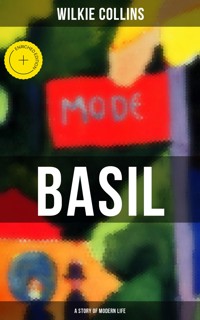
Erhalten Sie Zugang zu diesem und mehr als 300000 Büchern ab EUR 5,99 monatlich.
- Herausgeber: Musaicum Books
- Kategorie: Gesellschafts- und Liebesromane
- Sprache: Englisch
Wilkie Collins's novel 'Basil (A Story of Modern Life)' explores the complex dynamics of love, jealousy, and betrayal in Victorian society. The narrative follows the protagonist, Basil, as he navigates the pitfalls of an obsessive and toxic relationship with a mysterious woman. Collins's writing style is characterized by its intricate plotting, psychological depth, and nuanced characterizations, making 'Basil' a compelling and thought-provoking read. The novel is set against the backdrop of the rapidly changing social norms and values of the 19th century, offering a commentary on the constraints placed on individuals by societal expectations. With its exploration of dark passions and moral dilemmas, 'Basil' remains a timeless classic of English literature. In this enriched edition, we have carefully created added value for your reading experience: - A succinct Introduction situates the work's timeless appeal and themes. - The Synopsis outlines the central plot, highlighting key developments without spoiling critical twists. - A detailed Historical Context immerses you in the era's events and influences that shaped the writing. - An Author Biography reveals milestones in the author's life, illuminating the personal insights behind the text. - A thorough Analysis dissects symbols, motifs, and character arcs to unearth underlying meanings. - Reflection questions prompt you to engage personally with the work's messages, connecting them to modern life. - Hand‐picked Memorable Quotes shine a spotlight on moments of literary brilliance. - Interactive footnotes clarify unusual references, historical allusions, and archaic phrases for an effortless, more informed read.
Sie lesen das E-Book in den Legimi-Apps auf:
Seitenzahl: 659
Veröffentlichungsjahr: 2017
Das E-Book (TTS) können Sie hören im Abo „Legimi Premium” in Legimi-Apps auf:
Ähnliche

















Basil (A Story of Modern Life)
Published by
Books
Table of Contents
Introduction
In a city of quickened pulses and unforgiving reputations, a young gentleman’s sudden passion breaches the walls of class and custom, unleashing a chain of secrecy whose consequences tighten like a noose around every choice he makes.
Basil (A Story of Modern Life), first published in 1852, is an early novel by Wilkie Collins that situates private desire within the crowded streets and drawing rooms of Victorian Britain. Written at a moment when the domestic sphere was becoming a stage for public anxieties, the book follows a privileged narrator whose impulsive attachment to a woman outside his social rank leads to a reckless commitment that he struggles to control. Without relying on grand historical canvases, Collins locates drama in everyday life, exploring how modern urban existence magnifies temptation, accelerates decisions, and intensifies the peril of being seen—or not seen—by the right people.
Its classic status rests on a compelling fusion of psychological realism and narrative suspense that anticipates the “sensation” fiction Collins would later help to define. The novel’s pages move with a restless energy, yet its excitements arise from recognizable pressures: family expectations, precarious reputations, and the magnetic pull of forbidden attachment. Collins’s insight into motive and self-deception grants the story a durable seriousness beyond mere melodrama. The book’s audacity lies not in supernatural thrills but in the insistence that modern, respectable life—buses, shops, parlors, ledgers—can harbor passions and dangers as grave as any Gothic castle. That premise continues to feel disquietingly fresh.
Basil also marks a decisive moment in Collins’s artistic development. In its taut, first-person design, one hears the early rehearsal of techniques that would reverberate through later Victorian fiction: the careful layering of testimony, the ethical tangle produced by social codes, and the slow revelation of private histories. Though not as widely known as The Woman in White or The Moonstone, this earlier work demonstrated that suspense could be achieved through ordinary settings and plausible psychology. Its legacy is strongest within Collins’s own career, where it opened a path from traditional romance toward the modern domestic thriller, reshaping what a popular novel could accomplish.
Collins crafts his narrative as a retrospective confession, channeling intensity through a single, fallible voice. The effect is a deepening tunnel of self-scrutiny: every impulse is weighed, justified, feared, and often misread. By withholding certain facts and releasing them with careful timing, he converts everyday scenes into chambers of dread. The pacing, flexible and vigilant, moves between swift turns and dilated moments of introspection. We witness a mind attempting to narrate itself into clarity, while the social world refuses tidy coherence. This intimate focus serves the book’s moral inquiry, for the drama is as much inward as it is outward.
At the core lies a study of class and its invisible architecture. Collins portrays a society where lineage confers authority, taste is policed as rigorously as law, and professions and addresses speak louder than declarations of love. The novel’s romance is therefore never simply private; it is entangled with rank, money, and the rituals that separate “gentleman” from “tradesman.” These divisions are not caricatured but rendered as working constraints that shape hope and fear. In this frame, passion becomes a social gamble, and the cost of losing is measured in silence, exile, and the erosion of a name.
The book also probes gendered power, exposing how women’s circumstances are narrowed by guardianship, surveillance, and the crowded marketplace of reputation. Collins never pretends that attraction occurs in a vacuum; it is routed through fathers, employers, and neighbors who translate sentiment into leverage. Yet he resists reducing any figure to an emblem, attending instead to positions, compromises, and risks. The story’s intimacy with domestic spaces—the shop, the parlor, the shared corridor—reveals how the smallest thresholds become battlegrounds for autonomy. By charting this terrain, the novel anticipates later debates about agency, consent, and the social scripts that bind desire.
Honor and legality form another double helix within the plot. Oaths, signatures, and social contracts carry force, but so do private promises and the ethics of secrecy. Collins explores the punishing discrepancy between what the law recognizes and what conscience demands, a gap that can swallow lives whole. Respectability acts as both shield and trap: it grants access while demanding conformity, opening a path to advancement even as it seals avenues of escape. The novel’s moral interest lies in how characters navigate these constraints, improvising codes of conduct under the steady threat of public exposure.
Stylistically, Basil blends directness with dramatic poise. Collins’s prose is lucid and economical, yet he stages scenes with a nearly theatrical sense of timing and sightlines, inviting readers to notice who watches, who is watched, and who remains unseen. The apparent simplicity of his sentences masks a web of pressure points—glances, doors, timetables—that tighten the narrative grip. While the plot contains coincidence, its plausibility rests on human temperament: impatience, vanity, loyalty, fear. This balance between design and psychology is one reason the novel retains vitality for readers who may not share Victorian sensibilities but recognize the persistence of human error.
In literary terms, the book mediates between Gothic atmosphere and realist observation, relocating dread from castles to counting-houses and narrow streets. Its “modern life” is a world of paper trails, social rituals, and quick encounters in public spaces, where anonymity both liberates and endangers. By drawing on Gothic tension and embedding it in ordinary routines, Collins helped invent a domestic mode of suspense later identified as sensation fiction. The uncanny arises not from ghosts but from the sudden awareness that ordinary choices, made rashly or proudly, can unleash consequences beyond intention.
The influence radiates outward through Collins’s broader contribution to Victorian narrative. Basil foreshadows techniques he would refine in later, widely influential novels, techniques that helped consolidate the sensation tradition and inspired many contemporaries to locate drama within the home and the street. The novel’s confessional voice, moral ambiguity, and emphasis on social surveillance anticipate practices later adopted and adapted across popular and serious fiction alike. Even when subsequent writers pursued different plots or tones, they benefited from the permission Basil helped establish: that the everyday could be the stage for the most exacting thrills.
Today the book’s appeal rests on both its historical interest and its unnerving pertinence. Readers will find in it a lucid portrait of Victorian pressures—class, propriety, and the freight of a family name—yet they may also recognize modern concerns about impulse, secrecy, and the speed at which reputations can be made and ruined. In its measured intensity and ethical complexity, Basil offers a durable meditation on how love, pride, and the demand to appear respectable can collide. That collision, always contemporary, ensures the novel’s lasting power and secures its place among enduring works of nineteenth-century fiction.
Synopsis
Wilkie Collins’s Basil: A Story of Modern Life (1852) unfolds as a retrospective confession by its young gentleman narrator, Basil, who sets out to record the steps by which a heedless impulse overturns a carefully guarded life. Raised in a household that prizes lineage, discretion, and obedience to a stern father, he enjoys comfort but little purpose. The narrative opens in contemporary London, where Basil describes the familial code that governs his prospects, the quiet bonds with his siblings, and his dawning sense that the restraints of class are both protection and prison. From this calm beginning, a private fixation begins to stir.
The inciting moment arrives in the most ordinary way: a glimpse of a young woman in public transit jolts Basil out of complacency. Learning that she is Margaret Sherwin, the daughter of a prosperous linen-draper, he is torn between the allure of romance and the certainty that his father would never sanction such a match. The city’s crowded anonymity feeds his obsession, and he follows the clue of her address into a different social world. Convinced that the intensity of his feeling justifies secrecy, he plans a courtship that evades parental scrutiny and tests the limits of his own conscience.
Negotiations with Margaret’s father, Mr. Sherwin, produce an arrangement that seems to reconcile passion with propriety. A private marriage is concluded under strict conditions: the union is to remain concealed and cohabitation deferred for a specified period, preserving appearances until circumstances allow acknowledgment. Basil embraces these terms as a chivalric pledge, shielding Margaret from scandal and himself from immediate confrontation at home. In Sherwin’s establishment he notices a trusted clerk, Mannion, a reserved and self-possessed presence whose polished manner contrasts with the shop’s bustle. Basil, meanwhile, idealizes Margaret’s beauty and docility, reading silence as depth and compliance as proof of affection.
A double life ensues. At home, Basil sustains the role of dutiful son; elsewhere, he attends furtive meetings and charts the calendar that will legitimize his secrecy. Friends and family counsel caution without guessing the truth, while small dissonances in the Sherwin household unsettle him—unguarded looks, hurried messages, a servant’s half-hint. Mannion’s discreet efficiency increasingly frames Basil’s visits, his tact making him indispensable yet unreadable. The class barrier that Basil once romanticized begins to feel like a web of mutual surveillance. What was conceived as a gallant prize of patience hardens into vigilance, and tenderness yields to jealousy and unease.
Suspicion hardens into certainty on a night of pursuit that marks the novel’s hinge. Confronted with signs of clandestine communication, Basil follows their trail and witnesses a betrayal that shatters his ideal. In the violent encounter that follows, he attacks a rival—Mannion—and leaves him hideously injured. The act, committed in passion, cannot be contained. It exposes the secret marriage to the glare of gossip and law, and turns a private misjudgment into a public stain. In this moment, Collins pivots from tentative romance to sensation, anchoring the narrative in consequences that neither breeding nor bravado can mitigate.
The repercussions are immediate and severe. Basil’s father, informed of the unsanctioned marriage and scandal, withdraws protection and demands separation from all that has compromised the family’s name. The household divides along lines of principle and sympathy, and Basil, shaken by shock and remorse, collapses into illness. While he struggles toward recovery, the Sherwin family recalibrates its interests, balancing reputation, advantage, and the precarious position of Margaret. Mannion survives the assault, his ruined face emblematic of grievances that will not be pacified. The legal standing of the secret union, and the social penalties accruing to it, gather like storm clouds.
Emerging from convalescence, Basil resolves to confront what his vows and conscience require. Letters, interviews, and consultations draw him into the technicalities of marriage, separation, and support, none offering a clean escape from moral entanglement or public scrutiny. He seeks a path that will acknowledge responsibility without yielding to exploitation, and that will protect the few family ties still open to him. Meanwhile, shifting accounts of Margaret’s conduct and of Mannion’s influence complicate every decision. The young man who pursued an ideal of romantic honor now negotiates contracts, reputations, and practical safeguards in a world intent on exacting payment.
Collins gradually darkens the tone from domestic drama to suspense. Mannion, animated by deliberate hatred, engineers a campaign of intimidation and pursuit that tests Basil’s nerve and judgment. Messages, surprises, and strategically timed encounters draw the narrator across the city and beyond, into unfamiliar streets and moral predicaments. The revenge is psychological as much as physical, designed to erode trust and isolate its target. Yet the narrative insists that external danger mirrors inward fault: Basil’s peril is inseparable from vanity, secrecy, and willfulness. The chase tightens, the stakes widen to include innocent bystanders, and the prospect of reckoning becomes inescapable.
Without disclosing the final turns, the novel closes its net around the consequences of a single reckless choice amplified by social pride and calculated malice. Basil explores how modern urban life—crowded, anonymous, layered by class—can turn a private impulse into a public cataclysm. It is an early experiment in what would become Collins’s hallmark blend of realism and sensation: legal scruples, domestic spaces, and psychological obsession rubbing against melodramatic peril. Beneath the excitement lies a sober question about what honor means when appearances rule. The book’s endurance rests on that warning and on its sharp anatomy of secrecy’s costs.
Historical Context
Wilkie Collins set Basil in the midst of early- to mid-Victorian England, a world dominated by family lineage, Anglican respectability, and the expanding power of commerce. The novel’s “modern life” unfolds largely in London, then the fastest-growing metropolis in Europe. It was a city of new streets, shops, and public conveyances, yet still governed by inherited hierarchies and rituals. Institutions such as the Church of England, the law courts, and the paternalistic family structured everyday conduct. That framework provided a recognizable backdrop for readers in the early 1850s, when the book first appeared, and shaped the anxieties and ambitions that drive Collins’s characters.
The reign of Queen Victoria (1837–1901) supplied more than a chronological marker; it defined an ethos. After the reformist turbulence of the 1830s and the Chartist agitations of the 1840s, mid-century Britain prized order, propriety, and rising prosperity. Government was cautious and pragmatic, while the press celebrated industriousness and respectability. London’s municipal modernization—policing, sanitation debates, and street improvements—coexisted with crowded housing and sharp class contrasts. Collins’s narrative registers this mix of stability and unease: a society confident in its moral codes yet unsettled by rapid urban and economic change that allowed social borders to be crossed and reputations to be risked.
Victorian class structure rested on land, lineage, and the display of refined manners. Primogeniture and entails commonly preserved family estates for eldest sons, leaving younger sons to seek professions or advantageous marriages. Meanwhile, an assertive commercial middle class—merchants, shopkeepers, clerks—sought cultural legitimacy. This friction between “gentlemanly” status and trade is central to mid-century debates. Basil’s portrait of attraction across class lines closely reflects contemporary tensions, echoing real anxieties about whether wealth from commerce could erase the stigma of origins. The stakes were not merely romantic: they involved inheritance prospects, social standing, and the fragile currency of honor.
Marriage law and custom illuminate much of the novel’s dilemmas. Lord Hardwicke’s Marriage Act (1753) had standardized banns or licence and required parental consent for those under 21 marrying by licence, curbing furtive unions. The Marriage Act of 1836 introduced civil ceremonies and allowed non-Anglican marriages in registered places, widening legal channels while maintaining social scrutiny. Before the Matrimonial Causes Act (1857), divorce for most people required a private Act of Parliament, effectively making marital dissolution rare and scandalous. Under coverture, a married woman’s legal identity was subsumed by her husband’s. Collins’s plot probes how secrecy and status collide under these constraints.
Gender ideology—the “separate spheres” doctrine—held that men belonged to the public realm of work and politics, while women were guardians of the private, moral home. Chaperonage, careful courtship, and an emphasis on female purity governed middle-class practice. Popular culture reinforced these ideals, even as real urban life complicated them. When Collins shows the risks that attach to courtship outside sanctioned channels, he speaks to an audience trained to read social and sexual transgression as both moral and practical peril. The novel’s restrained treatment of desire and reputation is steeped in the period’s precise codes of propriety and surveillance.
The drapery and textile trades formed a conspicuous part of London’s retail economy. Linen-drapers, outfitters, and haberdashers clustered along major thoroughfares, selling ready-made goods to a growing consumer base. Assistants often “lived in,” working long hours behind glittering shopfronts that advertised respectability as much as merchandise. From the 1840s, the Early Closing movement advocated shorter hours for shopworkers. Collins’s use of a tradesman’s household situates his story within this commercial milieu, where shop display, polite service, and family reputation intertwined. The retail counter was both a marketplace and a stage for class aspiration, an ideal setting for conflicts over status and intimacy.
Urban anonymity—amplified by new transportation—reshaped social interaction. London omnibuses (introduced in 1829), cabs, and improved street lighting extended mobility and blurred the line between respectable and dubious spaces. The Metropolitan Police, established in 1829, increasingly regulated public behavior, while crowded pavements made chance encounters plausible and private surveillance difficult. Collins exploits the city’s mixed visibility: crowded yet concealing, familiar yet threatening. The possibility of meeting unchaperoned, of following unnoticed, or of slipping through districts with different moral codes, was a recognized feature of metropolitan life that fiction could turn into suspense and social diagnosis.
Railways, rapidly consolidating from the 1830s to the 1850s, were the most dramatic sign of modernity. London’s great termini—Euston (opened 1837), Waterloo (1848), King’s Cross (1852), and Paddington (1854)—reordered time and distance. Timetables, compartment travel, and the occasional widely reported accident made railways symbols of speed, risk, and dislocation. Mid-century readers were aware that trains enabled elopements, business expansion, and clandestine movements. Collins, like many contemporaries, registers how mechanical velocity unsettled older rhythms of courtship and family authority, turning travel into a narrative device that heightened both opportunity and peril in “modern life.”
The Great Exhibition of 1851, staged in Hyde Park’s Crystal Palace, showcased British industrial prowess, especially textiles, machinery, and consumer goods. It promoted a civic gospel of improvement—taste, thrift, and technological progress—aligned with commercial expansion. For Londoners, displays of fabrics, fashions, and manufactured luxuries legitimized desire as part of respectable consumption. Collins’s focus on shop culture and domestic interiors reflects this new visual economy, where goods and display reframed identity. The Exhibition’s self-congratulation also masked anxieties about imitation, fraud, and superficial polish—concerns that sensation narratives would later dramatize through deceptive appearances and the peril of misreading signs.
The literary marketplace reinforced these social currents. Novels commonly appeared in three volumes for circulating libraries, whose subscribers—especially families—shaped what was publishable. Mudie’s Select Library (founded 1842) exercised significant moral and economic influence, favoring works that conformed to middle-class proprieties. Basil, issued in 1852, entered this context of cautious gatekeeping and voracious demand. Writers navigated expectations for contemporary settings, moral legibility, and narrative excitement without overstepping perceived decency. Collins’s early experiment with domestic scandal tested these boundaries, pointing toward a new kind of realism that made everyday respectability itself a source of narrative tension.
By the early 1860s, critics labeled such domestic thrillers “sensation fiction,” a term popularized in hostile reviews like H. L. Mansel’s 1863 essay condemning their alleged moral excess and nervous stimulation. Though predating the full sensation boom, Basil anticipates its methods: crimes and secrets lodged within households, legal traps, and shocks arising from ordinary rituals—courtship, marriage, inheritance. The sensation mode treated the drawing room as a crime scene and the family as a stage for legal and psychological conflict. Collins’s novel thus stands at a hinge point, translating legal modernity and urban experience into suspense rooted in the most respectable spaces.
Collins’s own formation sharpened these themes. Born in 1824, trained at Lincoln’s Inn and called to the bar in 1851, he never practiced law but absorbed legal procedures, property rules, and evidentiary thinking. This knowledge infuses his plots with credible constraints and loopholes. His friendship with Charles Dickens, begun in the early 1850s, further oriented him toward contemporary subjects and rapid, event-driven storytelling. Working with Dickens on journal fiction later in the decade, Collins refined techniques of cliffhangers and social observation that Basil already gestures toward—legal exactitude meshed with narrative urgency to expose pressure points in mid-Victorian domestic life.
Policing and detection were themselves modern inventions to which fiction responded. The Detective Branch of the Metropolitan Police was formed in 1842, institutionalizing investigative methods that fascinated the public. Newspapers reported sensational trials, coroner’s inquests, and forensic novelties. While Basil is not a detective story, its attention to following, watching, and uncovering secrets mirrors contemporary investigative cultures. Readers were learning to interpret clues—documents, handwriting, schedules, witness testimony—within a framework of ordinary domestic experience. Collins leverages this interpretive habit, showing how private lives are increasingly legible to law, the press, and curious onlookers in the modern city.
Political ferment set the background tone. Chartism (c. 1838–1848) failed to win universal male suffrage but left a legacy of organization and class-conscious debate. The 1848 revolutions on the Continent and the subsequent British reaction intensified fears of disorder while prompting incremental reforms. Parliamentary measures targeting labor conditions—the Factory Acts culminating in the 1847 Ten Hours Act—and public-health inquiries showcased a government negotiating social change case by case. Although Basil stays within genteel circles and commercial households, its sensitivity to status anxiety and social mobility reflects a polity managing underlying tensions without fully resolving them.
Economically, the decades around 1850 oscillated between exuberance and panic. Railway Mania (mid-1840s) inflated fortunes and expectations before collapsing, leaving a culture wary of speculation yet dependent on credit and reputation. In such a climate, “respectability” was a form of capital: outward propriety enabled advantageous marriages, business credit, and social access. Retail trades wooed customers with polished manners and display, while families guarded names and alliances. Collins’s story of courtship entangled with class and commerce mirrors this economy of appearances, where misjudging a person’s background or stability could have severe financial as well as emotional consequences.
Print culture amplified these dynamics. A growing newspaper press, cheap weeklies, and family magazines turned private scandal and legal change into public conversation. The appetite for “modern life” tales—contemporary settings, topical problems, recognizable institutions—encouraged writers to dramatize current debates about marriage, inheritance, and propriety. The very subtitle of Collins’s book signals an intent to capture the present. Without relying on historical costume or distant locales, Basil mines the immediacy of mid-century London, turning current institutions—shops, parishes, courts, conveyances—into both scenery and plot machinery intelligible to readers tracking the news and gossip of their day.
Religious currents shaped the moral atmosphere. Evangelicalism within the Church of England emphasized self-discipline, family piety, and philanthropy, reinforcing ideals of chastity and duty. Confessional controversies—Oxford Movement ritualism on one side, Nonconformist activism on the other—kept questions of authority and conscience alive. Moral reformers campaigned against vice and for domestic virtue. Fiction that ventured near sexual misconduct or marital irregularity risked censure, yet also engaged earnest debates about redemption, responsibility, and the limits of surveillance. Collins’s careful handling of impropriety shows an author navigating—and interrogating—the moral vocabulary by which Victorians judged intimate behavior and social worth.`,`London’s geography made these pressures visible. The West End’s genteel squares, the City’s mercantile streets, and emerging suburbs connected by rail fostered daily crossings of class space. Respectable façades masked precarious finances; bright shopfronts abutted poorer courts. Improvements in paving and lighting enabled evening promenades that were both respectable and risky. Mid-century building booms created new terraces promising privacy, while lodging houses and servants’ quarters compressed hierarchies under one roof. Collins situates movement across districts and thresholds—shop, parlor, street, carriage—as morally charged acts, using the city’s layered topography to map characters’ ambitions and the hazards of traversing social boundaries.`,`Seen against this historical canvas, Basil functions as both mirror and critique. It reflects a society enthralled by progress—railways, retail, urban growth—while bound to fragile codes of lineage and propriety. By locating transgression inside ordinary institutions—family, shop, marriage ceremony—Collins exposes the costs of rigid class pride, the inadequacy of legal and moral safeguards, and the uncertainties introduced by modern mobility and display. Without preaching, the novel reveals how “modern life” multiplies opportunities for misreading and misalliance, urging readers to scrutinize the surfaces they trust and to question whether inherited hierarchies can survive the pressures of a swiftly changing age.`]}``` }```*Note: The output format requires valid JSON only; remove any extra characters outside the JSON object.*`
Author Biography
Wilkie Collins (1824–1889) was an English novelist, short-story writer, and playwright who became one of the most widely read authors of the Victorian era. Associated with the rise of the sensation novel and with innovations that shaped detective fiction, he fused intricate plotting with social critique and an experimental use of narrative voices. Publishing primarily in serial form, he reached a vast audience and helped define popular storytelling in mid-nineteenth-century Britain. His most enduring books, including The Woman in White and The Moonstone, set new expectations for suspense, evidence, and testimony in fiction, while his dramas and shorter tales extended his range across page and stage.
Collins was educated in London and, after early employment in the commercial world, undertook legal training at Lincoln's Inn, being called to the bar though he chose not to practice. That grounding in procedure, documents, and evidentiary argument shaped both the themes and forms of his later fiction. He also absorbed the techniques of popular theatre—melodrama, surprise, and revelations—and the demands of the periodical press, which favored cliffhangers and modular episodes. A close professional association with Charles Dickens, to whose journals Household Words and All the Year Round he contributed, introduced him to a vast readership and reinforced his interest in collaborative, serial storytelling.
His first novel, Antonina; or, The Fall of Rome, appeared in 1850, revealing historical interests but also a taste for dramatic incident. He quickly turned to contemporary settings in Basil (1852) and Hide and Seek (1854), developing the themes of secrecy, identity, and social constraint that would define his reputation. During the 1850s he published short fiction later collected in After Dark and collaborated in theatrical projects, notably The Frozen Deep, which sharpened his sense of stagecraft. Regular work for Dickens's journals refined his pacing and multi-part structure. By the end of the decade he had established himself as a versatile professional writer.
Collins's breakthrough came with The Woman in White, first issued in serial form and then as a three-volume novel. It became a publishing phenomenon, admired for its chorus of narrators, documentary textures, and mounting suspense. He followed with The Dead Secret and, especially, No Name, which combined legal intricacy with a gripping study of resourcefulness under social pressure. These works helped define the sensation novel—a mode that brought domestic settings into contact with crime, secrecy, and scandal—and they demonstrated how serialized fiction could orchestrate revelation without sacrificing psychological interest. Adaptations for the stage and international reprints amplified Collins's visibility and commercial success.
At his mid-career height Collins produced Armadale and The Moonstone, the latter often cited as a foundational English detective novel. The Moonstone's mosaic of testimonies, attention to physical evidence, and memorable investigator helped codify conventions later associated with crime fiction. Even as he embraced puzzle and plot, Collins retained an interest in motive, conscience, and the social conditions that generate wrongdoing. His craftsmanship in narrative design, together with his mastery of the serial cliffhanger, secured large readerships and mixed critical responses—admiration for ingenuity balanced by anxieties about the sensational. Over time, however, the sophistication of these experiments has been widely recognized.
Many of Collins's novels foreground social critique. Man and Wife probes the inconsistencies of marriage law and the vulnerability those inconsistencies created. The New Magdalen addresses stigma and the possibility of moral rehabilitation; Poor Miss Finch explores disability and perception; The Law and the Lady features a determined heroine confronting the limits of legal redress. Essays such as The Unknown Public considered how broad audiences read and what they desired from fiction. Across these works he questioned rigid hierarchies, spotlighted legal ambiguities, and advocated—through plot rather than polemic—for fairer treatment of those excluded or constrained by class expectations and gendered inequities.
Collins continued to publish in later years despite chronic illness, including severe gout, and reliance on opiates for pain relief, conditions that he acknowledged in correspondence and that sometimes affected his working rhythm. Late novels such as Jezebel's Daughter, The Black Robe, Heart and Science, I Say No, The Evil Genius, and The Legacy of Cain maintained his interest in law, medicine, and ethics; Blind Love was left unfinished and completed after his death in 1889. Though his reputation dipped in the early twentieth century, scholars and readers have since revived his standing. Today his narrative innovations and social acuity remain central to discussions of modern popular fiction.
Basil (A Story of Modern Life)
Letter of Dedication to Charles James Ward, Esq.
It has long been one of my pleasantest anticipations to look forward to the time when I might offer to you, my old and dear friend, some such acknowledgment of the value I place on your affection for me, and of my grateful sense of the many acts of kindness by which that affection has been proved, as I now gladly offer in this place. In dedicating the present work to you, I fulfil therefore a purpose which, for some time past, I have sincerely desired to achieve; and, more than that, I gain for myself the satisfaction of knowing that there is one page, at least, of my book, on which I shall always look with unalloyed pleasure — the page that bears your name.
I have founded the main event out of which this story springs, on a fact within my own knowledge. In afterwards shaping the course of the narrative thus suggested, I have guided it, as often as I could, where I knew by my own experience, or by experience related to me by others, that it would touch on something real and true in its progress. My idea was, that the more of the Actual I could garner up as a text to speak from, the more certain I might feel of the genuineness and value of the Ideal which was sure to spring out of it. Fancy and Imagination, Grace and Beauty, all those qualities which are to the work of Art what scent and colour are to the flower, can only grow towards heaven by taking root in earth. Is not the noblest poetry of prose fiction the poetry of everyday truth[2q]?
Directing my characters and my story, then, towards the light of Reality wherever I could find it, I have not hesitated to violate some of the conventionalities of sentimental fiction. For instance, the first love-meeting of two of the personages in this book, occurs (where the real love-meeting from which it is drawn, occurred) in the very last place and under the very last circumstances which the artifices of sentimental writing would sanction. Will my lovers excite ridicule instead of interest, because I have truly represented them as seeing each other where hundreds of other lovers have first seen each other, as hundreds of people will readily admit when they read the passage to which I refer? I am sanguine enough to think not.
So again, in certain parts of this book where I have attempted to excite the suspense or pity of the reader, I have admitted as perfectly fit accessories to the scene the most ordinary street-sounds that could be heard, and the most ordinary street-events that could occur, at the time and in the place represented — believing that by adding to truth, they were adding to tragedy — adding by all the force of fair contrast — adding as no artifices of mere writing possibly could add, let them be ever so cunningly introduced by ever so crafty a hand.
Allow me to dwell a moment longer on the story which these pages contain.
Believing that the Novel and the Play are twin-sisters in the family of Fiction; that the one is a drama narrated, as the other is a drama acted; and that all the strong and deep emotions which the Playwriter is privileged to excite, the Novel-writer is privileged to excite also, I have not thought it either politic or necessary, while adhering to realities, to adhere to everyday realities only. In other words, I have not stooped so low as to assure myself of the reader’s belief in the probability of my story, by never once calling on him for the exercise of his faith. Those extraordinary accidents and events which happen to few men, seemed to me to be as legitimate materials for fiction to work with — when there was a good object in using them — as the ordinary accidents and events which may, and do, happen to us all. By appealing to genuine sources of interest within the reader’s own experience, I could certainly gain his attention to begin with; but it would be only by appealing to other sources (as genuine in their way) beyond his own experience, that I could hope to fix his interest and excite his suspense, to occupy his deeper feelings, or to stir his nobler thoughts.
In writing thus — briefly and very generally — (for I must not delay you too long from the story), I can but repeat, though I hope almost unnecessarily, that I am now only speaking of what I have tried to do. Between the purpose hinted at here, and the execution of that purpose contained in the succeeding pages, lies the broad line of separation which distinguishes between the will and the deed. How far I may fall short of another man’s standard, remains to be discovered. How far I have fallen short of my own, I know painfully well.
One word more on the manner in which the purpose of the following pages is worked out — and I have done.
Nobody who admits that the business of fiction is to exhibit human life, can deny that scenes of misery and crime must of necessity, while human nature remains what it is, form part of that exhibition. Nobody can assert that such scenes are unproductive of useful results, when they are turned to a plainly and purely moral purpose. If I am asked why I have written certain scenes in this book, my answer is to be found in the universally-accepted truth which the preceding words express. I have a right to appeal to that truth; for I guided myself by it throughout. In deriving the lesson which the following pages contain, from those examples of error and crime which would most strikingly and naturally teach it, I determined to do justice to the honesty of my object by speaking out. In drawing the two characters, whose actions bring about the darker scenes of my story, I did not forget that it was my duty, while striving to portray them naturally, to put them to a good moral use; and at some sacrifice, in certain places, of dramatic effect (though I trust with no sacrifice of truth to Nature), I have shown the conduct of the vile, as always, in a greater or less degree, associated with something that is selfish, contemptible, or cruel in motive. Whether any of my better characters may succeed in endearing themselves to the reader, I know not: but this I do certainly know: — that I shall in no instance cheat him out of his sympathies in favour of the bad.
To those persons who dissent from the broad principles here adverted to; who deny that it is the novelist’s vocation to do more than merely amuse them; who shrink from all honest and serious reference, in books, to subjects which they think of in private and talk of in public everywhere; who see covert implications where nothing is implied, and improper allusions where nothing improper is alluded to; whose innocence is in the word, and not in the thought; whose morality stops at the tongue, and never gets on to the heart — to those persons, I should consider it loss of time, and worse, to offer any further explanation of my motives, than the sufficient explanation which I have given already. I do not address myself to them in this book, and shall never think of addressing myself to them in any other.
Those words formed part of the original introduction to this novel. I wrote them nearly ten years since; and what I said then, I say now.
“Basil” was the second work of fiction which I produced. On its appearance, it was condemned offhand, by a certain class of readers, as an outrage on their sense of propriety. Conscious of having designed and written, my story with the strictest regard to true delicacy, as distinguished from false — I allowed the prurient misinterpretation of certain perfectly innocent passages in this book to assert itself as offensively as it pleased, without troubling myself to protest against an expression of opinion which aroused in me no other feeling than a feeling of contempt. I knew that “Basil” had nothing to fear from pure-minded readers; and I left these pages to stand or fall on such merits as they possessed. Slowly and surely, my story forced its way through all adverse criticism, to a place in the public favour which it has never lost since. Some of the most valued friends I now possess, were made for me by “Basil.” Some of the most gratifying recognitions of my labours which I have received, from readers personally strangers to me, have been recognitions of the purity of this story, from the first page to the last. All the indulgence I need now ask for “Basil,” is indulgence for literary defects, which are the result of inexperience; which no correction can wholly remove; and which no one sees more plainly, after a lapse of ten years, than the writer himself.
I have only to add, that the present edition of this book is the first which has had the benefit of my careful revision. While the incidents of the story remain exactly what they were, the language in which they are told has been, I hope, in many cases greatly altered for the better.
WILKIE COLLINS. Harley Street, London[1], July, 1862.
Part I
I.
What am I now about to write[1q]?
The history of little more than the events of one year, out of the twenty-four years of my life.
Why do I undertake such an employment as this?
Perhaps, because I think that my narrative may do good; because I hope that, one day, it may be put to some warning use. I am now about to relate the story of an error, innocent in its beginning, guilty in its progress, fatal in its results; and I would fain hope that my plain and true record will show that this error was not committed altogether without excuse. When these pages are found after my death, they will perhaps be calmly read and gently judged, as relics solemnized by the atoning shadows of the grave. Then, the hard sentence against me may be repented of; the children of the next generation of our house may be taught to speak charitably of my memory, and may often, of their own accord, think of me kindly in the thoughtful watches of the night.
Prompted by these motives, and by others which I feel, but cannot analyse, I now begin my self-imposed occupation. Hidden amid the far hills of the far West of England, surrounded only by the few simple inhabitants of a fishing hamlet on the Cornish coast, there is little fear that my attention will be distracted from my task; and as little chance that any indolence on my part will delay its speedy accomplishment. I live under a threat of impending hostility, which may descend and overwhelm me, I know not how soon, or in what manner. An enemy, determined and deadly, patient alike to wait days or years for his opportunity, is ever lurking after me in the dark. In entering on my new employment, I cannot say of my time, that it may be mine for another hour; of my life, that it may last till evening.
Thus it is as no leisure work that I begin my narrative — and begin it, too, on my birthday! On this day I complete my twenty-fourth year; the first new year of my life which has not been greeted by a single kind word, or a single loving wish. But one look of welcome can still find me in my solitude — the lovely morning look of nature, as I now see it from the casement of my room. Brighter and brighter shines out the lusty sun from banks of purple, rainy cloud; fishermen are spreading their nets to dry on the lower declivities of the rocks; children are playing round the boats drawn up on the beach; the sea-breeze blows fresh and pure towards the shore — — all objects are brilliant to look on, all sounds are pleasant to hear, as my pen traces the first lines which open the story of my life.
II.
I am the second son of an English gentleman of large fortune. Our family is, I believe, one of the most ancient in this country. On my father’s side, it dates back beyond the Conquest[2]; on my mother’s, it is not so old, but the pedigree is nobler. Besides my elder brother, I have one sister, younger than myself. My mother died shortly after giving birth to her last child.
Circumstances which will appear hereafter, have forced me to abandon my father’s name. I have been obliged in honour to resign it; and in honour I abstain from mentioning it here. Accordingly, at the head of these pages, I have only placed my Christian name — not considering it of any importance to add the surname which I have assumed; and which I may, perhaps, be obliged to change for some other, at no very distant period. It will now, I hope, be understood from the outset, why I never mention my brother and sister but by their Christian names; why a blank occurs wherever my father’s name should appear; why my own is kept concealed in this narrative, as it is kept concealed in the world.
The story of my boyhood and youth has little to interest — nothing that is new. My education was the education of hundreds of others in my rank of life. I was first taught at a public school[3], and then went to college to complete what is termed “a liberal education[4].”
My life at college has not left me a single pleasant recollection. I found sycophancy established there, as a principle of action; flaunting on the lord’s gold tassel in the street; enthroned on the lord’s dais in the dining-room. The most learned student in my college — the man whose life was most exemplary, whose acquirements were most admirable — was shown me sitting, as a commoner, in the lowest place. The heir to an Earldom, who had failed at the last examination, was pointed out a few minutes afterwards, dining in solitary grandeur at a raised table, above the reverend scholars who had turned him back as a dunce. I had just arrived at the University, and had just been congratulated on entering “a venerable seminary of learning and religion.”
Trite and commonplace though it be, I mention this circumstance attending my introduction to college, because it formed the first cause which tended to diminish my faith in the institution to which I was attached. I soon grew to regard my university training as a sort of necessary evil, to be patiently submitted to. I read for no honours, and joined no particular set of men. I studied the literature of France, Italy, and Germany; just kept up my classical knowledge sufficiently to take my degree; and left college with no other reputation than a reputation for indolence and reserve.
When I returned home, it was thought necessary, as I was a younger son, and could inherit none of the landed property of the family, except in the case of my brother’s dying without children, that I should belong to a profession. My father had the patronage of some valuable “livings,” and good interest with more than one member of the government. The church, the army, the navy, and, in the last instance, the bar[5], were offered me to choose from. I selected the last.
My father appeared to be a little astonished at my choice; but he made no remark on it, except simply telling me not to forget that the bar was a good stepping-stone to parliament[6]. My real ambition, however, was, not to make a name in parliament, but a name in literature. I had already engaged myself in the hard, but glorious service of the pen; and I was determined to persevere. The profession which offered me the greatest facilities for pursuing my project, was the profession which I was ready to prefer. So I chose the bar.
Thus, I entered life under the fairest auspices. Though a younger son, I knew that my father’s wealth, exclusive of his landed property, secured me an independent income far beyond my wants. I had no extravagant habits; no tastes that I could not gratify as soon as formed; no cares or responsibilities of any kind. I might practise my profession or not, just as I chose. I could devote myself wholly and unreservedly to literature, knowing that, in my case, the struggle for fame could never be identical — terribly, though gloriously identical — with the struggle for bread. For me, the morning sunshine of life was sunshine without a cloud!
I might attempt, in this place, to sketch my own character as it was at that time. But what man can say — I will sound the depth of my own vices, and measure the height of my own virtues; and be as good as his word? We can neither know nor judge ourselves; others may judge, but cannot know us: God alone judges and knows too. Let my character appear — as far as any human character can appear in its integrity, in this world — in my actions, when I describe the one eventful passage in my life which forms the basis of this narrative. In the mean time, it is first necessary that I should say more about the members of my family. Two of them, at least, will be found important to the progress of events in these pages. I make no attempt to judge their characters: I only describe them — whether rightly or wrongly, I know not — as they appeared to me.
III.
I always considered my father — I speak of him in the past tense, because we are now separated for ever; because he is henceforth as dead to me as if the grave had closed over him — I always considered my father to be the proudest man I ever knew; the proudest man I ever heard of. His was not that conventional pride, which the popular notions are fond of characterising by a stiff, stately carriage; by a rigid expression of features; by a hard, severe intonation of voice; by set speeches of contempt for poverty and rags, and rhapsodical braggadocio about rank and breeding. My father’s pride had nothing of this about it. It was that quiet, negative, courteous, inbred pride, which only the closest observation could detect; which no ordinary observers ever detected at all.
Who that observed him in communication with any of the farmers on any of his estates — who that saw the manner in which he lifted his hat, when he accidentally met any of those farmers’ wives — who that noticed his hearty welcome to the man of the people, when that man happened to be a man of genius — would have thought him proud? On such occasions as these, if he had any pride, it was impossible to detect it. But seeing him when, for instance, an author and a new-made peer of no ancestry entered his house together — observing merely the entirely different manner in which he shook hands with each — remarking that the polite cordiality was all for the man of letters, who did not contest his family rank with him, and the polite formality all for the man of title, who did — you discovered where and how he was proud in an instant. Here lay his fretful point. The aristocracy of rank, as separate from the aristocracy of ancestry, was no aristocracy for him. He was jealous of it; he hated it. Commoner though he was, he considered himself the social superior of any man, from a baronet up to a duke, whose family was less ancient than his own.
Among a host of instances of this peculiar pride of his which I could cite, I remember one, characteristic enough to be taken as a sample of all the rest. It happened when I was quite a child, and was told me by one of my uncles now dead — who witnessed the circumstance himself, and always made a good story of it to the end of his life.
A merchant of enormous wealth, who had recently been raised to the peerage, was staying at one of our country houses. His daughter, my uncle, and an Italian Abbe were the only guests besides. The merchant was a portly, purple-faced man, who bore his new honours with a curious mixture of assumed pomposity and natural goodhumour. The Abbe was dwarfish and deformed, lean, sallow, sharp-featured, with bright birdlike eyes, and a low, liquid voice. He was a political refugee, dependent for the bread he ate, on the money he received for teaching languages. He might have been a beggar from the streets; and still my father would have treated him as the principal guest in the house, for this all-sufficient reason — he was a direct descendant of one of the oldest of those famous Roman families whose names are part of the history of the Civil Wars in Italy.
On the first day, the party assembled for dinner comprised the merchant’s daughter, my mother, an old lady who had once been her governess, and had always lived with her since her marriage, the new Lord, the Abbe, my father, and my uncle. When dinner was announced, the peer advanced in new-blown dignity, to offer his arm as a matter of course to my mother. My father’s pale face flushed crimson in a moment. He touched the magnificent merchant-lord on the arm, and pointed significantly, with a low bow, towards the decrepit old lady who had once been my mother’s governess. Then walking to the other end of the room, where the penniless Abbe was looking over a book in a corner, he gravely and courteously led the little, deformed, limping language-master, clad in a long, threadbare, black coat, up to my mother (whose shoulder the Abbe’s head hardly reached), held the door open for them to pass out first, with his own hand; politely invited the new nobleman, who stood half-paralysed between confusion and astonishment, to follow with the tottering old lady on his arm; and then returned to lead the peer’s daughter down to dinner himself. He only resumed his wonted expression and manner, when he had seen the little Abbe — the squalid, half-starved representative of mighty barons of the olden time — seated at the highest place of the table by my mother’s side.
It was by such accidental circumstances as these that you discovered how far he was proud. He never boasted of his ancestors; he never even spoke of them, except when he was questioned on the subject; but he never forgot them. They were the very breath of his life; the deities of his social worship: the family treasures to be held precious beyond all lands and all wealth, all ambitions and all glories, by his children and his children’s children to the end of their race.
In home-life he performed his duties towards his family honourably, delicately, and kindly. I believe in his own way he loved us all; but we, his descendants, had to share his heart with his ancestors — we were his household property as well as his children. Every fair liberty was given to us; every fair indulgence was granted to us. He never displayed any suspicion, or any undue severity. We were taught by his direction, that to disgrace our family, either by word or action, was the one fatal crime which could never be forgotten and never be pardoned. We were formed, under his superintendence, in principles of religion, honour, and industry; and the rest was left to our own moral sense, to our own comprehension of the duties and privileges of our station. There was no one point in his conduct towards any of us that we could complain of; and yet there was something always incomplete in our domestic relations.
It may seem incomprehensible, even ridiculous, to some persons, but it is nevertheless true, that we were none of us ever on intimate terms with him. I mean by this, that he was a father to us, but never a companion. There was something in his manner, his quiet and unchanging manner, which kept us almost unconsciously restrained. I never in my life felt less at my ease — I knew not why at the time — than when I occasionally dined alone with him. I never confided to him my schemes for amusement as a boy, or mentioned more than generally my ambitious hopes, as a young man. It was not that he would have received such confidences with ridicule or severity, he was incapable of it; but that he seemed above them, unfitted to enter into them, too far removed by his own thoughts from such thoughts as ours. Thus, all holiday councils were held with old servants; thus, my first pages of manuscript, when I first tried authorship, were read by my sister, and never penetrated into my father’s study.
Again, his mode of testifying displeasure towards my brother or myself, had something terrible in its calmness, something that we never forgot, and always dreaded as the worst calamity that could befall us.
Whenever, as boys, we committed some boyish fault, he never displayed outwardly any irritation — he simply altered his manner towards us altogether. We were not soundly lectured, or vehemently threatened, or positively punished in anyway; but, when we came in contact with him, we were treated with a cold, contemptuous politeness (especially if our fault showed a tendency to anything mean or ungentlemanlike) which cut us to the heart. On these occasions, we were not addressed by our Christian names; if we accidentally met him out of doors, he was sure to turn aside and avoid us; if we asked a question, it was answered in the briefest possible manner, as if we had been strangers. His whole course of conduct said, as though in so many words — You have rendered yourselves unfit to associate with your father; and he is now making you feel that unfitness as deeply as he does. We were left in this domestic purgatory for days, sometimes for weeks together[5q]. To our boyish feelings (to mine especially) there was no ignominy like it, while it lasted.
I know not on what terms my father lived with my mother. Towards my sister, his demeanour always exhibited something of the old-fashioned, affectionate gallantry of a former age. He paid her the same attention that he would have paid to the highest lady in the land. He led her into the dining-room, when we were alone, exactly as he would have led a duchess into a banqueting-hall. He would allow us, as boys, to quit the breakfast-table before he had risen himself; but never before she had left it. If a servant failed in duty towards him, the servant was often forgiven; if towards her, the servant was sent away on the spot. His daughter was in his eyes the representative of her mother: the mistress of his house, as well as his child. It was curious to see the mixture of high-bred courtesy and fatherly love in his manner, as he just gently touched her forehead with his lips, when he first saw her in the morning.
In person, my father was of not more than middle height. He was very slenderly and delicately made; his head small, and well set on his shoulders — his forehead more broad than lofty — his complexion singularly pale, except in moments of agitation, when I have already noticed its tendency to flush all over in an instant. His eyes, large and gray, had something commanding in their look; they gave a certain unchanging firmness and dignity to his expression, not often met with. They betrayed his birth and breeding, his old ancestral prejudices, his chivalrous sense of honour, in every glance. It required, indeed, all the masculine energy of look about the upper part of his face, to redeem the lower part from an appearance of effeminacy, so delicately was it moulded in its fine Norman outline. His smile was remarkable for its sweetness — it was almost like a woman’s smile. In speaking, too, his lips often trembled as women’s do. If he ever laughed, as a young man, his laugh must have been very clear and musical; but since I can recollect him, I never heard it. In his happiest moments, in the gayest society, I have only seen him smile.
There were other characteristics of my father’s disposition and manner, which I might mention; but they will appear to greater advantage, perhaps, hereafter, connected with circumstances which especially called them forth.
IV.
When a family is possessed of large landed property, the individual of that family who shows least interest in its welfare; who is least fond of home, least connected by his own sympathies with his relatives, least ready to learn his duties or admit his responsibilities, is often that very individual who is to succeed to the family inheritance — the eldest son.
My brother Ralph was no exception to this remark. We were educated together. After our education was completed, I never saw him, except for short periods. He was almost always on the continent, for some years after he left college. And when he returned definitely to England, he did not return to live under our roof. Both in town and country he was our visitor, not our inmate.
I recollect him at school — stronger, taller, handsomer than I was; far beyond me in popularity among the little community we lived with; the first to lead a daring exploit, the last to abandon it; now at the bottom of the class, now at the top — just that sort of gay, boisterous, fine-looking, dare-devil boy, whom old people would instinctively turn round and smile after, as they passed him by in a morning walk.
Then, at college, he became illustrious among rowers and cricketers, renowned as a pistol shot, dreaded as a singlestick player. No wine parties in the university were such wine parties as his; tradesmen gave him the first choice of everything that was new; young ladies in the town fell in love with him by dozens; young tutors with a tendency to dandyism, copied the cut of his coat and the tie of his cravat; even the awful heads of houses looked leniently on his delinquencies. The gay, hearty, handsome young English gentleman carried a charm about him that subdued everybody. Though I was his favourite butt, both at school and college, I never quarrelled with him in my life. I always let him ridicule my dress, manners, and habits in his own reckless, boisterous way, as if it had been a part of his birthright privilege to laugh at me as much as he chose.
Thus far, my father had no worse anxieties about him than those occasioned by his high spirits and his heavy debts. But when he returned home — when the debts had been paid, and it was next thought necessary to drill the free, careless energies into something like useful discipline — then my father’s trials and difficulties began in earnest.
It was impossible to make Ralph comprehend and appreciate his position, as he was desired to comprehend and appreciate it. The steward gave up in despair all attempts to enlighten him about the extent, value, and management of the estates he was to inherit. A vigorous effort was made to inspire him with ambition; to get him to go into parliament. He laughed at the idea. A commission in the Guards was next offered to him. He refused it, because he would never be buttoned up in a red coat; because he would submit to no restraints, fashionable or military; because in short, he was determined to be his own master. My father talked to him by the hour together, about his duties and his prospects, the cultivation of his mind, and the example of his ancestors; and talked in vain. He yawned and fidgetted over the emblazoned pages of his own family pedigree, whenever they were opened before him.
In the country, he cared for nothing but hunting and shooting — it was as difficult to make him go to a grand county dinner-party, as to make him go to church. In town, he haunted the theatres, behind the scenes as well as before; entertained actors and actresses at Richmond; ascended in balloons at Vauxhall[15]




