


3,49 €
Mehr erfahren.
- Herausgeber: Jenny Smith
- Kategorie: Fremdsprachen
- Sprache: Englisch
Learn to speak in French about the things that matter to you.
Massively improve your French vocabulary and speaking skills through reading about these 32 everyday topics.
By the end of this book you will:
- Know the essential French vocabulary for speaking about 32 everyday topics.
- Feel confident having real conversations about real topics with other French speakers.
- Know 100’s of new French words and feel comfortable about moving up to the intermediate level.
- Who is it for?
If you are a high beginner with a good understanding of basic grammar and vocabulary then this is the book to help you to take your French to the next level.
How does it work?
Each article covers a topic that you would commonly talk about in your own language. So instead of learning boring vocabulary lists, you will be reading interesting articles and learning the specific language you will need for having real conversations with other French speakers.
We’ve kept it interesting by giving each topic an ‘angle’. So, for example the ‘romance’ article is about ‘online dating’ and the ‘food’ article is about ‘cooking shows’ etc. This way, you will be much more engaged and learn more smoothly.
Get started today and click the buy button, and start speaking with confidence about 32 everyday topics.
Das E-Book können Sie in Legimi-Apps oder einer beliebigen App lesen, die das folgende Format unterstützen:
Veröffentlichungsjahr: 2018
Ähnliche










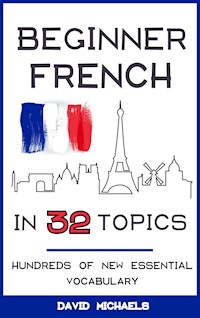
Beginner French in 32 Topics.
Learn 100’s of New Essential Vocabulary
David Michaels
©David Michaels 2017
All rights reserved. No part of this book can be reproduced or distributed in any form whatsoever without the permission of the publisher. The only exceptions are short quotations and some non-commercial uses allowed by copyright laws.
Free Audiobook!
Get the Complete Audiobook for Free!
Improve your listening and pronunciation skills.
Learn and practice 100’s of new essential words.
Learn French wherever you are.
Have it on in the background and learn naturally.
By signing up to an Audible free trial you can get this book for free. You can quit before the trial is over and keep this audiobook or continue and enjoy more audiobooks. If you are already an Audible member, you can of course get this audiobook with one of your ‘credits’.
Get started listening and learning today:
US: Audible.com
UK: Audible.co.uk
Introduction
Why learn French through topics?
So you want to speak French, right? To be able to converse with other French speakers you will need to speak about various topics. Here we introduce the essential vocabulary you will need to speak about 32 everyday topics such as ‘money’, ‘politics’ and ‘food’. This will equip you with both the vocabulary and language skills for speaking in French about the things that you would normally speak about in your own language.
How does it work?
We start with an article about each topic. But to keep things interesting we have added an angle. So for example, if the topic is ‘Money,’ then the article is about ‘The History of Money’. This way you will learn essential vocabulary while remaining interested in what you are reading. In order to fully understand how to use the vocabulary there are also example sentences for each of the target words. We have also included full translations of everything to ensure you gain the most from the articles.
Who is this book for?
If you have a good knowledge of basic grammar and vocabulary then this book will help you gain confidence in what you already know, and help you to take your French to the next level. Essentially, if you are a high level beginner or pre-intermediate learner you will definitely benefit and improve both your vocabulary and overall French level.
Please be sure to leave a review.
If you enjoy this audiobook please be sure to help us spread the word by leaving a review. It helps more than you can imagine. Thanks a lot.
Driving
Driving in Europe.
Conduite
Conduire en Europe.
Part 1.
Tout le monde pense être un bon conducteur mais il est évident que certains ne le sont pas. Les Italiens ont la réputation de conduire roulervite et de ne pas respecter les feux de signalisation. Ils aiment aussi vous coller au pare-chocs et dépasser les autres conducteurs. C'est une conduite dangereuse qui entraîne de nombreux accidents, ce que j'ai pu constater lorsque j'étais là-bas. Cependant, le bon côté de la conduite en Italie, c'est que vous pouvez vous garer partout.
English:
Everybody thinks that they are a good driver. But of course some people are not good. Italians are famous for speeding and ignoring traffic lights. They also love to tailgate and overtake each other. This is dangerous and they often have crashes. I saw lots of accidents there. The good thing about driving in Italy is that you can park anywhere.
Vocabulary:
Être en excès de vitesse : Speeding
Exemple : Il était en excès de vitesse et il a eu un accident.
Example: He was speeding and then he had an accident.
Feux de signalisation : Traffic lights.
Exemple : Vous devez vous arrêter quand le feu est rouge.
Example: You must stop at the traffic lights if they are red.
Coller au pare-chocs : To tailgate.
Exemple : Il est très dangereux de coller aux pare-chocs des autres véhicules. En effet, s'ils freinent de manière soudaine, vous risquez la collision.
Example: It is very dangerous to tailgate someone because if they stop suddenly you could hit them.
Doubler (une autre voiture) : To overtake (another car).
Exemple : Faites attention lorsque vous doublez, une voiture pourrait arriver en face.
Example: You should be careful when you overtake in case a car is coming from the opposite direction.
Un accident/percuter : A crash/to crash.
Exemple 1 : J'ai vu accidentsur le bord de la route.
Example 1: I saw a car crash on the side of the road.
Exemple 2 : La voiture a percuté un arbre.
Example 2: The car crashed into a tree.
Un accident : An accident.
Exemple : Il y a plus d'accidents la nuit.
Example: There are more accidents at night.
Se garer : To park (a car).
Exemple : Je me suis garé(e) à côté de la maison.
Example: I parked my car next to my house.
Part 2.
La réputation des Allemands est meilleure car ils ont des radars partout et conduisent donc assez lentement sur les routes. Cependant, il n’y a pas de limite de vitesse sur les autoroutes. Vous devez donc faire attention. Les meilleurs conducteurs sont probablement les Slovaques. Ils mettent toujours leur clignotant et font attention aux ronds-points. Mais, où que vous soyez, faites attention.
English:
Germans are ok because there are speed cameras everywhere so they drive quite slowly on normal roads. However, there is no speed limit on the motorway so you need to be careful. Probably the best drivers on the road are Slovaks. They always indicate when turning and are careful on roundabouts. But wherever you are, please be careful.
Vocabulary:
Un radar : A speed camera.
Exemple : Vous devez conduire prudemment à l’approche d’un radar.
Example: You need to drive carefully around speed cameras.
Une route : A road.
Exemple : Cette route mène en ville.
Example: This road goes to the city.
La limite de vitesse : The speed limit.
Exemple : La limite de vitesse sur cette route est de 50km heure.
Example: The speed limit on this road is 50km an hour.
Une autoroute : A motorway.
Exemple : Vous pouvez conduire rapidement sur une autoroute.
Example: You can drive fast on a motorway.
Mettre son clignotant : To indicate.
Exemple : Vous devez mettre votre clignotant avant de tourner.
Example: You need to indicate before turning.
Un rond-point :A roundabout.
Exemple : Il y a beaucoup de ronds-points au Royaume-Uni.
Example: There are lots of roundabouts in the UK.
Property
The UK Property Boom.
Immobilier
Le boom de l’immobilier au Royaume-Uni.
Part 1.
Il est chaque année de plus en plus cher d’acheter une maison ou un appartement au Royaume-Uni. Même un studio est trop cher pour la plupart des gens. Un grand nombre de personnes ne peuvent pas faire d’emprunt immobilier car ils n’ont pas les moyens déposer de caution. La situation est tellement grave aujourd’hui que la plupart des gens qui achètent la première fois ont une quarantaine d’années.
English:
Every year it gets more and more expensive to buy a house or a flat in the UK. Even a studio flat is too expensive for most people. A lot of people can’t get a mortgage because they don’t have a deposit. It’s so bad now that most first time buyers are in their forties.
Vocabulary:
Une maison : A house.
Exemple : J’habite dans une maison.
Example: I live in a house.
Un appartement : A flat.
Exemple : Il y a deux appartements dans cet immeuble.
Example: There are 2 flats in this building.
Un studio : A studio flat.
Exemple : Les studios sont très petits et n’ont pas de chambre séparée.
Example: Studio flats are very small and usually don’t have a separate bedroom.
Un emprunt (immobilier) : A mortgage.
Exemple : La plupart des gens ont besoin de contracter un emprunt pour acheter une maison.
Example: Most people need a mortgage to buy a house.
Une caution : A deposit. (Note: this is different from a deposit you make in the bank).
Exemple : Quand vous achetez une maison, vous déposez généralement une caution.
Example: When you buy a house, you usually pay a deposit.
Part 2.
Bien sûr, la plupart des gens peuvent tout de même louer mais cela reste cher. Vous aurez besoin d’un contrat et, parfois, de vous engager à rester longtemps. Vous devez payer votre loyer pour ne pas avoir de problèmes avec votre propriétaire.
English:
Of course people can still rent but that is also expensive. You will need a contract and sometimes will have to stay for a long time. You must pay your rent, so you don’t have problems with your landlord.
Vocabulary:
Louer : To rent.
Exemple : Je loue un appartement en ville.
Example: I rent a flat in the city.
Un contrat : A contract.
Exemple : Vous avez besoin d’un contrat quand vous louez une maison.
Example: You need a contract when you rent a house.
Payer le loyer : To pay rent.
Exemple : Je paie 800€ de loyer par mois.
Example: I pay $800 rent a month.
Un propriétaire : A landlord.
Exemple : Mon propriétaire possède dix appartements.
Example: My landlord has ten flats.
Part 3.
Pourquoi les immeubles sont-ils si chers ? certains pensent qu’il n’y a pas assez de biens immobiliers pour tout le monde. D’autres pensent que les taux d’intérêt sont trop bas. Mais une chose est sure, les agents immobiliers et les banques aiment lorsque les prix sont élevés et les gens normaux détestent ça.
English:
So why are buildings so expensive? Some people think there are not enough properties for everyone. Some people think that interest rates are too low. But one thing is for certain, estate agents and banks love the high prices and normal people hate them.
Vocabulary:
Un immeuble : A building.
Exemple : Cet immeuble est très grand. Il fait 10 étages et a deux ascenseurs.
Example: This building is very big. It has 10 floors and two elevators.
Un bien immobilier : Property.
Exemple : Les biens immobiliers sont chers au Royaume-Uni.
Example: Property is expensive in the UK.
Les taux d’intérêt : Interest rates.
Exemple : Le taux d’intérêt est de 3%. Cela signifie que je dois payer 15.000€ de plus sur mon emprunt immobilier.
Example: The interest rate is 3%. That means I will have to pay $15,000 extra on my mortgage.
Un agent immobilier : An estate agent.
Exemple : L’agent immobilier m’a fait visiter un appartement.
Example: The estate agent showed me a new flat.




