


8,49 €
Mehr erfahren.
- Herausgeber: Rana Books India
- Kategorie: Ratgeber
- Sprache: Englisch
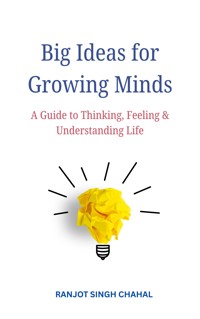
Big Ideas for Growing Minds is a modern, thoughtful, and deeply human guide for anyone who wants to understand life more clearly, think more deeply, and grow with confidence in an ever-changing world. Designed for young thinkers, new learners, and curious minds of all ages, this book turns everyday questions into powerful lessons about who we are and how we see the world.
Blending simple explanations with rich insights, it explores the hidden world inside us—our thoughts, feelings, choices, fears, dreams, and the way our minds make sense of life. Each chapter opens a door to a big idea: Why do we feel confused? What makes something beautiful? Why do people disagree? Where do our thoughts come from? What does it mean to be kind? How do we choose the right path when life feels difficult?
Written in a warm and engaging style, this book helps readers slow down, reflect, and discover wisdom in places they never noticed before. It encourages emotional awareness, critical thinking, empathy, curiosity, and self-understanding—skills that shape not only how we think, but also how we live.
Whether you’re a young reader searching for meaning, a student learning to understand your emotions, or an adult rediscovering the power of simple questions, Big Ideas for Growing Minds offers guidance that is gentle, practical, and deeply relatable.
If you want to grow your mind, strengthen your heart, and understand yourself and others better, this book is your companion on the journey.
Das E-Book können Sie in Legimi-Apps oder einer beliebigen App lesen, die das folgende Format unterstützen:
Seitenzahl: 121
Veröffentlichungsjahr: 2025
Ähnliche


















Ranjot Singh Chahal
Big Ideas for Growing Minds
A Guide to Thinking, Feeling & Understanding Life
First published by Rana Books ( India ) 2025
Copyright © 2025 by Ranjot Singh Chahal
All rights reserved. No part of this publication may be reproduced, stored or transmitted in any form or by any means, electronic, mechanical, photocopying, recording, scanning, or otherwise without written permission from the publisher. It is illegal to copy this book, post it to a website, or distribute it by any other means without permission.
First edition
Contents
Chapter 1 — Questions That Make Us Think
Chapter 2 — What Is Really Important in Life?
Chapter 3 — Where Do Our Thoughts Come From?
Chapter 4 — Why Do We Feel Confused Sometimes?
Chapter 5 — Is Everyone’s View Correct?
Chapter 6 — What Does It Mean to Be Kind?
Chapter 7 — Why Do We Dream Big?
Chapter 8 — Can We Control Our Choices?
Chapter 9 — Why Do Rules Exist?
Chapter 10 — What Makes Something Beautiful?
Chapter 11 — Why Are We Afraid of Being Wrong?
Chapter 12 — Why Do People See Life Differently?
Chapter 13 — Why Do People Change?
Chapter 14 — What Should We Do When Life Feels Hard?
Chapter 15 — How Can We Make the World Better?
Chapter 1 — Questions That Make Us Think
1. The Beginning of Curiosity
Every great idea in human history began with a question.
Not an answer —
a question.
Questions are the quiet spark that wakes up the mind.
They appear suddenly, sometimes in the middle of an ordinary moment,
when nothing special is happening —
yet something within you whispers,
“Look again. Something here is worth understanding.”
A curious mind doesn’t accept life as it is.
It doesn’t stop at the first explanation.
It doesn’t settle for the easy story.
It whispers:
“There must be more. Let me explore deeper.”
That whisper is where thinking truly begins.
Curiosity is the invisible engine behind all discovery.
It pulls you out of the routine,
out of the surface of life,
and into the layers beneath it.
The moment you let curiosity wake up inside you,
your world slowly begins to expand —
not outward,
but inward.
2. Simple Questions That Open Big Doors
Deep thinking doesn’t always begin with big, dramatic questions.
Sometimes it starts with the smallest spark:
“Why do people behave this way?”
“What is the real meaning behind this feeling?”
“Why do I think differently from others?”
“Where do ideas come from?”
“Why does time feel fast some days and slow on others?”
These questions feel simple,
but they are keys.
Once you allow a simple question to stay inside you,
it does not remain simple —
it grows roots.
It turns into reflection.
Reflection turns into understanding.
Understanding turns into awareness.
And slowly, without even noticing it,
your mind becomes richer, brighter, sharper.
3. Kids Ask Better Questions Than Adults
Children ask the purest, bravest questions in the world.
They ask without fear of judgment,
without pretending to know more than they do.
A child may wonder:
“Who made the rules of life?”
“Why do people fight?”
“Where do thoughts go when we forget them?”
“Why can’t we see the wind?”
Adults forget how to ask like this.
Life becomes louder, faster, heavier.
Responsibilities pile up.
Routines take over.
Curiosity shrinks behind the closed door of busy days.
But growing up was never supposed to mean
shutting down curiosity.
It was supposed to mean
learning how to ask better, deeper, more honest questions —
questions that reveal not only the world,
but also yourself.
4. Questions Are Mirrors of the Mind
The questions you ask are a reflection of who you are becoming.
They reveal the stories you believe,
the fears you carry,
the values you hold,
and the dreams you protect in silence.
Some ask:
“What will people think of me?”
While others ask:
“Why do I care so much about what people think?”
Some ask:
“Why is life unfair?”
Others ask:
“How can I understand life better?”
Your questions reveal your emotional depth,
your maturity,
your wounds,
your growth,
and the shape of your inner world.
If you want to know yourself,
don’t look at your answers —
look at your questions.
5. The Courage to Ask ‘Why?’
Humans often accept things because
“that’s how it is.”
But curious minds do not stop at the surface.
They ask:
“Why do I believe this?”
“Where did this idea come from?”
“Is this the truth, or just a habit?”
“Is there another way to see this?”
“Am I living my life, or someone else’s expectations?”
Asking why is not rebellion —
it is intelligence.
It is the first movement of the mind
towards independence.
The moment you ask “why?”
you take ownership of your thinking.
You stop living on autopilot
and begin living consciously.
6. Thinking Slows Down the World
Deep questions have a strange power —
they slow the world down.
In a time where everything moves fast,
questions make you pause.
You stop rushing.
You stop reacting.
You begin observing.
You begin listening.
Observation leads to clarity.
Clarity leads to understanding.
Understanding leads to wisdom.
Questions are not interruptions to life —
they are invitations
to experience life more fully.
When the world speeds up,
a thinking mind becomes your anchor.
7. Some Questions Don’t Have Answers — And That’s Okay
Not every meaningful question in life
has a final, perfect answer.
Some questions remain open:
What is the purpose of life?
What makes something truly beautiful?
Is truth the same for everyone?
Where does consciousness come from?
What happens after we die?
These questions exist not to be solved,
but to be explored.
They make your mind stretch beyond its limits.
They keep curiosity alive.
They keep humility alive.
Living with an unanswered question
is the sign of a mind that is expanding,
not shrinking.
8. Questions Shape Perspective
Two people can face the same moment,
the same problem,
the same failure —
but ask completely different questions.
One asks:
“Why is this happening to me?”
Another asks:
“What can I learn from this?”
One asks:
“Who is at fault?”
Another asks:
“What is the deeper truth here?”
The questions you choose
shape your reality.
They decide whether you see life
as something attacking you
or something teaching you.
Change your questions,
and you change your perspective.
Change your perspective,
and your entire life shifts.
9. Great Thinkers Are Great Questioners
History does not remember people
because they memorised answers.
It remembers those
who dared to ask questions
that others avoided.
Socrates asked uncomfortable questions.
Einstein asked impossible questions.
Confucius asked moral questions.
Simone de Beauvoir asked societal questions.
Da Vinci asked questions about everything around him.
Every revolutionary idea in the world
began with someone wondering
about something everyone else ignored.
Great thinkers are not defined by intelligence —
but by courage.
The courage to question
and the courage to imagine.
10. A Question Can Change Your Entire Path
Sometimes a single question
arrives quietly,
like a soft knock on the door of your mind —
but it changes everything.
Questions like:
“Is this truly what I want?”
“Why am I afraid of this?”
“What if I try something new?”
“Who am I becoming?”
“Am I living, or merely surviving?”
These are turning-point questions.
They break old habits.
They expose hidden fears.
They shake the dust off forgotten dreams.
One honest question
can redirect your whole future.
11. The Questions You Fear Are the Ones You Need Most
Some questions make you uncomfortable.
They challenge:
your beliefs
your choices
your identity
your excuses
your routines
your assumptions
They force you to face
what you’ve been avoiding.
A mind that avoids difficult questions
avoids its own evolution.
A mind that welcomes them
begins transformation.
Growth doesn’t start with motivation.
It starts with a brave question
you’re finally willing to ask.
12. Your Inner World Expands Through Curiosity
Thinking is not an academic skill —
it is a human skill.
You think when you observe people,
reflect on your behaviour,
notice emotions,
recognise patterns,
connect experiences,
and question your reactions.
Every question you ask
adds another window in your mind
through which you can see the world.
The more curious you become,
the more your inner world widens —
quietly, beautifully, endlessly.
Curiosity builds a mind
that never stops growing.
13. Asking Good Questions Is a Life Skill
A good question is powerful.
It can:
open possibilities
increase clarity
remove confusion
strengthen thinking
improve decisions
deepen understanding
reveal truth
prevent mistakes
When you master the art of questioning,
you gain access to deeper layers of life
that most people walk past
without noticing.
Good questions are the foundation
of good decisions,
good judgement,
good relationships,
and good self-understanding.
A strong mind is not one
that knows everything —
but one that knows what to ask.
14. The World Changes When You Change Your Questions
Questions build your reality.
If you change:
“What is wrong with my life?”
to
“What can I change today?”
your life shifts.
If you change:
“Why am I like this?”
to
“How can I grow from here?”
your growth begins.
If you change:
“What do others want from me?”
to
“What do I want for myself?”
your identity strengthens.
If you change:
“Why is life against me?”
to
“What is life trying to teach me?”
your resilience awakens.
Questions shape your direction.
They shape your choices.
They shape your beliefs.
They shape your future.
Change your questions,
and you change your world.




