


3,99 €
Mehr erfahren.
- Herausgeber: Bastei Entertainment
- Kategorie: Krimi
- Serie: Countryside Mysteries: A Cosy Shorts Series
- Sprache: Englisch
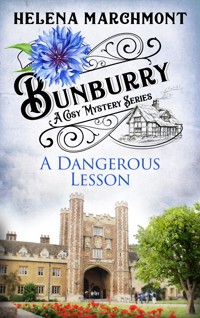
There is shock in the local high school when Alison Shaw, a young, dynamic chemistry teacher, goes into a coma after being struck by a falling smart board. But is it an unfortunate accident or something more sinister? When the headteacher asks amateur sleuth Alfie McAlister to investigate, Alfie enlists the help of Liz and Marge, his fellow members of the Bunburry Triangle. And Noah, a pupil at the school and an aspiring detective, is also determined to help the investigation. As they delve deeper, they encounter an alarming number of possible suspects. Will they uncover the truth behind the dangerous events unfolding at the school?
Das E-Book können Sie in Legimi-Apps oder einer beliebigen App lesen, die das folgende Format unterstützen:
Seitenzahl: 149
Veröffentlichungsjahr: 2023
Ähnliche




















Contents
Bunburry – A Cosy Mystery Series
Miss Marple meets Oscar Wilde in this new series of cosy mysteries set in the picturesque Cotswolds village of Bunburry. In “Murderous Ride”, the second Bunburry book, Alfie discovers that he has not only inherited a cottage from his late Aunt Augusta but also a 1950s Jaguar. He is dismayed: for reasons of his own, he no longer drives. Aunt Augusta’s best friends, Liz and Marge, persuade him to get behind the wheel again – but that’s just the start of his troubles.
About the Book
There is shock in the local high school when Alison Shaw, a young, dynamic chemistry teacher, goes into a coma after being struck by a falling smart board. But is it an unfortunate accident or something more sinister? When the headteacher asks amateur sleuth Alfie McAlister to investigate, Alfie enlists the help of Liz and Marge, his fellow members of the Bunburry Triangle. And Noah, a pupil at the school and an aspiring detective, is also determined to help the investigation. As they delve deeper, they encounter an alarming number of possible suspects. Will they uncover the truth behind the dangerous events unfolding at the school? …
Cast
Alfie McAlister flees the hustle and bustle of London for the peace and quiet of the Cotswolds. Unfortunately, the “heart of England” turns out to be deadlier than expected …
Margaret “Marge” Redwood and Clarissa “Liz” Hopkins have lived in Bunburry their entire lives, where they are famous for their exceptional fudge-making skills. Between Afternoon Tea and Gin o’clock they relish a bit of sleuthing …
Emma Hollis loves her job as policewoman, the only thing she is tired of are her aunt Liz’s constant attempts at matchmaking.
Betty Thorndike is a fighter. Mostly for animal rights. She’s the sole member of Bunburry’s Green Party.
Oscar de Linnet lives in London and is Alfie’s best friend. He tries luring Alfie back to the City because: “anybody can be good in the country. There are no temptations there.”
Augusta Lytton is Alfie’s aunt. She’s dead. But still full of surprises …
Harold Wilson loves a pint (or two) more than his job as local police sergeant.
BUNBURRY is a picturesque Cotswolds village, where sinister secrets lurk beneath the perfect façade …
HELENA MARCHMONT
A Dangerous Lesson
“Education is an admirable thing, but it is well to remember from time to time that nothing that is worth knowing can be taught.”
Oscar Wilde
Prologue
The sudden noise startled him. He hadn’t expected anyone to be there, not at this time, when the place was supposed to be closed. He could hear footsteps, the click of high heels – a woman, and the heavier tread of a man.
But who were they, and how had they got in? The woman giggled and he immediately recognised the voice. Of course. She had a key card. But why was she there? And who was with her? The man was whispering, his voice too low to make out. That was strange. If they thought the place was deserted, why the need?
The woman said something equally quietly, and then there was a sound he initially couldn’t identify. A kiss. Followed by rustling, more whispering, the creaking of a desk. Now there was no doubt as to what was going on. Half-revolted, half-fascinated, he increased the volume. He still couldn’t quite decipher the breathless words, or recognise her companion, but she was unmistakable.
He congratulated himself. It had been a wise precaution, setting up the noise-activated sensor to warn him if anyone came into the room. But this was an added bonus. If there was any prospect of trouble, he could use it as leverage. He leaned over and pressed “Record”.
1. Alfie and Emma
“Mr McAlister!”
Alfie McAlister turned to see a small Harry Potter lookalike waving at him energetically. The boy was so slight that Alfie still had difficulty remembering that Noah was now in secondary school. Alfie had always been tall for his age, probably one of the things that stopped him being bullied in the bog-standard comprehensive he went to in London’s East End.
Noah had been an unexpected asset in setting up the community library while he was still in primary school. He turned up every weekday after his lessons until his mother got home from work and virtually ran the children’s section single-handed.
He had been taken under the guidance of Miss Radford-Jones, the redoubtable elderly lady who had allowed the library to be housed in her large mansion. She was particularly insistent on good manners and so Noah refused to call Alfie by his first name, insisting that that would be disrespectful to an adult. Alfie wondered when Noah would stop thinking it was disrespectful. He had a sudden image of himself, stooped with age in an old folks’ home, being visited by Noah who was now either an Oxbridge professor or a detective chief superintendent, but still calling him “Mr McAlister.”
“I haven’t seen you for ages,” said the boy as he caught up with Alfie. “Sorry I can’t get to the library so often, but I’ve got football practice and the chess club and things. And Mum’s given me a key now.”
Alfie had also been brought up by a single mother, but he had been a latch-key kid from an illegally early age. And the extra-curricular activities in his school in the east end of London definitely didn’t include things like football practice and chess. He sometimes found it hard to believe that he was now a multi-millionaire, thanks to the sale of his start-up.
“That’s okay, Noah,” he said. “I’m afraid I haven’t been in the library as much as usual – I’m helping to set up the new local history museum.” No need to say he was underwriting the project.
“And what about the Bunburry Triangle?” asked the small boy, his eyes shining. “Are you and Ms Hopkins and Ms Redwood working on a case at the moment?”
“It’s very quiet, with nothing that needs investigating,” said Alfie. “Liz is getting on with making fudge, and Marge is busy delivering it and doing the accounts.”
“That’s a shame,” said Noah, disappointed. “I might have been able to help.”
His enthusiasm for amateur sleuthing had been boosted by being told he could be an associate member of the Bunburry Triangle. Alfie’s friend Oscar made things worse by suggesting that Noah head up a freelance group called the Bunburry Irregulars, stealing the name from Sherlock Holmes’s band of youthful intelligence agents, the Baker Street Irregulars.
“If anything happens, you’ll be the first to know,” Alfie promised. Then he registered that it was a weekday. “Why aren’t you in school? You’re not skiving off, are you?”
“Of course not.” Noah looked earnest. “I wouldn’t do that. It’s an inset day.”
“A what?”
“A teacher development day. When the teachers have to go in, but we don’t. It would be good if that happened every day.”
“But you like school,” said Alfie, hoping to be reassured.
The small boy frowned. “It’s a bit like the curate’s egg.”
“I’m sorry?” said Alfie.
“It’s an expression that comes from an old cartoon,” said Noah. “Mrs Walters, our English teacher, told us about it. She’s my favourite. The cartoon shows people having a meal, with a bishop saying to the curate, ‘I’m afraid you’ve got a bad egg,” and the curate says, ‘Oh no, I assure you that parts of it are excellent.’ So, if you say something’s like the curate’s egg, it means there are a lot of bad things about it.”
Alfie stifled a grin. “I’m sorry to hear that,” he said. “What are the bad things?”
“Some of the teachers are pretty horrible,” said Noah, wrinkling his nose. “Like the history teacher. He’s always shouting at us for no reason. And the janitor’s always shouting as well and blaming us for things we haven’t done. I don’t like Miss Milton either. She’s our PE teacher, and she doesn’t like me because I’m no good at the long jump and the high jump. She only likes the kids who win.”
Alfie was frowning now. Noah wasn’t long-legged enough to excel at these. “That doesn’t sound very fair,” he said.
“It’s not,” said Noah. “But the history teacher always tells us life isn’t fair.”
That was true enough, Alfie thought, but it didn’t sound like a helpful part of the curriculum. Some of his own teachers had been positively brutal, although that was possibly the only way they could try to control a class when half the pupils had absolutely no interest in learning and only wanted to disrupt things. But Noah’s secondary school seemed decent enough, and surely things had improved over the years.
“Is there a counsellor or someone at the school you can talk to about these people?” he asked.
“Oh no, Mr McAlister,” said Noah. “I can talk to my friends, but I can’t talk to anyone else. I’m not a grass.”
That sounded depressingly familiar. Pupils in Alfie’s school had indulged in activities from shop lifting to drug dealing, and being a grass would definitely have led to being beaten up. But it was a completely different thing to protest about staff being unnecessarily authoritarian.
Alfie was about to explain this to Noah when the small boy said: “Is it your birthday?”
Alfie blinked at the unexpected change of topic. “No, it’s not. Why do you ask?”
Noah was peering at him intently. “You just look really happy,” he said. “Sometimes you look a bit sad. So, I wondered if something nice had happened.”
Alfie almost blurted out that Noah was right, something nice had happened. Thankfully, he stopped himself in time.
“I’m glad I look happy,” he said. “That’s a lot better than looking sad.”
“It is,” agreed Noah. “Anyway, I’d better go. I promised Gwendolyn I’d give her a hand in the library. She’s very good with the grown-ups’ bit, but she doesn’t really understand the children’s section.”
“I’m sure she’ll be very grateful for your help,” said Alfie. Gwendolyn, the librarian, almost never looked happy, but that was because she was a Goth, and cheerfulness didn’t fit the image. However, she had blossomed in the role of running the community library, and Alfie was sure she was secretly delighted by its success.
“See you later,” said Noah, heading towards the library.
Alfie set off for the outbuilding which Miss Radford-Jones had allocated to the history museum. It needed significant renovations, and he was keeping an eye on progress.
In light of Noah’s comment, he realised he was smiling. He suspected he had been smiling all morning. Ever since waking up with Emma beside him. He still couldn’t quite believe it. He realised now what a tight rein he had been keeping on his feelings for her, convinced that the age gap between them was too great, and that she found him staid and boring. He had left her sleeping while he went out to buy fresh croissants for breakfast. But when he returned, he discovered that although Emma was now awake, breakfast wasn’t her first priority.
Alfie, cursing himself for being staid and boring but still feeling obliged to ask the question, said: “Don’t you have to go to work? Shouldn’t you go home to change?” Her discarded clothes were the leggings and t-shirt she wore for yoga, not her police uniform.
Emma leant back lazily against the pillows. “Didn’t I tell you? It’s my day off.”
She hadn’t told him, and he briefly wondered whether it was true or if she was pulling a sickie. Could police get away with taking sickies?
It was well after breakfast time when the croissants were finally eaten with farmhouse butter and thick-cut marmalade. And eventually Emma reluctantly decided that she should go home.
“I’ll call you,” she said, picking up her yoga mat and giving Alfie a final kiss. “Thank heavens Dorothy isn’t here. Within half an hour, the whole village would know I was a dirty stop out.”
Dorothy the postwoman delivered as much gossip as mail – possibly more – but had become the subject of gossip herself by embarking on an unlikely romance with Police Sergeant Harold Wilson. Dorothy had confided to Alfie that the sergeant was going to propose marriage to her.
The most common reaction to the relationship from the villagers was that Dorothy needed her head examined. Alfie couldn’t imagine how they would react when they discovered the pair were getting married. And how would they react if they found out about him and Emma? Would they disapprove of the age gap, Alfie being well over a decade older than Emma? At least he had no intention of proposing. He had learned his lesson with Vivian. She had firmly refused to get married, telling him that love should be based on mutual respect, not a legal contract. A marriage certificate, she said, was not just an unnecessary piece of paper, it represented a social construct that subjugated women. Emma was virtually the same age that Vivian would have been. Like her, she was a strong, independent woman and would share her views. Alfie wasn’t going to do anything that could be construed as pressurising her, or suggesting that their current relationship wasn’t good enough for him.
With a pang, he remembered how he had thought he and Vivian would spend the rest of their lives together, and then came that horrific moment when the police came to his door to tell him she had been killed in a car crash. That was what precipitated his move to Bunburry – it had been too painful to live in the London flat without her.
For a long time after Vivian’s death, he had felt as though he was simply trudging on from day to day, and he had certainly never imagined that he would find love again. Now that he had a new chance of happiness, he would accept however Emma wanted to play it.
Her relief at Dorothy’s absence sounded as though she didn’t want to publicise this new relationship. While Alfie was prepared to proclaim it from the rooftop of The Drunken Horse, he wasn’t going to do anything that might jeopardise the romance.
Now, on his way to see how the history museum was progressing, he found himself wondering when Emma would call him. And as though they now had a telepathic bond, at that instant his mobile rang.
“Hi,” she said abruptly. “We need to talk.”
Those were never good words to hear.
“The tea-room at half-past?” she went on.
He was tempted to tell her he was busy with the museum, simply to postpone the evil hour. But whatever bad news she had for him, he might as well get it over with.
“See you there,” he said.
He was the first to arrive and chose a small table right at the back, well away from the other customers. He was pretty sure he didn’t want an audience for what she was going to tell him. She came in a few minutes later, a tense expression on her face as she scanned the room and then came over to join him.
“Hello,” he said with a cheerfulness he didn’t feel. There was no answering smile as she sat down, scarcely looking at him.
A motherly waitress approached. “Have you decided?” she asked.
“Tea,” said Emma promptly. “And a fruit scone.”
“The same for me, thanks,” said Alfie, wondering if Emma had decided with equal speed whatever it was she wanted to talk about.
When the waitress left, Emma smoothed down the white linen tablecloth. She seemed in no hurry to start the conversation.
“I just saw Noah,” said Alfie, to fill the silence.
“He’s a great kid,” she said, her voice warm. “If they were all like him, my job would be a lot easier.”
“What do you mean?” he asked. “Are you having problems with them?”
“Nothing I can’t handle,” she said crisply.
He had said the wrong thing. Or rather, she seemed to have taken it the wrong way, thinking he was questioning her professionalism. It would only make it worse if he said: “I worry about you.”
Instead, he said: “What is it we need to talk about?”
She began to laugh. “Your face! You look as though you think I’m about to dump you.”
“Of course not,” he said, with an overwhelming surge of relief.
“No, what it is-”
“Two cream teas with fruit scones,” announced the waitress, carrying a laden tray. She unloaded the china cups and plates, the warmed scones, the ramekins of clotted cream and home-made strawberry jam, the silver teapot, the silver milk jug, another jug with hot water, and the tea strainer.
“Thank you,” said Alfie, hoping he didn’t sound as impatient as he felt.
As soon as the waitress had gone, he turned to Emma. She had already snaffled the largest scone and was cutting it in two.
“It’s important to eat them while they’re still warm,” she said.
Alfie took it upon himself to pour the tea, catching the leaves in the strainer, while Emma applied jam and cream to the scone. She took a bite and chewed thoughtfully. A delaying tactic?
“There’s something you want to discuss?” he prompted.
“This scone,” she said, “is excellent. I could happily live on these scones.”
“Maybe not the most balanced diet,” he said. “But I’m guessing you didn’t ask me here to discuss scones.”
She grimaced. “I know you won’t like the idea. It’s just, I really want to. I mean, if you’re totally against it, I suppose I’ll just have to go along with that. But I’d rather not.”
“Emma,” he said, “I have absolutely no idea what you’re talking about.”




