


3,99 €
Mehr erfahren.
- Herausgeber: Bastei Entertainment
- Kategorie: Krimi
- Serie: Countryside Mysteries: A Cosy Shorts Series
- Sprache: Englisch
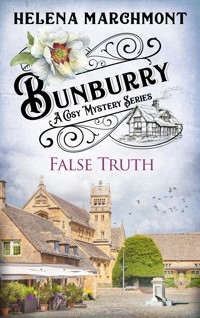
The Cotswolds village of Bunburry is not only picturesque but also historic, about to mark its 500th anniversary. Self-made millionaire and amateur sleuth Alfie McAlister is dreading the celebrations, having been coopted to make a speech from an outsider’s perspective, despite having lived in the village for more than four years. But Dorothy from the post office has worse concerns. She suspects the mayor of the neighbouring town of Rimingford is using the celebrations for dodgy dealings. It’s exactly the sort of situation to be investigated by the Bunburry Triangle: Alfie and his elderly friends Liz and Marge. But Dorothy decides she’s going to uncover the truth without any help. This could prove a dangerous mistake ...
Das E-Book können Sie in Legimi-Apps oder einer beliebigen App lesen, die das folgende Format unterstützen:
Seitenzahl: 198
Veröffentlichungsjahr: 2023
Ähnliche




















Contents
Bunburry – A Cosy Mystery Series
Miss Marple meets Oscar Wilde in this new series of cosy mysteries set in the picturesque Cotswolds village of Bunburry. In “Murderous Ride”, the second Bunburry book, Alfie discovers that he has not only inherited a cottage from his late Aunt Augusta but also a 1950s Jaguar. He is dismayed: for reasons of his own, he no longer drives. Aunt Augusta’s best friends, Liz and Marge, persuade him to get behind the wheel again – but that’s just the start of his troubles.
About the Book
The Cotswolds village of Bunburry is not only picturesque but also historic, about to mark its 500th anniversary. Self-made millionaire and amateur sleuth Alfie McAlister is dreading the celebrations, having been coopted to make a speech from an outsider’s perspective, despite having lived in the village for more than four years. But Dorothy from the post office has worse concerns. She suspects the mayor of the neighbouring town of Rimingford is using the celebrations for dodgy dealings. It’s exactly the sort of situation to be investigated by the Bunburry Triangle: Alfie and his elderly friends Liz and Marge. But Dorothy decides she’s going to uncover the truth without any help. This could prove a dangerous mistake …
The Author
Helena Marchmont is a pseudonym of Olga Wojtas, who was born and brought up in Edinburgh. She was encouraged to write by an inspirational English teacher, Iona M. Cameron. Olga won a Scottish Book Trust New Writers Award in 2015, has had more than 30 short stories published in magazines and anthologies and recently published her first mystery Miss Blaine’s Prefect and the Golden Samovar.
Cast
Alfie McAlister flees the hustle and bustle of London for the peace and quiet of the Cotswolds. Unfortunately, the “heart of England” turns out to be deadlier than expected …
Margaret “Marge” Redwood and Clarissa “Liz” Hopkins have lived in Bunburry their entire lives, where they are famous for their exceptional fudge-making skills. Between Afternoon Tea and Gin o’clock they relish a bit of sleuthing …
Emma Hollis loves her job as policewoman, the only thing she is tired of are her aunt Liz’s constant attempts at matchmaking.
Betty Thorndike is a fighter. Mostly for animal rights. She’s the sole member of Bunburry’s Green Party.
Oscar de Linnet lives in London and is Alfie’s best friend. He tries luring Alfie back to the City because: “anybody can be good in the country. There are no temptations there.”
Augusta Lytton is Alfie’s aunt. She’s dead. But still full of surprises …
Harold Wilson loves a pint (or two) more than his job as local police sergeant.
BUNBURRY is a picturesque Cotswolds village, where sinister secrets lurk beneath the perfect façade …
HELENA MARCHMONT
False Truth
“When I was young, I thought that money was the most important thing in life. Now that I am old, I know that it is.”
Oscar Wilde
Prologue
There was a sharp chill in the night air, but the young woman with the blue titanium nose ring was oblivious to it. Reaching the small clearing in the wood, she switched off her torch and stood motionless, tense, watching and waiting.
A faint beam of light in the distance. Getting closer. Someone else with a torch. She took a step backwards, concealing herself behind a sturdy tree trunk.
A few moments later, an older, white-haired man came into the clearing. He laid his torch on the ground, stretched his arms wide, gave a deep inhalation, and began to speak, so softly that she caught only a few phrases. “The knowledge of justice … the love of justice … the love of Earth our mother.”
When he seemed to have finished, she emerged from her hiding place.
“Hello. I got here before you.”
He gave a gasp of alarm, grabbing his torch to illuminate her. “Oh, it’s you! You startled me!”
“Sorry. I wasn’t sure that it was you to begin with. I was going to say something when I realised, but then – I didn’t want to interrupt.”
“It was just a short prayer. But why on earth are you in the dark? Did you forget your torch?”
She took her torch out of her jacket pocket and switched it on, the trees’ branches casting weird shadows over them.
“I didn’t want to be obvious until I knew who it was. You might have been a spy.”
“A spy?” He sounded nonplussed. “You’ve been reading too many thrillers.”
She bristled. Just because the rest of them were so much older, there was no need to treat her like a child. “We can’t be too careful.”
“We’re being very careful. That’s why we’re meeting in Wildshaw Woods when everyone else is asleep.”
Two more beams of light wavered through the wood in their direction.
“Halt - who goes there?” the white-haired man called softly. “I hope you’ve remembered the password. This young lady thought I was a spy.”
Two more men reached the clearing, the first large, cheerful and stocky, with a bushy black beard, the other slighter and nervous, shivering despite his heavy parka.
The bearded man grinned at her. “Goodness,” he said in a deep rumbling voice. “A spy? What would you have done if he had been?”
“Hit him over the head with my torch,” she declared.
The grin disappeared. “Please don’t even joke like that.”
She felt like saying she wasn’t joking.
As if he had read her mind, he said: “There is to be absolutely no violence.”
“We can’t exactly stage a kidnapping without a bit of violence,” she muttered.
The men exchanged glances. Then the white-haired man said: “We’re here to finalise the plans for the kidnapping. As far as I’m concerned, there are two key aims: that we don’t get caught, and that nobody gets hurt. If you can’t commit to sticking to the plan, we can’t let you get involved.”
“I’ve got more right than any of you,” she thought. Aloud, she said: “I’m sorry. Of course, I’ll stick to the plan. I promise.” She wondered whether she should cross her fingers behind her back.
*
In the nearby village of Bunburry, someone else was still awake, someone working on a laptop in a darkened office. They too were planning criminal activity. But there was absolutely no question of violence. Keys tapped rapidly, files appeared and disappeared. This was white-collar crime.
1. An Anniversary
It was a gloriously sunny day, the sky a cloudless blue, the breeze warm, the sort of day that called for pottering in the garden, or picnicking by the river.
This meant that Alfie McAlister was on his own in Bunburry’s community library, with not a borrower in sight. Even Miss Radford-Jones, who housed the library on the ground floor of her extensive mansion, had summoned Mr Harper to take her out in the silver Ford Mondeo for a visit to the new garden centre.
Gwendolyn the librarian was out giving a talk to a Women’s Institute group in a neighbouring village. The young goth, personally appointed by Miss Radford-Jones, had initially been terrified by the very sight of books. But she had blossomed so much in the post that she was now in great demand in schools and community groups as a champion of the importance of reading.
Alfie was glad of the peace and quiet. He had been strong-armed into making a speech and the mere prospect was giving him a headache. Perhaps scribbling some notes would help. He smoothed out a piece of paper on the desk in front of him and took out his pen.
He had been vaguely aware that more than real ale was brewing in the village, but hadn’t paid attention – there was always something going on. Until the phone call from Marge Redwood.
“You’re honoured,” said the elderly lady without preamble. “It turns out that you’ve been chosen to make one of the speeches.”
“I have?” he said. “Who by, exactly?”
“The committee, of course.”
“Any particular committee?”
“Oh, for goodness’ sake, Alfie, stop playing dumb. THE committee.”
“Marge, I honestly have no idea what you’re talking about.”
“The quincentenary, of course.”
“Quincentenary? That’s something to do with five hundred, isn’t it?”
Following a very lengthy shocked pause, Alfie was informed that this year was Bunburry’s five hundredth anniversary, the village dating from 1523.
“And,” said Marge heavily, “the committee thought you would be good at giving the perspective of an outsider.”
“An outsider?” Alfie protested. “I’ve been living here for over four years!”
“And you still don’t seem to know much about the place,” sniffed Marge. “You didn’t even know it was the quincentenary. Sounds to me as though you’re exactly the right choice.”
Now, as he stared at the blank sheet of paper in front of him in the library, Alfie had no idea what he could or should say in the speech. He had come to Bunburry almost by accident. His Aunt Augusta, whom he barely remembered, had left him Windermere Cottage in her will. And he moved there from London purely in search of sanctuary after his beloved Vivian died.
But now he considered Bunburry his home. The modern London flat overlooking the Thames was simply a pied-à-terre for his occasional visits to the capital.
He was, to all intents and purposes, living the dream, in a picturesque village in one of the most beautiful parts of the country. Except that, quite apart from his anxiety about the speech, he was still thoroughly disconcerted after being kissed, on separate occasions, by each of the Hollis sisters. The kiss from Laura had been unexpected and unwelcome, and he now did his best to dodge her, difficult in a small village. When they couldn’t avoid one another in the street, they pretended they were rushing past on urgent business, taking refuge in brief comments about the weather.
“Thank goodness the rain’s kept off.”
“I know, so lucky.”
Or:
“Quite a downpour this morning.”
“Wasn’t it just? Still, the gardens could do with it.”
But embarrassing though that was, it was less so than the memory of the kiss from Emma. No, he really didn’t want to think about that. Purposefully, he picked up his pen and held it over the sheet of paper, as though it might start writing the speech without any effort on his part.
When nothing happened, he rose and began pacing up and down the book-lined room. And he suddenly realised that the solution was literally staring him in the face. Gwendolyn, always keen to expand what the library could offer, had recently set up a self-help section, the books marked by turquoise stickers on the spine. Success. A book on the art of speech making. He checked it out and, glancing at his watch, saw it was just before closing time. And at that moment, Gwendolyn walked in.
Since she had been giving a talk, she was wearing her special outfit of a flounced calf-length black dress with fishnet tights, black lace-up boots and fingerless black lace gloves, as opposed to her everyday outfit of a flounced calf-length skirt with a purple bodice, fishnet tights, black lace-up boots and fingerless black lace gloves.
“I came to check that you had locked up properly,” she said.
“I was just about to,” he said. “Lock up properly,” he added, with a slight emphasis on properly. “How did the talk to the Women’s Institute go?”
“All right, I suppose,” she said gloomily, which he took to mean that it had been a roaring success.
She ferreted in her large black handbag, which was festooned with chains and embossed with a skull.
“They gave me a present,” she said, producing a thick pamphlet. “They made it. It has guides to their favourite walks, and poems inspired by the views. And jam recipes. I think we should start a new section with books of local interest. We could put this in it, alongside Oscar’s book.”
Oscar de Linnet, Alfie’s closest friend, who lived in London, was frequently asked by Gwendolyn to send books which would be of particular interest to the library’s borrowers. A package had recently arrived containing a large leather-bound volume which Oscar had discovered by chance in a second-hand bookshop. It was a history of the area around Bunburry and Rimingford, written by a Victorian gentleman who had had it privately published.
“A new section?” said Alfie. “I think we’ve run out of colours of stickers.”
But Gwendolyn wasn’t listening. She was scanning the shelves.
“It’s not there,” she said.
“What’s not there?”
“Oscar’s book. Did someone take it out today?”
“No, nobody’s been in. Too sunny. You’re the first person I’ve seen.” He thought back. “The historical society got very excited about it, but that was ages ago. I’m sure they returned it.”
“Yes, they did,” she said impatiently, checking the records. “There. Look – nobody else has borrowed it since then. So, it could have disappeared any time in the last fortnight.” She looked at him accusingly. “We need to keep a closer eye on things.”
The library now had a vast selection of books, largely thanks to Oscar. It would be impossible to have a visual inspection. That was the point of the borrow and return system.
“Someone may have been looking at it and accidentally put it back on the wrong shelf,” he said. “It should be easy to spot. It’s much bigger than most of the other books.”
They each took one side of the room, methodically looking down and along the shelves. The book was nowhere to be seen.
“It definitely seems to have gone walkabout,” said Alfie.
“Books don’t just walk out on their own,” said Gwendolyn acidly. “They don’t have legs.”
“I’m sure it will be back soon,” Alfie soothed. “Someone may have borrowed it and just forgotten to check it out.”
Gwendolyn’s expression suggested that none of her borrowers would be so forgetful.
“Or someone’s checked it out and we haven’t logged it correctly,” said Gwendolyn. Her expression suggested that if she discovered which of her volunteers had been so careless, they would be struck off the rota.
“Please don’t tell Oscar,” she begged. “I couldn’t bear him to think we were being careless with his books, when he’s been so generous.”
“He won’t hear a word from me,” Alfie promised. He picked up his jacket and the book on speechmaking, ready to leave.
“That book you’ve got,” said Gwendolyn severely. “I didn’t see you check it out.”
It was Oscar who had remarked that the librarian had morphed from “Gwendolyn the Timid Goth” to “Gwendolyn the Intimidating Goth.”
“I already have,” said Alfie. “Properly.” He showed her the records book to prove it, and she gave him a wave of dismissal.
The day was still sunny and warm, so he took a walk along the river to the bench by Frank’s Bridge, which had been Aunt Augusta’s favourite place to read. He opened the book which eagerly promised to help him communicate effectively. Was that why things had gone wrong with Laura and Emma, because he wasn’t communicating effectively?
“Hey there, stranger,” came a voice behind him. An American accent.
“Betty.” He turned. Her long fair hair gleamed in the sunshine, and she looked even more fit and lithe than when he had seen her last. Perhaps that was only to be expected now that she was living with Haridasa, the yoga teacher.
She grinned down at him. “Following the family tradition of reading racy novels by the river? I never dared ask Gussie for book recommendations.”
It had been quite a shock to discover that Aunt Augusta hadn’t exactly been the demure elderly spinster he had imagined.
He grinned back at Betty. “Chance would be a fine thing.” He held up the volume for her to inspect.
She nodded in sympathy. “So, they got you after all? I heard they wanted you to make one of the speeches.”
Not for the first time, Alfie wondered how long it would be before he was fully aware of everything that went on in Bunburry. Betty, who hadn’t even been around for the past few weeks because of her teaching commitments, knew more than he did. She even seemed to know who the mysterious “they” were.
“Who exactly is organising these anniversary celebrations?” he asked.
She came round to sit on the bench beside him. “There’s a small committee of local worthies, but the whole thing is the brainchild of the mayor.”
He stared at her. “The mayor? Does Bunburry have a parallel universe that nobody’s invited me into? I had no idea we had a mayor.”
She laughed. “We don’t. We have a parish council. He’s the mayor of Rimingford.”
This made no sense.
“What on earth does the mayor of Rimingford have to do with Bunburry’s quincentenary?”
“Because he’s Geoffrey Wheatley, a direct descendant of the original Geoffrey Wheatley.” When Alfie looked blank, she elaborated: “Bunburry’s first mayor, appointed in 1608, when Rimingford was still just a couple of hovels beside the river. The current mayor wants to celebrate his distinguished ancestor. He’s donating a statue of the original Wheatley to adorn our market square.”
Her tone suggested that the market square was a lot better unadorned.
“Very generous of him,” said Alfie.
“Not generous at all. He’s persuaded the Rimingford council to underwrite the whole thing, not just the statue but the celebrations as well. That’s the only reason Bunburry’s going along with it. Rimingford gets to bask in the reflected glory, with the bonus of not having Geoffrey Wheatley’s statue uglifying their market square.”
Alfie did a belated calculation. “Hang on, did you say Wheatley was appointed in 1608? But that’s not five hundred years ago.”
Betty gave him a kindly smile. “You’re confusing two different things. Bunburry was granted a royal charter establishing it as a borough in 1523 under Henry VIII. The first mayor was appointed under the new municipal government system introduced by the charter of 1573.”
This was humiliating, an American informing him about English history, casually talking about dates and charters he had never heard of. And then a thought struck him.
“The local committee – they’ve invited me to give a speech because they want the view of an outsider. But surely you’re much more of an outsider than I am. Wouldn’t you like to-”
She interrupted before he finished the sentence. “First, no, I so wouldn’t. Second, I may hail from the States, but I’ve lived in Bunburry a lot longer than you have. And third, they wouldn’t dream of letting me speak, in case I delivered a lecture on climate change. Sorry, but you’re on your own.”
He gave a wry laugh at her last sentence, and she grimaced.
“Hell, that came out wrong. I didn’t mean-” This time she was the one who didn’t finish the sentence, even though he hadn’t interrupted.
“I know,” he said. “Don’t worry about it. You and Haridasa were meant for one another. You could never turn me into a vegetarian, and while I come to your Green Party meetings, I’m not exactly an activist.”
“There are different ways of being an activist,” she said. “You think I don’t know it’s you who’s taken over from Gussie in underwriting the animal shelter?”
She looked over to a small clump of trees where a plump brown wren was busily hunting for insects among the leaves on the ground.
“And that little bird told me you’re funding a local history museum.”
Dismayed, Alfie shifted to face her directly. “Where did you hear that?”
“Relax. It wasn’t broadcast by the town crier. It was in a confidential conversation with Miss Radford-Jones.”
The local historical society had approached Miss Radford-Jones to ask if they could have a permanent display in the library.
The formidable elderly lady had summoned Alfie for a chilled Manzanilla sherry and small macaroon biscuits, which signified a business meeting.
“Can you imagine young Gwendolyn’s reaction if I took away space that could otherwise be used for books? It doesn’t bear thinking about,” she had said.
“No indeed,” Alfie had murmured, wondering how they would be able to tell that the goth librarian was upset, given her perpetually gloomy expression.
“I believe in plain speaking, Mr McAlister,” Miss Radford-Jones went on, something Alfie had been well aware of from the first moment he met her. “I’ve been most gratified by the success of the library as a community resource. I have an outbuilding lying empty which would be perfect for a local history museum. But it will take a very considerable sum to renovate, and while I’m sure the historical society members will do their best to fundraise, we may all be history by the time they gather the requisite amount.”
Alfie took another sip of the chilled dry sherry. As Miss Radford-Jones knew perfectly well, he had planned to finance the library prior to her offer to give it a good home.
“I might have an idea of where to find the funds before we become historic,” he said.
She raised her glass to him. “Your very good health, Mr McAlister.”
But he hadn’t intended any of this to be public knowledge.
“Miss Radford-Jones had no right to tell you,” he said to Betty.
“The poor woman had no choice,” she said. “She asked me to be a trustee. When you’ve been involved in as many disastrous green projects as I have, which failed because the funding fell through, you’re interested in the viability of any proposal. She could see how sceptical I was, and that’s the only reason she told me. She also swore me to secrecy, but I figured it was safe to talk to you about it.”
He realised he must still have been frowning when she said softly: “Hey, Al, don’t blame Miss Radford-Jones, and don’t blame me. We’re all on the same side.”
Alfie caught sight of the book beside him. Betty was certainly communicating effectively: she was quite right, and he had over-reacted before he knew the full facts.
But she had once been guilty of doing exactly the same, putting paid to their embryonic relationship because she had misunderstood what had happened. She had even fled to another continent to get away from him, and when she eventually came back, neither of them had ever referred to it.
Effective communication. It was worth a try.
“The house party we were at,” he began, and saw her stiffen. “No, please, I know I behaved really badly, but it wasn’t quite what you thought.”
He looked down at the ground, not wanting to see her reaction to his explanation, but still determined to give it.
“Yes, I had drunk too much and yes, I was flirting with the married woman sitting next to me.”
Flirting. A ridiculously coy word. He had been over Isobel Tennison like a rash, despite Betty being there as his partner. Betty, whom he had ignored completely.
“It wasn’t that I found her attractive. I didn’t. I was only doing it to get at her husband.”
“Okay,” said Betty in a way that meant it was very far from okay.
The words came out in a rush now. “My grandparents were killed in a head-on crash with Charlie Tennison when he was a teenager showing off his new sports car. It was entirely his fault, but he got off because he was a posh boy with a top lawyer.”
He heard Betty draw in her breath but didn’t pause. “I’d never met him, I didn’t know he was going to be at the party. And then his wife came on to me, and I could see that made him furious. I responded to her just to provoke him – it was stupid and childish, but I couldn’t help myself. And then – you walked out on me.”




