


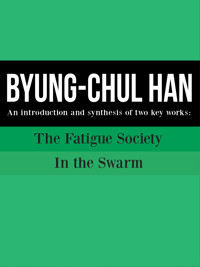
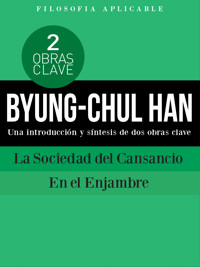
According to Byung-Chul Han, hyperproductivity and digital culture shape our emotions, relationships, and perceptions of the world. How can we reconnect with our own humanity in order to live a full life in a chaotic era? Byung-Chul Han argues that this reconnection will be key in a world that seems to push us toward constant alienation and exhaustion. The philosopher who revolutionized contemporary thought, Byung-Chul Han, invites us to reflect on how the accelerated pace of modern life, the obsession with productivity, and the omnipresence of technology penetrate our subjectivity to the point of eroding it. In his essays—which have become bestsellers and a phenomenon in their own right—Han provides readers with tools to question dominant narratives. The Burnout Society and In the Swarm are two of his key works. They function as a call to action, urging us to challenge the tendency to live on autopilot and to reclaim essential aspects of life that are overshadowed by the system's demands. For a first-time reader, engaging with Byung-Chul Han's books can be a revealing experience—if approached with the right mindset. Here are some recommendations on how to begin: Start with the more accessible topics: Some of Han's books, like The Burnout Society or In the Swarm, deal with issues that are easier to relate to everyday life. These texts offer an excellent gateway into his thinking. Read slowly and reflect: Although Han's books are often short, they are packed with deep insights that require time and patience to absorb. It's helpful to read each chapter or section slowly, pausing to reflect and savor each of his arguments. Embrace the provocation: Han often challenges preconceived ideas and suggests that many things we take for granted—such as the notion of freedom in the digital age or the value of transparency—may simply be illusions. A new reader should be open to questioning their own beliefs and allow Han's critique to open new perspectives. Discuss with others: Sharing the reading experience with others—whether in a book club or through informal conversation—can be an excellent way to deepen one's understanding of Han's ideas. In summary, the novice reader will find in the work of this innovative philosopher the opportunity to experience a philosophical awakening—one that can be meaningfully applied to everyday life.
Sie lesen das E-Book in den Legimi-Apps auf:
Seitenzahl: 65
Veröffentlichungsjahr: 2025
Das E-Book (TTS) können Sie hören im Abo „Legimi Premium” in Legimi-Apps auf:
Ähnliche




Introduction
Byung-Chul Han, the Korean-German philosopher whose essays have become bestsellers, has established himself as a celebrity and one of the most innovative and provocative philosophical voices. This is thanks to his sharp critique of today‘s society, particularly in relation to technology, capitalism, and digital culture. Interestingly, the common thread of his work addresses an undeniable reality that affects 99 percent of all inhabitants of planet Earth. His books, typically short but dense, tackle fundamental questions about life in the age of globalization. This insightful author explores central themes such as transparency, power, violence, hyperproductivity, and emotional exhaustion. With a clear and compelling style, Han analyzes how the modern dynamics of social network exposure, control, and self-demand have transformed the way we live, profoundly altering subjectivity and human freedom. His approach is characterized by a fusion of Western and Eastern philosophy, which allows him to offer a unique perspective on today‘s challenging issues. His essays undoubtedly appeal to both academics and general readers interested in better understanding the complexities of the contemporary world.
Byung-Chul Han has established himself as a leading figure in contemporary philosophy, not only for the relevance of his themes, but also for the originality and clarity with which he addresses the dilemmas of our complex modern society. Han has gained fame, in part, for his ability to identify and unravel the most pressing problems of our time: the obsession with productivity and the impact of technology on everyday life, among others. His compelling essays capture the essence of complex phenomena, revealing how the digital marketplace and invisible power structures shape our emotions, relationships, and perceptions of the world.
His critical approach to performance culture has resonated profoundly in an era where people increasingly feel hopeless and even exploited by a system that promises external well-being that never truly materializes. Furthermore, Han‘s ability to connect these issues to traditional philosophical concepts, but reinterpreted from a modern perspective, has made him a unique and indispensable voice in the current philosophical debate.
Reading this intellectual is recommended as he not only highlights the challenges facing contemporary society in an increasingly technology-dominated world, but also analyzes each phenomenon, prompting the reader to reflect on its impact on their daily lives, relationships, and world perception. Reading his books offers a theoretical framework for questioning, and if desired, resisting, the prevailing narratives for anyone seeking to understand how network-based consumption shapes emotions, behaviors, and thought processes.
In an era where it‘s easy to feel overwhelmed by external demands, Han‘s books enable us to question prevailing patterns and provide the chance to reconnect with our humanity by reconsidering what it means to live a full and authentic life. Han encourages us to contemplate how the rapid pace of modern life, the obsession with productivity, and the ubiquitous presence of technology are dehumanizing our experiences, eroding our relationships, and disconnecting us from our fundamental emotions and needs.
One of the most potent aspects of Han‘s work is his ability to highlight how these external forces infiltrate our subjectivity, molding profound aspects of our identity. By revealing certain concealed dynamics, Han provides a critical perspective that enables us to recognize what we have lost: the capacity to be present, to experience authentic leisure, to deeply connect with others, and to nurture a rich inner life.
His books serve as a call to action, encouraging us to challenge the tendency to live on autopilot and to reassess certain fundamental aspects that are being overshadowed by the demands of the system. In reading Han, readers will sense that there are opportunities to reconnect with the true essence of being human. Undoubtedly, this reconnection will be crucial in a world that appears to be driving us towards alienation and perpetual exhaustion. Han‘s remarkable talent lies in sparking a philosophical awakening, which is likely why his books have become an undisputed bestseller.
For a novice reader, delving into Byung-Chul Han‘s books can be an enlightening experience when approached with the right mindset. Here are some suggestions on how to engage with them:
Begin with the most relatable topics: Some of Han‘s books, like “The Fatigue Society” or “In the Swarm,” address subjects that are more easily connected to everyday life. These texts can serve as an excellent introduction to his thought process.
Read slowly and reflect: Although Han‘s books are typically concise, they are filled with profound ideas that demand time and patience to fully comprehend. It is beneficial to read each chapter or section slowly, taking a moment to reflect and appreciate each of his arguments.
Embrace Provocation: Han frequently challenges preconceived notions, suggesting that many things we take for granted, like the concept of freedom in the digital age or the value of transparency, might just be wishful thinking. A novice reader must be prepared to question their own beliefs and allow Han‘s critique to guide them to new insights.
Discussing with Others: Sharing readings with others, whether in a reading group or simply chatting with friends, can be an excellent way to deepen one‘s understanding of the ideas presented.
Persist Despite Complexity: Although Han writes clearly, his ideas can be complex and challenging. It may not be possible to absorb everything he has to offer on a first reading, but those who approach his work should not be discouraged if they don‘t grasp the concepts immediately. Persistence and a willingness to reread and reflect are essential to fully appreciate his works.
In short, a reader unfamiliar with his texts should approach Byung-Chul Han‘s work with patience, open-mindedness, and a certain willingness to be transformed by his ideas. In this way, they will not only gain a deeper understanding of Byung-Chul Han‘s philosophy, but also a better comprehension of his concepts.
As an innovative philosopher, they will also be able to apply it in a meaningful way in their daily lives.
Why “In the Swarm” and “The Fatigue Society”?
“In the Swarm” and “The Fatigue Society” are two pivotal works by Byung-Chul Han. Although they address different facets of contemporary society, they are profoundly interconnected in their analysis of power dynamics, productivity, and subjectivity in the digital age.
Social Structure and Control: In “The Society of Exhaustion,” Han argues that we live in a society that has supplanted traditional forms of control and repression with self-imposed actions that compel us to be perpetually productive. The pressure to succeed, be efficient, and maximize performance is internal, leading to burnout, depression, and other pathologies. This “performance society” is a power structure that operates through self-demand, causing individuals to exploit themselves.
On the other hand, in “In the Swarm,” Han also clarifies that certain appearances can be deceptive. He delves into how digitalization and social networks have revolutionized the way we interact with each other and organize ourselves collectively. Here, the term “digital swarm” refers to the multitude of individuals who, by through digital platforms, individuals engage in a continuous stream of communication, information, and opinion sharing, albeit in a fragmented and individualistic manner. This lack of structure, coupled with the superficial nature of digital interaction, weakens the capacity for collective action, leading to uniformity and conformism, according to Han.
Isolation and Alienation: Both works underscore how contemporary structures cultivate a form of isolation and alienation that, although seemingly distinct, share common origins. In “The Fatigue Society,” self-exploitation results in profound exhaustion, leaving the individual isolated in their own suffering, incapable of forming authentic relationships due to the incessant pressure to perform.
In “In the Swarm,” Han describes a different kind of isolation, one that arises amidst digital hyperconnectivity. Although people are constantly “connected,” the quality of these interactions is superficial, leading to a different but equally profound sense of alienation. The digital swarm does not foster community or true solidarity but rather perpetuates a shared loneliness in a sea of data and empty interactions.




