


2,99 €
Mehr erfahren.
- Herausgeber: Snapshot Systems
- Kategorie: Für Kinder und Jugendliche
- Sprache: Englisch
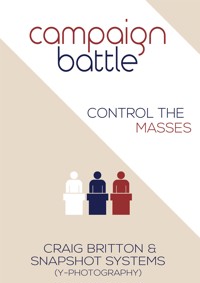
The winning candidate does not need all the support, just enough to secure more votes than their opponents. Campaign Battle aims to shed some light on primary principles that shape the election process and the best campaign strategies.
Das E-Book können Sie in Legimi-Apps oder einer beliebigen App lesen, die das folgende Format unterstützen:
Veröffentlichungsjahr: 2024
Ähnliche











![Tintenherz [Tintenwelt-Reihe, Band 1 (Ungekürzt)] - Cornelia Funke - Hörbuch](https://legimifiles.blob.core.windows.net/images/2830629ec0fd3fd8c1f122134ba4a884/w200_u90.jpg)



© Copyright, Y-Photography, Craig Britton.
No part of this book may be distributed, posted, or reproduced in any form by digital or mechanical means without prior written permission of the publisher.
Snapshot Systems, 2022 (Second edition)
Legal Disclaimer
This book is designed to provide information and motivation to our readers. It is sold with the understanding that the publisher is not engaged to render any type of psychological, legal, or any other kind of professional advice. The content of each chapter is the sole expression and opinion of its author, and not necessarily that of the publisher. No warranties or guarantees are expressed or implied by the publisher’s choice to include any of the content in this volume. Neither the publisher nor the individual author shall be liable for any physical, psychological, emotional, financial, or commercial damages, including, but not limited to, special, incidental, consequential or other damages. You are responsible for your own choices, actions, and results.
Chapter 1: Introduction
Politicians need to be crafty ba$tards; they need to be inspired by the past but learn to adapt to changes in a very dynamic environment. To be successful, one should learn how to fully utilize tools such as trending policies, media and religion to influence the masses. In this book, I will attempt to give you the dirty tricks strategists use to enable a specific candidate to gain the momentum needed to be elected and analyze how they work in conjunction with the factors within the election process.
A lot of what people see is just a mask. Politicians just have to appear in a certain way, that’s just how it works. The concept given to voters is vital in gaining their support and if it doesn’t look like a politician has vision, no one is going to vote for them. It needs to get people excited, promise something better than what they already have. It is like a business proposal; however, politicians are not making a deal at this point, they are just looking for your attention.
A candidate’s true beliefs don’t matter. Don’t get me wrong, of course, they have beliefs, but if they want to win, they often need to put these beliefs aside. The most important thing about campaigning is to be relevant and understand what masses want NOW. It doesn’t matter what the political situation was five years ago or even a year ago. What might have been relevant back then might never be spoken about again. Politicians can potentially contradict themselves because they are juggling so many different positions. If they want to win, they have to ‘sell their soul’ and go completely against their gut instincts. It’s the price of power.
The average voter is naive and doesn’t understand why all their wishes and demands can’t be met. They expect a lot for minimum commitment and because of this, there is a lot of room for manipulation by the political machine. Also, many people rely on only a couple of sources of information and do not question them. Their pool of information is limited which leaves them to make generalizations and false (or over-exaggerated) conclusions about the political situation as a whole.
It’s not just about core voters and swing voters. You have a wide range of people involved in the political process: families and friends, people in the country and people in the city, students, brain surgeons and financial brokers. There are a variety of views that have developed over time or have been influenced by their specific surroundings, which means that they might be very fractured in what they think and believe. It’s the strategists’ job to put all these puzzle pieces together, faster than the other side and explore how this data can be used in the best possible way.
Candidates have got to read the voters and see what their mood is. By keeping neutral ground candidates can develop a better understanding of the political situation and play it to their advantage. Otherwise, they are limiting themself and not accepting reality. Politicians that are too extreme will only attract extreme voters. Although this may be a strategy for those who aim to just represent a particular group or belief, this won’t win them the popular vote.
Ideology clash
The difference in ideologies is always going to be a thing in politics. And since politics is an inevitable part of life itself, there is no situation where there is no clash of ideologies. If there is no imminent conflict, a situation could arise as people are pushed to extremes because of the lack of representation of their opinions (or partial representation of their opinion).
The strength of ideology is heavily connected with the power structure of the political system. For example, a centralized government is where the decisions within the country are taken by a small group of people, so there are not many clashes because the leadership is powerful enough to silence any opposition groups and voices.
On the other hand, having a multiparty system might mean the power is more decentralized and the decision making is distributed among more branches. Having such structure, though, can lead to a more serious clash of ideologies depending on how divided the voters are. This, in turn, could bring the country to a political crisis or new elections.
A two-party system could also resemble either of the two extreme scenarios above. The two parties basically have a monopoly on the voters, and they control most of the political spectrum and can silence ideas outside of their scope. But when they are divided in almost equal measure and disagree on a major issue, it could cause a political deadlock and consequently, even a government shutdown.
No political system is better than another, they all have pros and cons based on the circumstances. Here are the three possible scenarios to consider during the election process and how they are related to ideological struggles:
• One-party system - The party has total dominance over different points of view or can easily oppress ideological differences and shut down other people’s opinions.




