


5,99 €
Mehr erfahren.
- Herausgeber: Boris Pronsky
- Kategorie: Gesellschafts- und Liebesromane
- Sprache: Englisch
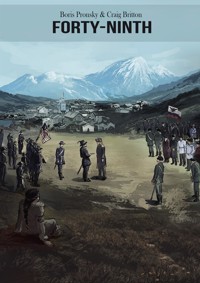
A novel about one of the largest land deals in history, the Alaska purchase.
In 1866, the failed assassination of Alexander II unfolds a series of events that coerces him into selling Alaska to the United States a year later. Meanwhile, Native Alaskans are stuck between the changing order. Some try to fit in while others attempt to fight back. Further south, in a deeply polarized post-Civil War America, the plans of President Johnson conflict with his Secretary of State's ambition to acquire Alaska. An approaching impeachment pressures Johnson to attempt to sabotage the deal. Behind closed doors, however, a powerful banking family is awaiting a long overdue payment from the Russians, but there is only so much gold to go around.
Das E-Book können Sie in Legimi-Apps oder einer beliebigen App lesen, die das folgende Format unterstützen:
Veröffentlichungsjahr: 2024
Ähnliche




















Copyright © 2021
Boris Pronsky, Craig Britton.
All rights reserved. This book or parts thereof may not be reproduced in any form, stored in any retrieval system, or transmitted in any form by any means—electronic, mechanical, photocopy, recording, or otherwise—without prior written permission of the publisher, except as provided by United States of America copyright law. For permission requests, contact the Author or the Publisher.
Concept Art: Yasen Denev
First Edition: October 2021
PREFACE
On January 3, 1959, Alaska became the 49th state of the United States of America. A century earlier, the territory was under the control of a very different nation, the Russian Empire. The payment for Alaska mysteriously vanished on its way to the capital of the Russian Empire, St Petersburg, in 1867 which suspiciously coincides with a series of major geopolitical events that shaped the mid to late 19th century.
But before understanding the actions of every character and historical figure, the reader needs to recognize the culture and the soul of the people. This is why the novel’s research was based not only on official documents and sources but also on interviews with historians, politicians, and various experts across the world. Their knowledge and personal take on the matter made the story more colorful and exciting.
The Author
DISCLAIMER
This novel is based on true events. In certain cases, incidents, characters, and timelines have been changed for dramatic purposes. Certain characters and events may be composites, or entirely fictitious.
PROLOGUE
Horseshoes pound the sloshing mud and puddles pooling in the torn tracks of the road.The storm could not slow this finely tuned animal for which running at great speed was a pleasure; rain and mud just made it more of a sport. The black horse lavished in the challenge of harsh weather and the coachman knew this, it was almost fun for him too, regardless of the long trip.
The heavy rain was the coachman’s least concern. The real danger was the wind and thunder on the open fields around them that could easily harm the ‘precious’ cargo in the back.
Another flash of lightning revealed a silhouette of the château in the near distance. It was a long, solid rectangular shape with strong form and contrasted the roundness of the trees nearby, with little chimneys sticking out and two large buildings at either side. The horse did not flinch at the sound of the thunder, and the coachman smiled to himself. This magnificent animal would have stayed calm even if chased by the four horsemen of the apocalypse.
As the carriage neared the château, its character became clearer. It was likely more than 160 feet wide and comprised three floors with an additional fourth on the two sections that protruded. It was a brick construction built within the last century which was uncommon because it looked different from the Age of Enlightenment style of architecture of that time. Its practicality seemed to be more important for its creators than the fancy design, though that was a part of it too. While it looked rather simplistic, it gave a solid impression.
Halting the horse at the side entrance, the coachman went to open the carriage door. The horse was foaming at the mouth, it had barely stopped in two days. An army of servants and butlers exited the building to assist the arrivals.
A portly man in his mid-fifties in well-dressed attire hurled himself out of the door, “take care of my wife” he said in a clean French accent and stumbled past the French garden towards the side entrance to the château. He did his best to walk fast but struggled with a limp, dragging his weak leg while forcing himself with his lion-headed cane. Out of nowhere, an umbrella appeared above his head, shielding him from the rain. The man didn’t even question the servant that was holding it.
Another servant opened the door and instinctively the limping man took off his jacket and handed it to a maid who then handed him a towel to gently wipe himself down. It was an entirely automatic process. The limping man didn’t even acknowledge the maid’s presence.
“They are already here, sir,” said the butler who accompanied him further down the hall.
“When I enter the room, leave us as we are. We shouldn’t be disturbed” the limping man replied.
In front of them, there was a large double door on the other end of the luxuriously decorated, red-walled corridor, lined with several golden ornamented oil paintings of influential individuals. For the most part, they didn’t necessarily have sentimental value and were considered more like expensive collectibles, whose sole purpose was to convey the feeling of high class and style.
The butler rushed to open the door for the limping man and immediately close it once he had entered, bowing respectfully. Inside, an overweight man with mutton chops and a skinny tall man with a round white beard were in the middle of a discussion, both sitting ata large coffee table.
The third man in the room was standing in front of a painting on the wall, holding his chin with one hand, and the other behind his back, critiquing the artist’s craftsmanship. In his youth, he was a tall and classically handsome man with a delicate appearance, but his hair was thinning, and naturally it bothered him. He was the only one who engaged with the newcomer by looking at him. The limping man politely nodded and greeted him back by name: “Anselm”. The other two continued their discussion as if nothing happened.
The limping man didn’t want to interrupt the conversation and sat in the closest chair. He placed his cane next to him, and started to massage his bad knee, listening intently in an attempt to catch up with the conversation.
“Willi, I hope you told Bleichröder to act swiftly given the latest occurrences,” said the overweight man.
“Of course,” followed a quick response by the tall man, “we shouldn’t allow a repetition of the Naples fiasco.”
Once the sentence was finished, everyone fell silent and looked at the limping man. He tried to look back at all the eyes on him. The only sound in the room was the tall man briefly coughing.
“You are late!” the overweight man’s sarcastic tone broke the silence with a typical matter-of-fact statement.
“200 miles in weather like this is not a joke, I can tell you that” the limping newcomer smiled as he continued to massage his knee. “You didn’t miss me that much. It wouldn’t be a problem for you to start without me anyway. Any news from across the Atlantic?”
“Things are relatively fine according to the report from our man in New York” the overweight man said tapping two times with the tips of his fingers on the report on the table, “you can see it for yourself.”
Using his same two fingers, the overweight man slid the report across the table towards the limping man, only extending his arm and not his body.
The limping man was bemused that the overweight man hadn’t considered his condition – reaching the report would be an unnecessary struggle. Nevertheless, the limping man uneasily shifted himself to the very edge of his chair, cautious not to fall off, and without standing, grasped the report.
“The South is not taking the occupation very well and, of course, our exports are down,” continued the overweight man, “but, on the other hand, we have nothing to worry about in the long run, since the banking legislation had finally passed.”
“This is excellent news! A window of opportunity used to the max” responded the limping man, dumping the report on the table and began to massage his joints.
“We had no choice,” said the overweight man, “the French invasion of Mexico failed – they weren’t quick enough. The cities they captured are now falling one after another. Very disappointing.”
Anselm looked back at everyone condescendingly. It appeared as if the last comment was addressed to him, though it wasn’t explicit. He considered responding but wisely decided not to, stepping aside to gaze at the next painting. A portrait of his younger self.
“They lost momentum a long time ago,” responded the limping man, “but that’s all part of the game. When one of your horses gets injured, you place a bet on another.”
“Exactly my thoughts; circulating money through the system is what makes the difference, not stockpiling it all,” said the tall man but was interrupted by the overweight man. “Willi!” he groaned with irritation, his hand raised to stop any further unnecessary ‘insightful’ statements. The overweight man then turned to respond to the limping man. “Since we are sharing arbitrary clichés,” he again briefly stopped to glance at the tall man pointedly, “it is important to focus on projections and implications, not basic economic ideas. And be more cautious – it is not the best time for big wars right now.”
The limping man looked at the tall man with a somewhat supportive look and shrugged his shoulders, but his expression indicated that he also thought the statement was a cliché.
“Speaking of large accounts, our friend in the East is struggling with payments and we might use this as a bargaining tool for...” the overweight man stopped in his tracks and waved his hand in the air as if he was trying to remember something, “...you know what.”
“We need to send him a message!” Anselm answered, still admiring the painting of his younger self.
“Who can orchestrate this without it going too far? If something happens to him, the consequences might be unpredictable” said the limping man.
Anselm postponed his answer, still looking at his portrait as if it was a mirror, a past reflection of himself. He even stood in the same position as the portrait – most likely unintentionally. Then he faced the others, who were waiting for an answer. “Joseph Günzburg!” he said.
ACT I: SIN
Native Alaskan Perspective
Dionisiy
Chapter I: Winter of 1866
“Blessed are the pure in heart, for they will see God.”– Matthew 5:8
“Forgive me, Father,” the young Native Alaskan girl said, “for I have sinned.” She bowed her head in front of the priest.
A triumphant smile appeared on priest Dionisiy’s bearded face. His work was continuing to show signs of success, converting more and more of the locals to the Orthodox Church. Now they are coming to him. When he first arrived in Alaska several years ago, he had no idea what to expect from this isolated place. This was a place he just heard about on the other side of the planet, the most extreme end of the Russian Empire.
Dionisiy arrived with the Russian settlers to the New World, after living all his life in Tersa, a small town on the Volga River near the city of Saratov. Back at home, the priest witnessed the Sobriety riots against the alcohol merchants, a series of events he believed likely led to the long awaited Emancipation reform to free the serfs. The liquor industry was heavily subsidized by the government and the serfs were essentially forced into drunkenness – and had to pay for it.
Naturally, over the course of a few years, riots broke out sporadically in region. Dionisiy was in a moral dilemma knowing the conditions that most serfs endured. The hard-working villagers were chained to the land, and never had a chance to enjoy quality wheat they grew. Russian villagers even had a saying: ‘white bread is for white skin color; black breath is for black bones.’
Alcohol just made the people’s struggles worse. Forced onto the villagers, corrupting their souls and worsening their lives. Dionisiy had to act in support of his people who couldn’t take it anymore, and began publicly blessing the crowds. The result of the riot was that tens of thousands of serfs were jailed and forced into hard labor, and many were killed.
The blessings he gave cost him his old life. Dionisiy was soon summoned by the bishop who scorned him for acting on his own accord and embarrassing the church in front of some of the most powerful people in the Empire. And that’s how the priest was forced into volunteering into joining the Alaska mission. At first, he declined but the constant pressure and eventually the threat of being excommunicated made him finally agree.
Though Dionisiy was punished he made his own thing out of it. He saw it as an opportunity to create a better society, where he was able to start from scratch and finally felt settled. Though he would face unforeseen challenges, he could shape the faith of the regular people. Dionisiy liked to compare the serfs of Russia to the Native Alaskans, but he always concluded that they were all God’s children.
“Go on my child, you should not be afraid to confess in front of God,” Dionisiy encouraged. Hesitating for a moment, Sakari continued “my brother, I feel that he is distant since I found God.”
The priest was hoping there was more to this story. Sakari, still not sure how to explain her confession, looked up at the priest. Dionisiy’s eyes encouraged her to speak more. Sakari glanced at the iconostasis in front, then looked back down at the floor in front of her.
“He is going against the word of God, he brings many slaves back from other villageson his raids,” Sakari revealed, “and his bad thoughts… he cannot accept the settlement, and he might even incite violence.”
Dionisiy, to put it mildly, strongly disapproved of some unholy practices of the local’s culture, such as cremating their dead instead of burying them. He was doing his best to fight against it. But the most outrageous for Dionisiy was the practice of slavery; unfortunately for him, it was an integral part of the social structure of the strongest tribes in the region – the Tlingit and the Haida. It was one of the few topics that might easily enrage Dionisiy, but he tried to be careful when he discussed the topic with them.
“Is the Devil whispering in your ear, my child?” cried Dionisiy in an irritable tone “you shouldn’t waste God’s time with such minor intrigues!” Dionisiy occasionally still heard rumors of slave sacrifices at the funerals of high-ranking clan members to ‘continue serving them in the Village of the dead.’ Dionisiy managed to convince several clan leaders to set the poor condemned people free, arguing it would be a symbolic death; besides that, he also offered sanctuary to the slaves in New Archangel.
“I’m sorry, Father” she exhaled, squeezing the cross in her hands tighter.
Dionisiy was supposed to be calm, but it was an extremely tough week for him. With a sigh, Dionisiy’s harsh tone retreated “we should all remember that even I am a sinner before God, and we should all speak the truth and seek forgiveness from Him. I am only a servant of God and man. But our ability to confess in front of God is a sign that we can confront our sins and get back on the path of wisdom and faith.”
***
After taking Sakari’s confession, Dionisiy walked toward the church’s exit. Sakari followed him, keeping her head down and looking at the floor. She looked confused and slightly ashamed of her confession. The girl didn’t look like she felt the relief she was probably expecting, nor her sins absolved.
Dionisiy approached the door, turned around to face the inside, and made the sign of the cross on his chest three times. As he was about to step out of the church, Sakari made a step toward the exit to follow him. But Dionisiy stood still, looking at her with judgmental eyes. Sakari looked back at his eyes confused and ashamed, she knew she was forgetting something but was not aware of what it was. Dionisiy made a rough sound clearing his throat as a sign to remind her. Realizing what she forgot, the young girl covered her mouth with the tips of her fingers of both hands. Then, Sakari faced the inside of the church and made the cross sign three times before leaving.
Outside St Michael’s Cathedral, the night was beginning to cascade over the sky and the temperature had dropped significantly. At this time of the year, it got dark in the afternoon. During their time in the church, an inch of wet sleet had covered the ground.
Sakari looked up at the copper roof of the pointy bell tower at the top of the church and looked at the cross that stood on top of it.
Dionisiy tried to explain to her about all the different branches of Christianity, but it was too complicated and Sakari couldn’t see the logic in it. As always, Sakari got strange looks from the locals helping in the church. Typically, a brief glance before they looked away. Dionisiy asked one of his sextons to clean and close the church. At this time of day, everyone had gone home. For them, it was too late and too cold to be outside on the streets.
Sakari was cautious when she walked alone outside her village and Dionisiy could see it. The priest wanted to establish a good connection with the girl as her role was vital for his most imminent plans.
“Do you want me to walk with you to your raft at the docks?” asked Dionisiy, “I’m on my way to see the governor.”
Sakari hesitated for a moment but agreed. Dionisiy didn’t feel like walking with her, but he also felt some guilt for making her wait a few hours before her confession. He was on a mission to convert a tribe and it had taken longer than he had expected. Almost every week Dionisiy was sent out to different tribes throughout the territory, most only accessible by boat.
It had been a long day for Dionisiy, though irritable, he knew he had to encourage Sakari to come again. She was one of his best converts – a daughter of a local chieftain could bring more converts. If successful, with her help, they might be able to convert the whole village to Orthodox Christianity.
“Your Russian is improving very fast, my child,” Dionisiy said, trying to break the awkward silence.
“Thank you, Father, and I thank you for giving me the book. It has helped me a lot” Sakari said, referring to the copy of Gogol’s Dead Souls she was given by the priest during their last meeting.
As they walked silently along, he realized they didn’t have much to talk about, except religion. All he could hear was the crunching footsteps of his feet on the snow and the waves of the sea afar.
“Have you spoken to your father about your newfound faith? I would be happy to meet him and explain more” Dionisiy said. Another reason he was so invested in Sakari’s tribe, the Chilkat, was that he wanted to establish a church mission in their lands up in the north.
“I’m still waiting for the right moment, Father.”
“You know, I am very proud of your frequent visits and the progress you have made with the church over the last few weeks.”
Sakari didn’t respond and quietly continued walking on, a step behind Dionisiy. In the meantime, they had reached the grounds before the Governor’s residence, also known as Castle Hill. The solid stone building towered over the town, like a guardian angel watching over its residents.
“When we are in, you should wait in the lobby. It shouldn’t take too long” Dionisiy explained and invited Sakari out of the cold with a gesture of his hand.
***
The meeting took longer than Dionisiy expected, and he almost forgot about the girl waiting in the lobby. Dmitriy Pavlovich Maksutov, the Governor and Chief Manager of the Russian-American Company, perhaps the most important person in the region, walked Dionisiy out of his office.
“A great report as always, Dionisiy. Don’t be too upset about today’s lack of progress, next time it will be better,” Maksutov said energetically shaking Dionisiy’s hand “After all, this is still the Russian America, we live in a unique time and place.”
“Thank you, Dmitriy Pavlovich, I’m doing my best to spread the word of God and enlighten the locals to our religion across these lands” but Dionisiy realized that Maksutov was no longer listening to him. Instead, Maksutov’s eyes were fixated on the young native girl sitting in the lobby.
“Who’s the lovely young lady here?” Maksutov said loudly so it would draw the attention of Sakari, still waiting patiently, and who had jumped in her seat.
‘Not again’, Dionisiy thought. With almost no Russian women in the area, a man like Maksutov couldn’t help but take every opportunity that came to him. To other Russians, Dionisiy would always say, ‘if you want to be with a Native woman, you need to marry her first,’ but he could never bring himself to say the same thing to Maksutov, as it would certainly backfire and risk all his work.
Maksutov brushed past Dionisiy as if he were magnetically drawn to Sakari. She got up from her seat and stood firmly. Her eyes directed themselves to Dionisiy to ask what on Earth was happening? Dionisiy could only return a forced grin. A short man with a high hairline, Dionisiy assumed that Maksutov wasn’t a person Sakari would remember under regular circumstances.
“What is your name, darling?” Maksutov asked, leaning a little too close to her, smiling. His mood had changed dramatically, a newly born man, revitalized with energy despite the long working day and the late hour. The game was on, and he wanted to play.
But Sakari, a shy young girl, wasn’t prepared for such a man and had an incredible urge to leave. Dionisiy remembered that she mentioned that she needed to get home before sunset and it was getting extremely late, but he was very tired. He started to wonder if he could back out of walking her home and get some sleep instead.
“Sakari, would you be disappointed if I don’t walk you back tonight? I’m dreadfully tired” said Dionisiy.
“At this hour? A woman alone in the town? Nonsense, I’ll walk her” Maksutov said, taking his chance.
Dionisiy immediately saw Sakari’s eyes change again. She was definitely feeling uncomfortable about being left with this stranger. For a second Dionisiy felt extremely shallow in backing out and he knew exactly what Maksutov wanted from the girl.
“You’re right, Dmitriy Pavlovich, we can’t leave her to walk alone,” Dionisiy said, trying to redeem himself. He knew that Maksutov would be joining them, it was not an option anymore.
***
There was no straight journey to the place Sakari left her canoe, close to a field north along the harbor. But even though the location was within walking distance from the town, Baranof Island was very jagged and covered in cliffs and mountains, and the narrowness of the path meant that they had to walk in a single file every so often. Dionisiy led the way forward holding an oil lantern.
During this time of year, it was better to get home quickly during the light to avoid accidents on the treacherous terrain; the path was narrow, and the snow was getting slightly deeper, but luckily for them, it still only covered a few inches for the most part.
During the whole walk, Maksutov tried to get close to Sakari, who tried to keep her distance. Maksutov was clearly happy that Dionisiy was carrying the torch and not him, keeping his hands free to observe Sakari from top to bottom.
“Sakari, did you know that this Island was supposed to be named after the ancient god of the sky, thunder, and war by the Russian general that first came to these shores?” Maksutov said, trying to impress Sakari.
Dionisiy knew that this was utterly false, as Baranof Island was named by the Imperial Russian Navy captain Lisianski to honor a famous Russian trader and merchant of the same name. But he didn’t want to get involved or start an argument with Maksutov. The priest just wanted the long day to end and finally get some sleep.
“No, Mr Maksutov, I wasn’t aware of this fact,” replied Sakari.
“Please!” Maksutov made a short pause to get Sakari’s attention, and when she finally looked back at him, he continued, “call me Dima.”
“I will try to do that, Mr Maksutov” Sakari was looking extremely uncomfortable with the conversation. Dionisiy knew that Maksutov was not a person who gives up easily.
“So... when you come here; do you enter frontally through the docks or through the back of the city like now? Personally, I prefer to do everything from behind.” He giggled at his vulgar joke, which stressed Sakari even more. ‘Forgive him, God, he does not know’ Dionisiy thought to himself. The priest did not approve of the inappropriate tone of the conversation nor Maksutov’s pushy behavior toward the girl, but was unable to find the strength to criticize the high-ranking official.
Sakari looked down ashamed of the question and pretended that she didn’t hear what Maksutov asked. After a moment of silence, Maksutov asked “Dionisiy, did I mention to you the great personal letter I got from Emperor Alexander II himself?”
Dionisiy was initially surprised by the question and didn’t know how to respond, as Maksutov had never shared such information before. But then, he realized Maksutov was not waiting for Dionisiy’s answer. Instead, he was looking at Sakari for a reaction. It became obvious that it was just another attempt to impress Sakari with his connections. But before Dionisiy could react, Sakari interrupted them by saying: “there, next to this meadow is my boat” pointing ahead. The young girl impatiently turned to Dionisiy and Maksutov and said, “thank you very much for escorting me, I truly appreciate it.”
Maksutov gave a naughty smile and playfully waved his forefinger at her “next time, I will show you the best view in town from my office.”




