


Erhalten Sie Zugang zu diesem und mehr als 300000 Büchern ab EUR 5,99 monatlich.
- Herausgeber: Hard Case Crime
- Kategorie: Krimi
- Serie: Hard Crime
- Sprache: Englisch
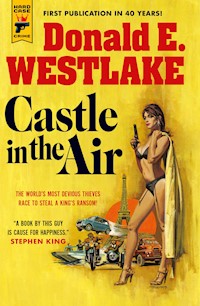
When four groups of international heist artists team up to pull off the theft of the century – stealing an entire castle, and the treasure secreted in its walls – what could possibly go wrong? Well, consider this: none of the master thieves speak each other's languages…and no one knows precisely where the loot is stashed…and every one of them wants to steal it all for him or herself. It's Westlake at his wildest, a breathless slapstick chase through the streets of France with the law in hot pursuit…
Sie lesen das E-Book in den Legimi-Apps auf:
Seitenzahl: 231
Veröffentlichungsjahr: 2021
Das E-Book (TTS) können Sie hören im Abo „Legimi Premium” in Legimi-Apps auf:
Ähnliche




















Contents
Cover
Acclaim for the Work of Donald E. Westlake!
Hard Case Crime Books By Donald E. Westlake:
Title Page
Leave us a review
Copyright
Dedication
1
2
3
4
5
6
7
8
9
10
11
12
13
14
15
16
17
18
19
20
21
22
23
24
25
26
27
28
29
Want More Westlake?
1
2
Acclaim for the Workof DONALD E. WESTLAKE!
“Dark and delicious.”
—New York Times
“The wildest, screwiest, fastest-paced yet…It is also insanely funny.”
—Des Moines Register
“Westlake is a national literary treasure.”
—Booklist
“Westlake knows precisely how to grab a reader, draw him or her into the story, and then slowly tighten his grip until escape is impossible.”
—Washington Post Book World
“Brilliant.”
—GQ
“A wonderful read.”
—Playboy
“Marvelous.”
—Entertainment Weekly
“Tantalizing.”
—Wall Street Journal
“A brilliant invention.”
—New York Review of Books
“A tremendously skillful, smart writer.”
—Time Out New York
“Donald Westlake must be one of the best craftsmen now crafting stories.”
—George F. Will
“Suspenseful…As always, [Westlake] writes like the consummate pro he is.”
—Cleveland Plain Dealer
“Westlake remains in perfect command; there’s not a word…out of place.”
—San Diego Union-Tribune
“Donald E. Westlake is probably the funniest crime writer going.”
—Chicago Sun-Times
“The suspense and the laughs multiply as the mad one-upmanship resembles doings at the Tower of Babel…The dénouement is a stunner.”
—Publishers Weekly
“Westlake is one of the best.”
—Los Angeles Times
The driver was just starting to accelerate when all at once, directly in his path, a wobbly girl on a bicycle crashed into a doddering old man in a motorized wheelchair. The whole kaboodle collapsed virtually under his wheels, and the shocked driver stood on the air brakes, so that the truck, with every wheel locked, did two heavy, loud, bone-jarring bunny hops forward and came to an abrupt stop.
Ignoring the shrieks of horns and squeals of metal scraping metal from behind the truck, the driver opened his door and leaned out to see if the girl and old man were still both sufficiently alive to be yelled at. They were; in fact, both seemed to have been increased in agility by their mishap, since the motorized wheelchair was suddenly zipping away like a Le Mans racer and the girl on the bicycle had abruptly learned everything about balance and speed, to judge by the manner in which she was hastening away. The driver released the open door in order to shake a fist at the departing miscreants, but all at once he found himself in midair. Someone had entered his truck cab from the right, and had given him a huge shove.
Truckdrivers were not meant by God to be airborne; at least not for long. This one soon found himself earthbound again, in a discouragingly hard and abrupt manner, and as he rolled over, shocked and disoriented, he discovered that his head was down amid a lot of automobile tires. Moving automobile tires.
And his truck was gone…
HARD CASE CRIME BOOKSBY DONALD E. WESTLAKE:
361
BROTHERS KEEPERS
CASTLE IN THE AIR
THE COMEDY IS FINISHED
THE CUTIE
DOUBLE FEATURE
FOREVER AND A DEATH
HELP I AM BEING HELD PRISONER
LEMONS NEVER LIE (writing as Richard Stark)
MEMORY
SOMEBODY OWES ME MONEY
SOME OTHER HARD CASE CRIME BOOKSYOU WILL ENJOY:
JOYLAND by Stephen King
THE COCKTAIL WAITRESS by James M. Cain
BRAINQUAKE by Samuel Fuller
THIEVES FALL OUT by Gore Vidal
QUARRY by Max Allan Collins
PIMP by Ken Bruen and Jason Starr
SINNER MAN by Lawrence Block
THE KNIFE SLIPPED by Erle Stanley Gardner
SNATCH by Gregory Mcdonald
THE LAST STAND by Mickey Spillane
UNDERSTUDY FOR DEATH by Charles Willeford
A BLOODY BUSINESS by Dylan Struzan
THE TRIUMPH OF THE SPIDER MONKEY by Joyce Carol Oates
BLOOD SUGAR by Daniel Kraus
ARE SNAKES NECESSARY? by Brian De Palma and Susan Lehman
SONGS OF INNOCENCE by Richard Aleas
CASTLE inthe AIR
byDonald E. Westlake
LEAVE US A REVIEW
We hope you enjoy this book – if you did we would really appreciate it if you can write a short review. Your ratings really make a difference for the authors, helping the books you love reach more people.
You can rate this book, or leave a short review here:
Amazon.com,
Amazon.co.uk,
Goodreads,
Barnes & Noble,
or your preferred retailer.
A HARD CASE CRIME BOOK
(HCC-148)
First Hard Case Crime edition: March 2021
Published by
Titan Books
A division of Titan Publishing Group Ltd
144 Southwark Street
London SE1 0UP
in collaboration with Winterfall LLC
Copyright © 1980 by Donald E. Westlake
Cover painting copyright © 2021 by Paul Mann
All rights reserved. No part of this book may be reproduced or transmitted in any form or by any electronic or mechanical means, including photocopying, recording or by any information storage and retrieval system, without the written permission of the publisher, except where permitted by law.
This book is a work of fiction. Names, characters, places, and incidents either are the products of the author’s imagination or are used fictitiously, and any resemblance to actual events or persons, living or dead, is entirely coincidental.
Print edition ISBN 978-1-78565-722-1
E-book ISBN 978-1-78565-723-8
Design direction by Max Phillips
www.maxphillips.net
Typeset by Swordsmith Productions
The name “Hard Case Crime” and the Hard Case Crime logo are trademarks of Winterfall LLC. Hard Case Crime books are selected and edited by Charles Ardai.
Visit us on the web at www.HardCaseCrime.com
And this one is for the guys and galsat the Internal Revenue Service.
CASTLE IN THE AIR
1
Eustace Dench, master criminal, paid the cabby with a legitimate five pound note, accepted his change, gave the man a twenty pence tip—not enough; the chap did not touch his cap—and turned away to take the delectable Lida’s slender arm. It was not raining, but otherwise it was unmistakably London—Belgravia, Herbert Way, a curving street of magnificent ivory-colored houses, several of them still private residences, the others all converted into embassies, offices, clubs or oil-sheiks’ pieds-à-terre. Number nine, with a large black “9” painted on the pillars flanking the entrance, was Eustace’s destination: the Tobacco and Artillery Club, founded 1711. “Come along, my dear,” he said to the lovely Lida, and they crossed the flagstones.
Inside, Eustace asked for Sir Mortimer Maxwell, identified himself as “Eustace Digby,” and was shown up the broad staircase—mahogany and maroon carpeting everywhere—to the members’ dining room, where Sir Mortimer was seated by himself at a table, crumbling rolls onto the snowy linen napery and sipping at a glass of gin-and-it, an abysmal cousin of the martini, reeking of vermouth. Sir Mortimer, a stocky broad-shouldered well-dressed man with white hair and moustache, red cheeks and nose, had the look of a former military man and present sot, and his eyes were appropriately bleary when he lifted them to say, “Ah, Eustace.”
“Sir Mortimer.” The men shook hands, and Eustace said, “May I present Miss Lida Perez, Sir Mortimer Maxwell.”
Lida curtsied, as she’d been taught in the convent. Most of the men in the room were looking at her by now, except for those who were looking at the perky new busboy.
“D’je do,” Sir Mortimer said. He was too weary for sex.
Eustace and Lida sat at the table, Eustace turned to the waiter to order gin-and-water for himself and rum-and-Coca-Cola for Lida, and then he turned back to explain to Sir Mortimer. “Lida is Yerbadoroan.”
Sir Mortimer managed to look sympathetic.
Forcefully, rather more loudly than the setting suggested, Lida said, “My people are oppressed!” Her eyes flashed, her coal-black hair flashed, her teeth flashed. She was the true Latin beauty, fire and ice.
Sir Mortimer looked at her in exhausted surprise. “I beg your pardon?”
“My people are oppressed!”
“Ah.” His expression wistful, Sir Mortimer nodded, saying, “If only I could say the same for mine.” To Eustace, he said, “On the phone, you suggested you had something useful for me.”
“Oh, you’ll like this,” Eustace said, smiling cheerfully and rubbing his hands together.
“I certainly hope so.”
They paused while the waiter delivered their drinks, and then Sir Mortimer went on: “To be frank, old man, I’m on my uppers. You’ll see what I mean when the food arrives. Worst sole in London, but this’s the last place’ll take my signature.”
“This little caper’s going to change all our luck,” Eustace assured him.
“Tell me at once.”
“The story begins in Yerbadoro,” Eustace said. “Lida’s brave little nation,” he added, patting the girl’s forearm.
Lida, fortunately, was drinking rum-and-Coca-Cola at the time, and so couldn’t speak. She contented herself with a quick flash of the eyes.
“The president of Yerbadoro,” Eustace went on, “is a chap named Lynch. Escobar Lynch.”
Sir Mortimer reared back: “You’re having me on.”
Placing her glass on the table, Lida explained, “In the early nineteenth century, Irish pirates liberated my country from the Spanish.”
“Ah hah,” said Sir Mortimer.
“This fellow Lynch,” Eustace went on, “the president, he’s in trouble. Days are numbered. Army coup from the right, urban guerrillas on the left.”
“Viva Yerbadoro!” Lida announced, raising a clenched fist.
Eustace patted her arm again, to soothe her. “Yes, yes, Lida, that’s right.” To Sir Mortimer, he went on, “Lynch wants to get out of the country.”
“Can’t say I blame him.”
“But he can’t get his money out, you see.”
“Ill-gotten gains,” Lida announced, while gentlemen at neighboring tables hunched over their hock. “Blood from the veins of the peasants!”
Sir Mortimer’s head shook at the phrase.
“They’re watching Lynch too closely,” Eustace went on, ignoring Lida’s outburst with the readiness of long practice. “Not the guerrillas. The Army, and the right wing. As far as they’re concerned, he can leave, but not his profits. If he tries to open a Swiss bank account, or travel with all his wife’s jewelry—” Eustace slid a graphically illustrative finger across his neck.
Sir Mortimer winced. “Sounds a difficult position.”
Leaning closer, lowering his voice, Eustace said, “But he’s found a way out.”
“Good for him!” Then Sir Mortimer frowned, somewhat baffled. “An Irishman, you say?”
“A Yerbadoroan,” Eustace corrected. “A rich Yerbadoroan.”
“Oh, I see. And these ill-gotten gains of his—”
“Exactly.” Broadly beaming, Eustace whispered, “Soon they shall be ill-gotten gains of ours.”
“Tell me more.”
“I intend to. You know this exposition coming up soon in Paris?”
Sir Mortimer looked disapproving. “They’re always exposing something in Paris,” he said.
* * *
“Every country involved in the exposition is building a pavilion,” Eustace explained, and popped a delicious shrimp into his mouth. “All over the city,” he said, and waved an arm to indicate Paris, teeming just beyond the restaurant windows. He was here with Lida, ingesting magnificent bouillabaisse in this tiny Left Bank restaurant on the Quai des Grands-Augustins, in order to tell his story to Jean LeFraque, a charming debonair middle-aged conman with a sinfully tiny moustache. “Each nation’s building,” he went on, “will reflect the style and thinking of that nation.”
Jean paused briefly in his admiring perusal of Lida to sigh, shake his head, and say, “How I despise architecture.”
Peeling the sweet meat from the carapace of a lobster fragment, Eustace said, “Lynch is having a building in Yerbadoro dismantled and shipped here to Paris. A small castle.”
Jean permitted himself to look startled. “Importing a building to Paris? From South America?”
“Just as London Bridge was transported to Arizona. Just as other buildings and monuments have been moved from place to place.”
“The man’s mad,” Jean decided, and shrugged.
“No, he isn’t,” Eustace said, and paused to savor his lobster. So much better than the Tobacco and Artillery Club sole. “What Lynch has done,” he went on, “he’s hollowed out a dozen stones, large building blocks from the outer walls of this castle, and he’s filled the hollow spaces with cash, jewels, stocks, his entire fortune. Then he’s disguised the openings so the stones look exactly as before. But inside them are valuables worth millions!”
“The rape of my people!” Lida announced, brandishing her bouillabaisse spoon.
Jean considered her thoughtfully. “Mm, yes,” he said.
“Lida’s cousin,” Eustace went on, “was one of the stonemasons on the project. He was sworn to secrecy, of course, but he told Lida the whole story.”
“Before he disappeared,” Lida said grimly.
“There’s millions in it, Jean,” Eustace said.
“Mmmm,” Jean said. Behind his dark eyes his brain could be seen ticking away faster than a taxicab meter in Milan. “One sees the possibilities,” he acknowledged.
Lida, her expression and posture valiant, clutched Jean’s forearm to say, “You shall save my people from destitution!”
Jean looked at her askance. “What’s this?”
“Half,” Eustace said. “That’s the arrangement I have with Lida.”
“What arrangement?” Storm clouds were crossing Jean’s face now, and his moustache was at half mast.
“We take half the profit for our work and expenses,” Eustace explained, “and the other half goes back to Yerbadoro with Lida.” But simultaneously, behind Lida’s back, Eustace was briskly waving his hand back and forth, to let Jean know he was lying.
“Ah,” Jean said, with a large nod and a small smile, “I see. Well, that sounds fair.” To Lida, pouring on the charm, he said, “You are a stirring spokeswoman for your people.”
Her response was violent: “I am a fiery furnace for my people!”
Taken aback, Jean retreated into his chair a few inches. “Yes,” he said. “Yes, I can see that.”
“Now,” Eustace said. “The only problem is—”
* * *
“Of course there’s a problem,” Rosa Palermo said. Stuffing scungilli and spaghetti into her mouth, she went on talking just the same: “There’s always a problem, Eustace.”
“A small problem, Rosa,” Eustace said, with a casual shrug of the shoulders and an airy gesture with his fingers. There was something about lunch at an outdoor restaurant on Rome’s Via Veneto that made him more than usually expressive with his body and his hands. “A minor problem,” he said. “Nothing that need stop us.”
Rosa, a hefty beauty in her mid-forties, aggressive and excitable, swigged down a mouthful of Bardolino and said, “Tell me about this problem, this minor problem.”
“It’s nothing at all,” Eustace assured her. He was aware of the male passerby frowning at him, wondering by what system of punishments and rewards a fellow like Eustace Dench deserved to be at table with such a fiery pair of beautiful women; so different from one another but both so desirable. “It’s merely,” he said, “that we don’t know exactly which stones we want.”
In sudden anger, Rosa flung her fork onto the table, sat back in her chair, squared her shoulders, aimed her breasts at Eustace, and said, “What? Then it’s useless, we can’t do a thing!”
“Of course we can—”
“You take me away from a perfectly fine shoplifting operation, you—”
“Rosa, Rosa, wait. It’s simple, really, I promise you it is.”
“You promise me, do you?” Glaring mistrustfully, Rosa picked up her fork, stuck it into the spaghetti, bore down, and twisted. “Tell me about it,” she said.
“We steal the entire castle.”
“Steal—?” Rosa’s fork halted. She stared at Eustace’s smiling confident face, and slowly shook her head. “This girl,” she said, with a quick glance at Lida, “has scrambled your brains.”
“It can be done, Rosa,” Eustace assured her. “You know me, you know my history, I only organize capers of the highest character.”
Dubious, Rosa filled her mouth with spaghetti, and chewed. “A whole castle,” she said.
“We need more help,” Eustace told her. “That’s the only thing.”
“Oh, yes,” Rosa said. “Oh, surely.”
“Think of it,” Eustace said, leaning toward her, unmindful of his tie in the tomato sauce, “think of it. The best criminal brains in Europe, the masters, and each bringing in his own assistants.”
Still dubious, Rosa pondered the idea, saying, “Who, for instance?”
“Well, you and me, of course. And from Germany, Herman Muller.”
With a judicious nod, Rosa said, “Yes. Yes. I’ve heard of him.”
Eustace checked the names off on his fingers. “From England,” he said, “Sir Mortimer Maxwell.”
* * *
“Sir Mortimer,” Herman Muller said. “Yes, I worked with him once, in a counterfeiting scheme.”
“A good man,” Eustace said.
Herman, a skeleton-thin smooth and eerie man with a long pockmarked face, shrugged: “A trifle unsocial,” he suggested.
“None of us is perfect,” Eustace said, and peeled a slice from the large white radish on the side dish. Chewing it, swallowing it with a mouthful of beer, he returned his attention to his bratwurst. Here in the sunny tree-filled central courtyard of Munich’s Hofbräuhaus, he and Lida were lunching with their German connection.
Who now said, “Who else?”
“From France,” Eustace said, around a pillow of bratwurst, “Jean LeFraque.”
Herman considered. “I don’t think I know the name.”
“A very good man,” Eustace assured him. “He’s been working American widows recently, in a sort of semi-retirement, but he’s been responsible for some of the finest outrages in the files of the Sûreté.”
“Widows can ruin a man for serious work,” Herman said sternly. “Particularly American widows.”
“You don’t have to worry about Jean.”
Dispassionate, Herman said, “If you say so. Anyone else?”
“From Italy, Rosa Palermo.”
Herman stopped with his beer stein halfway to his mouth. For the first time, a bit of color came into his cheeks. He said, “That madwoman?”
“Ah,” Eustace said, with his blandest smile. “You’ve heard of her.”
“Heard of her? On a clear night, you can hear her, the other side of the Alps.”
“She’s a bit excitable,” Eustace admitted, “but she’s the best.”
Herman considered that, frowning, “The best? In Italy, you mean.”
“Of course.”
“That’s possible, I suppose,” Herman said, and drank his beer.
“Then you’ll head the German contingent,” Eustace told him, “and I will serve as liaison among the groups.”
* * *
“Well, that’s the situation,” Eustace said, smiling around at his guests. Here in the garden of his little château outside Zurich, with the high privet hedge to guarantee privacy, Eustace and Sir Mortimer Maxwell and Jean LeFraque and Herman Muller and Rosa Palermo and Lida Perez were seated around the white-painted iron lawn table, eating potato pancakes and drinking chablis. The sun shone down, the grass was a rich dark green, the mountains were comfortably massive above the privet hedge, the wine was good, the potato pancakes were as light as clouds, and Eustace basked in a glow of well-being. Not one of his first-choice assistants had turned him down, and he knew full well it wasn’t because the caper itself seemed such a sure thing, but because of him, his unarguable skill, his enviable reputation. Only Eustace Dench could pull off a heist of such magnitude! To steal an entire castle! Smiling, beaming, already feeling the warmth of the victory to come, he said, “Any questions?”
Sir Mortimer immediately asked the obvious one: “How much is this thing worth?”
“Impossible to say, precisely,” Eustace told him. “Best estimates, going on the basis of newspaper accounts of Lynch’s probable worth, place our haul at somewhere between ten and twenty-five million pounds.”
Sir Mortimer was honestly awed. “Good God,” he said.
Rosa Palermo said, “What’s that in lire?”
Herman Muller’s lip curled. “Seven wheelbarrows full,” he said.
“Lire?” Eustace did some fast mental math. “Between sixteen and forty billion.”
Rosa merely gaped. “Billion?”
“As I said,” said Herman.
Jean LeFraque said, “Would you put that in a currency I understand?”
“In francs?” Eustace’s brain ticked over again. “It would be, in new francs—”
“No, not francs,” Jean LeFraque said. “I understand dollars best. U.S.”
“In U.S. currency,” Eustace told him, “it would be between twenty and fifty million dollars.”
“All right,” Jean said, smiling, touching his tiny moustache with his fingertips. “Very nice.”
Herman said, “What’s the split?”
Eustace, with a meaningful look around the table, said, “Well, you know the arrangement with the little lady.”
They all looked at Lida, who responded with an expression that was at once embarrassed and determined and valiant. She looked like a figure on a piece of paper money, but without the shield.
“Yes,” Jean murmured, “we know about that…arrangement.”
“So,” Eustace said carefully, “we’re talking about the remaining half.”
“Of course,” said Herman.
“Well,” Eustace said. “I’m taking ten percent. From the top. Because I’m the one who organized it all in the first place, and I’m to be liaison.”
“Yes yes,” Rosa said impatiently. “What about the rest?”
“Of the remainder,” Eustace said, “there’ll be one fifth for each of you. Out of that, you will pay whatever you think appropriate to as many assistants as you think you will require.”
Jean said, “Excuse me, Eustace. Permit me to ask more questions, numbers confuse me so. We are talking about in my case twenty percent of ninety percent.”
With another meaningful look in Lida’s direction, Eustace amended, “Of fifty percent.”
“Yes, of course,” Jean said. “I do apologize. Twenty percent of ninety percent of fifty percent.”
“A woman can’t deal with things like that,” Rosa said briskly. “Just tell me one thing. Will I make a profit?”
“God, yes,” Eustace said.
Herman said, “Another question. How do we make the split afterwards?”
“Part of Jean’s job,” Eustace told him, “will be to find a hideout in Paris. We’ll all go there once the job is done, and take our separate pieces.”
“But,” Herman said, “we’ll be in different parts of the city, with different parts of the castle. Only one group will actually find what we’re all looking for. How can we be sure there won’t be a double-cross?”
Eustace spread his hands, like St. Francis. “We’re all friends here,” he said.
There was general skepticism on the faces around the table.
“Very well,” Eustace said, with a little sigh for the mistrustfulness of the human mind. “Look about you,” he said. “Which of us here would want to spend the rest of his or her life knowing that everyone else at this table was searching for him, with a grudge?”
They all looked around at one another. Now, each face became slightly abashed, as though each had been developing some sort of private plan and now all were having second thoughts. Jean was clearly speaking for them all when he said, “An excellent point, I’m afraid.”
“Yes,” Rosa said glumly. “It seems we can trust one another.”
“Our common interest,” Herman said, in a monotone, “must take precedence over selfish desires.”
“I hate England,” Sir Mortimer said, “but I wouldn’t want to have to leave it, not forever. Everywhere else is so much worse.”
“Good,” Eustace said, and looked around the table. “Any more questions?”
Herman asked, “How much time have we, for preparation?”
“Lida tells me,” Eustace answered, “that the dismantling and packing, in far-off Yerbadoro, are nearly finished, and the shipping will begin in three weeks. The parts going by sea will leave first, with the airborne sections coming later. They want the entire castle to arrive in Paris at the same time, ready for immediate reconstruction.”
Herman said, “So we have three weeks to assemble our teams. Thereafter, you will supply us with intelligence as to routes and objectives.”
“Exactly.”
“With this young lady, Fräulein Perez, as your primary source of this intelligence.”
“Through her family and other contacts in Yerbadoro, yes.”
Jean, with a little bow in Lida’s direction, said, “I pray the young lady will forgive me, but how certain can we be of her information?”
“Years ago I sold guns to her father,” Eustace told him. “They’re a perfectly reliable family, I guarantee them.”
“Ah,” Jean said, and offered Lida a semi-tragic smile: “Do forgive me.”
Fiery, forceful, flaming, Lida announced, “My father fought the oppressors from the jungles! All his life!”
“Of course,” Jean said, taken aback. “Yes.”
Eustace looked around. “Anything else?”
The group waited, glancing at one another, but there were no more questions.
“Very well,” Eustace said. “You will be hearing from Jean as to our rendezvous point, and we shall meet again in three weeks in Paris, after you have assembled your groups.”
* * *
After the final guest had departed—Herman Muller, in his open-top black Volkswagen Beetle—Eustace turned his eyes, his attention and his hands on Lida. “My dear,” he said, in a not quite fatherly way, patting her arm, holding her arm, “success is in our grasp.”
“It’s wonderful,” Lida agreed. “Someday, you shall be a hero of Yerbadoro!”
“But it isn’t—exclusively—for Yerbadoro that I’m doing this, my duckling,” Eustace said, drawing the girl a bit closer. “I think you know what I mean.”
“Oh, but Eustace,” she said, drawing herself a bit farther away, “you know my gratitude can only find verbal expression. I am saving myself.”
“Lida—”
“No, please, you kind, generous, brilliant, wonderful, sweet man.” Now, disengaging his fingers one by one from her arm, she said, “I mustn’t tempt you any more with my presence. Good night, Eustace.”
Watching the girl go, Eustace continued to smile until she had left the room; whereupon the smile turned rancid. “Saving herself. For what, the Yerbadoroan Army?” Turning to the armoire in which he kept his sherries, he muttered, “Here am I, the premier professional criminal of Europe. I can get into any safe, any bank, any locked room, any strongbox in the world. I can get into anything, in short, but her.”
2(a)
Six black taxis muttered and growled at the cabrank just round the corner from London’s Dorchester Hotel. It was not raining, but neither was the sun shining, and the strollers in beautiful green Hyde Park across the way mostly carried brollies, as did Sir Mortimer Maxwell, swinging his rather jauntily in the manner of a cane as he approached the line of taxis and squinted at each driver in turn. As all six drivers were deeply engrossed in studying the bikini photos in that day’s Sun, Sir Mortimer’s perusal went generally unperceived. Apparently content with what he had seen, Sir Mortimer strolled on to Park Lane and stood there making a lowercase “h” with his umbrella as he smiled across at the park and breathed deep of the bus fumes.
Brreeeett! The Dorchester’s lordly doorman accompanied his blast upon the whistle with great vigorous wavings of his arm—a taxi was required, at once, for a Maharajah, no doubt. The first cab left the cabrank, little diesel motor gurgling loud, and curved around to present its right-hand door to the doorman and—a honeymoon couple from Liverpool, temporarily rich from the pools. Ah, well.
Sir Mortimer switched his umbrella to the other hand and made a mirror-image “h.”
Brreeett-breet-breet! Another taxi was most urgently in demand, and rapidly under way to answer the summons. Sir Mortimer, about-facing on his right heel at the instant of the sound of the doorman’s whistle, marched straight to taxi number three—which by attrition had become taxi number one—and entered the passenger compartment.
The driver lowered his paper and lifted his eyes to the rearview mirror: “Yes, guv. Where to?”
“Hel-lo, Bruddy,” Sir Mortimer said, with a cheery smile. “Just around the park a bit while we talk.”
The driver, Bruddy Dunk by name and plug-ugly by profession, twisted around and looked with surprise—but not pleasure, or displeasure either; merely surprise—at his passenger: “Well, blow me down,” he said. “Sir Mortimer himself, in the flesh.”
“That’s right, Bruddy.”
“Let me get it away from here,” Bruddy said, and faced front again to put the cab in gear and drive out onto Park Lane, turning left toward Hyde Park Corner.




