


1,99 €
Mehr erfahren.
- Herausgeber: DigiCat
- Kategorie: Geisteswissenschaft
- Sprache: Englisch
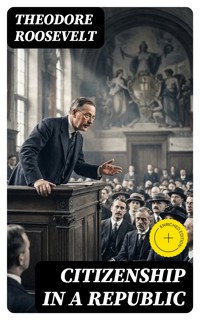
Theodore Roosevelt's "Citizenship in a Republic" is a profound exploration of the duties and responsibilities of American citizens within a democratic society. Delivered as a speech at the Sorbonne in 1910, this work combines rhetorical elegance with a persuasive call to civic engagement and moral integrity. Roosevelt's literary style is marked by his vigorous prose and passionate advocacy for a robust, participatory citizenry. This text emerges from the broader philosophical context of Progressive Era America, highlighting the emerging complexities of democracy amidst industrialization and social change. Theodore Roosevelt, the 26th President of the United States, was a prominent figure whose beliefs and political actions were deeply rooted in his commitment to social justice and national strength. Influenced by his own experiences in leadership and governance, as well as the prevailing issues of his time, Roosevelt sought to articulate a vision of citizenship that transcended mere legal status, emphasizing ethical conduct and active participation as the bedrock of democracy. "Citizenship in a Republic" is essential reading for anyone interested in the interplay between individual rights and communal responsibilities. Roosevelt's timeless insights resonate with contemporary discussions on civic duty, making this work not only a historical artifact but a relevant guide for engaged citizenship in the modern era. In this enriched edition, we have carefully created added value for your reading experience: - A succinct Introduction situates the work's timeless appeal and themes. - The Synopsis outlines the central plot, highlighting key developments without spoiling critical twists. - A detailed Historical Context immerses you in the era's events and influences that shaped the writing. - An Author Biography reveals milestones in the author's life, illuminating the personal insights behind the text. - A thorough Analysis dissects symbols, motifs, and character arcs to unearth underlying meanings. - Reflection questions prompt you to engage personally with the work's messages, connecting them to modern life. - Hand‐picked Memorable Quotes shine a spotlight on moments of literary brilliance. - Interactive footnotes clarify unusual references, historical allusions, and archaic phrases for an effortless, more informed read.
Das E-Book können Sie in Legimi-Apps oder einer beliebigen App lesen, die das folgende Format unterstützen:
Veröffentlichungsjahr: 2022
Ähnliche









Citizenship in a Republic
Table of Contents
Introduction
At the heart of this work beats a contest between comfortable spectatorship and the arduous, imperfect labor of self-government. Theodore Roosevelt’s “Citizenship in a Republic” confronts the universal temptation to watch rather than to act, to critique rather than to build. It invites readers to measure political ideals not only by their beauty, but by their embodiment in daily effort. In a voice at once candid and urgent, Roosevelt asks what becomes of a republic when its citizens prefer detachment to duty. The pages that follow present a compelling case that civic vitality depends less on grand theory than on steadfast participation.
“Citizenship in a Republic” was written and delivered by Theodore Roosevelt at the Sorbonne in Paris on April 23, 1910, during his post-presidential European tour. Although first given as a public address, it has long circulated as an essay and has often been published as a standalone text. Its author had recently concluded a consequential American presidency and spoke to an international audience steeped in its own republican tradition. The piece reflects Roosevelt’s characteristic clarity and vigor, while addressing questions that outlive their immediate moment: what a republic asks of its people, and how individuals sustain the institutions they inherit.
This work holds classic status because it belongs to the durable canon of modern oratory and political literature, where forceful language, vivid imagery, and a coherent moral vision converge. It has been widely reprinted, studied in classrooms, and cited by readers across generations. Its influence rests not merely on reputation but on craft: a carefully staged argument that moves from principle to practice. Even detached from its original occasion, the speech retains an unmistakable cadence and a persuasive momentum. The result is a text that invites rereading, rewarding attention with fresh connections between private character and public life.
Roosevelt’s central themes are enduring precisely because they are elemental. He addresses the dignity of work, the necessity of civic courage, the hazards of cynicism, and the ethical demands placed upon free people. Rather than treating citizenship as a distant abstraction, he binds it to habits of mind and conduct that are accessible to all. The emphasis falls on responsibility shared, not heroism reserved for a few. He insists that institutions cannot thrive without citizens who accept both limits and obligations. In these pages, duty is not a grim sentence, but a source of energy and meaning.
The historical context deepens the text’s authority. Composed at the height of the Progressive Era, the speech reflects a period of economic change, social strain, and expanding democratic participation. Roosevelt, having served as New York governor and as President of the United States, had tested his convictions in public office before bringing them to a European forum. Speaking in Paris connected American experience to a broader republican inheritance, acknowledging both common aspirations and local differences. That cosmopolitan setting underscores a key point: the challenges of citizenship are not bounded by borders, but recur wherever free institutions depend on public virtue.
The premise is direct and timely: the strength of a republic rests on the character and effort of ordinary citizens who willingly shoulder their share of the common burden. Laws, leaders, and constitutions matter, but they cannot substitute for personal engagement. Roosevelt argues that participation—in public deliberation, in honest work, in community life—forms the bedrock of political health. He praises neither passivity nor perfectionism, but steady striving animated by conscience. In so doing, he reframes civic life as a field where fallible people learn, improve, and contribute, rather than as a theater for spectators who judge from a distance.
Part of the book’s power lies in its rhetorical design. Roosevelt defines terms, draws contrasts, and uses history to illuminate principle without reducing modern dilemmas to simple parallels. The prose is plain yet charged, accessible without sacrificing seriousness. One feels the momentum of a case built step by step, guided by an ethic that favors effort over ease. Imagery grants memorable shape to ideas, while the cadence of the sentences carries the argument forward. That balance of moral clarity and stylistic restraint helps explain why the piece thrives both on the page and in the ear.
The cultural reach of “Citizenship in a Republic” has been unusually broad. Its most famous passage, often known by a phrase identifying the figure at the center of the action, has become a touchstone in discussions of leadership and resilience. Writers and speakers across fields—from civic education to sports to business—have drawn on its core insight about the dignity of engagement. Contemporary authors, including Brené Brown in her work on vulnerability and courage, have explicitly engaged its themes. Such borrowing is not mere ornament; it signals recognition that Roosevelt’s formulation names a permanent feature of democratic life.
Its literary impact extends beyond quotation. The speech has shaped the vocabulary with which many describe public responsibility and personal initiative. Editors have included it in collections of American oratory and in volumes of Roosevelt’s writings, preserving its accessibility for new readers. Teachers assign it not only for its historical importance, but for its argumentative clarity. Journalists and commentators invoke it when distinguishing between the risk of involvement and the ease of detached critique. In short, the text offers a shared reference point when citizens debate what they owe to one another and to their institutions.
Because the work arose from a specific moment, it also contains references rooted in its time; yet the underlying claims remain legible today without specialized knowledge. Readers need not master early twentieth-century policy debates to grasp its stakes. The emphasis falls on virtues and practices that travel well across eras: honesty, persistence, fairness, and a willingness to accept accountability. When the historical frame appears, it does so in service of a larger argument about conduct in a free society. That accessibility is one reason the piece continues to invite readers from varied backgrounds and disciplines.
Approaching this book, expect an argument that marries exhortation to reflection. Roosevelt is not content to praise ideals; he presses the reader to consider how ideals become habits. He does not deny complexity or risk, but he contests the notion that uncertainty absolves anyone from participation. The structure proceeds with deliberate clarity, building from general principles toward the concrete terrain where citizens live and choose. The result is neither policy manual nor abstract treatise, but a summons to thoughtful action. It is literature that aims at consequences, measuring itself by the lives it hopes to influence.
The contemporary relevance of “Citizenship in a Republic” is difficult to miss. In an age saturated with commentary, the call to exchange mere observation for accountable effort carries renewed weight. Democracies old and new still depend on people willing to work, to disagree honorably, and to accept the costs of common purpose. That is why this text endures: it reminds us that the promise of a republic is never self-executing. To read it now is to encounter a demanding but sustaining vision of citizenship—one that links private character to public hope, and that continues to speak with bracing clarity to our unsettled times.




