


7,19 €
Mehr erfahren.
- Herausgeber: Krishnamurti Foundation America
- Kategorie: Geisteswissenschaft
- Serie: KFA
- Sprache: Englisch
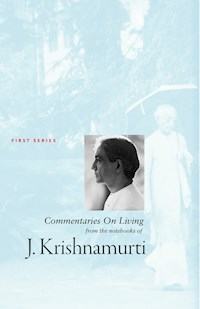
In this series of commentaries J. Krishnamurti, one of the great thinkers of our time, touches upon many human problems-our hopes, our fears, our illusions, our beliefs, our prejudices-and in the simplest language seems to pierce to their roots."The sheer simplicity is breathtaking. The reader is given, in one paragraph, often in one sentence, enough to keep him exploring, questioning, thinking for days." -Anne Morrow Lindbergh."The insight, spiritual and poetic, of these commentaries is as simply expressed as it is searching in its demand."-Times Literary Supplement (London)."Krishnamurti is no other than he seems, a free man, one of the first quality, growing older as diamonds do but the gem-like flame not dating, and alive in these Commentaries. It is a treasure."-Francis Hacket, The New Republic
Das E-Book können Sie in Legimi-Apps oder einer beliebigen App lesen, die das folgende Format unterstützen:
Seitenzahl: 673
Veröffentlichungsjahr: 2012
Ähnliche

Contents
COMMENTARIES ON LIVING
THIRD SERIES
In this series of commentaries J. Krishnamurti, one of the great thinkers of our time, touches upon many human problems— our hopes, our fears, our illusions, our beliefs, our prejudices— and in the simplest language seems to pierce to their roots.
“The sheer simplicity is breathtaking. The reader is given, in one paragraph, often in one sentence, enough to keep him exploring, questioning, thinking for days.”
–Anne Morrow Lindbergh.
“The insight, spiritual and poetic, of these commentaries is as simply expressed as it is searching in its demand.”
–Times Literary Supplement (London).
“Krishnamurti is no other than he seems, a free man, one of the first quality, growing older as diamonds do but the gem-like flame not dating, and alive in these Commentaries . It is a treasure.”
–Francis Hacket, The New Republic.
J. Krishnamurti was born in South India and educated in England. Hailed by many from early youth as a spiritual teacher, he rejected adulation and leadership in order to en courage spiritual freedom and understanding. He devoted his life to speaking and counseling, traveling in the U.S.A., Europe, India and other parts of the world, addressing thou sands of people, always pointing the way to individual dis covery of truth.
These Commentaries on Living are published in three vol umes: First, Second, and Third Series.
Copyright © 1956, by Krishnamurti Foundation of America
Original edition 1956
Or whatever you want to put here
Published by Krishnamurti Foundation of America
Library of Congress Cataloging-in-Publication Data is available
eBook conversion by M-Y Books
Does Thinking Begin with Conclusions?
The hills across the lake were very beautiful, and beyond them rose the snow-covered mountains. It had been raining all day; but now, like an unexpected miracle, the skies had suddenly cleared, and everything became alive, joyous and serene. The flowers were intense in their yellow, red and deep purple, and the raindrops on them were like precious jewels. It was a most lovely evening, full of light and splendor. The people came out into the streets and along the lake children were shouting with laughter. Through all this movement and bustle there was enchanting beauty, and a strange, all-pervading peace.
There were several of us on the long bench facing the lake. A man was talking in rather a high voice, and it was impossible not to overhear what he was saying to his neighbor. “On an evening like this I wish I were far away from this noise and confusion, but my job keeps me here, and I loathe it.” People were feeding the swans, the ducks and a few stray seagulls. The swans were pure white and very graceful. There wasn’t a ripple on the water now, and the hills across the lake were almost black; but the mountains beyond the hills were aglow with the setting sun, and the vivid clouds behind them seemed passionately alive.
“I am not sure I understand you,” my visitor began, “when you say that knowledge must be set aside to understand truth.” He was an elderly man, much traveled and well-read. He had spent a year or so in a monastery, he explained, and had wandered all over the world, from port to port, working on ships, saving money and gathering knowledge. “I don’t mean mere book knowledge,” he went on; “I mean the knowledge that men have gathered but have not put down on paper, the mysterious tradition that’s beyond scrolls and sacred books. I have dabbled in occultism, but that has always seemed to me rather stupid and superficial. A good microscope is vastly more beneficial than the clairvoyance of a man who sees superphysical things. I have read some of the great historians with their theories and their visions, but... Given a first-rate mind and the capacity to accumulate knowledge, a man should be able to do immense good. I know it isn’t the fashion, but I have a sneaking compulsion to reform the world, and knowledge is my passion. I have always been a passionate person in many ways, and now I am consumed with this urge to know. The other day I read something of yours which intrigued me, and when you said that there must be freedom from knowledge, I decided to come and see you–not as a follower, but as an inquirer.”
To follow another, however learned or noble, is to block all understanding, isn’t it?
“Then we can talk freely and with mutual respect.”
If I may ask, what do you mean by knowledge?
“Yes, that’s a good question to begin with. Knowledge is everything that man has learned through experience; it is what he has gathered by study, through centuries of struggle and pain, in the many fields of endeavor, both scientific and psychological. As even the greatest historian interprets history according to his learning and mood, so an ordinary scholar like me may translate knowledge into action, either ‘good’ or ‘bad’. Though we are not concerned with action at the moment, it is inevitably related to knowledge, which is what man has experienced or learned through thought,
through meditation, through sorrow. Knowledge is vast; it is not only written down in books, but it exists in the individual as well as in the collective or racial consciousness of man. Scientific and medical information, the technical ‘know-how’ of the material world, is rooted principally in the consciousness of western man, just as in the consciousness of eastern man there is the greater sensitivity of unworldliness. All this is knowledge, embracing not only what is already known, but what is being discovered from day to day. Knowledge is an additive, deathless process, there is no end to it, and it may therefore be the immortal that man is after. So I can’t understand why you say that all knowledge must be set aside if there is to be the understanding of truth.”
The division between knowledge and understanding is artificial, it really doesn’t exist; but to be free of this division, which is to perceive the difference between them, we must find out what is the highest form of thinking, otherwise there will be confusion.
Does thinking begin with a conclusion? Is thinking a movement from one conclusion to another? Can there be thinking, if thinking is positive? Is not the highest form of thinking negative? Is not all knowledge an accumulation of definitions, conclusions and positive assertions? Positive thought, which is based on experience, is always the outcome of the past, and such thought can never uncover the new.
“You are stating that knowledge is ever in the past, and that thought originating from the past must inevitably cloud the perception of that which may be called truth. However, without the past as memory, we could not recognize this object which we have agreed to call a chair. The word ‘chair’ reflects a conclusion reached by common consent, and all communication would cease if such conclusions were not taken for granted. Most of our thinking is based on conclusions, on traditions, on the experiences of others, and life would be impossible without the more obvious and inevitable of these conclusions. Surely you don’t mean that we should put aside all conclusions, all memories and traditions?”
The ways of tradition inevitably lead to mediocrity, and a mind caught in tradition cannot perceive what is true. Tradition may be one day old, or it may go back for a thousand years. Obviously it would be absurd for an engineer to set aside the engineering knowledge he has gained through the experience of a thousand others; and if one were to try to set aside the memory of where one lived, it would only indicate a neurotic state. But the gathering of facts does not make for the understanding of life. Knowledge is one thing and understanding another. Knowledge does not lead to understanding; but understanding may enrich knowledge, and knowledge may implement understanding.
“Knowledge is essential and not to be despised. Without knowledge, modern surgery and a hundred other marvels could not exist.”
We are not attacking or defending knowledge, but trying to understand the whole problem. Knowledge is only a part of life, not the totality, and when that part assumes all-consuming importance, as it is threatening to do now, then life becomes superficial, a dull routine from which man seeks to escape through every form of diversion and superstition, with disastrous consequences. Mere knowledge, however wide and cunningly put together, will not resolve our human problems; to assume that it will is to invite frustration and misery. Something much more profound is needed. One may know that hate is futile, but to be free of hate is quite another matter. Love is not a question of knowledge.
To go back, positive thinking is no thinking at all; it is merely a modified continuity of what has been thought. The outward shape of it may change from time to time, depending on compulsions and pressures, but the core of positive thinking is always tradition. Positive thinking is the process of conformity and the mind that conforms can never be in a state of discovery.
“But can positive thinking be discarded? Is it not necessary at a certain level of human existence?”
Of course, but that’s not the whole issue. We are trying to find out if knowledge may become a hindrance to the understanding of truth. Knowledge is essential, for without it we should have to begin all over again in certain areas of our existence. This is fairly simple and clear. But will accumulated knowledge, however vast, help us to understand truth?
“What is truth? Is it a common ground to be trodden by all? Or is it a subjective, individual experience?”
By whatever name it may be called, truth must ever be new, living; but the words ‘new’ and ‘living’ are used only to convey a state that is not static, not dead, not a fixed point within the mind of man. Truth must be discovered anew from moment to moment, it is not an experience that can be repeated; it has no continuity, it is a timeless state. The division between the many and the one must cease for truth to be. It is not a state to be achieved, nor a point towards which the mind can evolve, grow. If truth is conceived as a thing to be gained, then the cultivation of knowledge and the accumulations of memory become necessary, giving rise to the guru and the follower, the one who knows and the one who does not know.
“Then you are against gurus and followers?”
It’s not a matter of being against something but of perceiving that conformity, which is the desire for security, with its fears, prevents the experiencing of the timeless.
“I think I understand what you mean. But is it not immensely difficult to renounce all that one has gathered? Indeed, is it possible?”
To give up in order to gain is no renunciation at all. To see the false as the false, to see the true in the false, and to see the true as the true–it is this that sets the mind free.
Self-Knowledge or Self-Hypnosis?
It had rained all night and most of the morning, and now the sun was going down behind dark, heavy clouds. There was no color in the sky, but the perfume of the rain-soaked earth filled the air. The frogs had croaked all night long with persistency and rhythm, but with the dawn they became silent. The tree trunks were dark with the long rain, and the leaves, washed clean of the summer’s dust, would be rich and green again in a few more days. The lawns too would be greener, the bushes would soon be flowering, and there would be rejoicing. How welcome was the rain after the hot, dusty days! The mountains beyond the hills seemed not too far away, and the breeze blowing from them was cool and pure. There would be more work, more food, and starvation would be a thing of the past.
One of those large brown eagles was making wide circles in the sky, floating on the breeze without a beat of its wings. Hundreds of people on bicycles were going home after a long day in the office. A few talked as they rode, but most of them were silent and evidently tired out. A large group had stopped, with their bicycles resting against their bodies, and were animatedly discussing some issue, while nearby a policeman wearily watched them. On the corner a big new building was going up. The road was full of brown puddles, and the passing cars splashed one with dirty water which left dark marks on one’s clothing. A cyclist stopped, bought from a vendor one cigarette, and was on his way again.
A boy came along carrying on his head an old kerosene tin, half filled with some liquid. He must have been working around that new building which was under construction. He had bright eyes and an extraordinarily cheerful face; he was thin but strongly built, and his skin was very dark, burnt by the sun. He wore a shirt and a loincloth, both the color of the earth, brown with long usage. His head was well shaped, and there was a certain arrogance in his walk–a boy doing a man’s work. As he left the crowd behind, he began to sing, and suddenly the whole atmosphere changed. His voice was ordinary, a boyish voice, lusty and raucous; but the song had rhythm, and he would probably have kept time with his hands, had not one hand been holding the kerosene tin on top of his head. He was aware that someone was walking behind him, but was too cheerful to be shy, and he was obviously not in any way concerned with the peculiar change that had come about in the atmosphere. There was a blessing in the air, a love that covered everything, a gentleness that was simple, without calculation, a goodness that was ever flowering.
Abruptly the boy stopped singing and turned towards a dilapidated hut that stood some distance back from the road. It would soon be raining again.
The visitor said he had held a government position that was good as far as it went, and as he had had a first class education both at home and abroad, he could have climbed quite high. He was married, he said, and had a couple of children. Life was fairly enjoyable, for success was assured; he owned the house they were living in, and he had put aside money for the education of his children. He knew Sanskrit, and was familiar with the religious tradition. Things were going along pleasantly enough, he said; but one morning he awoke very early, had his bath, and sat down for meditation before his family or the neighbors were up. Though he had had a restful sleep, he couldn’t meditate; and suddenly he felt an overwhelming urge to spend the rest of his life in meditation. There was no hesitancy or doubt about it; he would devote his remaining years to finding whatever there was to be found through meditation, and he told his wife, and his two boys, who were at college, that he was going to become a sannyasi. His colleagues were surprised by his decision, but accepted his resignation; and in a few days he had left his home, never to return.
That was twenty-five years ago, he went on. He disciplined himself rigorously, but he found it difficult after a life of ease, and it took him a long time to master completely his thoughts and the passions that were in him. Finally, however, he began to have visions of the Buddha, of Christ and Krishna, visions whose beauty was enthralling, and for days he would live as if in a trance, ever widening the boundaries of his mind and heart, utterly absorbed in that love which is devotion to the Supreme. Everything about him–the villagers, the animals, the trees, the grass–was intensely alive, brilliant in its vitality and loveliness. It had taken him all these years to touch the hem of the Infinite, he said, and it was amazing that he had survived it all.
“I have a number of disciples and followers, as is inevitable in this country,” he went on “and one of them suggested to me that I attend a talk which was to be given by you in this town, where I happened to be for a few days. More to please him than to listen to the speaker, I went to the talk, and I was greatly impressed by what was said in reply to a question on meditation. It was stated that without self-knowledge, which in itself is meditation, all meditation is a process of self-hypnosis, a projection of one’s own thought and desire. I have been thinking about all this, and have now come to talk things over with you.
“I see that what you say is perfectly true, and it’s a great shock to me to perceive that I have been caught in the images or projections of my own mind. I now realize very profoundly what my meditation has been. For twenty-five years I have been held in a beautiful garden of my own making; the personages, the visions were the outcome of my particular culture and of the things I have desired, studied and absorbed. I now understand the significance of what I have been doing, and I am more than appalled at having wasted so many precious years.”
We remained silent for some time.
“What am I to do now?” he presently continued. “Is there any way out of the prison I have built for myself? I can see that what I have come to in my meditation is a dead end, though only a few days ago it seemed so full of glorious significance. However much I would like to, I can’t go back to all that self-delusion and self-stimulation. I want to tear through these veils of illusion and come upon that which is not put together by the mind. You have no idea what I have been through during the last two days! The structure which I had so carefully and painfully built up over a period of twenty-five years has no meaning any more, and it seems to me that I shall have to start all over again. From where am I to start?”
May it not be that there is no restarting at all, but only the perception of the false as the false, which is the beginning of understanding? If one were to start again, one might be caught in another illusion, perhaps in a different manner. What blinds us is the desire to achieve an end, a result; but if we perceived that the result we desire is still within the self-centered field, then there would be no thought of achievement. Seeing the false as the false, and the true as the true, is wisdom.
“But do I really see that what I have been doing for the last twenty-five years is false? Am I aware of all the implications of what I have regarded as meditation?”
The craving for experience is the beginning of illusion. As you now realize, your visions were but the projections of your background, of your conditioning, and it is these projections that you have experienced. Surely this is not meditation. The beginning of meditation is the understanding of the background, of the self, and without this understanding, what is called meditation, however pleasurable or painful, is merely a form of self-hypnosis. You have practiced self-control, mastered thought, and concentrated on the furthering of experience. This is a self-centered occupation, it is not meditation; and to perceive that it is not meditation is the beginning of meditation. To see the truth in the false sets the mind free from the false. Freedom from the false does not come about through the desire to achieve it; it comes when the mind is no longer concerned with success, with the attainment of an end. There must be the cessation of all search, and only then is there a possibility of the coming into being of that which is nameless.
“I do not want to deceive myself again.”
Self-deception exists when there is any form of craving or attachment: attachment to a prejudice, to an experience, to a system of thought. Consciously or unconsciously, the experiencer is always seeking greater, deeper, wider experience; and as long as the experiencer exists, there must be delusion in one form or another.
“All this involves time and patience, doesn’t it?”
Time and patience may be necessary for the achievement of a goal. An ambitious man, worldly or otherwise, needs time to gain his end. Mind is the product of time, as all thought is its result; and thought working to free itself from time only strengthens its enslavement to time. Time exists only when there is a psychological gap between what is and what should be, which is called the ideal, the end. To be aware of the falseness of this whole manner of thinking is to be free from it–which does not demand any effort, any practice. Understanding is immediate, it is not of time.
“The meditation I have indulged in can have meaning only when it is seen to be false, and I think I see it to be false. But...”
Please don’t ask the inevitable question as to what there will be in its place, and so on. When the false has dropped away, there is freedom for that which is not false to come into being. You cannot seek the true through the false; the false is not a stepping-stone to the true. The false must cease wholly, not in comparison to the true. There is no comparison between the false and the true; violence and love cannot be compared. Violence must cease for love to be. The cessation of violence is not a matter of time. The perception of the false as the false is the ending of the false. Let the mind be empty, and not filled with the things of the mind. Then there is only meditation, and not a meditator who is meditating.
“I have been occupied with the meditator, the seeker, the enjoyer, the experiencer, which is myself. I have lived in a pleasant garden of my own creation, and have been a prisoner therein. I now see the falseness of all that–dimly, but I see it.”
The Escape from What Is
It was a rather nice garden, with open, green lawns and flowering bushes, completely enclosed by wide-spreading trees. There was a road running along one side of it, and one often overheard loud talk, especially in the evenings, when people were making their way home. Otherwise it was very quiet in the garden. The grass was watered morning and evening, and at both times there were a great many birds running up and down the lawn in search of worms. They were so eager in their search, that they would come quite close without any fear when one remained seated under a tree. Two birds, green and gold, with square tails and a long, delicate feather sticking out, came regularly to perch among the rose bushes. They were exactly the same color as the tender leaves, and it was almost impossible to see them. They had flat heads and long, narrow eyes, with dark beaks. They would swoop in a curve close to the ground, catch an insect, and return to the swaying branch of a rose bush. It was a most lovely sight, full of freedom and beauty. One couldn’t get near them, they were too shy; but if one sat under the tree without moving too much, one would see them disporting themselves, with the sun on their transparent golden wings.
Often a big mongoose would emerge from the thick bushes, its red nose high in the air and its sharp eyes watching every movement around it. The first day it seemed very disturbed to see a person sitting under the tree, but it soon got used to the human presence. It would cross the whole length of the garden, unhurriedly, its long tail flat on the ground. Sometimes it would go along the edge of the lawn, close to the bushes, and then it would be much more alert, its nose vibrant and twitching. Once the whole family came out, the big mongoose leading, followed by his smaller wife, and behind her, two little ones, all in a line. The babies stopped once or twice to play; but when the mother, feeling that they weren’t immediately behind her, turned her head sharply, they raced forward and fell in line again.
In the moonlight the garden became an enchanted place, the motionless, silent trees casting long, dark shadows across the lawn and among the still bushes. After a great deal of bustle and chatter, the birds had settled down for the night in the dark foliage. There was now hardly anyone on the road, but occasionally one would hear a song in the distance, or the notes of a flute being played by someone on his way to the village. Otherwise the garden was very quiet, full of soft whispers. Not a leaf stirred, and the trees gave shape to the hazy, silver sky.
Imagination has no place in meditation; it must be completely set aside, for the mind caught in imagination can only breed delusions. The mind must be clear, without movement, and in the light of that clarity the timeless is revealed.
He was a very old man with a white beard, and his lean body was scarcely covered by the saffron robe of a sannyasi. He was gentle in manner and speech, but his eyes were full of sorrow–the sorrow of vain search. At the age of fifteen he had left his family and renounced the world, and for many years he had wandered all over India visiting ashramas, studying, meditating, endlessly searching. He had lived for a time at the ashrama of the religious-political leader who had worked so strenuously for the freedom of India, and had stayed at another in the south, where the chanting was pleasant.
In the hall where a saint lived silently, he too, amongst many others, had remained silently searching. There were ashramas on the east coast and on the west coast where he had stayed, probing, questioning, discussing. In the far north, among the snows and in the cold caves, he had also been; and he had meditated by the gurgling waters of the sacred river. Living among the ascetics, he had physically suffered, and he had made long pilgrimages to sacred temples. He was well versed in Sanskrit, and it had delighted him to chant as he walked from place to place.
“I have searched for God in every possible way from the age of fifteen, but I have not found Him, and now I am past seventy. I have come to you as I have gone to others, hoping to find God. I must find Him before I die–unless, indeed, He is just another of the many myths of man.”
If one may ask, sir, do you think that the immeasurable can be found by searching for it? By following different paths, through discipline and self-torture, through sacrifice and dedicated service, will the seeker come upon the eternal? Surely, sir, whether the eternal exists or not is unimportant, and the truth of it may be uncovered later; but what is important is to understand why we seek, and what it is that we are seeking. Why do we seek?
“I seek because, without God, life has very little meaning. I seek Him out of sorrow and pain. I seek Him because I want peace. I seek Him because He is the permanent, the changeless; because there is death, and He is deathless. He is order, beauty and goodness, and for this reason I seek Him.”
That is, being in agony over the impermanent, we hopefully pursue what we call the permanent. The motive of our search is to find comfort in the ideal of the permanent, and this ideal is born of impermanency, it has grown out of the pain of constant change. The ideal is unreal, whereas the pain is real; but we do not seem to understand the fact of pain, and so we cling to the ideal, to the hope of painlessness. Thus there is born in us the dual state of fact and ideal, with its endless conflict between what is and what should be. The motive of our search is to escape from impermanency, from sorrow, into what the mind thinks is the state of permanency, of everlasting bliss. But that very thought is impermanent, for it is born of sorrow. The opposite, however exalted, holds the seed of its own opposite. Our search, then, is merely the urge to escape from what is.
“Do you mean to say that we must cease to search?”
If we give our undivided attention to the understanding of what is, then search, as we know it, may not be necessary at all. When the mind is free from sorrow, what need is there to search for happiness?
“Can the mind ever be free from sorrow?”
To conclude that it can or that it cannot be free is to put an end to all inquiry and understanding. We must give our complete attention to the understanding of sorrow, and we cannot do this if we are trying to escape from sorrow, or if our minds are occupied in seeking the cause of it. There must be total attention, and not oblique concern.
When the mind is no longer seeking, no longer breeding conflict through its wants and cravings, when it is silent with understanding, only then can the immeasurable come into being.
Can One Know What Is Good for the People?
There were several of us in the room. Two had been in prison for many years for political reasons; they had suffered and sacrificed in gaining freedom for the country, and were well-known. Their names were often in the papers, and while they were modest, that peculiar arrogance of achievement and fame was still in their eyes. They were well-read, and they spoke with the facility that comes from public speaking. Another was a politician, a big man with a sharp glance, who was full of schemes and had an eye on self-advancement. He too had been in prison for the same reason, but now he was in a position of power, and his look was assured and purposeful; he could manipulate ideas and men. There was another who had renounced worldly possessions, and who hungered for the power to do good. Very learned and full of apt quotations, he had a smile that was genuinely kind and pleasant, and he was currently traveling all over the country talking, persuading, and fasting. There were three or four others who also aspired to climb the political or spiritual ladder of recognition or humility.
“I cannot understand,” one of them began, “why you are so much against action. Living is action; without action, life is a process of stagnation. We need dedicated people of action to change the social and religious conditions of this unfortunate country. Surely you are not against reform: the landed people voluntarily giving some of their land to the landless, the educating of the villager, the improving of the village, the breaking up of caste divisions, and so on.”
Reform, however necessary, only breeds the need for further reform, and there is no end to it. What is essential is a revolution in man’s thinking, not patchwork reform. Without a fundamental change in the mind and heart of man, reform merely puts him to sleep by helping him to be further satisfied. This is fairly obvious, isn’t it?
“You mean that we must have no reforms?” another asked, with an intensity that was surprising.
“I think you are misunderstanding him,” explained one of the older men. “He means that reform will never bring about the total transformation of man. In fact, reform impedes that total transformation, because it puts man to sleep by giving him temporary satisfaction. By multiplying these gratifying reforms, you will slowly drug your neighbor into contentment.”
“But if we strictly limit ourselves to one essential reform–the voluntary giving of land to the landless, let’s say–until it is brought about, will that not be beneficial?”
Can you separate one part from the whole field of existence? Can you put a fence around it, concentrate upon it, without affecting the rest of the field?
“To affect the whole field of existence is exactly what we plan to do. When we have achieved one reform, we shall turn to another.”
Is the totality of life to be understood through the part? Or is it that the whole must first be perceived and understood, and that only then the parts can be examined and reshaped in relation to the whole? Without comprehending the whole, mere concentration on the part only breeds further confusion and misery.
“Do you mean to say,” demanded the intense one, “that we must not act or bring about reforms without first studying the whole process of existence?”
“That’s absurd, of course,” put in the politician. “We simply haven’t time to search out the full meaning of life. That will have to be left to the dreamers, to the gurus, to the philosophers. We have to deal with everyday existence; we have to act, we have to legislate, we have to govern and bring order out of chaos. We are concerned with dams, with irrigation, with better agriculture; we are occupied with trade, with economics, and we must deal with foreign powers. It is sufficient for us if we can manage to carry on from day to day without some major calamity taking place. We are practical men in positions of responsibility, and we have to act to the best of our ability for the good of the people.”
If it may be asked, how do you know what’s good for the people? You assume so much. You start with so many conclusions; and when you start with a conclusion, whether your own or that of another, all thinking ceases. The calm assumption that you know, and that the other does not, leads to greater misery than the misery of having only one meal a day; for it is the vanity of conclusions that brings about the exploitation of man. In our eagerness to act for the good of others, we seem to do a great deal of harm.
“Some of us think we really do know what’s good for the country and its people,” explained the politician. “Of course, the opposition also thinks it knows; but the opposition is not very strong in this country, fortunately for us, so we shall win and be in a position to try out what we think is good and beneficial.”
Every party knows, or thinks it knows, what’s good for the people. But what is truly good will not create antagonism, either at home or abroad; it will bring about unity between man and man; what is truly good will be concerned with the totality of man, and not with some superficial benefit that may lead only to greater calamity and misery; it will put an end to the division and the enmity that nationalism and organized religions have created. And is the good so easily found?
“If we have to take into consideration//the implications of what is good, we shall get nowhere; we shall not be able to act. Immediate necessities demand immediate action, though that action may bring marginal confusion,” replied the politician. “We just haven’t time to ponder, to philosophize. Some of us are busy from early in the morning till late at night, and we can’t sit back to consider the full meaning of each and every action that we must take. We literally cannot afford the pleasure of deep consideration, and we leave that pleasure to others.”
“Sir, you appear to be suggesting,” said one of those who had thus far remained silent, “that before we perform what we assume to be a good act, we should think out fully the significance of that act, since, even though seemingly beneficial, such an act may produce greater misery in the future. But is it possible to have such profound insight into our own actions? At the moment of action we may think we have that insight, but later on we may discover our blindness.”
At the moment of action we are enthusiastic, impetuous, we are carried away by an idea, or by the personality and the fire of a leader. All leaders, from the most brutal tyrant to the most religious politician, state that they are acting for the good of man, and they all lead to the grave; but nevertheless we succumb to their influence, and follow them. Haven’t you, sir, been influenced by such a leader? He may no longer be living, but you still think and act according to his sanctions, his formulas, his pattern of life; or else you are influenced by a more recent leader. So we go from one leader to another, dropping them when it suits our convenience, or when a better leader turns up with greater promise of some ‘good’. In our enthusiasm we bring others into the net of our convictions, and they often remain in that net when we ourselves have moved on to other leaders and other convictions. But what is good is free of influence, compulsion and convenience and any act which is not good in this sense is bound to breed confusion and misery.
“I think we can all plead guilty to being influenced by a leader, directly or indirectly,” acquiesced the last speaker, “but our problem is this: Realizing that we receive many benefits from society and give very little in return, and seeing so much misery everywhere, we feel that we have a responsibility towards society, that we must do something to relieve this unending misery. Most of us, however, feel rather lost, and so we follow someone with a strong personality. His dedicated life, his obvious sincerity, his vital thoughts and acts, influence us greatly, and in various ways we become his followers; under his influence we are soon caught up in action, whether it be for the liberation of the country, or for the betterment of social conditions. The acceptance of authority is ingrained in us, and from this acceptance of authority flows action. What you are telling us is so contrary to all we are accustomed to, that it leaves us no measure by which to judge and to act. I hope you see our difficulty.”
Surely, sir, any act based on the authority of a book, however sacred, or on the authority of a person, however noble and saintly, is a thoughtless act which must inevitably bring confusion and sorrow. In this and other countries the leader derives his authority from the interpretation of the so-called sacred books, which he liberally quotes, or from his own experiences, which are conditioned by the past, or from his austere life, which again is based on the pattern of saintly records. So the leader’s life is as bound by authority as the life of the follower; both are slaves to the book, and to the experience or knowledge of another. With this background, you want to remake the world. Is that possible? Or must you put aside this whole authoritarian, hierarchical outlook on life, and approach the many problems with a fresh, eager mind? Living and action are not separate, they are an interrelated, unitary process; but now you have separated them, have you not? You regard daily living, with its thoughts and acts, as different from the action which is going to change the world.
“Again, this is so,” went on the last speaker. “But how are we to throw off this yoke of authority and tradition, which we have willingly and happily accepted from childhood? It is part of our immemorial tradition, and you come along and tell us to set it all aside and rely on ourselves! From what I have heard and read, you say that the very atman itself is without permanency. So you can see why we are confused.”
May it not be that you have never really inquired into the authoritarian way of existence? The very questioning of authority is the end of authority. There is no method or system by which the mind can be set free from authority and tradition; if there were, then the system would become the dominating factor.
Why do you accept authority, in the deeper sense of that word? You accept authority, as the guru also does, in order to be safe, to be certain, in order to be comforted, to succeed, to reach the other shore. You and the guru are worshipers of success; you are both driven by ambition. Where there is ambition, there is no love; and action without love has no meaning.
“Intellectually I see that what you say is true, but inwardly, emotionally, I don’t feel the authenticity of it.”
There is no intellectual understanding; either we understand, or we don’t. This dividing of ourselves into watertight compartments is another of our absurdities. It is better to admit to ourselves that we do not understand, than to maintain that there is an intellectual understanding, which only breeds arrogance and self-imposed conflict.
“We have taken too much of your time, but perhaps you will allow us to come again.”
I Want to Find the Source of Joy
The sun was behind the hills, the town was afire with the evening glow, and the sky was full of light and splendor. In the lingering twilight, the children were shouting and playing; there was still plenty of time before their dinner. A discordant temple bell was ringing in the distance, and from the nearby mosque a voice was calling for evening prayers. The parrots were coming back from the outlying woods and fields to the dense trees with their heavy foliage, all along the road. They were making an awful noise before settling down for the night. The crows joined them, with their raucous calling, and there were other birds, all scolding and noisy. It was a secluded part of the town, and the sound of the traffic was drowned by the loud chatter of the birds; but with the coming of darkness they became quieter, and within a few minutes they were silent and ready for the night.
A man came along with what looked like a thick rope around his neck. He was holding one end of it. A group of people were chatting and laughing under a tree, where there were patches of light from an electric lamp above; and the man, walking up to the group, put his rope on the ground. There were frightened screams as everyone started running; for the ‘rope’ was a big cobra, hissing and swaying its hood. Laughing, the man pushed it with his naked toes, and presently picked it up again, holding it just behind the head. Of course,
its fangs had been removed; it was really harmless, but frightening. The man offered to put the snake around my neck, but he was satisfied when I stroked it. It was scaly and cold, with strong rippling muscles, and eyes that were black and staring–for snakes have no eyelids. We walked a few steps together, and the cobra around his neck was never still, but all movement.
The street-lights made the stars seem dim and far away, but Mars was red and clear. A beggar was walking along with slow, weary steps, hardly moving; he was covered with rags, and his feet were wrapped in torn pieces of canvas, tied together with heavy string. He had a long stick, and was muttering to himself, and he did not look up as we passed. Further along the street there was a smart and expensive hotel, with cars of almost every make drawn up in front of it.
A young professor from one of the universities, rather nervous and with a high-pitched voice and bright eyes, said that he had come a long way to ask a question which was most important to him.
“I have known various joys: the joy of conjugal love, the joy of health, of interest, and of good companionship. Being a professor of literature, I have read widely, and delight in books. But I have found that every joy is fleeting in nature; from the smallest to the greatest, they all pass away in time. Nothing I touch seems to have any permanency, and even literature, the greatest love of my life, is beginning to lose its perennial joy. I feel there must be a permanent source of all joy, but though I have sought for it intensely, I have not found it.”
Search is an extraordinarily deceptive phenomenon is it not? Being dissatisfied with the present, we seek something beyond it. Aching with the present, we probe into the future or the past; and even that which we find is consumed in the present. We never stop to inquire into the full content of the present, but are always pursuing the dreams of the future; or from among the dead memories of the past we select the richest, and give life to it. We cling to that which has been, or reject it in the light of tomorrow, and so the present is slurred over; it is merely a passage to be gone through as quickly as possible.
“Whether it’s in the past or in the future, I want to find the source of joy,” he went on. “You know what I mean, sir. I no longer seek the objects from which joy is derived–ideas, books, people, nature–but the source of joy itself, beyond all transiency. If one doesn’t find that source, one is everlastingly caught in the sorrow of the impermanent.”
Don’t you think, sir, that we must understand the significance of that word ‘search’? Otherwise we shall be talking at cross purposes. Why is there this urge to seek, this anxiety to find, this compulsion to attain? Perhaps if we can uncover the motive and see its implications, we shall be able to understand the significance of search.
“My motive is simple and direct: I want to find the permanent source of joy, for every joy I have known has been a passing thing. The urge that is making me seek is the misery of not having anything enduring. I want to get away from this sorrow of uncertainty, and I don’t think there’s anything abnormal about it. Anyone who is at all thoughtful must be seeking the joy I am seeking. Others may call it by a different name–God, truth, bliss, freedom, moksha, and so on–but it’s essentially the same thing.”
Being caught in the pain of impermanency, the mind is driven to seek the permanent, under whatever name; and its very craving for the permanent creates the permanent, which is the opposite of what is. So really there is no search, but only the desire to find the comforting satisfaction of the permanent. When the mind becomes aware of being in a constant state of flux, it proceeds to build the opposite of that state, thereby getting caught in the conflict of duality; and then, wanting to escape from this conflict, it pursues still another opposite. So the mind is bound to the wheel of opposites.
“I am aware of this reactionary process of the mind, as you explain it; but should one not seek at all? Life would be a pretty poor thing if there were no discovering.”
Do we discover anything new through search? The new is not the opposite of the old, it is not the antithesis of what is. If the new is a projection of the old, then it is only a modified continuation of the old. All recognition is based on the past, and what is recognizable is not the new. Search arises from the pain of the present, therefore what is sought is already known. You are seeking comfort, and probably you will find it; but that also will be transient, for the very urge to find is impermanent. All desire for something–for joy, for God, or whatever it be–is transient.
“Do I understand you to mean that, since my search is the outcome of desire, and desire is transient, therefore my search is in vain?”
If you realize the truth of this, then transience itself is joy.
“How am I to realize the truth of it?”
There is no ‘how’, no method. The method breeds the idea of the permanent. As long as the mind desires to arrive, to gain, to attain, it will be in conflict. Conflict is insensitivity. It is only the sensitive mind that realizes the true. Search is born of conflict, and with the cessation of conflict there is no need to seek. Then there is bliss.
Pleasure, Habit and Austerity
The road led south of the noisy, sprawling town, with its seemingly endless rows of new buildings. The road was crowded with buses, cars and bullock carts, and with hundreds of cyclists who were going home from their offices, looking worn out after a long day of routine work which held no interest for them. Many stopped at an open market on the roadside to buy wilted vegetables. As we went through the outskirts of the town, there were rich green trees on both sides of the road, recently washed by the heavy rains. The sun was setting to our right, a huge golden ball above the distant hills. There were many goats among the trees, and the kids were chasing each other. The curving road went past an eleventh-century tower, standing red and lofty amidst Hindu and Mogul ruins. Dotted about here and there were ancient tombs, and a splendid, ruined archway told of a glory that was long ago.
The car was stopped, and we walked along the road. A group of peasants were returning from their work in the fields; all were women, and after a long day of toil, they were singing a lilting song. In that peaceful countryside their voices rang out, clear, resonant and gay. As we approached, they shyly stopped singing, but continued with their song as soon as we had passed.
The evening light was among the gently rolling hills, and the trees were dark against the evening sky. On a huge jutting rock stood the crumbling battlements of an ancient fortress. There was an astonishing beauty covering the land; it was all about us, filling every nook and corner of the earth, and the dark recesses of our hearts and minds. There is only love, not the love of God and the love of man; it is not to be divided. A big owl flew silently across the moon, and a group of the educated villagers were talking loudly, debating whether or not to go to the cinema in the town; they were rowdy, and aggressively occupied half of the road.
It was pleasant in the soft moonlight, and the shadows on the ground were clear and sharp. A lorry came rattling along the road, blowing its threatening horn; but it soon passed, leaving the countryside to the loveliness of the evening, and to the immense solitude.
He was a healthy and thoughtful young man, still in his thirties, and was employed in some government office. He was not too averse to his work, he explained, and everything considered, had a fairly good salary and a promising future. He was married and had a son of four whom he had wanted to bring along, but the boy’s mother had insisted that he would be a nuisance.
“I attended one or two of your talks,” he said, “and, if I may, I would like to ask a question. I have got into certain bad habits which are bothering me, and which I want to be free of. For several months now I have tried to get rid of them, but without success. What am I to do?”
Let us consider habit itself, and not divide it into good and bad. The cultivation of habit, however good and respectable, only makes the mind dull. What do we mean by habit? Let us think it out, and not depend on mere definition.
“Habit is an oft-repeated act.”
It is a momentum of action in a certain direction, whether pleasant or unpleasant, and it may operate consciously or unconsciously, with thought, or thoughtlessly. Is that it?
“Yes, sir, that’s right.”
Some feel the need of coffee in the morning, and without it they get a headache. The body may not have required it at first, but it has gradually got used to the pleasurable taste and stimulation of coffee, and now it suffers when deprived of it.
“But is coffee a necessity?”
What do you mean by a necessity?
“Good food is necessary to good health.”
Surely; but the tongue becomes accustomed to food of a certain kind or flavor, and then the body feels deprived and anxious when it does not get what it’s used to. This insistence on food of a particular kind indicates–does it not?–that a habit has been formed, a habit based on pleasure and the memory of it.
“But how can one break a pleasurable habit? To break an unpleasant habit is comparatively easy, but my problem is how to break the pleasant ones.”
As I said, we aren’t considering pleasant and unpleasant habits, or how to break away from either of them, but we are trying to understand habit itself. We see that habit is formed when there is pleasure and the demand for the continuation of the pleasure. Habit is based on pleasure and the memory of it. An initially unpleasant experience may gradually become a pleasant and ‘necessary’ habit.
Now, let’s go a little further into the matter. What is your problem?
“Amongst other habits, sexual indulgence has become a powerful and consuming habit with me. I have tried to bring it under control by disciplining myself against it, by dieting, practicing various exercises, and so on, but in spite of all my resistance the habit has continued.”
Perhaps there is no other release in your life, no other driving interest. Probably you are bored with your work, without being aware of it; and religion for you may be only a repetitious ritual, a set of dogmas and beliefs without any meaning at all. If you are inwardly thwarted, frustrated, then sex becomes your only release. To be inwardly alert, to think anew about your work, about the absurdities of society, to find out for yourself the true significance of religion–it is this that will free the mind from being enslaved by any habit.
“I used to be interested in religion and in literature, but I have no leisure for either of them now, because all my time is taken up with my work. I am not really unhappy in it, but I realize that earning a livelihood isn’t everything, and it may be that, as you say, if I can find time for wider and deeper interests, it will help to break down the habit which is bothering me.”
As we said, habit is the repetition of a pleasurable act brought about by the stimulating memories and images which the mind evokes. The glandular secretions and their results, as in the case of hunger, are not a habit, they are the normal process of the physical organism; but when the mind indulges in sensation, stimulated by thoughts and pictures, then surely the formation of habit is set going. Food is necessary, but the demand for a particular taste in food is based on habit. Finding pleasure in certain thoughts and acts, subtle or crude, the mind insists on their continuance, thereby breeding habit. A repetitive act, like brushing one’s teeth in the morning, becomes a habit when attention is not given to it. Attention frees the mind from habit.
“Are you implying that we must get rid of all pleasure?”
No, sir. We are not trying to get rid of anything, or to acquire anything; we are trying to understand the full implication of habit; and we have to understand, too, the problems of pleasure. Many sannyasis, yogis, saints, have denied themselves pleasure; they have tortured themselves and forced the mind to resist, to be insensitive to pleasure in every form. It is a pleasure to see the beauty of a tree, of a cloud, of moonlight on the water, or of a human being; and to deny that pleasure is to deny beauty.
On the other hand, there are people who reject the ugly and cling to the beautiful. They want to remain in the lovely garden of their own making, and shut out the noise, the smell and the brutality that exist beyond the wall. Very often they succeed in this; but you cannot shut out the ugly and hold to the beautiful without becoming dull, insensitive. You must be sensitive to sorrow as well as to joy, and not eschew the one and seek out the other. Life is both death and love. To love is to be vulnerable, sensitive, and habit breeds insensitivity; it destroys love.
“I am beginning to feel the beauty of what you are saying. It is true that I have made myself dull and stupid. I used to love to go into the woods, to listen to the birds, to observe the faces of people in the streets, and I now see what I have allowed habit to do to me. But what is love?”




