


Erhalten Sie Zugang zu diesem und mehr als 300000 Büchern ab EUR 5,99 monatlich.
- Herausgeber: Krishnamurti Foundation Trust UK
- Kategorie: Geisteswissenschaft
- Sprache: Englisch
This comprehensive record of Krishnamurti's teachings is an excellent, wide-ranging introduction to the great philosopher's thought. With among others, Jacob Needleman, Alain Naude, and Swami Venkatasananda, Krishnamurti examines such issues as the role of the teacher and tradition; the need for awareness of 'cosmic consciousness; the problem of good and evil; and traditional Vedanta methods of help for different levels of seekers.
Sie lesen das E-Book in den Legimi-Apps auf:
Seitenzahl: 870
Veröffentlichungsjahr: 2021
Das E-Book (TTS) können Sie hören im Abo „Legimi Premium” in Legimi-Apps auf:
Ähnliche


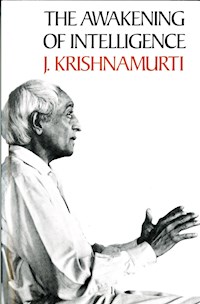
J. KRISHNAMURTI
THE AWAKENING OF INTELLIGENCE
Copyright © 2011 by: J. KrishnamurtiAll rights reserved.
ISBN: 1-9349-8925-8ISBN-13: 9781934989258eBook ISBN: 978-1-934989-30-2
QUOTATIONS
“Intelligence is not personal, is not the outcome of argument, belief, opinion or reason. Intelligence comes into being when the brain discovers its fallibility, when it discovers what it is capable of, and what it is not. Now what is the relationship of intelligence with this new dimension? . . . The different dimension can only operate through intelligence: if there is not that intelligence it cannot operate. So in daily life it can only operate where intelligence is functioning”—Part VIII, page 412.
“When (thought) sees that it is incapable of discovering something new, that very perception is the seed of intelligence, isn’t it? That is intelligence: ‘I cannot do’. I thought I could do a lot of things, and I can in a certain direction, but in a totally new direction I cannot do anything. The discovery of that is intelligence”—Part VIII, page 411.
“Thought is of time, intelligence is not of time. Intelligence is immeasurable”—Part VII, page 375.
“Intelligence comes into being when the mind, the heart and the body are really harmonious”—Part VIII, page 449.
“Is there the awakening of that intelligence? If there is . . . then it will operate, then you don’t have to say, ‘What am I to do?’ Perhaps there have been a thousand persons here during these three weeks who have listened. If they really live that, do you know what’s going to happen? We should change the world”—Part VIII, page 450.
“When there is that supreme energy, which is intelligence, is there death?”—Part VII, page 361.
EDITORS’ NOTE
FOR MANY YEARS J. Krishnamurti spoke to audiences of all sorts, as well as to individuals and to smaller groups, in America, Europe and India. This book was planned to indicate the wide range of his teaching and discussions. As the Talks were always extempore, with interchange of question and answer, the reports printed here were taken from tapes, so that the exact words and phrases were accurately recorded. They have been edited sufficiently to present a readable page, with some elimination of redundancies.
Several of the themes in these chapters are taken up in a different way in Conversations with four notable people interested in Krishnamurti’s ideas. These personal interviews are also reported from tapes recorded at the time.
A word should be said about the Dialogues and the small group Discussion in Chapter 10. The Dialogues are not discussions in the sense of debates or arguments, but are free exchanges between people with a common aim who are intent on understanding together with Krishnamurti fundamental problems. For instance, the five Dialogues at Saanen follow a series of seven Talks and continue the themes there initiated, clarifying or probing the issues further. It was at Saanen, Switzerland, for many years, that people gathered from all over the world to share some weeks with Krishnamurti.
The small group Discussion (Chapter 10) took place at Brockwood Park in Hampshire, England, where there is an educational centre and school for young people founded by Krishnamurti. This discussion was with people for the most part long connected with Krishnamurti in his work.
We are indebted to a number of helpers in the recording, transcribing and editing of this book.
George and Cornelia Wingfield Digby
CONTENTS
Title Page
Copyright Page
QUOTATIONS
EDITORS’ NOTE
AMERICA
Part ITwo Conversations: J. Krishnamurti and Professor Jacob Needleman
1THE ROLE OF THE TEACHER
2ON INNER SPACE; ON TRADITION AND DEPENDENCE
Part IIThree Talks in New York City
1INNER REVOLUTION
The need to change. A process in time or instantaneous? The conscious and the unconscious; dreams. The analytical process. To see the content of consciousness without the separation of observer and observed. Noise and resistance. “When there is complete cessation of division between the observer and the observed, then ‘what is’ is no longer what is.”QUESTIONS: Observer and observed; fragmentation; resistance.
2RELATIONSHIP
Relationship. “You are the world”. The separate self; corruption. To see what actually “is”. What love is not. “We have no passion; we have lust, we have pleasure.” To understand what death is. Love is its own eternity.QUESTIONS: The concept of good and bad; sharing; pain and fear: how to be free of the past?
3RELIGIOUS EXPERIENCE. MEDITATION
Is there a religious experience? Search for truth; the meaning of search. “What is a religious mind?”“What is the quality of mind which is no longer experiencing?” Discipline; virtue; order. Meditation is not an escape. The function of knowledge and freedom from the known. “Meditation is to find out if there is a field not already contaminated by the known.” “The first step is the last step.” QUESTIONS: The analogy of dirt; awareness; consciousness; love; psychological time.
Part IIITwo Conversations: J. Krishnamurti and Alain Naudé
1THE CIRCUS OF MAN’S STRUGGLE
2ON GOOD AND EVIL
INDIA
Part IVTwo Conversations: J. Krishnamurti and Swami Venkatesananda
1The guru and search. Four schools of Yoga scrutinised (Karma, Bhakti, Raja, Gnana Yoga).
2Four “mahavakyas” from the Upanishads discussed. Communication and the Bodhisattva ideal. Vedanta and the ending of knowledge.
Part VThree Talks in Madras
1THE ART OF SEEING
To see, not partially but totally. “The act of seeing is the only truth.” Of the vast mind only a fragment is used. The fragmentary influence of culture, tradition. “Living in a little corner of a distorted field.” “You cannot understand through a fragment.” Freedom from “the little corner”. The beauty of seeing.
2FREEDOM
To share a free mind. “If we could come upon this, it is really a mysterious flower.” Why has man not got this thing? Fear. “Living” is not living. Words taken for substance. Wastage of energy. “The mature mind has no comparison … no measure.” The validity of “the life that you lead every day . . . without understanding it you will never understand love, beauty, or death”. Through negation that thing which alone is the positive comes into being.
3THE SACRED
Ploughing, never sowing. Ideation. Sensitivity lacking in daily life. Attention and intelligence. Disorder in ourselves and the world: our responsibility. The question of seeing. Images and direct contact. The sacred. “When you have that love you can put away all your sacred books.”
Part VIFour Dialogues in Madras
1CONFLICT
Images: are we aware that we see through images? Concepts; the gap between concepts and daily living; resulting conflict. “To get illumination you must be able to look.” “To live without conflict, but not to go to sleep.”
2THE PURSUIT OF PLEASURE
Self-interest and self-dedication. Demand for satisfaction. Levels of gratification. Has psychological gratification any meaning? “A whirlpool of mischief and misery inwardly.” Aggression. Pursuit of pleasure. “There are no roots of heaven in pleasure—there are only roots of indifference and pain.” Watching is its own discipline.
3TIME, SPACE AND THE CENTRE
The ideal, the concept, and “what is”. Need to understand suffering: pain, loneliness, fear, envy. The ego-centre. The space and time of the centre. Is it possible not to have an ego-centre and yet live in this world? “We live within the prison of our own thinking.” To see the structure of the centre. To look without the centre.
4A FUNDAMENTAL QUESTION
What is clear thinking in relation to daily living? Meeting the present with the past. How to live with memory and technological knowledge and yet be free of the past? Double life: temple, office. How to live without fragmentation?—to answer from a concept is further fragmentation. Silence before the immensity of a fundamental question. “Can you live so completely that there is only the active present now?”
EUROPE
Part VIISeven Talks in Saanen, Switzerland
1WHAT IS YOUR OVER-RIDING INTEREST?
Passion and intensity needed. The inner and outer: can they be divided?QUESTIONS: Pleasure and interest; God; children and education; many different interests; the meaning of demonstrations; of love, truth and order.
2ORDER
The mind only knows disorder. The state of “not-knowing”. The “self” is part of the culture, which is disorder.QUESTIONS: Is the mind capable of looking? Analysis; the guru: relationship with Krishnamurti; can you look at yourself?
3CAN WE UNDERSTAND OURSELVES?
The problem of self-knowledge is the problem of looking. To look without fragmentation, without the “me”. Analysis, dreams and sleep. The problem of the “observer” and of time. “When you look at yourself without the eyes of time, who is there to look?”QUESTIONS: Are some images necessary? Is evaluation vitiated by our state of confusion? Conflict.
4LONELINESS
Preoccupation with oneself. Relationship. Action in relationship and daily life. Images isolate: the understanding of image-building. “Self-concern is my major image.” Relationship without conflict means love.QUESTIONS: Can the self have unmotivated passion? Images; drugs and stimulants.
5THOUGHT AND THE IMMEASURABLE
Can thought solve our problems? The function of thought. The field of thought and its projections. Can the mind enter into the immeasurable? What is the factor of illusion? Physical and mental fear and escapes. The mind that is constantly learning.QUESTIONS: Can one observe without judgment and evaluation? Is perception seeing something totally? Can words be used to describe a non-verbal state?
6THE ACTION OF WILL AND THE ENERGY NEEDED FOR RADICAL CHANGE
Great energy needed; its wastage. Will is resistance. Will as assertion of the “me”. Is there action without choice, which is not motivated? “To look with eyes that are not conditioned.” Choiceless awareness of conditioning. To see and reject the falseness. What love is not. To face the question of death. “The ending of energy as the ‘me’ is the capacity to look at death.” Energy to look at the unknown: supreme energy is intelligence.QUESTIONS: We understand intellectually, but can’t live it; is a man capable? How to listen? Are not feelings and emotions the cause of violence?
7THOUGHT, INTELLIGENCE, AND THE IMMEASURABLE
Different meanings of space. The space we think and act from; the space that thought has built. How is one to have immeasurable space? “To carry our burden and yet to seek freedom.” Thought which does not divide itself is moving in experiencing. The meaning of intelligence. Harmony: mind, heart and organism. “Thought is of time, intelligence is not of time.” Intelligence and the immeasurable.QUESTIONS: Hatha Yoga. Is there separation of observer and observed in technological work? Awareness and sleep.
Part VIIIFive Dialogues in Saanen
1THE FRAGMENTATION OF CONSCIOUSNESS
Are we aware that we look at life fragmentarily? The conditioning of consciousness. Do we really know its content? Is there a division into conscious and unconscious? The observer is part of the content of consciousness. Is there any agent outside this conditioned content? “Tricks I play upon myself.” What is action? Since the self is fragmented, “I” cannot see life as a totality.
2IS INTELLIGENCE AWAKE?
What is the relationship between intelligence and thought? The limitations of conditioned thinking. No new movement can take place if the “old brain” is constantly in operation. “I have been going South, thinking I was going North.” The perception of the limitations of the old is the seed of intelligence. Is the “new” recognisable? The different dimension can only operate through intelligence.
3FEAR
The link between pleasure and fear; the role of thought. Thought cannot reduce the uncertain unknown to terms of knowledge. Need to see the structure of fear. Psychologically, tomorrow may not exist. What does, “To live wholly in the present” imply?
4FEAR, TIME AND THE IMAGE
Chronological and psychological time. The dilemma of knowledge. The dilemma of thought and the image. Can one find the root of fear? “The mind that can never be hurt.”
5INTELLIGENCE AND THE RELIGIOUS LIFE
What is a religious life? Relationship between meditation and the quiet mind. Thought as measure; the action of measurement. How can the immeasurable be understood? Intelligence as the relationship between the measurable and the immeasurable. The awakening of intelligence. Choiceless awareness. Learning, not accumulating knowledge.
ENGLAND
Part IXTwo Talks at Brockwood
1THE RELATIONSHIP TO AWARENESS OF THOUGHT AND THE IMAGE
The uses and limitations of thought. Images: the authority of the image. “The more sensitive one is, the greater the burden of images.” Analysis and images. Psychological order; causes of disorder: opinion, comparison, images. Possible dissolution of images. Formation of images. Attention and inattention. “It is only when the mind is inattentive that the image is formed.” Attention and harmony: mind, heart, body.
2THE MEDITATIVE MIND AND THE IMPOSSIBLE QUESTION
“Meditation is the total release of energy.” Western world built on measurement, which is maya for the East. Schools of meditation useless. Energy depends on self-knowledge. Problem of self-observation. To look “without the eyes of the past”. Naming. The hidden in oneself. Drugs. The hidden content and the impossible question. “Meditation is a way of putting aside altogether everything that man has conceived of himself and the world.” A radical revolution in one affects the whole world. What takes place when the mind is quiet? “Meditation is . . . seeing the measure and going beyond the measure.” Harmony and a “totally different life”.QUESTIONS: Intuition; awareness; awareness and sleep; teacher and disciple.
Part XA Discussion with a small group at Brockwood
VIOLENCE AND THE “ME”
Does change imply violence? To what extent do we reject violence? Violence and energy: observing violence. What is the root of violence? Understanding the “me”; the “me” that wants to change is violent. Does the “me” or intelligence see? The implications of seeing.
Part XIConversation: J. Krishnamurti and Professor David Bohm
ON INTELLIGENCE
Thought is of the order of time; intelligence is of a different order, different quality. Is intelligence related to thought? Brain the instrument of intelligence; thought as a pointer. Thought, not intelligence, dominates the world.Problem of thought and the awakening of intelligence. Intelligence operating in a limited framework can serve highly unintelligent purposes.Matter, thought, intelligence have a common source, are one energy; why did it divide? Security and survival: thought cannot consider death properly.“Can the mind keep the purity of the original source?” Problem of the quietening of thought. Insight, the perception of the whole, is necessary. Communication without the interference of the conscious mind.
AMERICA
I
Two Conversations:J. Krishnamurti and Professor Jacob Needleman
1The role of the teacher
2On inner space; on tradition and dependence
1
THE ROLE OF THE TEACHER
Conversation between J. Krishnamurtiand Professor J. Needleman
Needleman:1 There is much talk of a spiritual revolution among young people, particularly here in California. Do you see in this very mixed phenomenon any hope of a new flowering for modern civilisation, a new possibility of growth?
KRISHNAMURTI: For a new possibility of growth, don’t you think, Sir, that one has to be rather serious, and not merely jump from one spectacular amusement to another? If one has looked at all the religions of the world and seen their organised futility, and out of that perception seen something real and clear, perhaps then there could be something new in California, or in the world. But as far as I have seen, I am afraid there is not a quality of seriousness in all this. I may be mistaken, because I see only these so-called young people in the distance, among the audience, and occasionally here; and by their questions, by their laughter, by their applause, they don’t strike me as being very serious, mature, with great intent. I may be mistaken, naturally.
Needleman: I understand what you are saying. My question only is: perhaps we can’t very well expect young people to be serious.
KRISHNAMURTI: That is why I don’t think it is applicable to the young people. I don’t know why one has made such an extraordinary thing out of young people, why it has become such an important thing. In a few years they will be the old people in their turn.
Needleman: As a phenomenon, apart from what is underneath it all, this interest in transcending experience—or whatever one wants to call it—seems to be a kind of seed-ground from which certain unusual people aside from all the phoneyness and all the deceivers, certain Masters perhaps, may spring up.
KRISHNAMURTI: But I am not sure, Sir, that all the deceivers and exploiters are not covering this up. “Krishna-consciousness” and Transcendental Meditation and all this nonsense that is going on—they are caught in all that. It is a form of exhibitionism, a form of amusement and entertainment. For something new to take place there must be a nucleus of really devoted, serious people, who go through to the very end. After going through all these things, they say, “Here is something I am going to pursue to the end.”
Needleman: A serious person would be someone who would have to become disillusioned with everything else.
KRISHNAMURTI: I would not call it disillusioned but a form of seriousness.
Needleman: But a pre-condition for it?
KRISHNAMURTI: No, I wouldn’t call it disillusionment at all, that leads to despair and cynicism. I mean the examination of all the things that are so-called religious, so-called spiritual: to examine, to find out what is the truth in all this, whether there is any truth in it. Or to discard the whole thing and start anew, and not go through all the trappings, all the mess of it.
Needleman: I think that is what I tried to say, but this expresses it better. People who have tried something and it has failed for them.
KRISHNAMURTI: Not “other people”. I mean one has to discard all the promises, all the experiences, all the mystical assertions. I think one has to start as though one knew absolutely nothing.
Needleman: That is very hard.
KRISHNAMURTI: No, Sir, I don’t think that is hard. I think it is hard only for those people who have filled themselves with other people’s knowledge.
Needleman: Isn’t that most of us? I was speaking to my class yesterday at San Francisco State, and I said I was going to interview Krishnamurti and what question would you like me to ask him. They had many questions, but the one that touched me most was what one young man said: “I have read his books over and over again and I can’t do what he says.” There was something so clear about that, it rang a bell. It seems in a certain subtle sense to begin in this way. To be a beginner, fresh!
KRISHNAMURTI: I don’t think that we question enough. Do you know what I mean?
Needleman: Yes.
KRISHNAMURTI: We accept, we are gullible, we are greedy for new experiences. People swallow what is said by anybody with a beard, with promises, saying you will have a marvellous experience if you do certain things! I think one has to say: “I know nothing.” Obviously I can’t rely on others. If there were no books, no gurus, what would you do?
Needleman: But one is so easily deceived.
KRISHNAMURTI: You are deceived when you want something.
Needleman: Yes, I understand that.
KRISHNAMURTI: So you say, “I am going to find out, I am going to enquire step by step. I don’t want to deceive myself.” Deception arises when I want, when I am greedy, when I say, “All experience is shallow, I want something mysterious”—then I am caught.
Needleman: To me you are speaking about a state, an attitude, an approach, which is itself very far along in understanding for a man. I feel very far from that myself, and I know my students do. And so they feel, rightly or wrongly, a need for help. They probably misunderstand what help is, but is there such a thing as help?
KRISHNAMURTI: Would you say: “Why do you ask for help?”
Needleman: Let me put it like this. You sort of smell yourself deceiving yourself, you don’t exactly know . . .
KRISHNAMURTI: It is fairly simple. I don’t want to deceive myself—right? So I find out what is the movement, what is the thing that brings deception. Obviously it is when I am greedy, when I want something, when I am dissatisfied. So instead of attacking greed, want, dissatisfaction, I want something more.
Needleman: Yes.
KRISHNAMURTI: So I have to understand my greed. What am I greedy for? Is it because I am fed up with this world, I have had women, I have had cars, I have had money and I want something more?
Needleman: I think one is greedy because one desires stimulation, to be taken out of oneself, so that one doesn’t see the poverty of oneself. But what I am trying to ask—I know you have answered this question many times in your talks, but it keeps recurring, almost unavoidably—the great traditions of the world, aside from what has become of them (they have become distorted and misinterpreted and deceptive) always speak directly or indirectly of help. They say “The guru is yourself too”, but at the same time there is help.
KRISHNAMURTI: Sir, you know what that word “guru” means?
Needleman: No, not exactly.
KRISHNAMURTI: The one who points. That is one meaning. Another meaning is the one who brings enlightenment, lifts your burden. But instead of lifting your burden they impose their burden on you.
Needleman: I am afraid so.
KRISHNAMURTI: Guru also means one who helps you to cross over—and so on, there are various meanings. The moment the guru says he knows, then you may be sure he doesn’t know. Because what he knows is something past, obviously. Knowledge is the past. And when he says he knows, he is thinking of some experience which he has had, which he has been able to recognise as something great, and that recognition is born out of his previous knowledge, otherwise he couldn’t recognise it, and therefore his experience has its roots in the past. Therefore it is not real.
Needleman: Well, I think that most knowledge is that.
KRISHNAMURTI: So why do we want any form of ancient or modern tradition in all this? Look, Sir, I don’t read any religious, philosophical, psychological books: one can go into oneself at tremendous depths and find out everything. To go into oneself is the problem, how to do it. Not being able to do it one asks, “Would you please help me?”
Needleman: Yes.
KRISHNAMURTI: And the other fellow says, “I’ll help you” and pushes you off somewhere else.
Needleman: Well, it sort of answers the question. I was reading a book the other day which spoke of something called “Sat-san”.
KRISHNAMURTI: Do you know what it means?
Needleman: Association with the wise.
KRISHNAMURTI: No, with good people.
Needleman: With good people, Ah!
KRISHNAMURTI: Being good you are wise. Not, being wise you are good.
Needleman: I understand that.
KRISHNAMURTI: Because you are good, you are wise.
Needleman: I am not trying to pin this down to something, but I find my students and I myself, speaking for myself, when we read, when we hear you, we say, “Ah! I need no one, I need to be with no one”—and there is a tremendous deception in this too.
KRISHNAMURTI: Naturally, because you are being influenced by the speaker.
Needleman: Yes. That is true. (Laughter.)
KRISHNAMURTI: Sir, look, let’s be very simple. Suppose, if there were no book, no guru, no teacher, what would you do? One is in turmoil, confusion, agony, what would you do? With nobody to help you, no drugs, no tranquillisers, no organised religions, what would you do?
Needleman: I can’t imagine what I would do.
KRISHNAMURTI: That’s it.
Needleman: Perhaps there would be a moment of urgency there.
KRISHNAMURTI: That’s it. We haven’t the urgency because we say, “Well, somebody is going to help me.”
Needleman: But most people would be driven insane by that situation.
KRISHNAMURTI: I am not sure, Sir.
Needleman: I’m not sure either.
KRISHNAMURTI: No, I am not at all sure. Because what have we done up to now? The people on whom we have relied, the religions, the churches, education, they have led us to this awful mess. We aren’t free of sorrow, we aren’t free of our beastliness, our ugliness, our vanities.
Needleman: Can one say that of all of them? There are differences. For every thousand deceivers there is one Buddha.
KRISHNAMURTI: But that is not my concern, Sir, if we say that it leads to such deception. No, no.
Needleman: Then let me ask you this. We know that without hard work the body may get ill, and this hard work is what we call effort. Is there another effort for what we might call the spirit? You speak against effort, but does not the growth and well-being of all sides of man demand something like hard work of one sort or another?
KRISHNAMURTI: I wonder what you mean by hard work? Physical hard work?
Needleman: That is what we usually mean by hard work. Or going against desires.
KRISHNAMURTI: You see, there we are! Our conditioning, our culture, is built around this “going against”. Erecting a wall of resistance. So when we say “hard work”, what do we mean? Laziness? Why have I to make an effort about anything? Why?
Needleman: Because I wish for something.
KRISHNAMURTI: No. Why is there this cult of effort? Why have I to make effort to reach God, enlightenment, truth?
Needleman: There are many possible answers, but I can only answer for myself.
KRISHNAMURTI: It may be just there, only I don’t know how to look.
Needleman: But then there must be an obstacle.
KRISHNAMURTI: How to look! It may be just round the corner, under the flower, it may be anywhere. So first I have to learn to look, not make an effort to look. I must find out what it means to look.
Needleman: Yes, but don’t you admit that there may be a resistance to that looking?
KRISHNAMURTI: Then don’t bother to look! If somebody comes along and says, “I don’t want to look”, how are you going to force him to look?
Needleman: No. I am speaking about myself now. I want to look.
KRISHNAMURTI: If you want to look, what do you mean by looking? You must find out what it means to look before you make an effort to look. Right, Sir?
Needleman: That would be, to me, an effort.
KRISHNAMURTI: No.
Needleman: To do it in that delicate, subtle way. I wish to look, but I don’t wish to find out what it means to look. I agree this is much more to me the basic thing. But this wish to do it quickly, to get it over, is this not resistance?
KRISHNAMURTI: Quick medicine to get it over.
Needleman: Is there something in me that I have to study, that resists this subtle, much more delicate thing you are speaking about? Is this not work, what you are saying? Isn’t it work to ask the question so quietly, so subtly? It seems to me it is work to not listen to that part that wants to do it . . .
KRISHNAMURTI: Quickly.
Needleman: For us particularly in the West, or maybe for all men.
KRISHNAMURTI: I am afraid it is all over the world the same. “Tell me how to get there quickly.”
Needleman: And yet you say it is in a moment.
KRISHNAMURTI: It is, obviously.
Needleman: Yes, I understand.
KRISHNAMURTI: Sir, what is effort? To get out of bed in the morning, when you don’t want to get up, is an effort. What brings on that laziness? Lack of sleep, over-eating, over-indulging and all the rest of it; and next morning you say, “Oh, what a bore, I have to get up!” Now wait a minute, Sir, follow it. What is laziness? Is it physical laziness, or is thought itself lazy?
Needleman: That I don’t understand. I need another word. “Thought is lazy?” I find that thought is always the same.
KRISHNAMURTI: No Sir. I am lazy, I don’t want to get up and so I force myself to get up. In that is so-called effort.
Needleman: Yes.
KRISHNAMURTI: I want that, but I shouldn’t have it, I resist it. The resistance is effort. I get angry and I mustn’t be angry: resistance, effort. What has made me lazy?
Needleman: The thought that I ought to be getting up.
KRISHNAMURTI: That’s it.
Needleman: All right.
KRISHNAMURTI: So I really have to go into this whole question of thought. Not make out that the body is lazy, force the body out of bed, because the body has its own intelligence, it knows when it is tired and should rest. This morning I was tired; I had prepared the mat and everything to do yoga exercises and the body said “No, sorry”. And I said, “All right”. That is not laziness. The body said, “Leave me alone because you talked yesterday, you saw many people, you are tired.” Thought then says, “You must get up and do the exercises because it is good for you, you have done it every day, it has become a habit, don’t relax, you will get lazy, keep at it.” Which means: thought is making me lazy, not the body is making me lazy.
Needleman: I understand that. So there is an effort with regard to thought.
KRISHNAMURTI: So no effort! Why is thought so mechanical? And is all thought mechanical?
Needleman: Yes, all right, one puts that question.
KRISHNAMURTI: Isn’t it?
Needleman: I can’t say that I have verified that.
KRISHNAMURTI: But we can, Sir. That is fairly simple to see. Isn’t all thought mechanical? The non-mechanical state is the absence of thought; not the neglect of thought but the absence of it.
Needleman: How can I find that out?
KRISHNAMURTI: Do it now, it is simple enough. You can do it now if you wish to. Thought is mechanical.
Needleman: Let’s assume that.
KRISHNAMURTI: Not assume. Don’t assume anything.
Needleman: All right.
KRISHNAMURTI: Thought is mechanical, isn’t it?—because it is repetitive, conforming, comparing.
Needleman: That part I see, the comparing. But my experience is that not all thought is of the same quality. There are qualities of thought.
KRISHNAMURTI: Are there?
Needleman: In my experience there are.
KRISHNAMURTI: Let’s find out. What is thought, thinking?
Needleman: There seems to be thought that is very shallow, very repetitive, very mechanical, it has a certain taste to it. There seems to be another kind of thought which is connected more with my body, with my whole self, it resonates in another way.
KRISHNAMURTI: That is what, Sir? Thought is the response of memory.
Needleman: All right, this is a definition.
KRISHNAMURTI: No, no, I can see it in myself. I have to go to that house this evening—the memory, the distance, the design—all that is memory, isn’t it?
Needleman: Yes, that is memory.
KRISHNAMURTI: I have been there before and so the memory is well established and from that there is either instant thought, or thought which takes a little time. So I am asking myself: is all thought similar, mechanical, or is there thought which is non-mechanical, which is non-verbal?
Needleman: Yes, that’s right.
KRISHNAMURTI: Is there thought if there is no word?
Needleman: There is understanding.
KRISHNAMURTI: Wait, Sir. How does this understanding take place? Does it happen when thought is functioning rapidly, or when thought is quiet?
Needleman: When thought is quiet, yes.
KRISHNAMURTI: Understanding is nothing to do with thought. You may reason, which is the process of thinking, logic, till you say, “I don’t understand it”; then you become silent, and you say, “Ah! I see it, I understand it.” That understanding is not a result of thought.
Needleman: You speak of an energy which seems to be uncaused. We experience the energy of cause and effect, which shapes our lives, but what is this other energy’s relationship to the energy we are familiar with? What is energy?
KRISHNAMURTI: First of all: is energy divisible?
Needleman: I don’t know. Go on.
KRISHNAMURTI: It can be divided. Physical energy, the energy of anger and so on, cosmic energy, human energy, it can all be divided. But it is all one energy, isn’t it?
Needleman: Logically, I say yes. I don’t understand energy. Sometimes I experience the thing which I call energy.
KRISHNAMURTI: Why do we divide energy at all, that is what I want to get at; then we can come to it differently. Sexual energy, physical energy, mental energy, psychological energy, cosmic energy, the energy of the businessman who goes to the office and so on—why do we divide it? What is the reason for this division?
Needleman: There seem to be many parts of oneself which are separate; and we divide life, it seems to me, because of that.
KRISHNAMURTI: Why? We have divided the world into Communist, Socialist, Imperialist, and Catholic, Protestant, Hindu, Buddhist, and nationalities, linguistic divisions, the whole thing is fragmentation. Why has the mind fragmented the whole of life?
Needleman: I don’t know the answer. I see the ocean and I see a tree: there is a division.
KRISHNAMURTI: No. There is a difference between the sea and the tree—I hope so! But that is not a division.
Needleman: No. It is a difference, not a division.
KRISHNAMURTI: But we are asking why the division exists, not only outwardly but in us.
Needleman: It is in us, that is the most interesting question.
KRISHNAMURTI: Because it is in us we extend it outwards. Now why is there this division in me? The “me” and the “not me”. You follow? The higher and the lower, the Atman and the lower self. Why this division?
Needleman: Maybe it was done, at least in the beginning, to help men to question themselves. To make them question whether they really know what they think they know.
KRISHNAMURTI: Through division will they find out?
Needleman: Maybe through the idea that there is something that I don’t understand.
KRISHNAMURTI: In a human being there is a division—why? What is the “raison d’être”, what is the structure of this division? I see there is a thinker and thought—right?
Needleman: I don’t see that.
KRISHNAMURTI: There is a thinker who says, “I must control that thought, I must not think this, I must think that”. So there is a thinker who says, “I must”, or “I must not”.
Needleman: Right.
KRISHNAMURTI: There is the division. “I should be this”, and “I should not be that”. If I can understand why this division in me exists—Oh look, look! Look at those hills! Marvellous, isn’t it?
Needleman: Beautiful!
KRISHNAMURTI: Now, Sir, do you look at it with a division?
Needleman: No.
KRISHNAMURTI: Why not?
Needleman: There wasn’t the “me” to do anything with it.
KRISHNAMURTI: That’s all. You can’t do anything about it. Here, with thought, I think I can do something.
Needleman: Yes.
KRISHNAMURTI: So I want to change “what is”. I can’t change “what is” there, but I think I can change “what is” in me. Not knowing how to change it I have become desperate, lost, in despair. I say, “I can’t change”, and therefore I have no energy to change.
Needleman: That’s what one says.
KRISHNAMURTI: So first, before I change “what is”, I must know who is the changer, who it is that changes.
Needleman: There are moments when one knows that, for a moment. Those moments are lost. There are moments when one knows who sees “what is” in oneself.
KRISHNAMURTI: No Sir. Sorry. Just to see “what is” is enough, not to change it.
Needleman: I agree. I agree with that.
KRISHNAMURTI: I can see “what is” only when the observer is not. When you looked at those hills the observer was not.
Needleman: I agree, yes.
KRISHNAMURTI: The observer only came into being when you wanted to change “what is”. You say: I don’t like “what is”, it must be changed, so there is instantly a duality. Can the mind observe “what is” without the observer? It took place when you looked at those hills with that marvellous light on them.
Needleman: This truth is absolute truth. The moment one experiences it one says, “Yes!” But one’s experience is also that one forgets this.
KRISHNAMURTI: Forget!
Needleman: By that I mean one continually tries to change it.
KRISHNAMURTI: Forget it, and pick it up again.
Needleman: But in this discussion—whatever you intend—there is help coming from this discussion. I know, as much as I know anything, it could not happen without the help that is between us. I could look at those hills and maybe have this non-judging, but it wouldn’t be important to me; I wouldn’t know that that is the way I must look for salvation. And this, I think, is a question one always wants to bring. Maybe this is the mind again wanting to grab and hold on to something, but nevertheless it seems that the human condition . . .
KRISHNAMURTI: Sir, we looked at those hills, you couldn’t change that, you just looked; and you looked inwardly and the battle began. For a moment you looked without that battle, without that strife, and all the rest of it. Then you remembered the beauty of that moment, of that second, and you wanted to capture that beauty again. Wait Sir! Proceed. So what happens? It sets up another conflict: the thing you had and you would like to have again, and you don’t know how to get it again. You know, if you think about it, it is not the same, it is not that. So you strive, battle. “I must control, I mustn’t want”—right? Whereas if you say, “All right, it is over, finished”, that moment is over.
Needleman: I have to learn that.
KRISHNAMURTI: No, no.
Needleman: I have to learn, don’t I?
KRISHNAMURTI: What is there to learn?
Needleman: I have to learn the futility of this conflict.
KRISHNAMURTI: No. What is there to learn? You yourself see that that moment of beauty becomes a memory, then the memory says, “It was so beautiful I must have it again.” You are not concerned with beauty, you are concerned with the pursuit of pleasure. Pleasure and beauty don’t go together. So if you see that, it is finished. Like a dangerous snake, you won’t go near it again.
Needleman: (Laughs) Perhaps I haven’t seen it, so I can’t say.
KRISHNAMURTI: That is the question.
Needleman: Yes, I think that must be so, because one keeps going back again and again.
KRISHNAMURTI: No. This is the real thing. If I see the beauty of that light, and it is really extraordinarily beautiful, I just see it. Now with that same quality of attention I want to see myself. There is a moment of perception which is as beautiful as that. Then what happens?
Needleman: Then I wish for it.
KRISHNAMURTI: Then I want to capture it, I want to cultivate it, I want to pursue it.
Needleman: And how to see that?
KRISHNAMURTI: Just to see that is taking place is enough.
Needleman: That’s what I forget!
KRISHNAMURTI: It is not a question of forgetting.
Needleman: Well, that is what I don’t understand deeply enough. That just the seeing is enough.
KRISHNAMURTI: Look, Sir. When you see a snake what takes place?
Needleman: I am afraid.
KRISHNAMURTI: No. What takes place? You run, kill it, do something. Why? Because you know it is dangerous. You are aware of the danger of it. A cliff, better take a cliff, an abyss. You know the danger of it. Nobody has to tell you. You see directly what would happen.
Needleman: Right.
KRISHNAMURTI: Now, if you see directly that the beauty of that moment of perception cannot be repeated, it is over. But thought says, “No, it’s not over, the memory of it remains.” So what are you doing now? You are pursuing the dead memory of it, not the living beauty of it—right? Now if you see that, the truth of it—not the verbal statement, the truth of it—it is finished.
Needleman: Then this seeing is much rarer than we think.
KRISHNAMURTI: If I see the beauty of that minute, it is over. I don’t want to pursue it. If I pursue it, it becomes a pleasure. Then if I can’t get it, it brings despair, pain and all the rest of it. So I say, “All right, finished.” Then what takes place?
Needleman: From my experience, I’m afraid that what takes place is that the monster is born again. It has a thousand lives. (Laughter.)
KRISHNAMURTI: No Sir. When did that beauty take place?
Needleman: The place when I saw without trying to change.
KRISHNAMURTI: When the mind was completely quiet.
Needleman: Yes.
KRISHNAMURTI: Wasn’t it? Right?
Needleman: Yes.
KRISHNAMURTI: When you looked at that, your mind was quiet, it didn’t say, “I wish I could change it, copy it and photograph it, this, that, and the other”—you just looked. The mind wasn’t in operation. Or rather, thought wasn’t in operation. But thought comes immediately into operation. Now one has asked, “How can thought be quiet? How can one exercise thought when necessary, and not exercise it when it is not necessary?”
Needleman: Yes, that question is intensely interesting to me, Sir.
KRISHNAMURTI: That is, why do we worship thought? Why has thought become so extraordinarily important?
Needleman: It seems able to satisfy our desires; through thought we believe we can satisfy.
KRISHNAMURTI: No, not from satisfaction. Why has thought in all cultures with most people become of such vital concern?
Needleman: One usually identifies oneself as thought, as one’s thoughts. If I think about myself I think about what I think, what kind of ideas I have, what I believe. Is this what you mean?
KRISHNAMURTI: Not quite. Apart from identification with the “me”, or with “not me”, why is thought always active?
Needleman: Ah, I see.
KRISHNAMURTI: Thought is always operating in knowledge, isn’t it? If there was no knowledge, thought would not be. Thought is always operating in the field of the known. Whether mechanical, non-verbal and so on, it is always working in the past. So my life is the past, because it is based on past knowledge, past experience, past memories, pleasure, pain, fear and so on—it is all the past. And the future I project from the past, thought projects from the past. So thought is fluctuating between the past and the future. All the time it says, “I should do this, I should not do that, I should have behaved.” Why is it doing all this?
Needleman: I don’t know. Habit?
KRISHNAMURTI: Habit. All right. Go on. Let’s find out. Habit?
Needleman: Habit brings what I call pleasure.
KRISHNAMURTI: Habit, pleasure, pain.
Needleman: To protect me. Pain, yes pain.
KRISHNAMURTI: It is always working within that field. Why?
Needleman: Because it doesn’t know any better.
KRISHNAMURTI: No. No. Can thought work in any other field?
Needleman: That sort of thought, no.
KRISHNAMURTI: No, not any thought. Can thought work in any other field except in the field of the known?
Needleman: No.
KRISHNAMURTI: Obviously not. It can’t work in something I don’t know; it can only work in this field. Now why does it work in this? There it is, Sir—why? It is the only thing I know. In that there is security, there is protection, there is safety. That is all I know. So thought can only function in the field of the known. And when it gets tired of that, as it does, then it seeks something outside. Then what it seeks is still the known. Its gods, its visions, its spiritual states—all projected out of the known past into the future known. So thought always works in this field.
Needleman: Yes, I see.
KRISHNAMURTI: Therefore thought is always working in a prison. It can call it freedom, it can call it beauty, it can call it what is likes! But it is always within the limitations of the barbed-wire fence. Now I want to find out whether thought has any place except in there. Thought has no place when I say, “I don’t know.” “I really don’t know.” Right?
Needleman: For the moment.
KRISHNAMURTI: I really don’t know. I only know this, and I really don’t know whether thought can function in any field at all, except this. I really don’t know. When I say, “I don’t know”, which doesn’t mean I am expecting to know, when I say I really don’t know—what happens? I climb down the ladder. I become, the mind becomes, completely humble.
Now that state of “not knowing” is intelligence. Then it can operate in the field of the known and be free to work somewhere else if it wants to.
MALIBU, CALIFORNIA26 MARCH 1971
__________________
1 Jacob Needleman is Professor of philosophy at San Francisco State College; author of The New Religions, and editor of the Penguin Metaphysical Library.
2
ON INNER SPACE; ON TRADITIONAND DEPENDENCE
Conversation between J. Krishnamurtiand Professor J. Needleman
Needleman: In your talks you have given a fresh meaning to the necessity for man to become his own authority. Yet cannot this assertion easily be turned into a form of humanistic psychology without reference to the sacred, transcendent dimension of human life on earth in the midst of a vast intelligent Cosmos? Must we not only try to see ourselves in the moment, but also as creatures of the Cosmos? What I am trying to ask about is this question of cosmic dimension.
KRISHNAMURTI: As soon as we use that word “dimension”, it implies space, otherwise there is no dimension, there is no space. Are we talking about space, outward space, endless space?
Needleman: No.
KRISHNAMURTI: Or the dimension of space in us?
Needleman: It would have to be the latter, but not totally without the former, I think.
KRISHNAMURTI: Is there a difference between the outer space, which is limitless, and the space in us? Or is there no space in us at all and we only know the outer space? We know the space in us as a centre and circumference. The dimension of that centre, and the radius from that centre, is what we generally call that space.
Needleman: Inner space, yes.
KRISHNAMURTI: Yes, inner space. Now if there is a centre, the space must always be limited and therefore we divide the inner space from the outer space.
Needleman: Yes.
KRISHNAMURTI: We only know this very limited space but we think we would like to reach the other space, have immense space. This house exists in space, otherwise there could be no house, and the four walls of this room make its space. And the space in me is the space which the centre has created round itself. Like that microphone . . .
Needleman: Yes, centre of interest.
KRISHNAMURTI: Not only centre of interest, it has its own space, otherwise it couldn’t exist.
Needleman: Yes, right.
KRISHNAMURTI: In the same way, human beings may have a centre and from that centre they create a space, the centre creates a space round itself. And that space is always limited, it must be; because of the centre, the space is limited.
Needleman: It is defined, it is a defined space, yes.
KRISHNAMURTI: When you use the words “cosmic space” . . .
Needleman: I didn’t use the words “cosmic space”; I said cosmic, the dimension of the Cosmos. I wasn’t asking about outer space and trips to the planets.
KRISHNAMURTI: So we are talking of the space which the centre creates round itself, and also a space between two thoughts; there is a space, an interval between two thoughts.
Needleman: Yes.
KRISHNAMURTI: And the centre having created that space round itself, there is the space outside the limit. There is a space between thinking, between thoughts; and also a space round the centre itself, and the space beyond the barbed-wire. Now what is the question, Sir? How to expand space? How to enter a different dimension of space?
Needleman: Not how to but . . .
KRISHNAMURTI: . . . not how to. Is there a different dimension of space except the space round the centre?
Needleman: Or a different dimension of reality?
KRISHNAMURTI: Space, we are talking about that for the moment, we can use that word. First I must see very clearly the space between two thoughts.
Needleman: The interval.
KRISHNAMURTI: This interval between two thoughts. Interval means space. And what takes place in this interval?
Needleman: Well, I confess I don’t know because my thoughts overlap all the time. I know there are intervals, there are moments when this interval appears, and I see it, and there is freedom there for a moment.
KRISHNAMURTI: Let’s go into this a bit, shall we? There is space between two thoughts. And there is space which the centre creates round itself, which is the space of isolation.
Needleman: All right, yes. That is a cold word.
KRISHNAMURTI: It is cutting itself off. I consider myself important, with my ambition, with my frustrations, with my anger, with my sexuality, my growth, my meditation, my reaching Nirvana.
Needleman: Yes, that is isolation.
KRISHNAMURTI: It is isolation. My relation with you is the image of that isolation, which is that space. Then having created that space there is space outside the barbed-wire. Now is there a space of a totally different dimension? That is the question.
Needleman: Yes, that embraces the question.
KRISHNAMURTI: How shall we find out if the space round me, round the centre, exists? And how can I find out the other? I can speculate about the other, I can invent any space I like—but that is too abstract, too silly!
Needleman: Yes.
KRISHNAMURTI: So is it possible to be free of the centre, so that the centre doesn’t create space round itself, build a wall round itself, isolation, a prison—and call that space? Can that centre cease to be? Otherwise I can’t go beyond it; the mind cannot go beyond that limitation.
Needleman: Yes, I see what you mean. It’s logical, reasonable.
KRISHNAMURTI: That is, what is that centre? That centre is the “me” and “non-me”, that centre is the observer, the thinker, the experiencer, and in that centre is also the observed. The centre says, “That is the barbed-wire I have created round myself.”
Needleman: So that centre is limited there too.
KRISHNAMURTI: Yes. Therefore it separates itself from the barbed-wire fence. So that becomes the observed. The centre is the observer. So there is space between the observer and the observed—right Sir?
Needleman: Yes, I see that.
KRISHNAMURTI: And that space it tries to bridge over. That is what we are doing.
Needleman: It tries to bridge it over.
KRISHNAMURTI: It says, “This must be changed, that must not be, this is narrow, that is wide, I must be better than that.” All that is the movement in the space between the observer and the observed.
Needleman: I follow that, yes.
KRISHNAMURTI: And hence there is conflict between the observer and the observed. Because the observed is the barbed-wire which must be jumped over, and so the battle begins. Now can the observer—who is the centre, who is the thinker, who is the knower, who is experience, who is knowledge—can that centre be still?
Needleman: Why should it wish to?
KRISHNAMURTI: If it is not still, the space is always limited.
Needleman: But the centre, the observer, doesn’t know that it is limited in this way.
KRISHNAMURTI: But you can see it, look. The centre is the observer, let’s call him the observer for the moment—the thinker, the experiencer, the knower, the struggler, the searcher, the one who says, “I know, and you don’t know.” Right? Where there is a centre it must have a space round itself.
Needleman: Yes, I follow.
KRISHNAMURTI: And when it observes, it observes through that space. When I observe those mountains there is space between me and the mountains. And when I observe myself there is space between me and the thing I observe in myself. When I observe my wife, I observe her from the centre of my image about her, and she observes me with the image which she has about me. So there is always this division and space.
Needleman: Changing the approach to the subject entirely, there is something called the sacred. Sacred teachings, sacred ideas, the sacred, which for a moment seems to show me that this centre and this space you speak about is an illusion.
KRISHNAMURTI: Wait. One has learnt this from somebody else. Are we going to find out what is the sacred, then? Are we looking because somebody has told me, “That is sacred”, or that there is a sacred thing? Or is it my imagination, because I want something holy?
Needleman: Very often it is that but there is . . .
KRISHNAMURTI: Now which is it? The desire for something holy? The imposition on my mind by others who have said, “This is sacred?” Or my own desire, because everything is unholy and I want something holy, sacred? All this springs from the centre.
Needleman: Yes. Nevertheless . . .
KRISHNAMURTI: Wait. We will find this out, what is sacred. But I don’t want to accept tradition, or what somebody has said about the sacred. Sir, I don’t know if you have experimented? Some years ago, for fun, I took a piece of rock from the garden and put it on the mantelpiece and played with it, brought flowers to it every day. At the end of a month it became terribly sacred!
Needleman: I know what you mean.
KRISHNAMURTI: I don’t want that kind of phoney sacredness.
Needleman: It’s a fetish.
KRISHNAMURTI: Sacredness is a fetish.
Needleman: Granted. Most of it is.
KRISHNAMURTI: So I won’t accept anything that anybody says about what is sacred. Tradition! As a Brahmin one was brought up in a tradition which would beat anybody’s tradition, I assure you!
What I am saying is: I want to find out what is holy, not man-made holiness. I can only find out when the mind has immense space. And it cannot have that immense space if there is a centre. When the centre is not in operation, then there is vast space. In that space, which is part of meditation, there is something really sacred, not invented by my foolish little centre. There is something immeasurably sacred, which you can never find out if there is a centre. And to imagine that sacredness is folly—you follow what I mean?
Can the mind be free of this centre—with its terribly limited yardage of space—which can be measured and expanded and contracted and all the rest of it? Can it? Man has said it can’t, and therefore God has become another centre. So my real concern is this: whether the centre can be completely empty? That centre is consciousness. That centre is the content of consciousness, the content is consciousness; there is no consciousness if there is no content. You must work this out . . .
Needleman: Certainly what we ordinarily mean by it, yes.
KRISHNAMURTI: There is no house if there are no walls and no roof. The content is consciousness but we like to separate them, theorise about it, measure the yardage of our consciousness. Whereas the centre is consciousness, the content of consciousness, and the content is consciousness. Without the content, where is consciousness? And that is the space.
Needleman: I follow a little bit of what you say. I find myself wanting to say: well, what do you value here? What is the important thing here?
KRISHNAMURTI: I’ll put that question after I have found out whether the mind can be empty of the content.
Needleman: All right.
KRISHNAMURTI: Then there is something else that will operate, which will function within the field of the known. But without finding that merely to say . . .
Needleman: No, no, this is so.
KRISHNAMURTI: Let’s proceed. Space is between two thoughts, between two factors of time, two periods of time, because thought is time. Yes?
Needleman: All right, yes.
KRISHNAMURTI: You can have a dozen periods of time but it is still thought, there is that space. Then there is the space round the centre, and the space beyond the self, beyond the barbed-wire, beyond the wall of the centre. The space between the observer and the observed is the space which thought has created as the image of my wife and the image which she has about me. You follow, Sir?
Needleman: Yes.
KRISHNAMURTI: All that is manufactured by the centre. To speculate about what is beyond all that has no meaning to me personally, it’s the philosopher’s amusement.
Needleman: The philosopher’s amusement . . .
KRISHNAMURTI: I am not interested.
Needleman: I agree. I am not interested sometimes, at my better moments, but nevertheless . . .
KRISHNAMURTI: I am sorry, because you are a philosopher!
Needleman: No, no, why should you remember that, please.
KRISHNAMURTI: So my question is: “Can the centre be still, or can the centre fade away?” Because if it doesn’t fade away, or lie very quiet, then the content of consciousness is going to create space within consciousness and call it the vast space. In that there lies deception and I don’t want to deceive myself. I don’t say I am not brown when I am brown. So can that centre be absorbed? Which means, can there be no image, because it is the image that separates?
Needleman: Yes, that is the space.
KRISHNAMURTI: That image talks about love, but the love of the image is not love. Therefore I must find out whether the centre can be completely absorbed, dissolved, or lie as a vague fragment in the distance. If there is no possibility of that, then I must accept prison.
Needleman: I agree.
KRISHNAMURTI: I must accept there is no freedom. Then I can decorate my prison for ever.
Needleman: But now this possibility that you are speaking about, without searching for it consciously . . .
KRISHNAMURTI: No, don’t search for it!
Needleman: I say, without searching for it consciously, life or something suddenly shows me it is possible.
KRISHNAMURTI: It is there! Life hasn’t shown me. It has shown me, when I look at that mountain, that there is an image in me; when I look at my wife I see that there is an image in me. That is a fact. It isn’t that I have to wait for ten years to find out about the image! I know it is there, therefore I say: “Is it possible to look without the image?” The image is the centre, the observer, the thinker and all the rest of it.
Needleman: I am beginning to see the answer to my question. I begin to see—I am speaking to myself—I am beginning to see that there is no distinction between humanism and sacred teachings. There is just truth, or non-truth.
KRISHNAMURTI: That’s all. False and true.
Needleman: So much for that. (Laughter)
KRISHNAMURTI: We are asking: “Can the consciousness empty itself of its content?” Not somebody else do it.
Needleman: That is the question, yes.
KRISHNAMURTI: Not divine grace, the super-self, some fictitious outside agency. Can the consciousness empty itself of all this content? First see the beauty of it, Sir.
Needleman: I see it.
KRISHNAMURTI: Because it must empty itself without an effort. The moment there is an effort, there is the observer who is making the effort to change the content, which is part of consciousness. I don’t know if you see that?
Needleman: I follow. This emptying has to be effortless, instantaneous.
KRISHNAMURTI: It must be without an agent who is operating on it, whether an outside agent, or an inner agent. Now can this be done without any effort, any directive—which says, “I will change the content” ? This means the emptying of consciousness of all will, “to be” or “not to be”. Sir, look what takes place.
Needleman: I am watching.
KRISHNAMURTI: I have put that question to myself. Nobody has put it to me. Because it is a problem of life, a problem of existence in this world. It is a problem which my mind has to solve. Can the mind, with all its content, empty itself and yet remain mind—not just float about?
Needleman: It is not suicide.
KRISHNAMURTI: No.
Needleman: There is some kind of subtle . . .
KRISHNAMURTI: No, Sir, that is too immature. I have put the question. My answer is: I really don’t know.
Needleman: That is the truth.
KRISHNAMURTI: I really don’t know. But I am going to find out, in the sense of not waiting to find out. The content of my consciousness is my unhappiness, my misery, my struggles, my sorrows, the images which I have collected through life, my gods, the frustrations, the pleasures, the fears, the agonies, the hatreds—that is my consciousness. Can all that be completely emptied? Not only at the superficial level but right through?—the so-called unconscious. If it is not possible, then I must live a life of misery, I must live in endless, unending sorrow. There is neither hope, nor despair, I am in prison. So the mind must find out how to empty itself of all the content of itself, and yet live in this world, not become a moron, but have a brain that functions efficiently. Now how is this to be done? Can it ever be done? Or is there no escape for man?
Needleman: I follow.
KRISHNAMURTI: Because I don’t see how to get beyond this I invent all the gods, temples, philosophies, rituals—you understand?
Needleman: I understand.
KRISHNAMURTI




